
Convexing woes--need help!

Joined
Nov 7, 2011
Messages
23
Let me preface this post by saying that I've successfully put a convex edge on many of my kitchen knives. These knives are scary sharp and a joy to use. I just purchased a Benchmade 940 with the S30V steel blade and was confident in my abilities to achieve a razor sharp convex edge on this knife. However, after two days and many attempts, I have been unsuccessful.

Originally, I started with 1000 grit on the factory edge (which was shave sharp) and was able to improve on it a bit. However, it seemed the more that I polished, the duller the blade got. Today I went out and bought 320, 600, and more 1000 grit sandpaper. My thought was that the edge just needed to be reprofiled a bit, then surely it will take a mean edge, right? Well... so far, this has not been the case, and i'm beginning to get a little frustrated.

I'm using the sandpaper on a rubber/foam mouse pad and doing everything (as it seems to me) that all the instructions and videos have outlined to get a "hair popping" edge; however, unsuccessfully achieving that goal with this knife. I'm trying to figure out what i'm doing wrong or if what i'm using is inadequate for the task (e.g., mouse pad too soft, bevel too steep, etc.). I thought id figure it out, but for the sake of not grinding my knife blade down to a nub, have to ask for advice. So, any ideas?

My "rig" this is 320 on one side and 600 on the other.
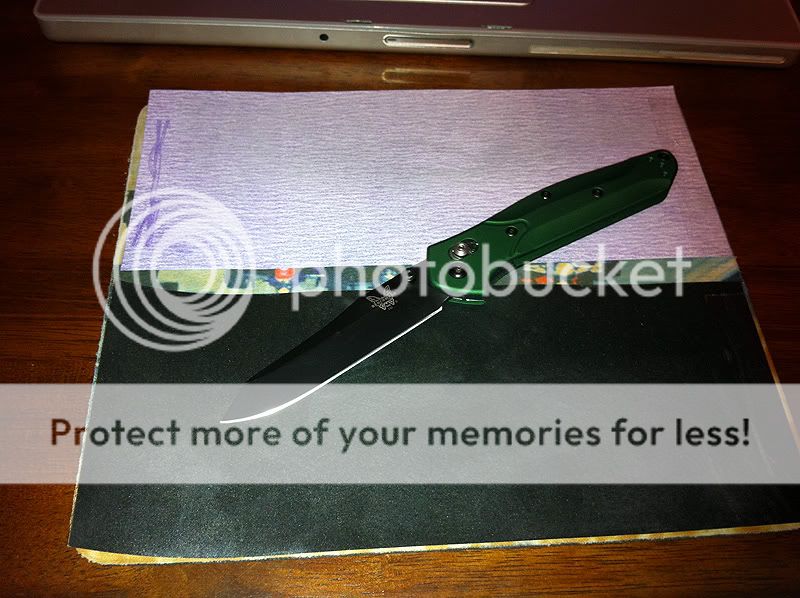
photo37.jpg
 
maybe try an abrasive like ceramic or something harder than sandpaper and do a micro, I find I cant get any good edges with sandpaper
 
it is possible for the pad to be too soft and you are making the edge too obtuse. are you getting a burr worked up? keep going with the 320 switching from side to side maintaining the same angle until you do get a burr if you are not. then go to the next higher grit and strop the burr and finish off the edge.


i have a method for convexing a blade that works very well but its too much to type out. if you want to give it a try send me an email with your number and i'll give you a call and help you out. rje196021@gmail.com welcome to the forum too :D.
 
I'd use a firmer backing for that blade. S30V is very abrasion-resistant, compared to the kitchen knives you've done previously. The soft backing pretty much dictates going very light on pressure, to avoid rounding off the edge. Problem is, that light pressure on soft backing is going to make for some very slow going with that steel. If you're like me, there's a natural temptation to 'press harder' in that situation, to speed the process along. That'll just round/dull the edge on the soft backing.

If it were me, I'd be using the same technique, but on much firmer backing, like very stiff leather, and not too thick. Another easy way to regulate the firmness of the backing is to use a magazine/catalog/newspaper as the backing for the sandpaper, over a hard surface like glass or hardwood. Adjust how many magazine pages are under the sandpaper, to regulate firmness and control the amount of convex in the edge. S30V is some very tough stuff. A slightly shallower/thinner convex would suit that blade just fine, I think. If you need to, re-establish the convex bevel from the beginning, with the coarse grit on firmer backing. Make sure you apex the edge (look for the burr), then use the subsequent grits to refine it, at progressively lighter pressure. The finishing grit should be done very, very lightly, to protect the sharpness and integrity of the new edge.
 
it is possible for the pad to be too soft and you are making the edge too obtuse. are you getting a burr worked up? keep going with the 320 switching from side to side maintaining the same angle until you do get a burr if you are not. then go to the next higher grit and strop the burr and finish off the edge.


i have a method for convexing a blade that works very well but its too much to type out. if you want to give it a try send me an email with your number and i'll give you a call and help you out. rje196021@gmail.com welcome to the forum too :D.

Thank you for the offer. I may take you up on it if things don't work out.

A little update on my situation.. I started to pay attention to the mouse pad that i'm using and noticed that the surface of the pad has a cloth-like overlay on top of the actual pad material. I started to think that, perhaps, this cloth is too soft and allowing too much "give" in the wake of the blade on the sandpaper--creating too much amplitude in the wave trailing the blade and removing the edge. I then flipped the pad over (raw material facing up-cloth side down) and gave the knife a few strokes on the 600grit. This seem to work well as the knife took a pretty good edge in just a few minutes. I'll work more on it tomorrow and report back. I may end up having to search for a firmer mouse pad to use.
 
I'd use a firmer backing for that blade. S30V is very abrasion-resistant, compared to the kitchen knives you've done previously. The soft backing pretty much dictates going very light on pressure, to avoid rounding off the edge. Problem is, that light pressure on soft backing is going to make for some very slow going with that steel. If you're like me, there's a natural temptation to 'press harder' in that situation, to speed the process along. That'll just round/dull the edge on the soft backing.

If it were me, I'd be using the same technique, but on much firmer backing, like very stiff leather, and not too thick. Another easy way to regulate the firmness of the backing is to use a magazine/catalog/newspaper as the backing for the sandpaper, over a hard surface like glass or hardwood. Adjust how many magazine pages are under the sandpaper, to regulate firmness and control the amount of convex in the edge. S30V is some very tough stuff. A slightly shallower/thinner convex would suit that blade just fine, I think. If you need to, re-establish the convex bevel from the beginning, with the coarse grit on firmer backing. Make sure you apex the edge (look for the burr), then use the subsequent grits to refine it, at progressively lighter pressure. The finishing grit should be done very, very lightly, to protect the sharpness and integrity of the new edge.

Thank you for the advice--I believe you're right. I'm looking into a firmer pad as we speak. What do you guys think about a piece of glass/hardwood with a few layers of wide blue painters tape to regulate the amount of padding under the blade? Seems like this might work very well for this application.
 
Thank you for the advice--I believe you're right. I'm looking into a firmer pad as we speak. What do you guys think about a piece of glass/hardwood with a few layers of wide blue painters tape to regulate the amount of padding under the blade? Seems like this might work very well for this application.

I see no harm in trying that. I tend to experiment with these things all the time, just to see what else works. It's a great way to get the 'feel' for how the backing affects the results, both in speed of metal removal, and in matching the backing to your own use of pressure, so the end result is a very SHARP edge. :)
 
travis, send me an email. the method i came up with has been tried by several members and they say it works great. i dont think the painters tape is soft enough to do the job right.
 
Richard, I can email you; however, it will be next to impossible for me to call you as you requested.
 
travis, send me an email. the method i came up with has been tried by several members and they say it works great. i dont think the painters tape is soft enough to do the job right.

It's soft enough. He only needs to choose the number of layers to accommodate for the pressure he's using. I often use a few sheets of paper to accomplish the same thing (as I described above). In the finishing stages especially, where light pressure is important, you don't need much thickness to make the backing just forgiving enough, without being too soft, and rounding off the cutting edge.
 
Richard J's way works like a freaking charm...and it's so simple you wouldn't believe it. I convexed by Bk2 his way when i got stuck using the mouse pad. Only problem is you can't patent something like that...I don't think?
 
I would like to make a case for thinning out the edge of these "super steels". S30V is plenty tough when taken down thin for a super slicer and it's strong enough to resist rolling an edge or chipping out. To me, that is the advantage of these steels VS milder or more brittle steels. I think you may be putting way too much effort for no, or even negative returns.;) Convexing shines in steels that need added support of of a fat support structure behind the working edge.

I have the same knife and blade steel that I put a thin edge on. I can butcher a whole deer and still shave arm hair afterwards. :)
 
I have used a hard leather backing for the sandpaper. Such a project today would cause me to get out the belt sander.

You may also keep in mind that S30V is several orders of magnitude more abrasion resistant than typical Euro-American kitchen knives. Which, unfortunately, translates to considerably more effort in modifying.:p
 
Travis, you've got a big set of b*lls to be convexing a cherry little 940 with black dlc. Like Thnuderstack posted - that knife is much better suited to a V grind as it's a relatively thin blade, Good job on not dinging it up. I personally would sharpen it conventionally and have fun using it. ;)
 
Thin blades can do very well with thin convexes. Many of my traditional pocketknives with thin, flat-grind blades (down to 1/16" at the spine) even benefit from it. At that level, there's probably not a huge difference in edge durability (though a convex will always be at least a little bit stronger than a V-bevel, all else being equal), but the difference in slicing is immediately noticeable. It's more about the reduced resistance of the rounded shoulders. Not the sort of 'big-shouldered' convex you might see on a heavy chopping knife, but a subtler one that makes itself apparent in fine slicing chores. The absolute best slicers I have are both Opinels, with 1/16" thin, fully-convexed blades and a zero edge. No shoulders at all, on those blades, to get in the way.

My favorite method for convexing involves initially putting a more acute V-bevel on the blade, usually with a guided setup (I use my DMT Aligner/Magna-Guide). Then I convex the shoulders using sandpaper and firm, thin leather or magazine/catalog pages over glass as the backing, like I described earlier. Being that the newly-created edge is already crisp & pure, I focus on protecting that new edge while smoothing out the shoulders (keep the angle conservatively shallow). The best of both worlds, when done carefully to completion (smooth convexed shoulders + pure, cleanly-apexed edge).
 
Last edited:
Still trying to get a nice razor's edge on this knife. It's as if i've hit a wall and can't get it any sharper--no matter what I do. Maybe I should just stick with a regular V edge. This knife has so far defeated me. Maybe a regular V edge will work better--the factory edge seemed sharper than what I have now..after hours of sharpening. :jerkit:
 
Success!! I spent about 15mins on the 1000grit using very light strokes and it's popin' hairs like nothing now. However, in my excitement, I shaved a little too much hair off and am now the proud owner of a few oddly placed bald spots.
 
Ah, "Sharpener's Mange!" I know that particular hairstyle well. :D

Glad to hear you got it working! Those little 940s do awesomely well with a thin convex on them.
 
Back
Top