Critiques / Comments on a first bush chopper

Joined
Sep 6, 2010
Messages
70
Hi all,
I’ve been lurking on the forum for a couple of years now and I am very, very grateful for the education and inspiration that I have received here because of the generosity and insight of so many gifted members. This is my first thread so shout if I I missed something in the stickies etc?

I have made maybe ten knives (that I would own up to any way:o) and, I have fallen into some of the common pit-falls, but I love trying to make something that is useful and beautiful - or at least chasing the illusion! Because I’ve made mistakes and regretted not getting/taking advice, I decided to ask here. I’m keen to learn, and I’ve seen some brilliant advice from many here.
I was following the Wilderness and Survival Extreme Build Off thread (http://www.bladeforums.com/forums/s...derness-amp-Survival-Skills-Extreme-Build-Off) and got into a piece of 5160. The biggest blade I have done before this was a 28cm bush knife in 6mm O1 that turned out OK:
cffeb604-1f6b-4f38-b37e-fc7774f08b3b_zps130555ab.jpg

2013-04-14120219_zpse79fe3b3.jpg


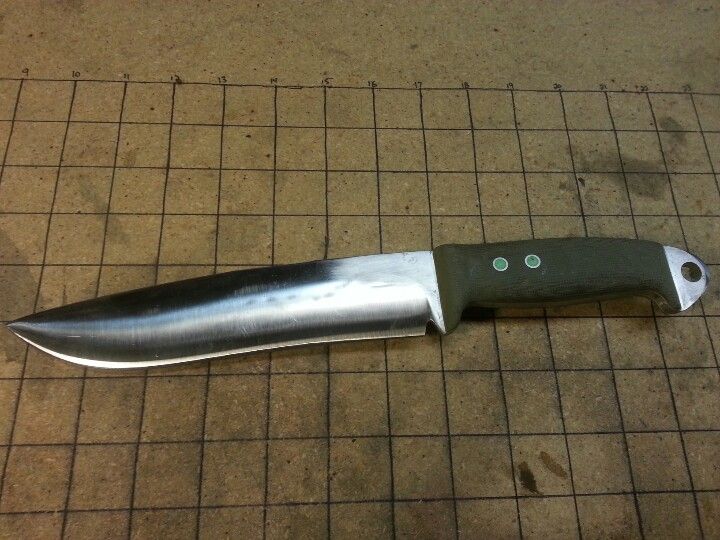
Anyway, back to the reason I posted. I decided to try a big bush chopper. This has taken some time, but I drew/redrew a design, got it profiled in a piece of thin plywood, cut and profiled it in the 5160, got the plunge lines in, ground it with a high flat grind (which I found convex-ed a bit, so I put it on a file jig to square things up). I’ve taken it up to a 600 grit hand-sand on the blade. As you can see I haven’t done much on the tang/handle portion yet.
2013-06-05170150_zpsdbacb7c9.jpg


It is OAL: 405mm (about 16 inches), sharp portion: about 260mm (10 Inches), thickness: 6mm (about 1/4 inch), and 50mm at the widest point in the blade (just shy of 2 inches)

I realize this is quite far down the line already, but I’d appreciate comments/critiques for what I can improve on. The handle profile looks off to me and I think it could be that it needs deeper finger groves front and back to accentuate the handle belly a bit more?

I’m also not 100% sure if I should go with green and black dimondwood handle slabs or some orange and black tiger-stripe micarta that I’ve got. My 12 year-old son recons the tiger-stripe would be “showing off”… I’m hoping this knife will be worth showing off;) . Either way, I’ll use 8mm stainless pins – probably three centered and in a row with the last one bored-out as a thong attachment … I’m also partial to the ‘bird’s eye’ look, so if you think two/three stainless pins and the hole behind the pinkie is a better deal, let me know.
Thanks for looking.
 
Last edited:
Hope you have a drum sander to work the bevel on the pinky swoop.that diamond wood is some tough stuff.looks good though.
 
Hope you have a drum sander to work the bevel on the pinky swoop.that diamond wood is some tough stuff.looks good though.
Thanks!
I like the diamond wood look and feel, but I have struggled to drill it without splinters around the pins causing words my kids shouldn't hear. I don't have a drum sander or a dremel, so its a case of round files and 80 grit paper over a mandrel...
 
I think that handle might not be too comfortable in actual use chopping. I am working on my first knife now and what I did was shape the handle/tang, then glue pine scales on,then contour the scales, then see how it felt when mimicing the tasks I wanted to do with it. This resulted in me making a lot of useful changes to the shape of the tang before I sent it off for heat treat.
 
I am not trying to hijack your thread, but I just happened to finish up something similar. I started my design with about as much curve on the index and pinky as you did, but after getting it 80% there I went with a bit less. If you look at my site by clicking my sig, I think you will see we have similar taste ;)

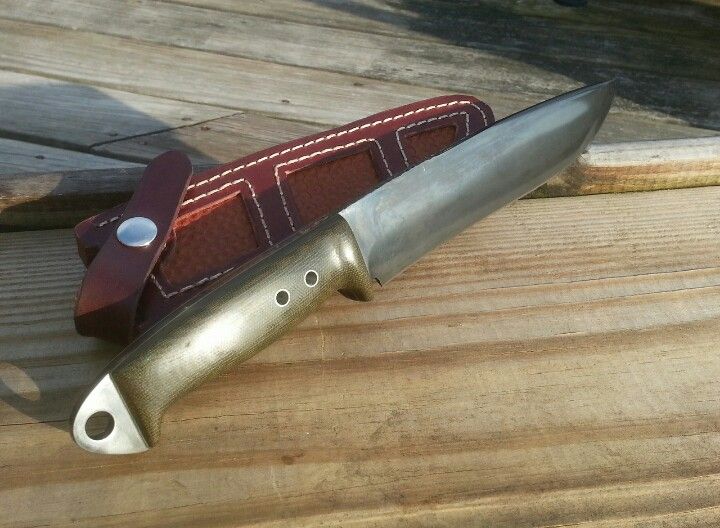
Here it is after HT, but still a little rough. It is a looooooooong and light convex grind with a blended plunge. Recurve 7" blade, olive micarta scales. I ended up ditching the GITD stuff in the hollow pins and going with a primitive finish. It is in 1075 and is differentially hardened. It swings very nicely with these dimensions...

f76c4d9091b0eda4e7821925695a9f86.jpg


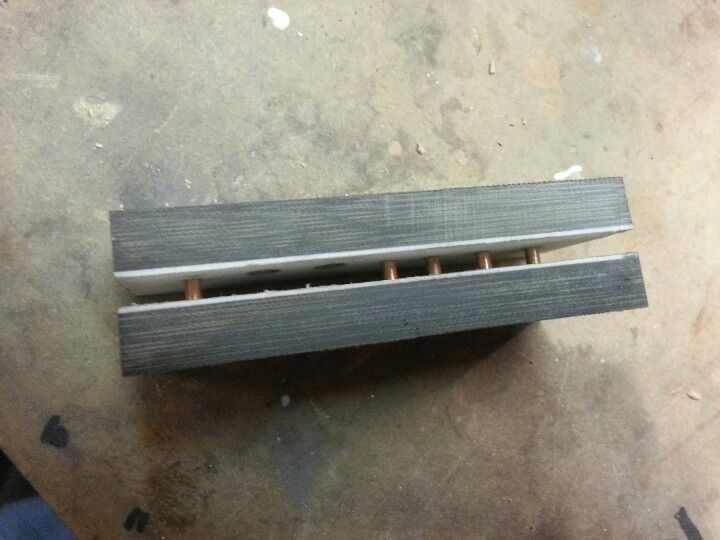
I used hidden copper pins to offset weight as well, and to keep it nice and tight with the two hollow pins so close together.

f8e78dfeb1e10f8716ff2f1dba8ed9a3.jpg


Here it is mostly finished with the inlay sheath which is a high ride design.

b6c35211aa3f324712364000b404a935.jpg


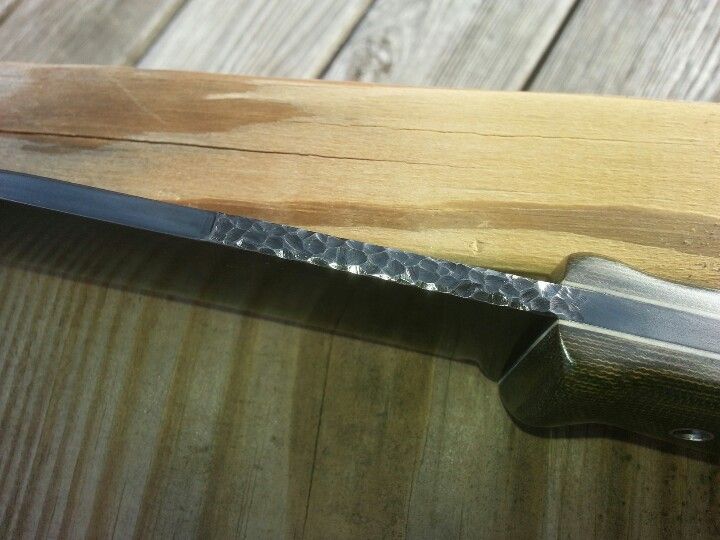
And a randomized section I did as a thumb 'anti-slip' area.

37ddde7f20fa314eacbd6f0203c6fb43.jpg


And here is how I did the handle area underside. I went with white spacers, however probably should have gone with something a bit more sedate...

608360bfac66d91305fed12214ea7073.jpg


Sorry if that hi-jacked your thread. I saw your other build, and I have done several that are similar. I made my own smaller bushy/camp knife a while ago and have been asked for that design more than anything else I do. I just hoped maybe since we seem to do the other design so similar maybe you could glean a little perspective from this one.
By the way, I sharpen that little inset at the end of the blade near the plunge as a little tooth to cut cord and whatnot. It has become almost a signature thing on my knives...
Good luck.
 
Last edited:
I think that handle might not be too comfortable in actual use chopping. I am working on my first knife now and what I did was shape the handle/tang, then glue pine scales on,then contour the scales, then see how it felt when mimicing the tasks I wanted to do with it. This resulted in me making a lot of useful changes to the shape of the tang before I sent it off for heat treat.
Great idea on gluing/test fitting the handle before final epoxy... that'll make sure I don't put lots of hours into something that ends up irritating in hand. Thanks!
 
I am not trying to hijack your thread, but I just happened to finish up something similar. I started my design with about as much curve on the index and pinky as you did, but after getting it 80% there I went with a bit less. If you look at my site by clicking my sig, I think you will see we have similar taste ;)...
No worries about any hijacking... that is a very nice blade, and, for what it's worth, I like the white contrast.
This is a great help Lucy, looks like we do have similar taste. I like the swell at the front of that handle... i'd like to try it out. The angles on that handle have helped me - the spine at the base, about where the pinky and ring-finger knuckle are needs t drop a bit on mine, and it looks like I could bring the whole finger groves and belly a fraction closer to the spine. I don't have big hands (:eek:yes...yes... i know!:p), so the full 35 mm breadth, the width of the handle material and the tang thickness might be a bit much ... definitely going to glue on some mock-up scales and test. A mock-up will also help picture pins/thong hole options too ...
Roll on Saturday and some time to get back to it!:D
 
Personally, I think your design looks great, if you took just a little belly out of the grip and maybe killed the points just a little it would be just fine... A chopper isn't necessarily going to have to be handled several different ways, so there isn't much need to account for different grip angles. The main areas I tend to find hotspots with choppers is right on the heel of the palm, or on the thumbside knuckle of the index finger. As long as these areas are smooth there isn't a whole lot of concern.

I saw this online a while ago and liked it so much I made a wood copy of it just to play with the grip angles and such. Don't know where my wooden one went, but it wraps around the fingers like yours, though probably more aggressively. It was actually quite comfortable in pretend use...
322773kopis-falkata%20(1).jpg


I also test fit mine but I don't use glue for it. I drill my pins before I finish the scales out so they are removable. I usually go for a pin fitment that takes a little bit of persuasion to get free so it is a nice and anchored fit. I can then finish the front and rear of the scales prior to epoxy without having to worry about them creeping out of perfect alignment when clamped, and I can also do the same thing with fitting, testing the feel, and then finishing them out. I can get everything 90% of the way there before HT this way, and afterward just knock it down and glue it up! Using this method also allows you to pin the scales together provided everything is plumb, and you can make absolutely sure they are in perfect alignment on the blade.

Good luck with it, it looks like it is going to be a nice finished product. Your other one looks terrific by the way. I for one don't see any mistakes, but we are all our own worst critics...
 
I saw this online a while ago and liked it so much I made a wood copy of it just to play with the grip angles and such. Don't know where my wooden one went, but it wraps around the fingers like yours, though probably more aggressively. It was actually quite comfortable in pretend use...
322773kopis-falkata%20(1).jpg


I also test fit mine but I don't use glue for it. I drill my pins before I finish the scales out so they are removable. I usually go for a pin fitment that takes a little bit of persuasion to get free so it is a nice and anchored fit. I can then finish the front and rear of the scales prior to epoxy without having to worry about them creeping out of perfect alignment when clamped, and I can also do the same thing with fitting, testing the feel, and then finishing them out. I can get everything 90% of the way there before HT this way, and afterward just knock it down and glue it up! Using this method also allows you to pin the scales together provided everything is plumb, and you can make absolutely sure they are in perfect alignment on the blade.

Good luck with it, it looks like it is going to be a nice finished product. Your other one looks terrific by the way. I for one don't see any mistakes, but we are all our own worst critics...

Oh wow, that is a stunning piece!! Got that Persian thing going on - so awesome!

Like the idea of being able to press-fit things and grind up to spec before HT...:thumbup:
 
I agree about the handle not looking comfortable. I also like my choppers a bit bigger usually. Love the blade shape, though.
 
I agree about the handle not looking comfortable. I also like my choppers a bit bigger usually. Love the blade shape, though.
Thanks... I did some sketches and will be working on the mock-ups. It looks like I'll be angling the handle a bit by increasing the depth of the front swoop and dropping the back. I'll post pictures of the mock-ups before cutting the steel ... measure twice ...;)
 
I'd probably just mellow out those transitions at the end of the grip, to make them more comfortable. And, maybe take a bit out of the belly. Not a big change. A sanding drum on a dremel should do that pretty well if you have that. Otherwise, your work looks promising.

drawing3.jpg
 
I have profiled the handle (thanks for all the advice!). Salem was right, it didn't take much to get it comfortable.
image_zps1d9ae3f9.jpg
[/URL][/IMG]

I also did the heat treat: normalized 3 times 899, 840, 750 degrees C; then triple quenched, 3 x 840 degrees and quenched in BE QUENCH 32 (a fast industrial quenchant I get from a knife supply store); triple tempered 210, 210, and 200 for 2 hrs.

Then used an old #320 belt to put an edge on and chopped through a pine 2 by 4 with no chipping or rolling of the edge. And it took some decent sized chunks....
image_zpsf0414684.jpg
[/URL][/IMG]

Now to clean it up and get the handle on. After that I will need to get some 3mm kydex for the sheath.

Thanks for looking.
 
Last edited:
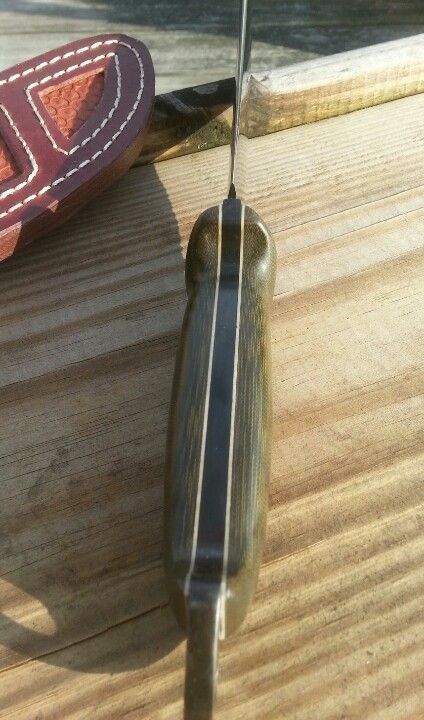
I finally found the time to finish up the handle and the blade finish (I took it to 2000 grit hand sand)...
2013-07-27142546_zpsa11b01fc.jpg
[/URL][/IMG]

Thanks to all for the advice:thumbup:
 
Beautiful knife! Very well done.

Quick question, What is the purpose of the hole at the spine of the ricasso?
 
Ohhhhhh, hell yeahhhh!!!

That finished up VERY nicely Stephen. It looks like you took just a tad off the pinky curve and the subtle re-do of the basic contour is spot on. I like that piece. Well done sir!

-Peter
 
Back
Top