Custom Bushcraft

Lorien

Nose to the Grindstone
Moderator
Knifemaker / Craftsman / Service Provider
Joined
Dec 5, 2005
Messages
28,391
I've seen tons and tons of hunting knives of superb quality and beauty on this forum over the years.

But I haven't seen much in the way of high end custom bushcraft knives, except a handful from Sweden and Norway etc. And some of those have been absolutely fabulous.

To me, it seems the lowly bushcraft knife has been sadly neglected in the high end in North America, and I'm hoping that this thread will either prove me wrong, or generate enough interest in this genre of knife that we start seeing more of them.

So, do any of you guys have any photos of bushcrafty knives you'd like to share? I'd love to see them:)
 
Define "bushcraft knife" for me - what are the design features and intended applications of such a knife as distinct from a hunter?

I've seen the term used quite a bit, but I can't say I really understand what it means.

Roger
 
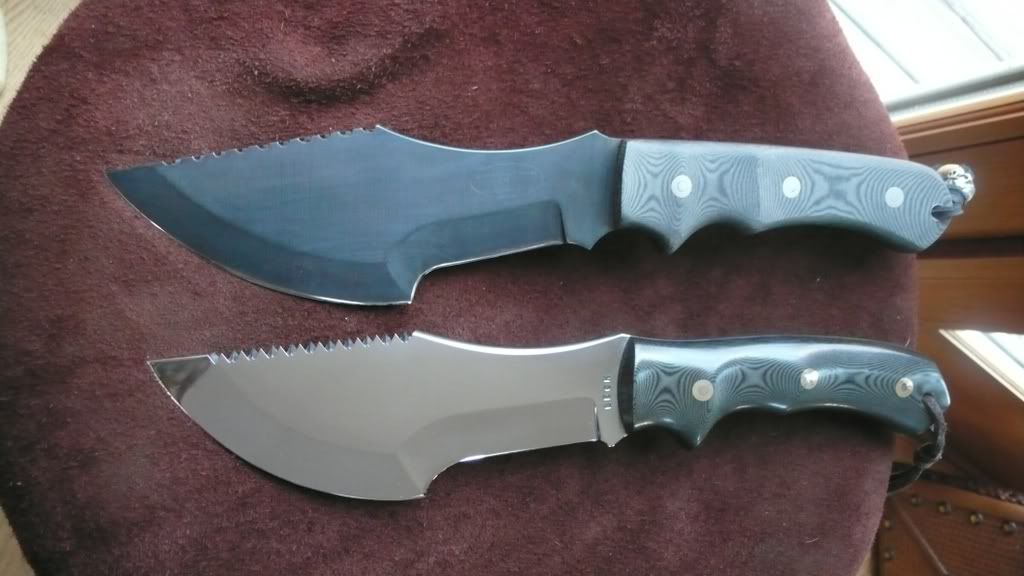
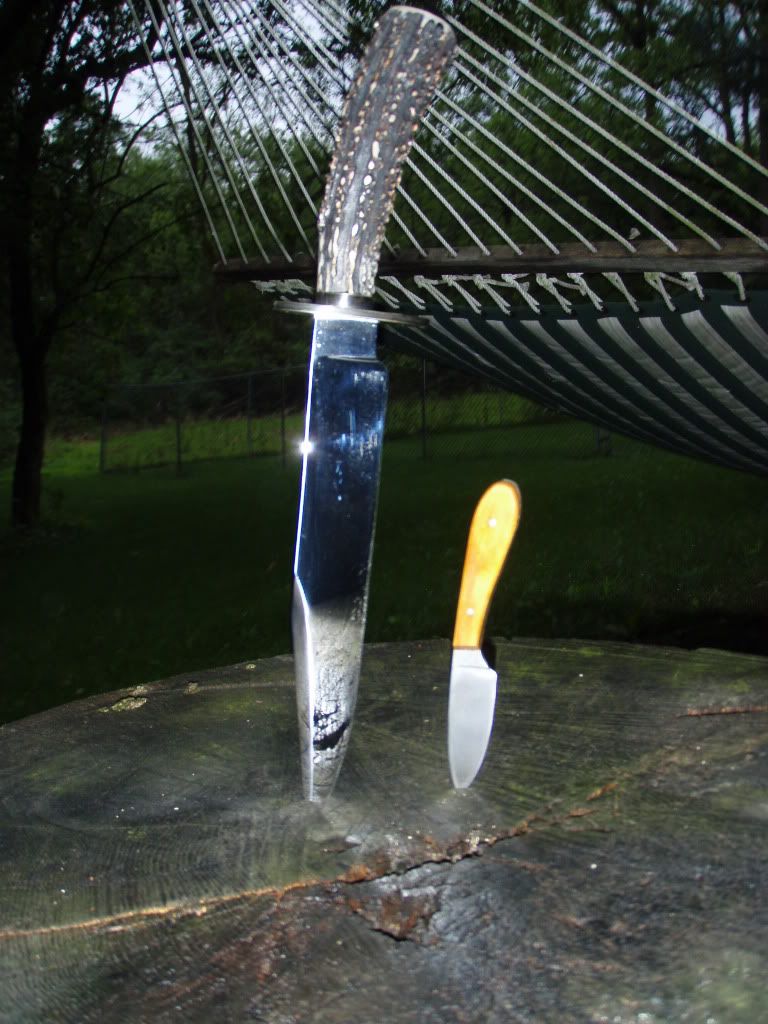
When you say bushcraft do you mean a knife that is designed to make shelters and traps etc. A knife designed to be a survival tool in the wilderness. If so then a WSK would fit the bill. Now let me tell you I am not a big fan of the wsk design and in my humble opinion and from my expierence a good fixed blade in the 9 to ten inch range and a small fixed blade capeing knife is much more serviceable. The teeth on the wsk do aid in makeing notches for traps or what ever but besides that they are heavy and do not work very well on the small tasks. The draw knife portion can be handy also and the rounded gut hook thing makes making dowels a bit easier. Well I guess if building things in the woods is your sole criteria then a WSK would not be a bad choice. I just can't get used to them and I have owned a few. The best example of a WSK is a Beck. Here is a Beck and a Martin rendition
knives096.jpg


Here is what I prefer
P6030001.jpg
 
Tom Krein and Dan Koster both make bushcraft styled knives. I have always thought of the bushcraft style as being more the knife of choice in Europe or the UK as folks from those locals seem to talk more about them. They are handy, but far from "survival" status. My opinion is they are great for fire building (fire starting) and preparing food etc, but nearly useless for chopping and shelter building unless you have nothing but time to get the task done.

Paul
 
I have spent a lot of time on British Blades and the typical "bushie" is a 4 inch MOL full tnag knife typically with a scandi grind and a rectangular pouch sheath with a fire steel attached. It is apparently very good for wood carving and rose to great popularity because of it's appearance on one of the survival type TV shows....NOT the Bear Grylls one, but the one with Ray Mears:D The Alan Wood custom version of the original TV show knife goes for silly money and the official production ones made by Wilkinson were going for upwards of $500 on Ebay in the UK last year!!!!! From what I have seen. a lot of the "batoning" craze arose out of the bushcraft or "woodlore" movement in the UK. You see them doing this all of the time. Probably the closest thing to an american "bushie' would be something like the basic Bark River small fixed blades, which a lot of the folks who do the "bushcraft" type thing (often called "wilderness survival" in the U.S.) seem to favor. The knives on this side of the pond are more likely to have a convex or flat grind as opposed to a scandi grind. There are some makers in the UK who do bushies with a convex grind.
 
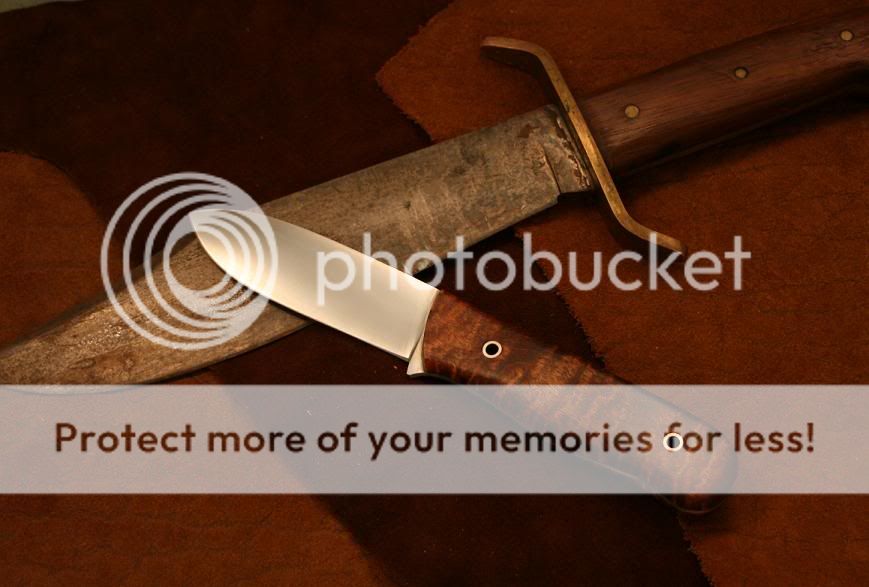
It's definitely not high-end, but to illustrate what I believe Lorien is asking about here's a pic of one of mine that turned out decently.

bushstylesp1.jpg


The picture makes it look a lot nicer than it is:p

I don't think there's much in the way of higher priced knives in this field, though I have seen a few nice damascus pieces. Partly because it's such a simple design without a lot of room to embelish, partly because those people who want them want them to use. Also, the preference in these strongly lean towards a scandi grind, which is very un-dramatic and utilitarian, no matter how you dress it up:foot:
 
Bushcraft knives are supposed to be well made, inexpensive to moderate priced knives. However, there may come a day when collectors of high end knives start asking to have them made with expensive handle materials and pattern welded blades.
 
Bushies were also nice profit centers of a number of custom makers in the UK for a while. I heard stories of one maker being able to knock out up to 20 blades per day to either be completed or sold sans fittings to hobbyists!!!!!!Even at under $50 per blade sale price before taking out the costs of production, thats a lot of cabbage for a lowly knifemaker!!!!:eek:
 
Define "bushcraft knife" for me - what are the design features and intended applications of such a knife as distinct from a hunter?

I've seen the term used quite a bit, but I can't say I really understand what it means.

Roger

okay Roger, I'll try my best;

A knife intended for use as a general outdoor utility/bushcraft knife will generally be of a fairly robust stock for its size.

The mid point at the heel of the handle and the point of the blade will be pretty much in line, and sometimes the tang will protrude slightly from the heel. Percussive strikes to the butt of the handle will drive the point into whatever, nice and straight, for example in starting a divot for use with a fire bow, or opening a can. Usually not much in the way of tapered tangs for this reason, methinks.

Generally, bushcraft knives are not intended for chopping or swinging around, as those activities can be dangerous in isolated locales, where an infected cut could equate to death. Third party percussion is the name of the game to ensure precision and safety. Ah, batoning!:) It's amazing what you can do with a stout little knife and a chunk of wood.

The blade would be 80- 140mm long and the handle just long enough to provide leverage and control, but not so long as to be in the way.

Not much in the way of a guard, but enough to keep your finger from slipping onto the blade.

Probably a lanyard hole, and almost always slab handles, but not in the case of the Finnish, Norwegian or Swedish traditional designs, (I expect the expense and availability of steel has more to do with that than weight or function in a historical context, but that's just a theory).

The durability of the edge is really important, and I think a proper bush knife would have a hardness anywhere from 56-59, whereas a hunter would have a harder, more wear resistant edge in the 58-62 range. A bushcraft knife should not break easily, but bend instead. The edge should never chip, but dent or roll instead. Toughness is more important for these types of knives than edge holding. The ability to restore the edge in the field is also a major attribute.

Preferably, there won't be a lot of 'belly' toward the tip of the blade, and the rest of the edge should follow a straight line. None of this recurve business. The spine will usually not be chamfered so it can be used as a 'mellow edge', or to strike your flint with.

A lot of times, these knives would not be made from chromium steel. I'm not altogether sure why, except that in my experience a flint reacts better to non chromium than the other option, but I don't have much science to back up that claim:rolleyes:

I have a theory that the 'chute knife' is a North American take on the traditional European bushcraft knife, (I think it's called a puuko) but again it's just a dumb theory.

The Fallkniven F1 in my view is the BEST production bushcraft knife available and really displays some great attributes of this design philosophy. If I had ONE knife to depend on in a survival situation, this would be it.

Now, that's just how I see it personally. I ain't sayin it's gotta be this way or that way, so if you disagree that's fine by me.


Mr. Davis- your knife looks like a fine example! Personally, I'd like it a little more pointy but that's just my preference.

Joe- thank you for the pics, I always thought those wsk knives looked really cool. Especially after I watched 'The Hunted':D. But, yeah, they really don't look that practical. I'd rather have your Bagwell and that little caper any day, than just one knife which is supposed to be able to 'do it all'. So, uh, can I have them? Haha, just kidding.:)

Jdm61- awesome background! I like the fact you pointed out the 'kit knife' option, maybe you'll make some someday, and with it, lots and lots of cabbage:cool:

Keith- it's eery, but you know exactly where I'm going with this.

Paul- I totally agree! That's why I carry a bushcraft knife in addition to a big-ass chopper, then there ain't anything I can't do!


Let me just say that I appreciate your participation in the thread guys:thumbup:

 
It all about economics and marketing. Try selling a plasma tv and a blue ray player to an Amish family. Kinda like pimp my horse and buggy it is not really a bushcraft knife once its pimped.
 
It all about economics and marketing. Try selling a plasma tv and a blue ray player to an Amish family. Kinda like pimp my horse and buggy it is not really a bushcraft knife once its pimped.

I can see your point, but I have a feeling you're missing mine:)

At their heart, all knives are tools. A maker can imbue the tool, whatever style it may be, with his/her art, and that's what I'm interested in here.

Bushcraft knives are simply another genre of knife, which I feel hasn't really been discovered yet by many collectors and top tier makers.

I'm hoping this thread will stimulate the imaginations of each.
 
Thanks Lorien.

Walter - that's a good looking knife and I'm sure it's not just the photo.

Roger
 
The W&SS subforum is full of photos of bushcraft knives. And a lot of them are users, not safe queens, if the sap stains are any indicator.
 
This is one I came up with. It is a custom design between me and the customer. I call it the "Rio Grande". I am making a few more with variations in the grind, some flat, convex and hollow ground.

This one is a full tang 1/8" 440C with black canvas micarta handle and a shallow hollow grind. I added a SS end cap for hammering. It has a 5" blade 1 1/4" wide. The knife is 9 1/2" overall. It is 8.6 oz. without the sheath and 10.8 oz. with the molded sheath.

file.php
 
I just saw an Ebay listing for a real Alan Wood handmade Woodlore bushie. Buy It Now price of $895!!!!!!!!!!!:eek:
 
This is my interpretation of the VSK or Tracker (I do not know who is the first author of that type of knife): total lenght is 333mm (about 13") blade is 210mm (about 8") x 5mm; stainless steel MA5M pers.temp. to 56 Hrc, black from oven, with 100mm of wood teeth (15 teeth prepared on light bending) + cutting edge for cords prepared to the intersection of the two grinding. Handle is black micarta. Leather sheath (4,5mm).

387apr3.jpg


denti387bhk7.jpg


denti387cwk0.jpg


denti387dvu3.jpg


387bss8.jpg


387cqf3.jpg


387dlg1.jpg


387ehp5.jpg


387frj8.jpg


387glj6.jpg
 
But I haven't seen much in the way of high end custom bushcraft knives, except a handful from Sweden and Norway etc. And some of those have been absolutely fabulous.

We have determined what we think a bushcraft kinife is. My question Lorien is what would the highend makers do different? Bushcraft blades are users by nature. Do you mean using higher end handle material and bolsters or are you talking about carved handles.

Highend steel is already being used. Koster uses CPM 3V

I think it is a case of diminshing returns for makers. People are not going to pay for a beautiful knife that they are going to use.

Just my thoughts on the subject.

Paul
 
We have determined what we think a bushcraft kinife is. My question Lorien is what would the highend makers do different? Bushcraft blades are users by nature. Do you mean using higher end handle material and bolsters or are you talking about carved handles.

Highend steel is already being used. Koster uses CPM 3V

I think it is a case of diminshing returns for makers. People are not going to pay for a beautiful knife that they are going to use.

Just my thoughts on the subject.

Paul

Why such resistance to the very concept of a higher end bushcraft knife? Hunters are using knives by their very nature - that doesn't stop collectors from buying fancified versions for their collections. And as we saw from Burt Foster's recent WIP thread, some guys actually do use their damascus / ivory pieces for their designed purpose. My most used knife at present is a damscus MS hunter / utility. I saw a few damascus EBK's on Ed Caffrey's table at Blade. Etc.

Roger
 
People are not going to pay for a beautiful knife that they are going to use.

That certainly is not true in all cases. I know of several people who wanted their "user" to be something special for them and ordered a custom knife built to thier specs. Making it pretty may not add to the function but it doesn't hurt either. Having a nice paint job on your car doesn't make it drive any better.

In fact, pretty sometimes does have function. I like to mirror polish my knives. Some people scoff at that and assume it can't be a "user" if it is polished. A Mirror polished blade offers less cutting resistance, it's much easier to clean and keep sanitary without all of the little pits and grooves to trap dirt and moisture, it repels water and transfers less crud into your sheath.

Sure, it will get some scratches in uses but so what? I have seen a lot of polished blades that have been in heavy use for years and they look much better than most people would expect and the function of the polished blade still holds true.
 
My question Lorien is what would the highend makers do different? Bushcraft blades are users by nature.

the best answer I can give is, is what high end makers always do different.

All types of knives are 'users by nature'- hunters, camp knives, etc. It's what the maker brings to whatever the genre which determines the knife's artistic merit.

One of the things that make this forum what it is, is our focus on the Art of custom knives, which is what I'm trying to get at here.
 
Back
Top