Cutting and Drying Wood

Joined
Jun 3, 2019
Messages
2,714
Since we have moved a little off-topic from my original Ebony query ... I am changing the name of this thread (well really creating a new one) to be more on-topic.

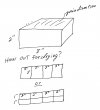
Ok ... so now that I have my wood blocks (NOT ebony) scraped of wax (except the endgrain), I am thinking of ripping them down to aid/speed the drying process. Understanding that bigger is better (i.e. more stable), but slower ... if I want to speed up the process without taking unreasonable risk of splits in the wood, I am looking at two scenarios (see attached picture). Given that we are looking at (not clearly species identified) resinous south american wood (again, NOT ebony), I can cut it into 2"x2"X 11" blocks and put those into my drying box. Advantage of this is that those 2"x2" will be more stable, and the cross sections can either be turned into flat scales, or used in Wa handles. Disadvantage is the longer drying time. Alternative is to cut in to 1" x 2" pieces ... drying will be faster, but more subject to dimensional instabilities (and I dont get the dimensions for Wa handles ... though I have another 1"x 1" piece I can use for that). I think my preference would be to go with the 2" x 2" approach - unless it will just take too ungodly long to dry.

So - my question is, for those who have done this, how long would you expect those 2" x 2" cross sections to dry in a drying box? (given that I have yet to build the thing, I have some time to decide.....)wood_cutsjpg.jpg
 
Last edited:
Resist the urge to cut either set up, but if you ABSOLUTELY have to cut, the first one.

Trust me, it does not take losing much ebony to twisting, bowing and warping to realize its safer to wait. Ask me how I know.
 
it does not take losing much ebony to twisting, bowing and warping
sorry if I was not clear - this question is NOT about the Ebony, it is about the blocks you (Dan) think is Goncalo Alves and Katalox ... why I identified them as "generic" resinous south american wood. Hopefully more stable than Ebony, and able to take some level of cut-down to help speed the drying process????

(message on the Ebony came through loud and clear - it is already at 1x1, and will sit on a shelf and go nowhere near a drying box :)
 
2X8" is a good size for drying. I would cut it as I need it once dried. Too many times someone cuts up a block only to find they need scales or a larger block later on. Better to cut what you need for a specific handle and leave the rest as one block.
 
That is like asking how much a cow weighs.

It depends on the species, moisture content size of pieces, drying box temp and air flow, etc. The drying box will cut the drying time to a fourth of air drying time on some wood, but on others it will cause them to twist and warp because of this acceleration. I think a drying box is best for woods that are mostly dried and just need a little more to send off for stabilizing.

You really need a moisture meter to determine all these things.


I hope Ben will chime in here, but my guess would be:
Above 15% I would let the blocks air dry
15% to 10% can go in the cabinet to finish drying
10% to 7% is ready to send off for stabilizing.
 
That is like asking how much a cow weighs.

It depends on the species, moisture content size of pieces, drying box temp and air flow, etc. The drying box will cut the drying time to a fourth of air drying time on some wood, but on others it will cause them to twist and warp because of this acceleration. I think a drying box is best for woods that are mostly dried and just need a little more to send off for stabilizing.

You really need a moisture meter to determine all these things.


I hope Ben will chime in here, but my guess would be:
Above 15% I would let the blocks air dry
15% to 10% can go in the cabinet to finish drying
10% to 7% is ready to send off for stabilizing.

Also depends on the moisture content of the wood when you begin. I have made a few slab tables. Rule of thumb on them is about 1 year/inch of thickness. 3 inch slab =about 3 years. But bring them inside, get a fan blowing, a bit warmer situation etc and you cut the drying time down drastically.

Another factor is climate where you live. I live a bit north of the Pacific Northwest on the "Wet Coast." 9% is about the best you will ever get here. If you live in Arizona 7% is easy to achieve.

Moisture meter is great. I bought this pinned moisture meter about 4 years ago. https://www.ryobitools.com/phoneworks/moisture-meter/
I think I paid $25. Tested it against a friend's $300 moisture meter and it was within 0.5% of the good one all the wood we tested it on. Problem with a pinned meter is that it leaves tiny holes in your wood. But if you push the pins in a spot that doesn't matter....it doesn't matter then!

You seem like you are in a rush to get this stuff dry. Is one year too long? My bet is that with a drying box and that thickness you would easily get them down to 10% in less than a year. But the moisture level when you start and all the factors above could make it much shorter than that.
 
You seem like you are in a rush to get this stuff dry. Is one year too long?
LOL- yes and no . After 40 years of waiting/wanting to do this hobby, i have a pent-up list of projects to try. It will not kill me to purchase ready-to-go scales ... but i also seem to have this inherent like/interest in “doing it myself” .. because doing so is interesting/fun/rewarding. These resinous tropical woods are so different from domestic hardwoods that i just have no intuition on how far you can “push” the process without damaging the goods (literally). I am quite aware of the interplay of factors such as starting moisture content, thickness, temperature, ambient humidity, air flow, etc ... but also believe that somewhere in there are useful rules of thumb, and that is what i am looking for right now. I will lay odds that your 1 year/inch (ambient) is not far off. Of course the engineer in me is curious how far this can be pushed (drying box) . Apparently, from earlier discussions, with Ebony it CANT be pushed.

(A couple asides: i will be buying a moisture meeter. Will need to go online - woodcraft had none. 2) i live in minnesota. In the winter, relative humidity is extremely low ... wonder if that will actually endanger drying a species that does not like to be dried fast?)
 
I love doing stuff myself too. I collect wood from all over and dry it. Whenever I spot a burl I am cutting/tossing it on my drying pile. I I've been doing that for about 5 years, so I have a ready supply of dry.
I guess a question is how raw the tropical woods were when you got them? I think if you didn't spend too much money on the wood you should experiment and see what can be done.
Thing I have found is that different species are so.....different. Haven't had problems with maple splitting, but I cut up some apple and cherry and painted the ends and it absolutely tore itself to toothpicks. I haven't managed to be successful with cherry yet. Also got a chunk of a redwood log about 10" round. That split quite bad too, but I got some useable wood out of it. It is a lot of trial and error for me.
 
I use to dry wood for a living and I can tell you there is a science to drying wood quick without stress and cracks. You have to monitor dry and wet bulbs as well as air temp. Heating rates and moisture venting. It’s tricky business and even with all the computer controls it’s still really easy to mess it up.

I have a log section of snake wood that I split around 2007-8 I think. And I’m now just thinking that it’s ready to be used.
 
there is a science to drying wood quick without stress and cracks
LOL. I almost made a comment above along the lines that I would lay odds that to really do this right, you would likely need to start out with a moderately elevated temperature, but high moisture around the wood, then slowly lower ambient humidity (at first), until the wood moisture content reached some critical point, at which point you could really both lower the ambient humidity and increase the temperature. My experience (which may not apply here) is that processes like these are exponential, with the biggest changes and biggest risks occurring during the beginning of the process. Way too nerdy for the forum I guess ... but unfortunately the way my mind works.... :(
 
I think if you didn't spend too much money on the wood you should experiment and see what can be done.
that is exactly what I am doing :)

I cut up some apple and cherry and painted the ends and it absolutely tore itself to toothpicks
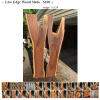
I has got to be doable. I recently did a search locally for cut wood, and came up with several folks. Example is this listing in Craigslist: https://minneapolis.craigslist.org/ram/for/d/saint-paul-live-edge-wood-slabs/6913914857.html
If you cant pull up the listing, an image is below... The common theme of all the listings is the longitudinal cut through the entire log, keeping the bark intact. this particular listing did indicate these pieces are kiln dried. Gotta love the black walnut :-) Think of all the lovely dark knife handle scales you could turn that baby into!!!!

upload_2019-6-28_11-7-13.png
 
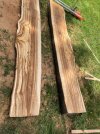
I slabbed out some birch recently. Close to 2 feet wide slabs x 3 inches thick. Its around 25% moisture content now. They will become counter tops at my cabin in about 3 years.birch.jpg

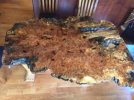
Built this maple burl table a few years ago. Bought the slab from a guy. He has a building that looks like a greenhouse to me full of slabs that are drying. He got this 3 inch deep slab down to 11% in a bit over a year.
IMG_0842.jpg
I have enough wood and projects that speeding up the drying process isn't on my radar....but I get how it could be for others. Have fun and don't love the wood too much until it is mostly stable. Less heartache that way when you get toothpicks.
 
Beautiful pieces.

Yeah - right now my “ready to go” collection of handle material consists of three sets of laminated scales that i bought 18 years ago ... so yes, i guess i feel some pressure to increase that supply, and quickly...

I did yesterday obtain several 2” slabs of black walnut (from the guy who posted the photos above) , at least one of which reads well below 10%, and also bought a finished cocobolo board from woodcraft .. so those help take the pressure off... i have got to get that drying box built!

BTW - in posts HOW do you get photos in- line with texts? Everytime i do it the website just appends them to the end of the post...
 
I'm in the process of moving right now, I'll post a full write up once I'm settled.

For now, avoid a fan. I tried to fan dry some red mallee blocks, and that just made them crack.

The harder the wood, the more difficult it is to dry. If those pieces you have are dense hardwoods, they are more likely to check and crack. For now, keep them with waxed ends, out of direct sunlight and away from a strong breeze
 
Thanks Ben - will do. Take your time, and good luck with the move! (I have equipment to set up, another work bench to build, another storage shelf to assemble, then will build the box. NOT going to happen all that quickly)
 
Slight update. I obtained a moisture meter (two pin type) and measured those four blocks of wood I got from Woodcraft. All of them came in in the range of 6 - 8%. The meter seems to be operating correctly (my finger reads at 40% moisture :) and really old wood around my house reads at 4% or so). I guess that wood had been sitting around / in transit long enough to lose a lot of moisture (or was dried before shipping)?? Anyway, I think I will try cutting some of them down to 2" x 2" blocks to continue drying.

Still need to get that drying box made, now that I have my drill press and band saw operational ... but I fear life and summer travels is going to interfere. Not to mention my 2 x 72 showing up next week (hopefully....).
 
Question for Stacy (and others as want to chime in :) ): I am cutting down some Black Walnut I obtained into 2" x 2" squares for completion of drying ... and something occurs to me. the 2" thickness seems very, very common: you recommend it, the stock of tropicals I obtained are mostly 2" thick, the walnut I got here in MN, which was rough cut and kiln dried is 2" thick ... BUT, pre-made scales are almost universally 1 1/2" wide by 3/8" thick. On one hand, the 1 1/2" wide scales seem to imply that for each of those 2" x 2" blocks I will waste 1/2" of good wood. On the other hand, my experience, which is very, very limited, but augmented by measuring my commercially made knife handles, is that I end up sanding away a good amount of that 1 1/2" wide scale ... most often a 1" wide scale will be just fine (making two complete scales out of the 2" wide block). So ... I think my question for you (and others who have done a lot of their own drying) is .... if you keep it to that 2" x 2" block (which seems optimum for drying), and use a "cut scales to size on demand" approach ... do you end up wasting a lot of material???? (understanding that there are other factors at play here, like warp of the stock, with subsequent sanding to flatten, loss to bandsaw cuts, etc, etc)...... Your thoughts / experience / insight is most welcome!!!!
 
I'm just updating this thread on current status. Going back to those ill-defined "exotic" blocks I bought from Woodsmith: I did purchase a moisture meter - and all the blocks I bought ended up testing at or less than 10% (YES you technically need to pay attention to species ... but I came across a species correction table: https://www.delmhorst.com/correction-tables#species ... and most of the corrections are only 2% moisture or so. Being the engineer that I am (for example, pi is often reasonably approximated as 3, not 3.14159.... the difference often ends up making no difference at all... ) for now take the readings at face value.

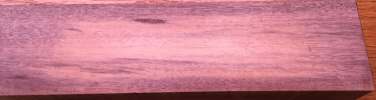
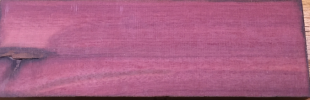
so ... today I went ahead and cut those babies up into 2" x 2" blocks for further drying. this one is for you Ben: the lighter colored block is this one (though not quite as purpleish as seems in this photo):
upload_2019-7-9_19-43-1.png

the darker colored one is this one:
upload_2019-7-9_19-43-47.png

(color is pretty true - really pretty reddish-purple coloring)
Do these help you any more to identify species??

Anyway ... tested the cross sections for moisture .. and the lighter one tested about 9-10% moisture. the darker (prettier one of course!) tested at ~15%. I am not sure why the cut versus existing surface measurements differed ... but maybe this is an argument for a pinless meter???

Anyway - given the moisture content of the darker sample, I took those and placed them into zip-loc baggies with a few holes punched in them - hopefully that will help slow down the moisture loss and reduce risk of checking. We will see.... I hope they turn out ok - those darker blocks are REALLY pretty :-)
 
Back
Top