Cutting and Drying Wood

BTW - when i first started up my drying box, i experimented with temps up to 120F - and all the wood in it survived just fine (again, all were below 15%). Because you want wood to be stabilized as dry as possible, i again cranked it up to 120F, left my spalted blocks in there until they read zero moisture, then quick vacuum sealed them into plastic bags before sending off to K&G. Most of the time ijust keep it at 90F to keep wood in there ready to use.


Thanks for all this information
 
Long time reader, first time poster... Are you able to post a completed picture of your drying box? Just curious if you ended up installing the fan, where you placed it, where you drilled the ventilation holes, and placed the heating lamp. Regardless, thanks for the thread, its been a great read with awesome info.
 
Last edited:
Long time reader, first time poster... Are you able to post a completed picture of your drying box? Just curious if you ended up installing the fan, where you placed it, where you drilled the ventilation holes, and placed the heating lamp. Regardless, thanks for the thread, its been a great read with awesome info.
Will do in a bit (probably tomorrow) ... gotta run out right now
 
Will do in a bit (probably tomorrow) ... gotta run out right now


Cushing, i'm hoping maybe you can help out or someone in this thread. That slab of maple burl i got - i unpacked and left in my room to kind of warm up to the ambient temperature & the weather here. I left for the week and have come back to some splits in the bottom (i can upload pictures) and it seems like it might continue? Its just in my room where my fan is sometimes on? Do i start processing it for it not to split? What can i do?
 
Oh boy, i am just using a guess here (hopefully somewhat educated) but any exposed wood (and existing crack) is your enemy here. A crack is a stress point (and another place for moisture to escape more quickly, leading to more cracking). If youcan cut the face back to where there are no cracks, start with that. Then cover that cut face with something to inhibit moisture loss (wax? Paint of some kind, but not sure what is best .. some other posts have mentioned latex? WEO - are you there and able to comment on paint?)

if you cant cut it back, i would melt wax, and really glob it on there ... make sure you really fill/plug those cracks to inhibit moisture loss .. not sure if it will save the day, but worth a try.

OH ... PUT THE THING INSIDE OF A TIGHTLY SEALED BIG PLASTIC BAG (several layers). That will will increase the moisture around the piece and inhibit rapid/nonuniform moisture loss...
 
The burl i got was dried in a kiln (i did not do it). Drying wood in a kiln is a dance between moisture and temperature. When starting the moisture is kept quite high, and the temperature moderate (this is a chem. engineering mass transport thing - it promotes uniform moisture in the wood, and reduces stresses that produce cracks). As time goes on, the moisture in the kiln is slowly reduced and the temperature increased (again, a dance), until at the end the temperature can be quite high, and the moisture low. The guy i was working with said he knew of one run where a worker opened the kiln vents much too soon (lowering the humidity too early). Destroyed practically all the wood in that run...

my recommendation of the big plastic bag is an attempt to emulate the raised humidity of the kiln...
 
I think cutting it might be asking for a different set of problems ... but if you do, slab it out into 2 inch thick slabs, paint all exposed surfaces, and get all the pieces into big plastic bags.
 
Long time reader, first time poster... Are you able to post a completed picture of your drying box? Just curious if you ended up installing the fan, where you placed it, where you drilled the ventilation holes, and placed the heating lamp. Regardless, thanks for the thread, its been a great read with awesome info.
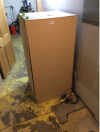
CJT - sorry - I should have posted these a while ago. Here is the box from the outside:
upload_2019-12-30_13-36-54.png

Originally I thought I would put that front panel on hinges ... but then decided it was just as effective just leaning it up against the cabinet. right now I just have tape holding the thing on, but do have some velcro strap (for whenever I get around to attaching it to the cabinet). Other than the hole (1") in the back for the controller plug wire, I did not cut holes in it - am relying on the gap between the front panel and the sides of the cabinet to give me some air exchange. the controller (bottom right) is just a simple thermostat controlling within 5 degrees (I figure for this application a PID controller would be way overkill). I have thought of putting insulating foam on the sides, back and top ... but have not gotten around to that either :-(

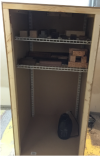
the inside looks like this:
upload_2019-12-30_13-40-59.png
Wire racks from home depot with the back rail attached to the rear upright 2x2's with through bolts. I can add more racks if needed, but dont need them yet. Keeping them high also gives plenty of room between the shelves and the ceramic space heater that heats the thing. I know it is often spoken about heating these with a 75-100W lamp ... but when I went to Home Depot there was not an incandescent bulb to be seen! (all LED's). I had this heater sitting around, so I figured "why not". (you can see I located the hot output side a ways away from the side of the box). I monitored the thing very closely when I first fired it up ... and the sides of the cabinet get nowhere near warm enough to be a concern. This little heater gives me both heat, and air circulation. It appears to work very well: spalted maple I put in there for stabilizing went from 10% moisture to not-measureable within a couple days. More dense wood (like black walnut) took less than a week to get to not-measureable moisture. really dense woods, like true rosewoods, take much longer ... but so far I have seen that if you put them in there with 15% or less moisture then have not split on me. Some of them have twisted a little .... but so have some of the pieces I have sitting out in the basement.

I have had the thing up to 120F when I was drying wood for stabilization, and the heater had no problem maintaining that temperature. Most of the time I just leave it sitting at 90F.

 
Very cool Cushing. I have always had a supply of dryish wood on my pile, but I have a couple of big maple burls that I would like to speed up the drying process with. 16% down to 10% is a 8 month process sitting under my porch. If I could turn that into a few week by slabbing them into 2" slabs and using a box....

BTW there is a specialty mill near where our school is meeting right now and they have a big 40 foot shipping container that is set up as a drying kiln. They burn scrap trimmings to heat it. Pretty cool set up...I am thinking of asking them to add the slabs of birch that I cut up recently to one of their runs.
58058811163__F5485D9D-7173-4991-B159-ADF22F2547A0 (1).jpg
 
CJT - sorry - I should have posted these a while ago. Here is the box from the outside:

Originally I thought I would put that front panel on hinges ... but then decided it was just as effective just leaning it up against the cabinet. right now I just have tape holding the thing on, but do have some velcro strap (for whenever I get around to attaching it to the cabinet). Other than the hole (1") in the back for the controller plug wire, I did not cut holes in it - am relying on the gap between the front panel and the sides of the cabinet to give me some air exchange. the controller (bottom right) is just a simple thermostat controlling within 5 degrees (I figure for this application a PID controller would be way overkill). I have thought of putting insulating foam on the sides, back and top ... but have not gotten around to that either :-(

the inside looks like this:
Wire racks from home depot with the back rail attached to the rear upright 2x2's with through bolts. I can add more racks if needed, but dont need them yet. Keeping them high also gives plenty of room between the shelves and the ceramic space heater that heats the thing. I know it is often spoken about heating these with a 75-100W lamp ... but when I went to Home Depot there was not an incandescent bulb to be seen! (all LED's). I had this heater sitting around, so I figured "why not". (you can see I located the hot output side a ways away from the side of the box). I monitored the thing very closely when I first fired it up ... and the sides of the cabinet get nowhere near warm enough to be a concern. This little heater gives me both heat, and air circulation. It appears to work very well: spalted maple I put in there for stabilizing went from 10% moisture to not-measureable within a couple days. More dense wood (like black walnut) took less than a week to get to not-measureable moisture. really dense woods, like true rosewoods, take much longer ... but so far I have seen that if you put them in there with 15% or less moisture then have not split on me. Some of them have twisted a little .... but so have some of the pieces I have sitting out in the basement.

I have had the thing up to 120F when I was drying wood for stabilization, and the heater had no problem maintaining that temperature. Most of the time I just leave it sitting at 90F.

Thank you for taking the time. All very helpful. The wire rack inside was a great idea. Thanks again!
 
CJT - you are welcome (yeah - I looked around quite a bit before I came across those racks at home depot. I had to cut them down widthwise to get them to fit .... but the cutoff wheel on a dremmel took care of that just fine.

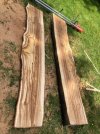
Randy - that is nice looking birch! A couple thoughts: if you create a box to dry something that is at 16% or so ... that might be borderline for damage ... so keep the heat low (90F?) and put a test piece in first to see how it goes.. Also, you might want to consider putting a cut slab into a plastic bag (maybe with some small holes punched in it) before putting it in the box - that will keep the humidity against the slab higher and produce more uniform drying and reduce stresses. Also, you might consider taking your dry-ish wood inside and putting a fans (one on each side of the slab) on them ... the convection and warmer temps inside should move things along pretty quickly. Also, check out that University of Wisconsin extension service on how to build a solar kiln - it does not appear hard at all ... and like I said, they give drying curves that allow you to dry at the max rate for the condition of the wood. I have a co-worker that built one and used it all the time....
 
That solar kiln idea looks pretty cool. There's a guy around here that I met today that made some thing that looks like a green house frame covered with clear plastic. Has a portable fan at either end. Looks like a poor man's greenhouse. He says it speeds up drying large slabs by quite a bit. He sells slabs for a living.
 
That solar kiln idea looks pretty cool. There's a guy around here that I met today that made some thing that looks like a green house frame covered with clear plastic. Has a portable fan at either end. Looks like a poor man's greenhouse. He says it speeds up drying large slabs by quite a bit. He sells slabs for a living.
Cool! If that spalted birch (which really DOES look really cool) is just one of your pieces sitting underneath your porch ... just how much wood are you waiting on to dry???? :-) No way a drying box would hold all that! FWIW - if you have room for a solar kiln (as you see from the wisconsin documentation, they dont have to be large, and you can really pack the wood into them) - here is what I would do: use the kiln to get slabbed pieces down to something like 15% ... then cut them up into blocks, and load them into a drying box at 90F to get them pulled down to a lower moisture. If you want the wood to be stabilized, I would consider cranking the box up to 120F (that will drive the residual moisture lower - absolute temp matters here, not time). Once they are as low as they will go, get those blocks into heat sealed bags (they will very quickly re-adsorb moisture when taken out of the box.....

I envy your ability to scanvenge that wood. But then again, I now have more than enough wood to last me quite a while. But then again, as WEO and I commented in another thread - this "finding cool wood" thing is addictive.... :-)
 
Appliance light bulbs are still incandescent, but I have only seen them in 40W.
Right ... all i found was very low wattage incandescents. The market has spoken! There are however ceramic heaters for reptilian pets with a wide range of wattages.
 
I have 16 ten foot slabs of birch. They are sitting in my buddy's barn. A few of them will become tables. Three will become countertops at our cabin. Some of the trimmings may become knife handles if the grain/spalting is tight enough to be effective on a knife handle. Sometimes big grain that looks great on a table doesn't translate into a knife handle. More of the trimmings will become native american flutes. Might do a coffee table for my parents.
 
Just thought I would give a slight update here. I bumped the temperature in my drying cabinet up to 110F, working to further dry some cherry burl in there prepatory to dyeing and stabilizing. After 3-4 days, I found that one of the half-blocks (roughly 2" x 1") of cocobolo had developed several cracks (different locations, different orientations). the other pieces of cocobolo look fine, as do all of the other pieces of tropical/resinous wood in the cabinet. The pieces of cherry burl also look just fine. (the cocobolo was bought at Woodcraft as kiln-dried wood). I measured the humidty of all pieces before they went into the cabinet - and all measured at 10% or less. Not sure what is going on with that piece - but be forwarned I guess if you try drying with a temperature like that.....
 
Back
Top