
-
The BladeForums.com 2024 Traditional Knife is available! Price is $250 ea (shipped within CONUS).
Order here: https://www.bladeforums.com/help/2024-traditional/
You are using an out of date browser. It may not display this or other websites correctly.
You should upgrade or use an alternative browser.
You should upgrade or use an alternative browser.
Dark Kwaiken
- Thread starter PMLKnives
- Start date

Kohai999
Second Degree Cutter
- Joined
- Jul 15, 2003
- Messages
- 12,554
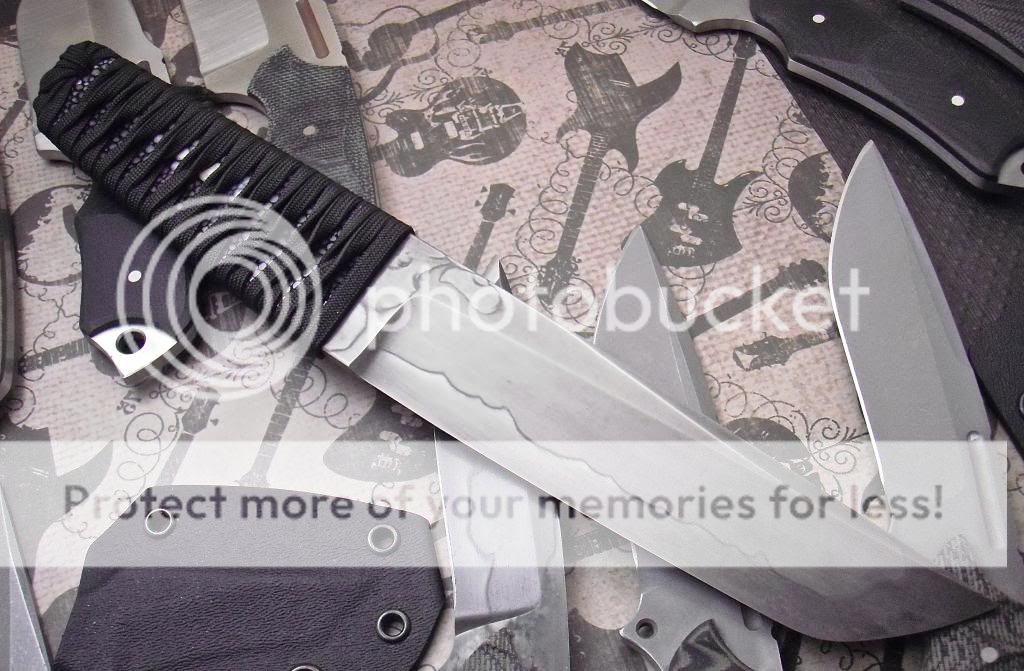
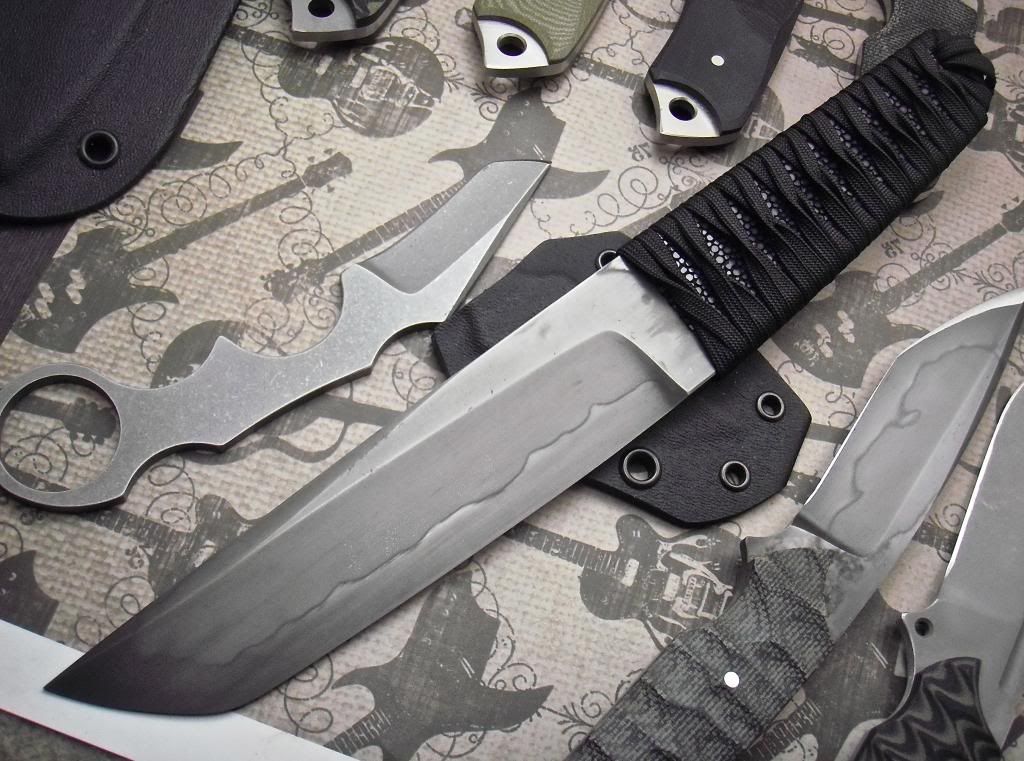
I like the shape of the blade very much but the wrap looks a little off
More than a little. The wrap is not up to the rest of the blade in any way, shape or form. It needs clearly shaped diamonds, in the way of the Japanese blades, hinari-maki....and for Pete's sake, use silk cord designed for tanto, and not shoelace material.
Best Regards,
STeven Garsson


- Joined
- Sep 1, 2006
- Messages
- 2,036
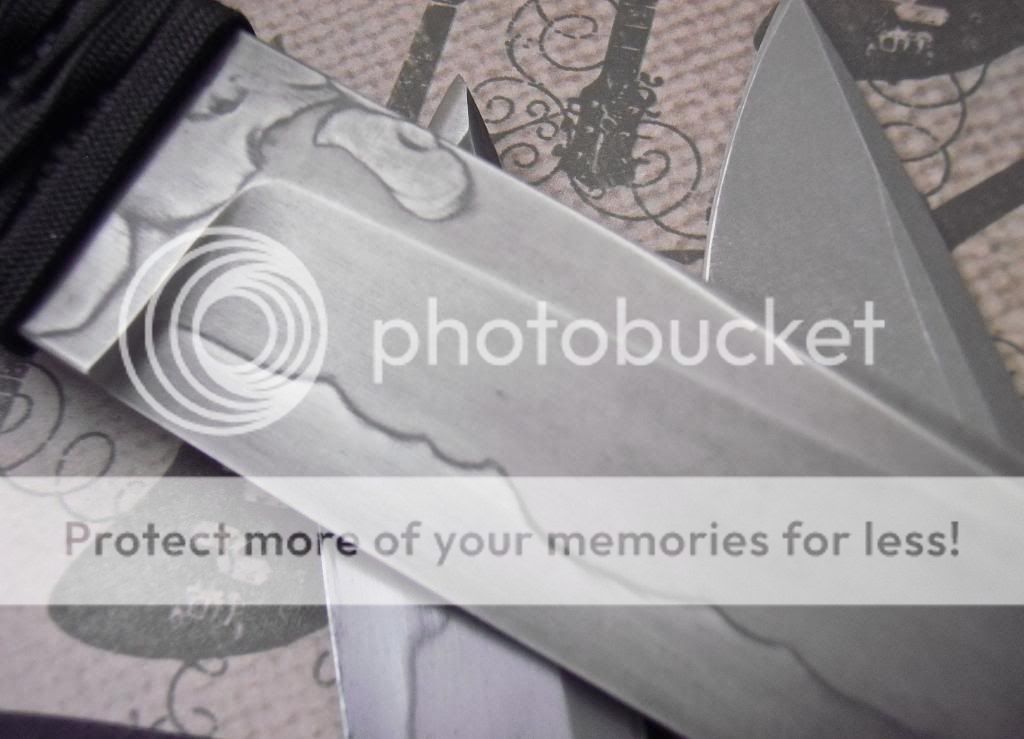
I'd just like to chime in that I agree with my esteemed fellow forumites, Joe and STeven, above. To my eye the blade itself is quite pleasing in both shape/grind and the character in the quench line. It deserves a good tsukamaki job.
On a more general note--not picking on you, Paul--we are seeing more and more Japanese-influenced design cues in knives from many makers. I would ask that in "borrowing" these elements that makers also consider whether (or not) their interpretation of these elements represent well-executed examples. This includes handle wrapping (tsukamaki), quench lines (hamon), blade collars (habaki), blade laminations (kitae), etc.
I feel it's important when adding elements that one must consider both the aesthetic and the intention that produced the original. I would not accept a shoddy, inelegant habaki on one of my swords, and neither would I accept one on a knife that uses one as a design element. A hamon that runs off the edge of a nihonto represents a "fatal flaw". This is true (in my opinion) for a knife with a similar quench line.
On a more general note--not picking on you, Paul--we are seeing more and more Japanese-influenced design cues in knives from many makers. I would ask that in "borrowing" these elements that makers also consider whether (or not) their interpretation of these elements represent well-executed examples. This includes handle wrapping (tsukamaki), quench lines (hamon), blade collars (habaki), blade laminations (kitae), etc.
I feel it's important when adding elements that one must consider both the aesthetic and the intention that produced the original. I would not accept a shoddy, inelegant habaki on one of my swords, and neither would I accept one on a knife that uses one as a design element. A hamon that runs off the edge of a nihonto represents a "fatal flaw". This is true (in my opinion) for a knife with a similar quench line.

CapitalizedLiving
Basic Member
- Joined
- Dec 1, 2007
- Messages
- 3,799
Nice work on the blade. I also really like that ring knife sitting next to it.

Josh Mason
Tombstone hand. Graveyard mind.
- Joined
- Jun 15, 2011
- Messages
- 1,512
I really like it! That blade is off the chain man. I'd love to babysit it and wrap her up for you. I don't do traditional work by any means, but I sure have fun. Awesome blade brother!

- Joined
- Sep 15, 2004
- Messages
- 484
The blade looks great.
Nothing about it has to be traditional. That's boring and gets done by any number of makers in every piece. I like where you were headed.
I think the problem was a combination of choosing that style of wrap and the cord (550?) 550 and similar cords only work with certain types of wrap styles.
Don't get me wrong, as someone who ain't a traditionalist or nitpicker- I'd buy the hell outta that thing already. However, a more precise looking wrap will knock that out of the park....and by that I mean you'll get more money for it.
Nothing about it has to be traditional. That's boring and gets done by any number of makers in every piece. I like where you were headed.
I think the problem was a combination of choosing that style of wrap and the cord (550?) 550 and similar cords only work with certain types of wrap styles.
Don't get me wrong, as someone who ain't a traditionalist or nitpicker- I'd buy the hell outta that thing already. However, a more precise looking wrap will knock that out of the park....and by that I mean you'll get more money for it.
Kohai999
Second Degree Cutter
- Joined
- Jul 15, 2003
- Messages
- 12,554
Nothing about it has to be traditional. That's boring and gets done by any number of makers in every piece. I like where you were headed.
If you think that traditional approaches are boring, I'd like to hear why.
Many Western makers ATTEMPT traditional and fail miserably because they don't understand what they are doing....the "why" of Japanese traditional blades is every bit as important as the "how". The terminology for elements of a hamon itself can number in the 100's and be somewhat confusing, even to those who speak Japanese as native tongue.
It is good to see that Paul is open to hearing where improvements can be made and willing to try. That is always the sign of a maker to watch.
Best Regards,
STeven Garsson

- Joined
- Jan 14, 2011
- Messages
- 3,685
It is good to see that Paul is open to hearing where improvements can be made and willing to try. That is always the sign of a maker to watch.
Exactly
Kris

- Joined
- Mar 9, 2012
- Messages
- 680
That blade is beautiful, really like that hamon you got on there. Great work!
- Joined
- Sep 15, 2004
- Messages
- 484
Sure,
I like seeing people go bold with their ideas. Not everything is going to be a straight up win the first time. However, pushing the envelope is how things evolve.
No argument that many may attempt traditional and failboat (I'd probably be one of them). I know everyone has a reason for doing what they do, if you accomplish your goal- I can't argue how you got there. "Good" "bad" and other words can be really subjective to us knifers as we all want different things.
For example: my big two questions are generally "how does it perform?" and "will it survive a combat deployment?" Obviously, others have other concerns. That's cool with me.
I'm not bashing traditional, like anyone I can admire great work no matter what it is. Even if it is not my thing.
What I like more is seeing people daring to try new stuff- there's much to be said about initiative.
I like seeing people go bold with their ideas. Not everything is going to be a straight up win the first time. However, pushing the envelope is how things evolve.
No argument that many may attempt traditional and failboat (I'd probably be one of them). I know everyone has a reason for doing what they do, if you accomplish your goal- I can't argue how you got there. "Good" "bad" and other words can be really subjective to us knifers as we all want different things.
For example: my big two questions are generally "how does it perform?" and "will it survive a combat deployment?" Obviously, others have other concerns. That's cool with me.
I'm not bashing traditional, like anyone I can admire great work no matter what it is. Even if it is not my thing.
What I like more is seeing people daring to try new stuff- there's much to be said about initiative.

- Joined
- Dec 23, 2006
- Messages
- 15,020
I don't think this has so much to do with traditional
There are many modern adaptations of Japanese style wraps like done by the late great PH or some one like RJ Martin
There is nothing traditional about them but they are done well and serve there purpose exceedingly well.
The talented maker in this thread has ground and made a fantastic looking blade and when he gets his handle wrap, material and technique down pat he's gonna light it up
There are many modern adaptations of Japanese style wraps like done by the late great PH or some one like RJ Martin
There is nothing traditional about them but they are done well and serve there purpose exceedingly well.
The talented maker in this thread has ground and made a fantastic looking blade and when he gets his handle wrap, material and technique down pat he's gonna light it up

- Joined
- Jan 26, 2008
- Messages
- 799
I, too, dig that blade! Really nice lines. Proportions seem right.
Please post up pics when this knife is completed. Would love to see and appreciate the final product.
Please post up pics when this knife is completed. Would love to see and appreciate the final product.


- Joined
- Jun 22, 2007
- Messages
- 721
So I am finally getting around to posting some of these pictures. I figured I would try some different ideas. Yes they are still para cord with out the core, I will get some done in silk when I get some in stock.
I noticed when I was rewrapping the first handle the para cord was really stiff. The handle all the way to the right and last picture. I did try to do two folds but it really didn't like it. I went to the rope warehouse to see if they had any more in stock. It seems like the new para cord was much more flexible.
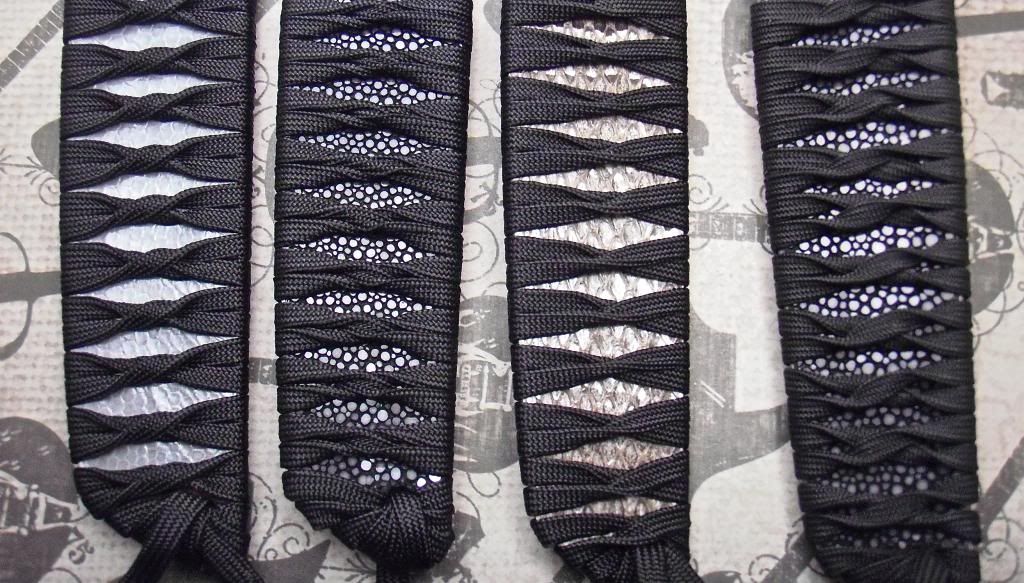
The handle on the farthest right was what I was initially trying for. A single fold I have done it in the past and I thought it looked good, but next to the others not so much.
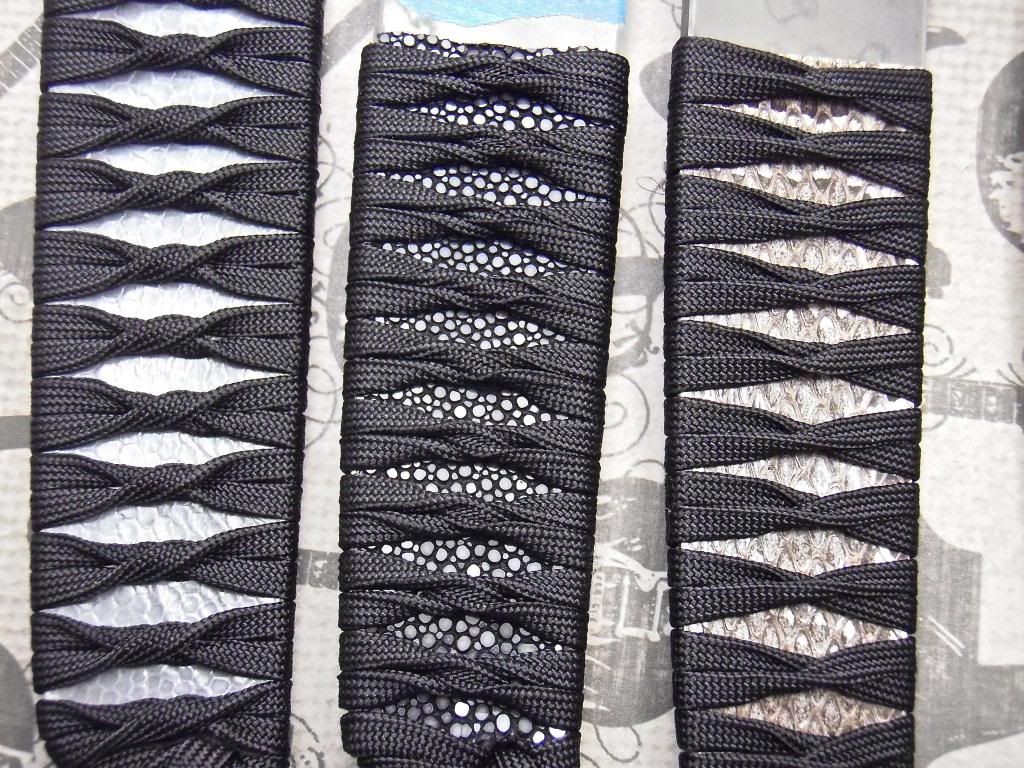
So what are you guys thinking
Paul
I noticed when I was rewrapping the first handle the para cord was really stiff. The handle all the way to the right and last picture. I did try to do two folds but it really didn't like it. I went to the rope warehouse to see if they had any more in stock. It seems like the new para cord was much more flexible.
The handle on the farthest right was what I was initially trying for. A single fold I have done it in the past and I thought it looked good, but next to the others not so much.
So what are you guys thinking
Paul