Deep Snow Camping, Tipi, Snowshoeing and More!

All I can say is wow! :eek: Fantastic trip report with fantastic pictures, in fact, I've saved quite a few to my scenery folder.

Your report just may be instrumental in getting me back out winter camping, maybe................

Thanks for sharing that, Brian.

Doc
 
I'm glad I'm not the only one who loves winter camping! I LOVE snow! To bad we don't get anything like that here in town, but snow is close.

Great pictures, I've always wanted to do some snowshoeing. I also love checking out water in the winter, looks like a great spot you have there.

Was there an actual camp bathroom? Or did you just setup "shop" somewhere? Going to the bathroom is one of my not-so-favorite activities, especially in cold cold weather. In the morning it was around 5F, and exposing half of my body to the cold is now how I like to wake up!

I really enjoy trip reports like this, keep them coming!
 
Awesome trip report. I am frantically blocking all pictures of your amazing shelter from my wife because she will totally want one of these. The fire inside the tent would be a really big draw for her. You mentioned using the volcano stove for fire containment. Does that help to focus the smoke upwards toward the ceiling? How was the smoke inside given you were using a variety of different woods and some of them being a bit wet?

I just adored some of those winter fall shots. Just gorgeous stuff!
 
Thanks for answering my questions Brian. This tipi could be a future investment for me. I need to get a warmer bag and a pad first though.
 
Great trip report Brian!!!

That is helluvalot of snow! You captured some great images, thanks for posting them.
 
Great report and pics Brian.

I haven't been to Tahquamenon for a few years. Last time was on a Labor Day weekend. It was above 90°F and the place was packed. Looked more like a water park with everyone in the falls. My next trip will definately be off season. We actually car-camped in the LP near Wolverine to avoid the crowds on that trip. Worked out better.

Thanks for the report.

Chris
 
Inspired by peripatew’s recent very detailed post titled ”Winter Canoe Report” I figured I would at least try to be as half as thorough on documenting my most recent adventure.

During the long holiday break, I was able to get up to Michigan’s UP for some deeper snow camping. This was a trip just for the big boys. Normally I take the kiddies, and the whole family along, but I did not think they would be able to handle the cold and the snow.

The plan was to basecamp in my Tentipi and to spend the days snowshoeing around.

We decided to stay in the Tahquamenon Falls area. There is a mostly primitive campground near the lower falls.There are two loops to campground, but only one is plowed. I normally would like to stay in a more primitive area than a “campground” but as you will soon see by the pictures, it was pretty deserted :D

I had no idea what this “campground” would be like, so we packed out gear in two stages. One “backpacking ready” with our normal multi-day packs and one-sled in tow. Then, larger “car camping” gear in case we were close enough to get it to the campsite with the sled.

We arrived around 5pm and the temperature was about 28 deg F. We were losing light, so I did not take any pictures of actually “setting up” but rather took these the day after.

Upon arrival, we snowshoed around the non-plowed area of the campground to select a spot. The snow was deep enough that snowshoes were pretty much required.

IMG_2895.jpg


After selecting a campsite, we had to tamp down the area for the tipi with our snowshoes.

I have posted here about my Tentipi before. I have used it in warm and somewhat cold weather, but this was my first time using it in deep snow. I absolutely love the thing because it allows an open fire, the use of a wood stove, provides great fresh air ventilation and setup is super easy. The only drawback to it (if you consider it a drawback) is that you need to anchor it securely to the ground (ie. sand would not work). That required me to come up with a method to anchor it in the snow, since traditional stakes would not work.

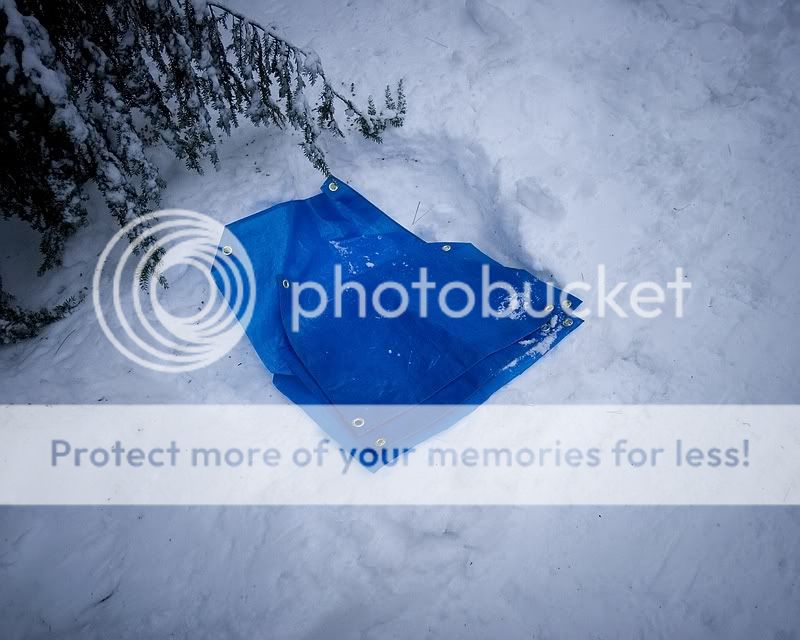
So, I made snow anchors out of an old blue tarp. I put grommets in each corner and tied cord on to make a parachute. Here are the tarp pieces I used.

IMG_2893.jpg


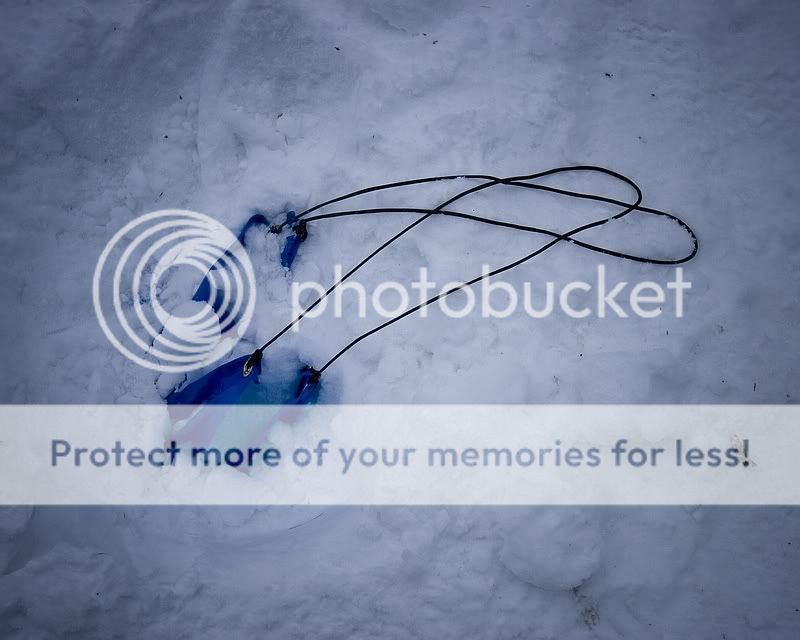
It was dark when we buried the anchors, so I took this picture as we were un-burying them. But, you get the idea.

IMG_2980.jpg


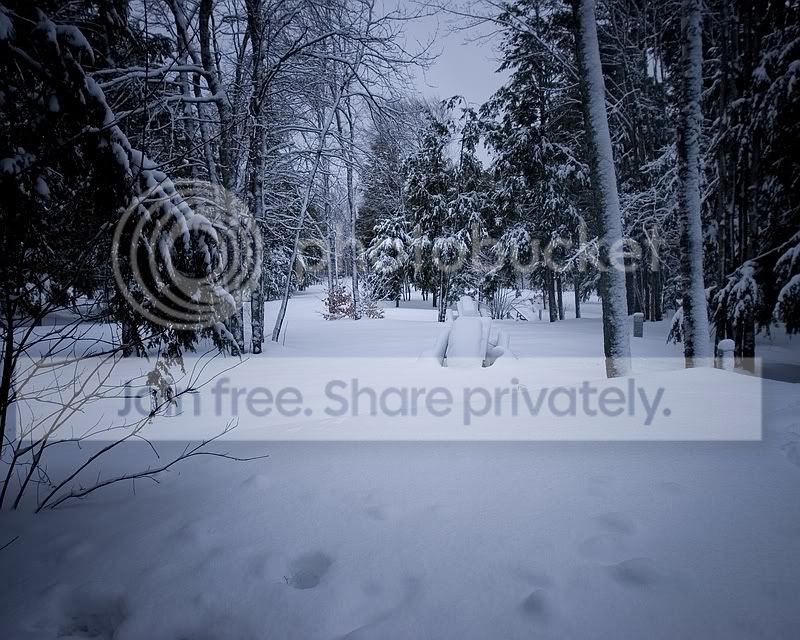
Next, we let the anchors settle for about an hour. During that time we collected lots of firewood (more on firemaking later) and packed down trails (such as to the latrine) so that we could walk around in normal boots, and not have to put on snowshoes for the midnight trips to the bathroom. Here is the latrine trail.

IMG_2892.jpg


Next, we finished setting up the tipi, and unrolled all the bedding material. Here is a picture of the tipi and camp.

IMG_2894.jpg


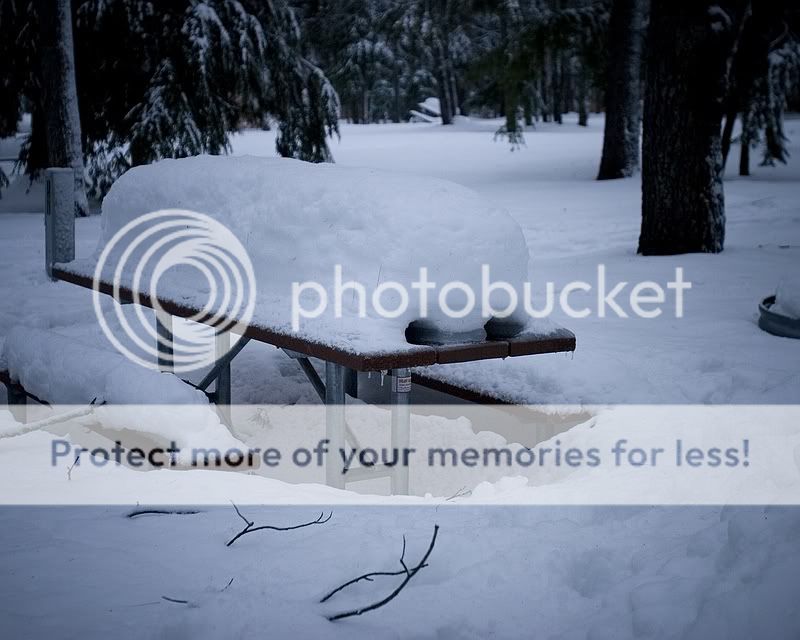
Here is a picture of how deserted the campground was. Notice all the picnic tables.

IMG_2973.jpg


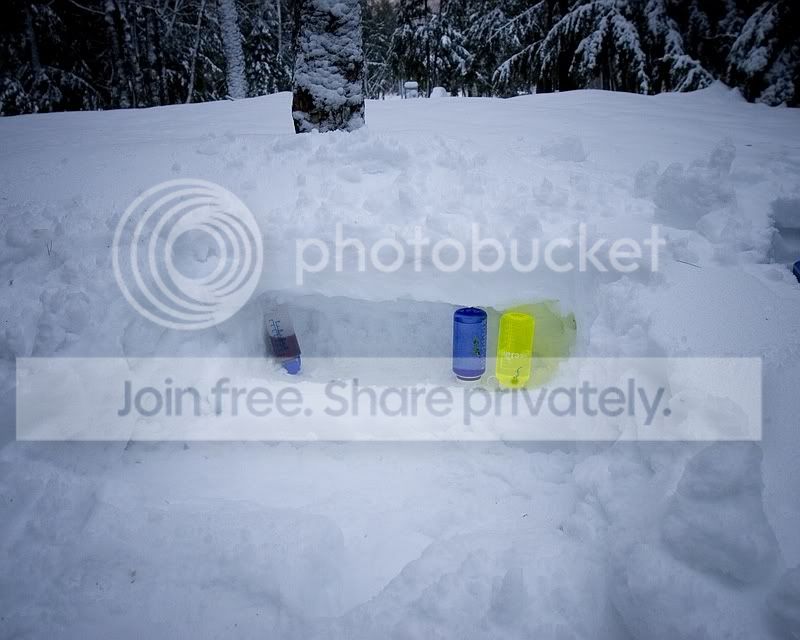
Finally, while I cooked dinner, one of my camp buddies dug two separate refrigerators. One for the food and one for the water. Besides having good luck with the water, I am happy to report that none of our food froze, including sour cream, salsa, juice and some other stuff (yes....we ate well). Here is the water fridge (only half full).

IMG_2891.jpg


I have camped in the winter before using Nalgene’s like this. I took along my 40oz Kleen Kanteen mostly to learn what it could do. I am happy to report that it survived every night in the refrigerator without freezing. There was mild freeze up on the camp, which is typical because the thin layer of water that always seems present.

One lesson I did learn there is to make sure and take the loop cap (instead of the flat camp) to break the ice crust free. The Kleen actually seemed to have less freeze up issues than the nalgene’s. Don’t know if the was just coincidence or what.

To Be Continued......

awsome! where can i get a tipi like the one you have is it made of nylon?

alex
 
When you were burning wood in the tepee where was the smoke going? I could not see a hole or pipe for the smoke to get out, please explain how that worked!

Thanks,
RickJ
 
Wow, there are a lot of questions. I will try and answer them all. If I miss something, don't take offense because I didn't mean to!

Great trip, thanks for the pictures and story.

One thing you did leave out was a detailed description of what safety measures you took in order to burn a open fire in a closed tent. While many people on this forum including myself have done such things it is very dangerous.

Not being a nitpicker but understanding that many young and inexperienced people use this forum as a reference and knowing that trying to produce heat in a closed environment has been the death of many good people.


Maybe you could give a safety briefing for people who do not understand the danger, thanks again for sharing your experience.

Hey Bubbanumber1,

You are not being nitpicky at all. You have a very good point and thanks for bringing it up.

I will make a few comments, but if you would want to add anything, please do.

With respect to safety, we are always taught "no fires in tents." I think that is a good rule, and I would not suggest trying what I have done unless you are shown by someone who has safely done it before.

The Tentipi is a bit of a different animal from a normal tent. Besides the door, it has 3 fresh air intakes at the bottom that are controllable.

The top has 2 ventilation caps. 1 is smaller and has a screen. It is used with the fresh air intakes (which have screens) just for airflow. The tipi works kind of like a chimney to circulate air, even when there is not much breeze.

The second vent cap is larger, and has no screen and is what is used to exhaust the smoke from the fire. It also has a zippered port to pass a stove pipe through. Both top vent caps are controlled by cords that run inside the tipi. If you are really interested in how this particular one works, you can check out Tentipi's website. I didn't mean to make this a post about the tipi :D But, I don't mind the questions either.

The combination of fresh air intake and exhaust is what is allowing me to have a fire. Please do not do this in a normal enclosure.

Also, the floor in the tipi zips away to have clear access to bare earth/snow below.

A couple things I do for safety:
- Have the fire in the container. While you can have it on the ground, the container contains the coals, can catch the occasional "pop", and by keeping wood from rolling to the outer edges of the fire, minimizes smoke.
- I move items a reasonable distance from the fire.
- I generally cover sleeping bags with a wool blanket.
- Wood selection is important. Know your woods. Avoid ones that produce lots of ash, or have a tendency to pop.
- I have never attempted to "sleep" with a fire going. I generally use it for atmosphere or to slightly warm things in the evening and morning. My sleeping bag was plenty sufficient for the cold temps, and the fire was not at all necessary.

Your report just may be instrumental in getting me back out winter camping, maybe................

Thanks for sharing that, Brian.

Doc

Doc,

I am ready to go! Let's start planning! :D

Actually, I am only 200 miles from you. I think we should plan a warm weather adventure before we try a cold weather one :D


Was there an actual camp bathroom? Or did you just setup "shop" somewhere? Going to the bathroom is one of my not-so-favorite activities, especially in cold cold weather. In the morning it was around 5F, and exposing half of my body to the cold is now how I like to wake up!

Campground was open, and we were all legal. But the outhouses were locked up. So, we packed down the latrine trail and kept all our business in the same area.

I don't enjoy the midnight trips to the bathroom either! Some keep a pee bottle in their sleeping bag. I do not.


awsome! where can i get a tipi like the one you have is it made of nylon?

alex

Hey Alex,

I sent you an e-mail about the tipi. They make them out of several materials. Mine happens to be a canvas/polyester blend that is impregnated for weather resistance, yet is supposed to allow the material to still breathe.


When you were burning wood in the tepee where was the smoke going? I could not see a hole or pipe for the smoke to get out, please explain how that worked!

Thanks,
RickJ

Hey Rick,

I hope I caught this one in the first section.
 
Brian, Thanks for explaining that, I'm certain the readers appreciate it and I do for sure. I often worry about people reading of adventure and not understanding simple details that will kill.

Anyone who reads this needs to know that any fire in a tent including charcoal smoldering can kill you by carbon monoxide poisoning. There are many documented cases of people who have accidentally died while trying to warm themselves, this cannot be understated. It can easily be the same as running a car in a garage or hooking a hose to a muffler then directing it into the cab of a car for a suicide.

Original Tipi's were made to build fires in and they were well ventilated. Modern tents like the Tipi Brian used and others are made with vents so that you can bring air from the outside into the firebox and then they have a exhaust for a chimney at the top. If your going to burn anything its better to burn wood as it will smoke but it too produces carbon monoxide. I would like to hear some other people expand on this aspect of winter camping if they have anything to add.


Consumer Product Safety Commission
Burning Charcoal in Homes, Vehicles, and Tents Causes 25 Deaths from Carbon Monoxide Each Year
CPSC Document #5012


The U.S. Consumer Product Safety Commission (CPSC) warns consumers - including hunters and campers - never to burn charcoal inside homes, vehicles, or tents. Burning charcoal produces carbon monoxide. Carbon monoxide has no odor, cannot be seen, and can kill you. Consumers may not realize that burning charcoal produces carbon monoxide and that it will build up to a dangerous level. Opening a window or using a fan will not assure that carbon monoxide will be reduced to safe levels.

Each year, approximately 25 people die and hundreds more suffer from carbon monoxide poisoning when they burn charcoal in enclosed areas such as their homes, in campers or vans, or in tents. Some of the victims die from carbon monoxide poisoning after they burn charcoal in a bedroom or living room for heat or cooking. Some are campers who burn charcoal inside a tent or camper to keep warm. Others are hunters who burn charcoal inside their trucks, cars, or vans. Those who do not die can suffer headaches, drowsiness, dizziness, weakness, nausea, vomiting, confusion, disorientation, or collapse.

CPSC warns consumers: Never use charcoal to cook or provide heat inside enclosed areas such as tents, campers, vans, cars, trucks, homes, garages, or mobile homes because the carbon monoxide can kill you.
 
Brian, Found this picture of a your model Tipi with a stove and chimney set in it. Your Tipi looks nice, about how much do they go for? I plan to scrounge up a sewing machine here in a couple months but will most likely make a wall tent.


L3_Varrie_cutout.jpg
 
Your Tipi looks nice, about how much do they go for? I plan to scrounge up a sewing machine here in a couple months but will most likely make a wall tent.

I just checked current prices, and they seemed to have went up a bit. If I remember correctly it was going for about 900 pounds when I bought it.

I have dreamed about a wall tent for years, and it was what I was looking at when I finally came across this. However, the reason I really like the Tentipi is because of the ease of setup, and its packed size.

The wall tents have so much pole structure to go along with it, there is a lot of setup time, and is difficult in high wind. It also seems like too much for "just a weekend" which we do all the time.

The tipi on the other hand sets up quicker and easier than even a small dome tent and since most of your setup is "on the ground" it is not difficult in wind either.

Even though the material of mine is not lightweight (canvas/poly mix) it still packs up to about 1/2 the size and 1/2 the weight of a cabin style tent.

I know this thing isn't for everyone, especially at the cost. I am just telling you my reasons for getting the thing.

If you do your own tent, you know we are going to want to see it! So, keep us posted.

B
 
Brian, all good points about your choice of a Tipi style backpacker tent. I had some friends long ago switching to single pole diamond or tipis. My last or should I say current tent is a four season Mountain Hardware and it got put through the paces down to zero multiple times. Sorry I don't have pictures available but I will try to get some this spring for you guys.

Will explain later about the wall tent, but your right, they can be difficult. Anyone camping in low impact areas should not even consider a wall tent in most cases as they do need poles, a good wood or gravel floor, and they are not worth messing with for hiking. However, longer camping trips, hunting trips, and other activities where horse or air support can get you into the field weighted down, they can be a true home away from home, as can be a 15 ft. canvas Tipi. I just think cots set up better in wall tents and in extreme temps and muddy messes its better to be up off the ground a couple feet.
 
Outstanding stuff Brian, thanks for the article.

Yhis may seem silly but what type of vehicle did you use to get there? Did they plow out the roads in the park? Jusy getting all your stuff there was a major chore.


Pat
 
I need a great winter camping trip! We got over 60 inches in less than two weeks here. Winter wonderland.

Nice Tipi!
 
Back
Top