Delica ZDP-189

Cliff Stamp

BANNED
Joined
Oct 5, 1998
Messages
17,562
First to see what this looks like, some really nice pictures by nozh2002 :

http://www.bladeforums.com/forums/showthread.php?t=406468

The edge profile was different on this one than the previous one in VG-10. The ZDP-189 version was slightly thicker at the edge but ground more acute. Specifically it was 0.022-0.025" at the shoulder of the edge bevel which was ground at 12.7 (2) degrees per side.

It was extremely sharp, even for Spyderco, well above shaving and push cutting newsprint. It needed 68 (4) grams on thread and 0.43 (6) cm on light cord under 200 grams of tension. It is the third sharpest knife I have measured to date. In fact out of the ten sharpest knives I have measured, seven of them, including the best one, are from Spyderco.

The high sharpness and acute edge transfer readily into high cutting performance on ropes and The Delica in ZDP-189 took just 13 (1) lbs to push cut 3/8" hemp and a bare 8.0 (5) lbs on a slice. Spyderco again dominates the rope cutting having eight out of the top ten spots (not including knives I reprofiled and resharpened) in the knives I have measured to date.

It also did well cutting hardwoods, birch flooring specifically, I need to repeat this a few times, but the performance seems solid. It will be behind some of the knives used with thinner edges and higher primary grinds but not outclassed. The high sharpness is very durable, lasting through the very heavy (75+ lbs) cuts through the hardwood and easily shaving.

It works well in the kitchen, the high sharpness makes it cut into potatos readily though the heavier cross section compared to the Calypdo Jr. can be felt when working the knife through the peels. It is very efficient in handling, being light in the hand with a precise point which easily handles eye removal :

delica_zdp_potato.jpg


The blade is a bit short for many utility applications, but can still handle a lot of work with some adjustment to method. Dicing peppers and such requires more of a draw on a angle than a chop as would be done with a chef's knife or fine cleaver :

delica_zdp_pepper.jpg


The sharpness is maintained through the rope and hardwood and other light cutting and it readily cuts up some previous cooked chicken :
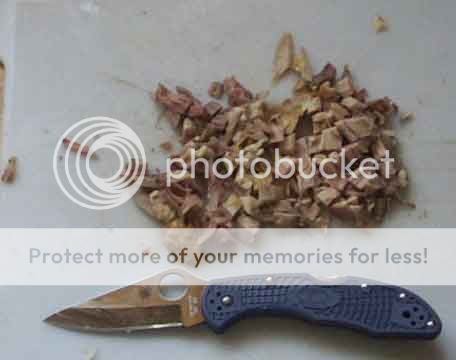
delica_zdp_chicken.jpg


It also carved a section of 1x2 into shavings and resplit some spruce rounds into finer sections for firestarting. This finally removed the fine shaving ability which was readily restored with some light honing on 0.5 micron chromium/aluminum oxide on leather.

Moving outside, it readily handles some work as a scraper, efficiently cutting off some paint :
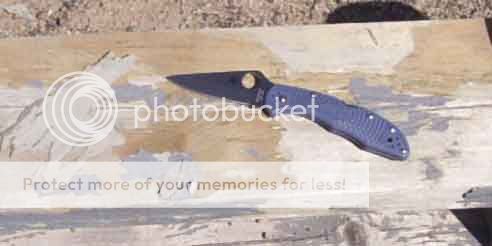
delica_zdp_scraper.jpg


On some stalky weeds it readily pops them off with a light chop holding onto the end of the handle. This type of chopping is overkill with even a light hatchet and the Delica gathers the material quickly though a longer blade would be more efficient. The Catcherman works quite well.


delica_zdp_stalky.jpg


The Delica also has enough dynamic cutting ability to cut some thicker wood. On Alders approaching the size of the opening hole it pops the limbs off readily and cleanly, again just needing wrists flicks. These don't burn well (wood is too wet), but they dry readily once cut, and also work well for a debris shelter and they make decent cordage once the fibres are broken. Mears demonstrates this on several occasions in his TV shows :

delica_zdp_alders_small.jpg


On the larger versions of the same wood, chopping isn't effective as the blade doesn't have the mass. You want at least something the size of the Endura to take out the ones that are about 1/2" thick and over. However by putting the wood under strain by bending it, the Delica readily slices them off :


delica_zdp_alders.jpg


On harder wood, even when the limbs are small, the Delica is too light to handle much chopping, but again putting the limbs under tension it readily cuts them off and an armful of boughs can be gathered in just a few minutes :

delica_zdp_boughs.jpg


It will be interesting to compare this one to the VG-10 one when it gets back from the passaround.

-Cliff
 
In what uses have you done or plan on doing in do you see the saber grind of a Delica function better than the flat grind of say a Calpyso Jr or Para-Military?
 
Cliff, may I translate your review in Russian and put on my website?

Thanks, Vassili.
 
kel_aa said:
In what uses have you done or plan on doing in do you see the saber grind of a Delica function better than the flat grind of say a Calpyso Jr or Para-Military?

That is the question isn't it, performance is relative and where would the Delica be a superior knife to the Calypso Jr. simply considering the nature of the blade. Generally there are three reasons for wanting thicker stock, more weight for dynamic cutting, more thickness to prevent wedging and a more steel in the blade to give the knife greater strength. On a knife of this size, sabre or full doesn't make a lot of difference in regards to power on a swing and a reducing in binding due to wedging isn't relevant either for most materials.

The only issue left is strength and this basically means prying. This topic constantly throws people into fits screaming about daring to expose a knife to lateral loads but in sane reality knives take such loads all the time in use, the only thing that changes is the amount. One of the things you can do with the Delica which you can't do with the UK Pen is use this strength to increase efficiency in lots of wood cutting. For example gathering materials for a fire.

delica_zdp189_shavings.jpg


Now the thin shavings are just sliced off, and these burn almost immediately, very similar to paper. You would be hard pressed for example to cut them from wood as fast as they burn so they just get the fire going. The splits on the side on the other hand are easily ignited by the shavings and will burn for an extended period of time, on the order of ten to twenty minutes depending on wind and wood type :

delica_zdp189_fire_init.jpg


This is easily long enough to gather some green woods for a smudge :

delica_zdp189_fire_alders.jpg


This will drive away insects, act as a signal fire, and also keeps rain snow off the dry wood, and it will also burn once it dries. This can then be augmented by other materials such as thick barks :

delica_zdp189_fire_bark.jpg


which produce a clean flame :

delica_zdp189_fire_bark_later.jpg


Now back to the grind, the sabre grind on the Delica allows it enough strength to use to pry the wood apart using light to medium wrist strain, so you rock the blade into the wood and then pop it apart and thus work faster and more efficiently. The danger in actually recommending this is that the tolerance isn't infinite and it is readily surpassed by aggressive loading by any normal adult which is why makers/manufacturers understandably don't promote it heavily.

Now of course a flat grind on thicker stock like the Paramiliary is more efficient from both a strength/weight issue and cutting/sharpening perspective than a sabre-flat grind, especially when you add in the distal tapers. It is very hard to argue for sabre-flat from that comparison on a performance based arguement but there are performance/cost arguements which can be made and general aesthetic ones.

As a side note, if the blade isn't robust enough to laterally pry apart woods, it may be still strong enough to take a torsional load as this will put a large component of the load through its width which is near impossible to break. Thus instead of rotating the wrist sideways you rotate it down. This is much harder on your but much easier on the knife.

This is speaking of course of making small splits, on larger splits you have to use wedges as prying is generally not effective unless the wood is fixed in place as in deadfall logs and then you tend to want much thicker blades at least 3/16" for the small ones and 1/4" for the large ones.

nozh2002 said:
Cliff, may I translate your review in Russian and put on my website?

I would not call that a review yet, but yes.

-Cliff
 
I don't think I've come close to loading a stainless steel folder to the limit. I've only batoned and pryed with a 1095 short Kabar, batoned with the Mora carbon laminates, and chopped with bayonets (poor knives by most standard). So I'll take your word for it, but how do you know you've come to the limit of your knife? You are not going to do finite element analysis everytime to intend to use your knife. And it's not like wood, where you can sometimes "hear" the strain. Of course, geometrically, a blade geometry can only take a certain load before a set. But isn't failure usually by fracture, and in those the most important variable is the size of exisiting stress concentrators or faults (do we have any information on that or make reasonable guesses?). So when you say

the Delica allows it enough strength to use to pry the wood apart using light to medium wrist strain, so you rock the blade into the wood and then pop it apart and thus work faster and more efficiently.

is it just based on experience that you say a Caly Jr or UK Pen Knife be critically/near critically loaded to do that?

As a side note, if the blade isn't robust enough to laterally pry apart woods, it may be still strong enough to take a torsional load as this will put a large component of the load through its width which is near impossible to break. Thus instead of rotating the wrist sideways you rotate it down.

Je ne comprends pas.

As a side note, we've noted that the Mora Lam's arn't very strong due to their weak laminate steel. As for the short Ka-bar, since the grind is so pathetic, it better well be able to baton and pry (actually in shallow cuts, it doesn't feel so bad (10 prim 20 edge on 4 mm stock, and the Kraton handles are fairly comfortable. But try to cut a large root product that doesn't fracture easily, you'll feel like you want to go for the rolling pin as a baton.)

PS: I ate a lot of melons and orange fruits last year (cantelope, honeydew, orange, grapefruit). The cafeteria served them sliced up into wedges with the skin on them. To eat them, you have to slice off the skin yourself. It's a specific use, but that's where I developed a dislike for saber grinds. Even though the application is very specific, the math (involving geometry) is transferable.
 
"performance/cost arguments"

It would be reasonable to say that 3 mm stock costs more than 2 mm stock, and to machine that stock into the same geometric ratios (or better) the costs would correspondingly be higher.

However, I think the argument can be made that you only get that performance/cost ratio because you accept it as the best you can get.
The economies of scale can make the above differences relatively minor. The Canadian chain Le Baron lists the Native I, with 3 mm stock and S30V less than two dollars more than the Delica 4, with 2.5 mm stock and VG-10 (I really want to make the comparsion to the Delica 3, since they are of the same construction, but the Delica 3 was priced at the same level anyway). Between the 2.5mm stock Delica and the 3mm Endura with its longer blade and handle, the price difference is only 5 dollars, or less than 10% of the fifty some you are going to spend anyways. We in fact don't see an Opinel Economie line or Victorinox Thrift line of saber ground knives, to save you 50 cents or a dollar.

I wasn't mature enough to take notice at the time, but my mother told me that checking (as in banking) used to charge a monthly fee. Now, we accept it as normal to get free checking (with some sort of minimal balance). To not turn this into a discussion on whether the service at banks has correspondingly decreased or whether they are earning the same profit elsewhere, I will sum up by restating my position that you only get the specific performance/cost ratio not because it is infact the best Spyderco can do, but because you accept it as so.
 
kel_aa said:
So I'll take your word for it, but how do you know you've come to the limit of your knife?

With stainless, it tends to be in two pieces. You have some warning because while the angles are low, they are not single digit, so there is a point at which you know it isn't productive. With the Delica specifically I can also feel the strain starting to effect the grip/pivot under high loads so the design seems well balanced.

is it just based on experience that you say a Caly Jr or UK Pen Knife be critically/near critically loaded to do that?

Yes, I cracked a Pen through the opening hole awhile ago doing it. .

In regards to prying vs torsional splitting :

ss_split_pry.jpg


This is a Safari Skinner used to split a piece of lumber by prying. The blade is rocked into the wood and soon becomes stuck and you can't press it any further. However it you pry to the side it will split the wood as shown. You then advance it to the apex of the crack and repeat. Once you get familiar it is very fluid and you can run the blade down the wood in seconds.

ss_split_roll.jpg


This is the same basic procedure however it doesn't load the knife laterally but torsionally and the knife is many times stronger under such a load. It would even be difficult to break a SAK like that and they are trivial to bend laterally. You are also much weaker in that movement and thus it isn't very demanding materials wise on a knife to be strong enough that you will give out before the blade. This method can also be made very fluid with experience, you just rapidly rock the knife down through the wood.

For many knives batoning is generally a better choice, however this may be problematic for blades with distal tapers or locks, and they can still be very functional with prying or torsional splitting. Some times wedges are more effective, it depends on the wood and what you have available and time constraints and your physical ability. Someone who has very strong wrists can split even fairly large wood quite rapidly in the above manner with a stout knife.


As a side note, we've noted that the Mora Lam's arn't very strong due to their weak laminate steel.

Yes you are basically looking at annealed steel and it bends similar to a coat hanger. The Japanese have similar style knives using even mild steel as side laminates and even wrought iron in some cases, though that is usually on tools which are never laterally or torsionally loaded like chisels.

To eat them, you have to slice off the skin yourself. It's a specific use, but that's where I developed a dislike for saber grinds.

They are not in general how I would pick knives to be ground either. I think the main reason they are chosen is aesthetics.

Even though the application is very specific, the math (involving geometry) is transferable.

Essentially yes, that is a point where many tend to get caught up, discounting a specific example of performance because of the material. It isn't the exact knife and material which need to be considered by the general geometry and general nature of the material.

kel_aa said:
I will sum up by restating my position that you only get the specific performance/cost ratio not because it is infact the best Spyderco can do, but because you accept it as so.

I think this is reasonable and just a demand/supply result. They are not a charity after all. In general I would agree that materials and geometry tends to be only a small influence on final price except in extremes.

-Cliff
 
pry.jpg


As I understand it, in prying you are basically have two point loads, while in torsional prying you have an area loading.
torsional.jpg


This doesn't seem very comfortable to the wrists. I don't have any experience with this method, but it seems you are trying to push the wood to the side, without any mechanical advantage, and fighting a lot of torque as your hand and the wood are not in line. But it is interesting.

By the way, what do you think of my "culturally faithful," "high performance/cost ratio," "tactical" knife design? It'll empoly a steel of "very expectional stain-resistance" and "incredible toughness" to meet the demands of those who don't know better. :D
 
By the way, what do you think of my "culturally faithful," "high performance/cost ratio," "tactical" knife design? It'll empoly a steel of "very expectional stain-resistance" and "incredible toughness" to meet the demands of those who don't know better.

Hmm... If you're talking about the one in the drawings your out of luck, Strider makes one just like that!
 
kel_aa said:
As I understand it, in prying you are basically have two point loads, while in torsional prying you have an area loading.

In torsional loading the spine pushes against one side of the wood and the edge on another. The loading is similar to the lateral prying in that regard as there are two forces inducing a torque but the load is through a much greater cross section. The blade is also under forces through the contact points on the handle. For lateral prying this can be enough in extreme cases to make the failure there and not in the blade because there is a torque between the index and pinky as these provide opposing forces.

This doesn't seem very comfortable to the wrists. I don't have any experience with this method, but it seems you are trying to push the wood to the side, without any mechanical advantage, and fighting a lot of torque as your hand and the wood are not in line.

Yes, you basically have to have a very powerful wrist curl and are at a severe disadvatage compared to lateral prying in which case you can just lock your wrist and lean on the wood so it is trivial to apply a significant fraction of your body weight. Lateral prying can be faster than batoning on some woods, generally though any wood you can pry/split you could chop split directly with a larger knife or small hatchet but you don't always have those

By the way, what do you think of my "culturally faithful," "high performance/cost ratio," "tactical" knife design? It'll empoly a steel of "very expectional stain-resistance" and "incredible toughness" to meet the demands of those who don't know better.

It lacks :

-speed holes
-blood groove
-saw back
-serrations
-gut hook
-tanto
-dual edge
-wire breaker
-skull crusher
-window breaker

and of course

-NOT TACTICAL BLACK

I think you are going to have a hard time selling it. The question is though - are you or anyone you know an operator, if so this tends to over ride any concerns about functionality.

-Cliff
 
It lacks :

-speed holes
-blood groove
-saw back
-serrations
-gut hook
-tanto
-dual edge
-wire breaker
-skull crusher
-window breaker

and of course

-NOT TACTICAL BLACK

It can only take 5 of those features before it will be classifed as an assualt knife and fall under federal regulations. Actually, my design is endorsed by Seal Team Six*.

*Seal Team Six is not part of the Navy. It is responsible for feeding and cleaning the seal and sea lion habitats at Sea World Orlando, on Mondays through Thursdays and alternate Saturdays.

---

I'm not picking on the Delica or Spyderco. The very fact that we are talking about Spyderco is a nod to the company. I don't think we can compare blades from any other company in the same way (Delica/Para-Mil/Caly Jr/UK Pen). But what I don't want to see is that someone read this as a categorical approval for the Delica. It depends on your temperment. If you want it to be versatile and pry a little with it, fine. However, if it bothers you that you are paying a penalty in terms of cutting efficiency, and are not going to use the extra strength it offers (over a flat grind on the same stock), then there are better choices.
 
kel_aa said:
It can only take 5 of those features before it will be classifed as an assualt knife and fall under federal regulations.

Yes it seems our rights are being limited all the time I mean how are you supposed to make do with only five or less of the above, how do you pick which ones to keep. So many times I am in the woods and I think "damn, if only I have went with the blood groove, blasted wire breakers what good are you to me now with my blade stuck to its hilt in a chupacabra!"

But what I don't want to see is that someone read this as a categorical approval for the Delica.

Generally, superiority is always of a narrow scope and discussing the disadvantages of geometry/steel is as valuable as the positives. Any commentary ignoring either is never a good thing. Comparisons of dissimilar designs are usually of benefit for this reason, avoided only by those who wish to propogate the nonsense that superiority is a uniforma and blanket label - usually made by someone trying to sell you the "superior" product.

-Cliff
 
If you were using a Cold Steel Voyager (tanto or clip, I don't see much difference) where there was less blade spine-to-edge-wise, and where you have a hollow ground blade, would you still attemp the torsional prying? Would that be sort of asking for a Spanish-notch in the middle of your blade?

How do you find the the lock and pivot on the Delica? On my Native I, the diameter of the pin is bit smaller than the diameter of the blade pivot hole. I'm assuming the screw construction takes care of this?
 
The Voyagers are quite thick through the spine due to the sabre grind and can take significant lateral prying in the larger blades so usually you would do that. Deep hollow grinds can cause problems in torsional loading though it takes a fairly extreme profile before I would be concerned due to the way the blade is loaded in splitting. I'll dig up a small Voyager and see if it has a problem with twist splitting.

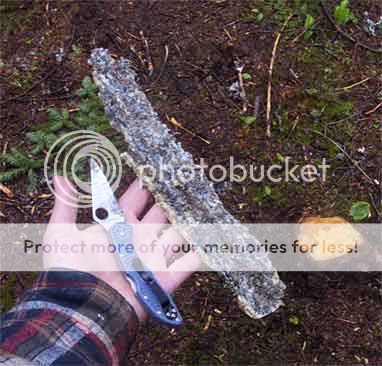
The lock on the Delica is secure under impacts, torques and white knuckling. It has some light play now which you can notice during cutting, however it doesn't effect the functionality and lock security and I have been doing a lot of very hard cutting with it. Yesterday I did some fire starting in the evening after it had rained all day, and was misting while I was out. I started by gathing some pitch bark. I did this first because it gets the blade full of gum and the only way to remove it outside is to just burnish it off with use, spray nine and most similar cleaners will take it off readily. To gather the bark just cut the blade into the bark at about a 45 and then rock the knife down through the bark running parallel to the wood. On thick barks you have to pull down hard. I was standing to the side with both hands on the handle and rocking the blade. It is easier with a large knife as you can use one hand on the handle and another on the spine and run it like a draw knife :

delica_pitch.jpg


The gum also tends to get all over your hands so you need to clean it up or soon it will be on everything. This is easy though just rub your hands with sandy dirt. This abrades off the gum and once the dirt dries it comes off readily. On really damp days just use dry inner rotted wood or pine needles to dry the wood, or you pants. I then gathered some loose birch bark for direct tinder and placed it between my clothing so it would dry. You can just peel this off with your fingers though a knife edge makes it a bit easier and faster, it also allows you to scrap the bark to make it easier to light.

delica_loose_birch.jpg


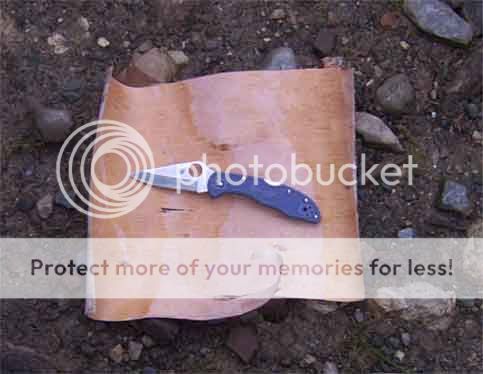
I then cut off a sheet to cover the tinder and protect it from the mist during the initial stage of the fire. I also put this under my clothing, I just wrapped it around my arm and put my coat back on. This of course has many uses besides fire starting. You can write on it, in large pieces it makes a rain proof shelter very quickly and you can make all manner of containers from it. The wood though itself is horrible to burn in contrast to the bark so you generally want birch and something else to make a fire, alders work well as does any close ingrowth. Birch is too sparce locally for that, I have never actually seen a piece of birch dead fall.

delica_birch_sheet.jpg


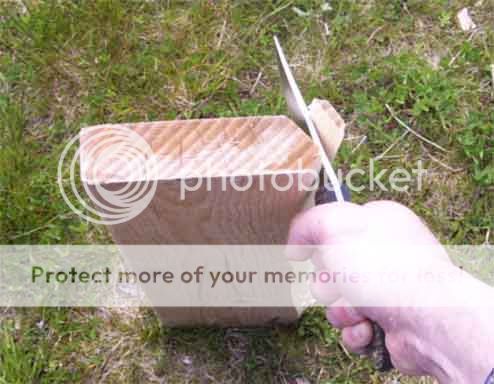
Usually you can gather small dead woods if you check around however I did some work on larger woods which needed to be split just to see how the Delica worked with batoning. I was using light wrist impacts so it took 10-20 impacts to split each of these small pieces of wood. With a heavy impact from the elbow they would go with one hit with the Temperance but I wasn't willing to see where the Delica would give yet. In any case it allowed separation of the wood much faster than by hand :

delica_batoning.jpg


The large piece on the left was also cut in half by driving the point about 3/8" deep into the wood by hitting the end of the handle. I made six point holes on one side and rocked the blade in each hole (NOT laterally) to widen them and the wood then cracked easily. I also carved a bunch of it into shavings. The wood gets wet really fast again in the mist so it is best done under cover. If you have another person they can just stand over you and form enough shelter. However with the bark and pitch it wasn't a problem anyway as they will burn very hot and I just needed to get the wood in a small diameter, being damp would not prevent them from burning.

delica_fire.jpg


The wind was high enough so that all of the wood burnt to embers in about 15 minutes. Initially I formed a windbreak myself but once the birch starts to going and especially after it lights the pitch it takes insane winds to blow it out, it just tends to burn hotter. Almost immediately the fire it stable enough to burn even green wood. I immediately cut a small arm load of boughs with the Delica which make a nice white smoke once they start to burn :

delica_fire_boughs.jpg


A serrated edge works better for cutting boughs on this size of knife because you can't chop and essentially have to slice the boughs off under tension. It you are really aggressive you can just pull them off when they are this small, but this is pretty tiring on something as large as a shelter and the long boughs which enable you to work fast are near impossible to crack off by hand.

-Cliff
 
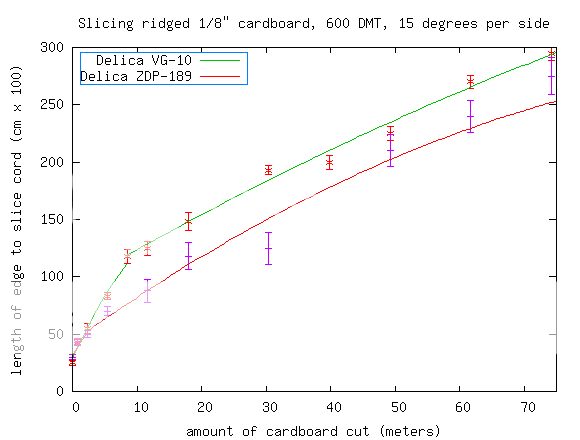
Five runs slicing 1/8" card stock were made with the reprofiled ZDP-189 Delica, and three with a VG-10 Delica at the same geometry. Random sampling was used through a collection of a dozen boxes of similar stock. The primary grind had been previously cut back full (8 degrees) by an x-coarse DMT and 200 silicon carbide waterstone. A secondary bevel was honed freehand on a 600 DMT pad, the bevel was 0.1-0.2 mm wide at 15 degrees per side.

After each run the edge was cut off with 10 passes directly iinto a 800 grit waterstone to remove all weakened metal which was verified under magnification (10X). The 800 grit waterstone then reground the primary bevel at 8-10 degrees until all evidence of the previous secondary bevel was removed and the knife readily slice newsprint. The edge was refined on a fine natural chinese waterstone up to shaving on the 8-10 primary bevel and the 600 DMT micro was then reapplied at 15. The edge was then cleaned on plain leather, 5 passes per side.

On four out of the five sharpenings on the ZDP-189 the edge required deburring to remove the secondary deformation burr. Very short passes (<1 cm) were used without elevating the angle, altering each pass. Two out of the three VG-10 sharpens didn't require burr removal steps.

card_st_delicas.png


At the end of the runs the knives were still able to slice newsprint but could not continue a push cut even at an angle. They were also steeled to check the effect of deformation/wear. Five passes per side on a smooth steel from Razor's Edge. The responce on the ZDP-189 delica was to increase the sharpness from 275 (16) to 133 (9). The VG-10 on increased from 295 (6) to 138 (10). The knives would slice shave after steeling (on one side) but not push cut newsprint.

-Cliff
 
Updated to included three runs with the VG-10 delica which was modified to a similar primary grind profile and edge grind. There are three things which are immediately visible when comparing the results,which were obvious when doing the cutting as well before the results were actually compiled/calculated.

1) The deviations seen with the VG-10 data is much smaller, the best seen to date. In contrast two of the ZDP-189 runs suffered premature blunting, at 12/50 m where it surpassed the blunting at 75 m on the other runs. I am leaning towards these sudden decreases as carbide issues as the edge will suddenly just go dull in large sections 1-2 cm and readily reflect light along the entire section. I don't however ignore the possibility of it being a sharpening issue. Maybe a more optimal technique would be to use all diamonds and see if that makes a difference? No parallel passes are used on the stone so there is no folding along stress lines.

2) The VG-10 blade blunts faster early, both in the rate and extent. See how fast both blades hit 75 grams for example. This may be due to the higher hardness of ZDP-189 resisting the initial deformaton stronger.

3) The laste stage blunting is similar for both blades, by the time they hit 75 m they are very similar and after steeling they are near identical. I origionally proposed wear resistance would dominate long term and the wear resistance of ZDP-189 should be far ahead of VG-10. However as noted the two runs with the ZDP-189 blade which had less than optimal performance did drag the performance down and this is having a significant effect.

In regards to sharpening, it took about 200-300 passes on the 800 grit waterstone to reset the primary grind on the ZDP-189 and 100-200 on the VG-10 Delica. With a 200 grit silicon carbide waterstone this is near instant with both blades, the 800 however minimizes waste. Time on the DMT was only 10 passes with both blades, micro-beveling tends to ignore grindability. The VG-10 blade also had consistently slightly higher initial sharpness, both by feel when shaving and measured on the cord. It also had less issues with burr removal but the ZDP-189 Delica was solid here as well.

I am going to repeat this on double layered cardboard with both blades and am leaning towards x-fine DMT to finish to see how they compare at a high polish.

-Cliff
 
Do you think a different type of regression is needed for the ZDP to model the behavior? The later measurements have more dulling than the fitted curve suggests. What do you think about ploting the recipicals of these values, as sort of an fraction of initial "sharpness".

What do you make of the changes in behavior of VG at 10m and the large jump of ZDP between 30 and 50m?
 
This is weighted quadratics so the influence is minor. If it is removed the curve tends to pass exactly through the points and parallels the VG-10 data. The fitting uses a different quadratic for the initial rapid raise and later fall off. This isn't ideal but I have not yet not found a model which matches both well and is smoothly monotonic increasing with a negative second derivative, which seem to me to be physical limitations aside from the obvious small scale random deviations.

I should be very clear that these curves are not meant as of yet to allow direct calculation of physical properties and are only to allow a quicker overview of trends and are thus more akin to splines than actual models. The full data will be made available in the review so anyone who wants to do modeling is welcomed to do so. One of the main points I want to make with the above is how nontrivial it is to reduce edge retention to a single number even when you are talking about very specific conditions, let alone change media, angle, grit, etc. .

-Cliff
 
Incredible, fantastic reviews, excellent photos, top notch info, many thanks for your efforts....
 
Interesting comparison. Can you add a similar S30V blade to this mix, say a Paramilitary?
 
Back
Top