Delica ZDP-189

zpaulg said:
Incredible, fantastic reviews, excellent photos, top notch info, many thanks for your efforts....

Glad you find it useful.

Don M said:
Can you add a similar S30V blade to this mix, say a Paramilitary?

Yes, I want to repeat this with the same knives on another round of cardboard to allow for a more definate statement. I then have other ZDP-189 knives and VG-10 knives which will be checked to see if the performance is consistent. S30V and SGPS are obvious benchmarks as well once VG-10 has been established.

kel_aa said:
Do you think a different type of regression is needed for the ZDP to model the behavior? The later measurements have more dulling than the fitted curve suggests.

Yes, additional points would have been of benefit, the end points are always problematic and extrapolation is always risky. It may be that the high carbide steels may need a different model or at least an additional degree of freedom due to the edge stability effects noted by Johnston and detailed by Landes. I would see a edge retention model as being influenced by strength, wear resistance and carbide stability (for this type of work, corrosion resistance and impact toughness would be relevant for other work), secondary variables would be fatigue limits, resilence and ductility.

What do you think about ploting the recipicals of these values, as sort of an fraction of initial "sharpness".

This is what CATRA does and this would effectively plot sharpness, plus you could also scale it so the first points were at 100% which makes for an easy visual inspection. I did this origionally years ago however this obscures late stage blunting significantly because the inverses basically make anything beyond the initial rapid blunting pretty much zero. Consider that with an initial performance of 25 then by the time you hit 250 you are at 10% of origional sharpness. Even increasing this to 500 changes it only to 5% and this doesn't look very different on the graph which is y-scaled from 0 to 100. However the knife is twice as blunt and you can readily tell the difference when cutting. These difference are much more dramatic without inversion.

What do you make of the changes in behavior of VG at 10m and the large jump of ZDP between 30 and 50m?

The ZDP-189 point at 30 is just I would assume random deviation. Only 60-70 points are expected to lie on the fitted lines anyway, and you expect 5% to be off the fitted line by twice the predicted deviations. Once I rerun the data on another cardboard sample there should be more capability for a definate statement. As additional data, Spyderco has done CATRA testing on ZDP-189 which shows it at 750 vs 505 for VG-10 respectively which is in the tolerance of the above graph. Phil Wilson has shown interest in it and hopefully he will discuss his rope cutting work as well.

-Cliff
 
So where do you think ZDP fits in the scheme of things?

Assuming a choice available between a $40 Delica/Caly Jr in VG10 and $70 Delica/Caly Jr in ZDP, what sort of user would you direct to each?
 
kel_aa said:
So where do you think ZDP fits in the scheme of things?

I would personally want to do more work with it before making a definate statment. I want to repeat the cardboard cutting with those two knives which is underway with a 1200 DMT finish now. I then want to see how they compare on really harsh abrasive cutting, sods and then look at push cutting edge retention on wood carving or similar.This should also be rechecked at a higher angle and at least one other ZDP-189 knife, optimally from another maker/manufacturer. I will also be interested in what Wilson comes up with as he is very frank and honest and can be counted on to give factual information with no hype. Based on what I have seen to date it is showing readily the effect of a lower grindability than the standard high carbon stainless, which is to be expected, and also better edge retention on abrasive media.

The exact extent and nature of the latter is still under investigation especially with respect to the nature of the influence of edge angle on stability. For awhile I figured that if you microbevel it would take care of any edge stability issues due to low primary angles. However consider a reprofile to 10 degrees and a micro-bevel about 0.1 mm wide which is thus about 15 microns thick. As the profiling here is done on a relatively coarse hone (800 grit waterstone is about 16 microns) and the scratches hit from both sides, it may be that the carbides are being torn out of the edge during the primary shaping and thus the micro-bevel forms on effectively a much lower carbide volume fraction.

This may be why the initial edge retention is significantly higher due to the hardness which would still be of benefit, but the long term isn't showing full strength to to influence of carbide tear out on wear resistance. Just conjecture at this point but would seem to agree with behavior noted by Johnston and Landes in similar (using the term loosely) steels. I am also still a bit bothered by the problematic consistency in the above ZDP-189 results, which could just be due to cardboard variation. I always benchmark carbboard with a stock blade through a given amount, so the cardboard is always marked with something like "Olfa, HD, 100cm/450 grams", and when I do runs I always random sample through very similar grades. However it is possible to get a sample with segregated high grit which can throw off a run. Again another reason to repeat this again. I generally would not go public which results at such a stage on a fairly unknown steel, but have been getting a number of emails about it so wanted to provide some information and hopefully encourage discussion/participation.

ZDP-189 also has an odd composition which I continue to wonder about. The chroimum is only slightly higher than 440C (20 vs 17) so why the massive increase in carbon? What is the extra 1.9% of carbon supposed to do with that 3% of chroimum? It would seem that all that carbon is just going to form cementite which is much softer than alloy carbides. It would seem more reasonable to use a harder carbide and get similar wear resistance with a lower carbide fraction and smaller carbides. However a japanese metallurgist strongly contended against the use of vanadium in knife steels on the Spyderco forum here but wasn't exactly detailed in his arguement.

What may be happening is that due to the powder metallurgy process the lower amount of segregation and higher distribution is forcing a switch from the type of chroimum rich carbides being formed. The chroimum rich carbides that form in 440C do so in about a 4:1 ratio with carbon (by mol, however the steel compositions are by *weight* so you need to adjust for that). However there is another type which forms in about 2:1 ratio where there is less chromium and I think a higher dispersion could induce this to form. If this is indeed the case then you would need double the amount to get similar carbide content and thus the higher carbon in ZDP-189 would logically follow. Again, conjecture on my part but it would also seem to agree with some comments about ease of obtaining a high sharpness which typically doesn't follow 440C to to the segregated and large primary carbides.

proguide said:
Great info Cliff, Thanks.

Glad you found it useful.

-Cliff
 
I generally would not go public which results at such a stage on a fairly unknown steel, but have been getting a number of emails about it so wanted to provide some information and hopefully encourage discussion/participation.

I don't mean to sound impatient. I know you said you would have more upcoming data, but thought since you came out with quantitative data and qualitative work here, with the Caly Jr, and the Jess Horn prehaps you'll be able to comment and aid people's choices, where those choices exist (in the Delica 4/Caly Jr for instance). The secondary-market price for these pieces have sky-rocketed. But I guess for those able to afford them and want them, it is not very relevent to suggest otherwise. Does any one think the BK77 Extreme in S30V will be a promotional dud? It's not like they are talking food from the mouths of their children to buy the latest steel.
 
kel_aa said:
...you'll be able to comment and aid people's choices, where those choices exist

Several inferences can be made from the above work, in general I would prefer people not just look for a summary as the data is made available for discussion vs direction generally. Some properties are still in question such as the extent of the advantage vs VG-10 in extended cutting. As of yet I am unsure of where it fits in compared to S30V. I did several runs with the Sebenza vs ZDP-189 Calypso Jr. and the Sebenza was radically outperformed in several respects. However I have come to the conclusion lately that my Sebenza may be defective or at least not representative of S30V. Once I finish with the VG-10 comparison I intend to look at Spyderco ZDP-189/S30V and then Wilson S30V which I have been meaning to check against production S30V directly for some time.

In general there are large performance differences between for example the soft and low carbide steels like 420J2/AUS-4A, the medium hardness/carbide fraction steels like 440A/AUS-8A and then the hard and high carbide fraction steels like VG-10/ATS-34. Most people will readily be able to notice a difference between 420J2 at 55 HRC and AUS-8A at 58/60 HRC and the jump then to VG-10 at 60/62 HRC. However among the groups the differences are smaller and generally secondary to the other characteristics of the knife. There is a lot of confusion in the industry because the steels are usually just ranked according to hardness or wear resistance and often with really suboptimal treatements. I am trying to clearify this somewhat on the materials webpage but it isn't where I want it to be yet. Hopefully I will eventually have a table showing such characteristics in a readily visible form.

Moving past VG-10 the performance starts to be less obvious mainly because the hardness stops increasing. While S30V has a wear increase it doesn't offer anything for strength and thus you get similar deformation and a lower grindability means more work to remove the same amount of deformation. ZDP-189 addresses allowing a higher hardness this which may explain the increase seen early on. I'll be more confident when I have at least more runs at 1200 DMT. In general there are also far less problems reported with chipping and sharpening, but there are also not as many knives made and Spyderco's edges in general tend to be very easy to sharpen given the geometry.

Does any one think the BK77 Extreme in S30V will be a promotional dud?

This was origionated at the peak of the S30V promotion for which it was being advocated for any and everything as the ideal blade steel. It made sense given the perception at the time, unfortunately that didn't last.

-Cliff
 
Cliff Stamp said:
I did several runs with the Sebenza vs ZDP-189 Calypso Jr. and the Sebenza was radically outperformed in several respects. However I have come to the conclusion lately that my Sebenza may be defective or at least not representative of S30V. Once I finish with the VG-10 comparison I intend to look at Spyderco ZDP-189/S30V and then Wilson S30V which I have been meaning to check against production S30V directly for some time.
-Cliff

You didn't expect me not to jump in here, I hope... :D

I'd be *very* interested in your conclusion after you've had a chance to compare the Sebenza to other S30V's. You might want to consider getting it re-hardened to, oh, I don't know, how about 60.5 HRC or so... It becomes a very good steel with regards to edge retention once it's been properly hardened.
 
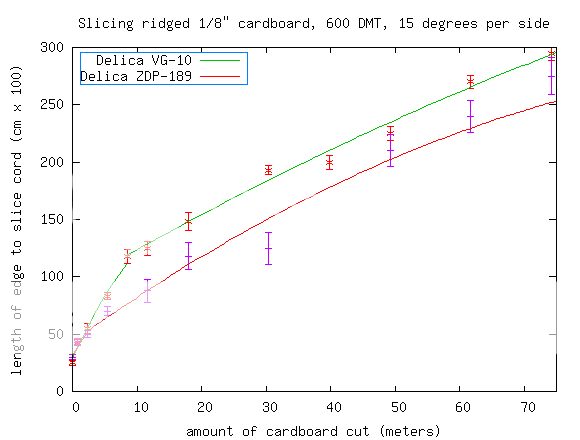
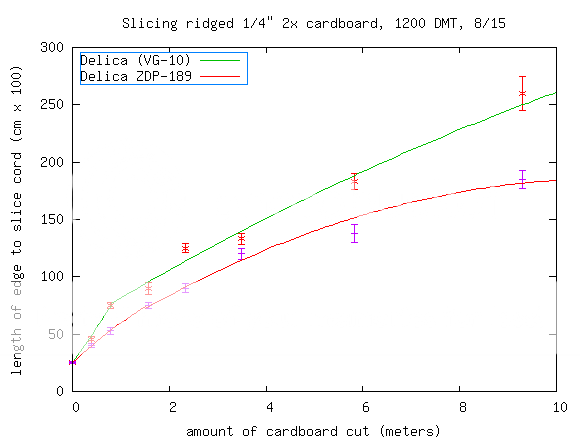
An update on the edge retention comparison of VG-10 and ZDP-189 in idential reground Delicas, here is the result of 6 runs with the VG-10 and 5 with the ZDP-189 slicing 1/4" double ridged cardboard through 4 cm of edge with the middle 3 cm tested for sharpness. The edges were set at 8/15, primary/secondary. This means a complete regrind flat to the primary bevel with a 0.1-0.2 mm wide microbevel freehand at 15 degrees per side. The 600 DMT results repeated for comparison :

card_st_delicas.png


and now the 1200 DMT results :


card_st_delicas_1_4.png


This duplicates the same behavior in many specific details as the 600 DMT graph which is always good. The VG-10 Delica blunts faster initially again and shows more blunting in the long run. Note the difference in the x-axis of the two graphs. Though comparing different card stocks is always problematic this gives you a rough idea of the difference in cutting power between 600/1200 DMT. I should have used more points in the latter stages as this would reduce the tendancy for radical drift behavior in the last point.The last VG-10 point in particular is I think on the high end of the actual behavior from looking at the raw data in detail.

On a critical note, the performance of the ZDP-189 blade was much more stable this time, note the very low variance. There was in fact no premature bluntnig as was seen in the runs at 600 DMT. However half of the six VG-10 runs did see such behavior meaning a run for each of the last three points for which the blunting was at least double what the median would predict. This confirms my hypothesis that this is a general behavior of high carbide steels at low angles. This could be checked by repeating the work at high angles, say 15/20, but quite frankly I have lost interest in knives ground at those profiles. I will be repeating the work with some low carbide steels at low angles to confirm.

I also got much better sharpening responce out of ZDP-189 this time, in all of the five runs the edge formed clean, no need to deburr. On three out of the six VG-10 runs a light deburr was needed. There is an ideal amount of pressure needed to form clean edges on steels and it is tricky to sharpen such different steels side by side and get both of them perfect. On an interesting note, a x-coarse DMT pad is actually slick on the ZDP-189 Delica and chews through the VG-10 one. A 200 silicon carbide waterstone chews through both like using a wood rasp on balsa. I will be looking at ZDP-189/S30V shortly, with Spyderco's S30V and the extending it to Wilson's S30V and Fallkniven's SPGS. I should for consistency check the three Spyderco ZDP-189's which is fairly uninteresting in bulk but would allow a check of the above proposed carbide issue at least. I have checked multiple Spyderco's S30V and they are consistent.

sodak said:
I'd be *very* interested in your conclusion after you've had a chance to compare the Sebenza to other S30V's.

I was always skeptical of mine since it fell apart on the plywood. I emailed Reeve to see if this was the expected behavior and check into warrenty/return, no responce, similar with issues with the S30V Beret and its hardening. Lately the Sebenza has refused to sharpen on rods and just cracks apart, the edge won't form. I can still sharpen it stones and mainly just use it as a rough work knife. I was considering getting it reworked, ground/hardened, but I am unsure that this would correct the chipping unless the blade was annealed, normalized and then rehardened and this plus the regrinding would not make sense economically, especially since the Jess Horn is a directly much better knife anyway.

darkestthicket said:
I didnt think to highly of the Delica until now ...

It is a solid small work knife, the name is not overly indicitative of its nature. I look forward to your work with the TRACKER.

-Cliff
 
Is the tip profile that of the Delica 3 rather than the Delica 4, or somewhere in between? It doesn't look as subdued as the Delica 4.

Was the original grind at 8 degrees per side on 2.5mm stock? Then if ground until they met the grind with would be 8.9mm wide?

Was the reprofiling done to bring them to the same level for comparison, to make results more discriminating, because that's how you like it, or any other reason?
 
kel_aa said:
Is the tip profile that of the Delica 3 rather than the Delica 4, or somewhere in between?

The ZDP-189/VG-10 and Wave all look to have the same point profile to me, there are some mior difference which I assume are just grind variances. The first two look a bit different in some pictures as they have been extensively reground.

Was the original grind at 8 degrees per side on 2.5mm stock?

I just checked a Wave/Delica which is at 7.0, stock profile. The two pictured in the above have convex profiles of 7.2/10.4 (1) with the secondary bevel less than 0.015" thick. They are then sharpened usually with a micro for most stock work and left as full for regular use. This 7.2/10.4 bevel convex grind is NOT desired, I would ratther them be flat to the primary. They just go that way on benchstones unless you hone on diamonds/ceramics and are very careful.

Was the reprofiling done to ...

Make them cut better and sharpen easier. With the microbevel on the ZDP-189 Delica, after cutting the 70+ meters of cardboard, I could slice right into a 800 grit waterstone just like Fowler does in his video to grind off all the edge, no cutting ability at all, and then restore the edge to full shaving sharpness with less than 10 passes per side on the 600 DMT pad. This of course does not indicate any "ease of sharpening" ability of ZDP-189, it just shows how proper use of micro-beveling makes grindability non-critical for a knife user.

In regards to the modifications, for most cutting on cardboard, ropes, foods, etc., I would grind them with deep hollows to allow ease of full honing - flat to primary. However if they are to be extended to wood craft I would leave them them as ground here (or full flat) because a deep hollow grind leave the edge too prone to cracking off on problematic wood. These knives, Delica/Endura of course are the workhorse blades in the Spyderco lineup in contrast to blades like the Horn/Calypso Jr. which have thinner profiles. The stock grinds of the Delica/Endura make sense for their intended use and add versatility to the line.

-Cliff
 
These knives, Delica/Endura of course are the workhorse blades in the Spyderco lineup in contrast to blades like the Horn/Calypso Jr. which have thinner profiles. The stock grinds of the Delica/Endura make sense for their intended use and add versatility to the line.

As a generalization, do you think the average non-forum Delica/Endura user is harsher on their blades than the forum users, or at least expect more from their $40/50 blade of any given design? By expecting more, take for example something like digging with the point in wood: if a forum member shares his experience of having the tip break, would the forum reaction more likely be "this shouldn't be done with such a knife with a vulnerable tip" verses the independent conclusion the "unconnected" user might arrive at, namely that the knife failed?

So I guess the question is do we actually use the versatility, does the forums promote proper tool selection and technique verses a degenerative conditioning of what you are limited to doing with your knife and also a blanket pushing of certain products (most prominently the Delica/Endura, although it it is not exactly the knife's fault or Spyderco's own doing)?

Overall, I'd agree the Delica/Endura are a solid package (although I'd prefer the generation 3's design emphasis due to weight and possible corrosion issues). I'd choose over the Delica myself with either the Native for its choil/handle, hollow grind with swedge-grind, and blade shape in general or the Caly Jr with its choil and flat grind, both of which are not as humped and have as wide a profile when closed and being carried.
 
kel_aa said:
As a generalization, do you think the average non-forum Delica/Endura user is harsher on their blades than the forum users, or at least expect more from their $40/50 blade of any given design?

In general, yes. While I have a reputation as an abuser of knives, most people I know are far less discriminating of their pocket knives than I am. They would readily take a pocket knife and use it to scrape the paint off some concrete for example without any hesitation, yet it is common here for people to be concerned about scratching a blade when sharpening. You can't cut any amount of cardboard of any used material without the finish on any blade getting significantly degraded.

By expecting more, take for example something like digging with the point in wood: if a forum member shares his experience of having the tip break, would the forum reaction more likely be "this shouldn't be done with such a knife with a vulnerable tip" verses the independent conclusion the "unconnected" user might arrive at, namely that the knife failed?

Bladeforums is currently very biased towards makers/manufacturers in that the burden of proof for critism is much higher than the demands placed on makers/manufacturers for promotion. Cashen has discussed this in detail on Swordforums noting how readily people accept claims from makers which have no basis at all in metallurgical fact and never even ask for any proof at all, even when the claims are extremely high.

Witness for example the arguement made by Stewart in regards to the failures of the tangs on the Cold Steel knives which is in fact in opposition to basic physics and of course ignores the fact that people do the exact same thing to other knives without harm. Many of the discussions betweens makers and users over such issues would run very differently on neutral forums. Try taking some of the same arguements about abuse for example to rec.knives where users and makers are treated with the same demands on arguement.

Such an enviroment is never productive for determing the truth which will only come out if everyone has equal requirements for proof and critically necessary for both condemnation and praise.

So I guess the question is do we actually use the versatility, does the forums promote proper tool selection and technique verses a degenerative conditioning of what you are limited to doing with your knife and also a blanket pushing of certain products (most prominently the Delica/Endura, although it it is not exactly the knife's fault or Spyderco's own doing)?

The forums is a large collective and the popular opinion now is readily swayed readily by a maker/manufacturer. However there are those that will point out failure rather than accept accuses for poor performance. I will gaurantee that you will see the following trends which are highly promoted by current makers but will shortly be recogonized as far from optimal. This will be a move away from high primary carbide fraction steels, a realization that wear resistance tested on large blocks does not equal superior cutlery steels, a move towards harder tempering and away from the "60 HRC is the ideal knife hardness" viewpoint, and towards much slimmer geometries, to the idea that you can not simply say one steel has better edge retention than another as there are simply too many variables (edge angle, grit finish, cutting media, type of cutting, etc.), that much of the hype about convex profiles is just that, and that "ease of sharpening" does not equal high grindability and is much more dependent on geometry and the type of knife than the steel, that is to say a steel can be very easy to sharpen in one knife but not in another if the grind is sub-optimal and/or the steel just not well suited to that type of knife.

Contending these ideas now can get you branded with extreme labels as these ideas are pushed very hard by makers and even several metallurgists so you would have to be insane obviously to say they are wrong. However more and more people are being made aware of the work done by Johnston, Verhoeven, Landes, Cashen, Wilson, Busse, etc. and in the end the truth will always come out. What I am personally interested in is how those with the earth is flat viewpoint react when prevailing opinion switches. With more makers like Jeff Check and Me2 becoming aware of such issues the days for the flat earth viewpoint are numbered. There are more and more user as well like Sodak and Thom discussing problems with the current viewpoints and it is only a matter of time before this gets enough voices to mean it can't be ignored any more.

How many people now can openly discuss the extreme benefits of forging which commonly used to be promoted by Fowler and other makers ever since Cashen has been publically vocal that there is no materials data to support such a viewpoint and that in fact there is much to support how easy it is to degrade the steels. You simply can't try to run with that arguement any more because all someone has to do it link to Cashens article and the relevant thread on Swordforums to point out the flaws. Since Cashen is a maker himself this negates the ability of the other makers to get users to disregard his comments.

Unfortunately Landes isn't well known in North America, and makers like Johnston are not UBB active. But there are makers aware of the work and some of them like Devin Thomas are very vocal about the misrepresentation of steels like AEB-L which for a long time was ranked as a low end steel simply because of the viewpoint of regarding steels simply on primary carbide fraction. Unfortunately Thomas isn't very vocal on the forums either, but again this doesn't matter in the long run because eventually the exposure will become wide spread enough.

The same thing happened with S30V. Early critism of it was very hard because of the massive push from makers and crucible for it as the ultimate blade steel. However as more people reported problems with chipping it became more easy for people to discuss it as it became then an accepted issue. There is also a guy selling M2 blades on rec.knives for extremely cheap and Alvin is doing his best to get people to make knives out of them and people are doing it. You really don't want a bunch of people armed with the experience of 66 HRC M2 evaluating ATS-34 class knives as cutting tools, but again it is starting to happen.

-Cliff

 
Cliff - just so I'm clear on this, are the edge angles you are quoting per side or total included? I know you like acute edges, but if the angles above are total included, some steels will not hold up.
 
Per side, I have knives which are sharpened at those included angles but that requires deep hollow grinds. Thanks for pointing that out, I'll make sure to clarify in the reviews.

-Cliff
 
I'm glad that this thread hasn't degenrated. Cliff, I appreciate the work you done.

I've starting to like thinner edges too. At blade I was at a sharpner demo booth and they where talking about their 40 degree or 20 per side sharpning. :yawn:

Also in regards to CRK and email, they don't anser my email either and I have to call. My questions are usually something that they have to ask about and they just never get back to me. I know what they are going to say though, send it back in for evaluation.
 
I'm glad that this thread hasn't degenerated.

Is the degeneration of threads that Cliff starts or participates in the expected behavior? Cliff, are you interested in degeneration insurance? For every thread you participate in I'll charge in 10 cents* on top of a $10 dollar* monthly retainer. And if within 24 hours of your participation it hasn't degenerated, I'll start flinging personal attacks, hype, inflamatory accusations, and false information myself.

*All values are in Canadian dollars.
 
DaveH said:
I've starting to like thinner edges too. At blade I was at a sharpner demo booth and they where talking about their 40 degree or 20 per side sharpning.

This is a common perspective, reinforced constantly by professionals unfortunately who are very resistant to change - do you really want to admit you have been doing everything wrong for years. It is of course far easier to sharpen at more obtuse angles, there is far less metal to remove. To hone most blades at 10 degrees requires extensive reshaping and then the bevels get wide which has aesthetic issues to some.

The other large effect is that edge retention, in general, tends to increase, not decrease with lower angles, Swaim was the first guy to really bring this aspect out on the internet. This stops at the point at which the edge collapses as Sodak and others have noted. Lee discusses this in detail and how you have to adjust for the type of steel. Of course if everything is 20 degrees you can safely ignore the steel type as well and of course the knife type and it is a lot easier.

kel_aa said:
Is the degeneration of threads that Cliff starts or participates in the expected behavior?

Depends on the forum, I am the same everywhere though and I'll give you the same answer to a question about knives/steel if you ask me on rec.knives, email, in person, or on Bladeforums. I don't say anything without facts and a logical arguement to support it so it doesn't matter to me where the discussion takes place.

I'll even give the same answer irregardless of who asks the question as I discuss the ideas irrespective of the participants. It also takes a lot, and I mean a lot, to actually get me upset, so you really have to work hard to cause a thread to lose information flow and it generally takes more than one person to generate enough white noise to cover the actual discussion because you won't cause me to deviate into personal issues very easily.

Here is how ideal discussions of contention are supposed to take place :

http://forums.swordforum.com/showthread.php?threadid=69594

Note the interaction towards between Cashen and I about blade testing which is a common arguement here. We are at opposite ends of an approach but we can actually have a discussion without any personal issues where we both contend the others viewpoint strongly but we are speaking of the issues and not each other and I am not talking to Kevin Cashen the knifemaker, just Kevin Cashen the individual.

It is essential in such exchanges that you are seeking the truth and not your truth which has an entirely different goal and strategy. A lawyer talking to a jury is seeking you to understand his truth as any salesmen, they are not open to being converted, all information flow is to be one way. When I discuss a matter with you I am seeking the truth and I don't care if you have it or do I as long as it is known to both of us at the end of the conversation.

And if within 24 hours of your participation it hasn't degenerated, I'll start flinging personal attacks, hype, inflamatory accusations, and false information myself.

I am paying quite a few of those already, some of the guys don't wait 24 hours, they really like their job.

-Cliff
 
Cliff, I'd just like to say you're my most respected member at these forums. Not only for the insightful, detailed information you provide us, but also how respectfully you manage to carry yourself through discussions.
 
Cliff Stamp said:
I am paying quite a few of those already, some of the guys don't wait 24 hours, they really like their job.

I think some of them are lazy and copying the cheat sheet I co-authored with Rob Angerer.

The performance you plotted on those graphs make it sound like the VG-10 Delica 4 is the way to go for users of stainless, folding pocketknives who haven't read stuff by Alvin Johnston.
 
Back
Top