Well, diamond dust/grit is an abrasive, so bonding it to the edge/side of the blade may work? That's how the diamond saw blades and drill bits work. It abrades, not cuts? It may cut worse because of the extra drag (slows down the cut), or it may give the edge more "bite" to slice and do more tissue damage, depending on the size of the diamond grit I would think?

-
The BladeForums.com 2024 Traditional Knife is available! Price is $250 ea (shipped within CONUS).
Order here: https://www.bladeforums.com/help/2024-traditional/
You are using an out of date browser. It may not display this or other websites correctly.
You should upgrade or use an alternative browser.
You should upgrade or use an alternative browser.
Diamond powder infused blades
- Thread starter Chabba chen
- Start date

Stacy E. Apelt - Bladesmith
ilmarinen - MODERATOR
Moderator
Knifemaker / Craftsman / Service Provider
- Joined
- Aug 20, 2004
- Messages
- 38,706
It would greatly reduce cutting ability. Diamond bonded tools are abrasive, not a severing process. Coating the blade sides with sintered diamond would increase friction by a huge factor. On a soft object like flesh, it would slow the penetration ... on a hard object, it may make cutting nearly impossible.
The physics involved are:
Abrasion - abrasion is a process of micro-cutting. The abrasion process is called tribological, where a harder abrasive particle (a diamond crystal in this discussion) cuts away a minute piece of the softer work material. Increasing friction aids abrasion.
Slicing/Cutting - In cutting, it is a fracture mechanics process, with a hard edge severing a softer work material in macro-sections. These pieces removed are usually a factor of 100 or more compared to abrasion. Thus, it requires far more energy to do the severing. Reduction of friction is key to efficient slicing.
The physics involved are:
Abrasion - abrasion is a process of micro-cutting. The abrasion process is called tribological, where a harder abrasive particle (a diamond crystal in this discussion) cuts away a minute piece of the softer work material. Increasing friction aids abrasion.
Slicing/Cutting - In cutting, it is a fracture mechanics process, with a hard edge severing a softer work material in macro-sections. These pieces removed are usually a factor of 100 or more compared to abrasion. Thus, it requires far more energy to do the severing. Reduction of friction is key to efficient slicing.
Last edited:
Yeah, it will abrade, but not cut as well. But if you slice thru the cut, it would probably be more painful for the person on the receiving end, but need a lot more force behind it! I remember with some Kurouchi style Japanese Kitchen knives how much extra friction that bead blasted kasumi finish caused! It would be more of a rip/shred in soft materials I would think.

Maximumbob54
Gold Member
- Joined
- Jun 10, 2024
- Messages
- 1,588
What about DLC? Would that do anything?
DLC is a skin coating type thing. It gives the surface a hard coating that may be more slippery (less resistance to cutting), but the surface under may still chip/roll/dent or dull. It usually isn't left on the edge, but sharpened off. Wouldn't really have any impact on being a better weapon really.
Maximumbob54
Gold Member
- Joined
- Jun 10, 2024
- Messages
- 1,588
Just thought it would be the opposite of adding abrasives as in maybe aid in the cut through ability. Like maybe a PTFE coating. Teflon? Anything like that.DLC is a skin coating type thing. It gives the surface a hard coating that may be more slippery (less resistance to cutting), but the surface under may still chip/roll/dent or dull. It usually isn't left on the edge, but sharpened off. Wouldn't really have any impact on being a better weapon really.

horseclover
Basic Member
- Joined
- Nov 21, 2000
- Messages
- 5,198
Steel cleaves diamonds
Stacy E. Apelt - Bladesmith
ilmarinen - MODERATOR
Moderator
Knifemaker / Craftsman / Service Provider
- Joined
- Aug 20, 2004
- Messages
- 38,706
Steel cleaves diamonds
Well not exactly.
I was a gem cutter for years before I became a goldsmith.
Gem cutters will never get away from that old 1972 Mercury Marquis Brougham commercial where an old Jewish master diamond cutter cleaves a large rough diamond in the back seat of a car. Everyone thinks it was a Lincoln Continental, but it was not. His comment, "If it goes right I have a $150,000 diamond ... if not, dust!" is all baloney. It might not cleave at all, or cleave at a different angle, but it won't shatter into dust.
SNL did a great spoof of that commercial with a Rabbi doing a bris in the back seat ... "Poifect!"
The steel wedge is placed in a groove sawn in the diamond crystal with a diamond saw on one of the cleavage planes. The wedge is placed in the groove and struck with a mallet creating a shock wave that causes a crack to propagate along the cleavage plane ... and split the diamond. Pretty much the same principle as a stress riser on a knife blade. Cleaving is only used on large rough to make more than one finished faceted diamond. A large rough crystal may be cleaved into three or more pieces. While some crystals are sawn to rough shape, most diamond crystals are shaped by abrasion on large iron laps charged with bort (tiny diamond crystals). This roughing to shape is called bruting. After bruting, they are faceted with finer diamond powder.
Diamonds will abrade diamonds because there are different planes in the crystal structure. The cubic structure of carbon creates the octahedron diamond shaped crystals, which have flats and corners. The corners of the crystal are slightly harder than flat surfaces. Thus, the corners of the bort wear the flats of the stone being cut. This is where a diamond cutter has to study the crystal and plan on what shape he wants to cut and how to orient the crystal on the lap.
Now days they use lasers to cut and shape the rough and computer operated faceting machines that resemble modern multi-head milling machines. These machines can cut diamonds from, 1/400th a carat to any size or shape the rough allows.
Cutting all other gemstones is simpler. The laps are either coated with sintered diamond, or charged with bort. Polishing is done with very fine diamond powder or other hard metal-oxides.
I found the SNL clip. I guarantee it will make you laugh.
Last edited:

horseclover
Basic Member
- Joined
- Nov 21, 2000
- Messages
- 5,198
There was a diamond grinder/polisher that surfaced 'somewhere' (2nd hand tool shop) at one point and I never figured any other application I could think of at the time and it just went in someone else's pile. The fellow then did get into rocks but I don't know what his results were. It would make a great tabletop something holder. Repurposing.Well not exactly.
I was a gem cutter for years before I became a goldsmith.
Gem cutters will never get away from that old 1972 Mercury Marquis Brougham commercial where an old Jewish master diamond cutter cleaves a large rough diamond in the back seat of a car. Everyone thinks it was a Lincoln Continental, but it was not. His comment, "If it goes right I have a $150,000 diamond ... if not, dust!" is all baloney. It might not cleave at all, or cleave at a different angle, but it won't shatter into dust.
SNL did a great spoof of that commercial with a Rabbi doing a bris in the back seat ... "Poifect!"
The steel wedge is placed in a groove sawn in the diamond crystal with a diamond saw on one of the cleavage planes. The wedge is placed in the groove and struck with a mallet creating a shock wave that causes a crack to propagate along the cleavage plane ... and split the diamond. Pretty much the same principle as a stress riser on a knife blade. Cleaving is only used on large rough to make more than one finished faceted diamond. A large rough crystal may be cleaved into three or more pieces. While some crystals are sawn to rough shape, most diamond crystals are shaped by abrasion on large iron laps charged with bort (tiny diamond crystals). This roughing to shape is called bruting. After bruting, they are faceted with finer diamond powder.
Diamonds will abrade diamonds because there are different planes in the crystal structure. The cubic structure of carbon creates the octahedron diamond shaped crystals, which have flats and corners. The corners of the crystal are slightly harder than flat surfaces. Thus, the corners of the bort wear the flats of the stone being cut. This is where a diamond cutter has to study the crystal and plan on what shape he wants to cut and how to orient the crystal on the lap.
Now days they use lasers to cut and shape the rough and computer operated faceting machines that resemble modern multi-head milling machines. These machines can cut diamonds from, 1/400th a carat to any size or shape the rough allows.
Cutting all other gemstones is simpler. The laps are either coated with sintered diamond, or charged with bort. Polishing is done with very fine diamond powder or other hard metal-oxides.
I found the SNL clip. I guarantee it will make you laugh.
Stacy E. Apelt - Bladesmith
ilmarinen - MODERATOR
Moderator
Knifemaker / Craftsman / Service Provider
- Joined
- Aug 20, 2004
- Messages
- 38,706
I rarely facet a stone anymore. My very old Raytech-Shaw machine is used for sharpening/shaping carbide drill bits and tools and sharpening gravers. The quill (the part that holds the stone) just sits there as a nice decoration. I started my career as a gem cutter, which led to me becoming a goldsmith, on that machine.
Your story about the pawn shop brings back old memories. A pawn shop that I did their jewelry for ended up with a 12" Imahashi faceting lap. They are the Rolls-Royce of laps. It had a full set of 12" diamond impregnated laps, copper laps, and thick steel lap for doing a repair on a chipped diamond. There was a 50 pound box full of accessories with it. It belonged to an old gem cutter who died and his son sold it to the pawn shop for beer money. The owner asked me if I wanted it, and I said, "Sure, but how much?" He said, "Just take it, no one will ever buy it." I set it up and used it for a few months until a friend offered me a grand for it ... I helped him load it in his car. My little Ray-Tech was really all I needed anyway. I put a photo of te engraving and faceting bench below. This was when I first set it up. Thw walls and shelves are a lot more packed there now.
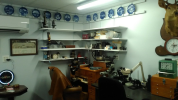
Your story about the pawn shop brings back old memories. A pawn shop that I did their jewelry for ended up with a 12" Imahashi faceting lap. They are the Rolls-Royce of laps. It had a full set of 12" diamond impregnated laps, copper laps, and thick steel lap for doing a repair on a chipped diamond. There was a 50 pound box full of accessories with it. It belonged to an old gem cutter who died and his son sold it to the pawn shop for beer money. The owner asked me if I wanted it, and I said, "Sure, but how much?" He said, "Just take it, no one will ever buy it." I set it up and used it for a few months until a friend offered me a grand for it ... I helped him load it in his car. My little Ray-Tech was really all I needed anyway. I put a photo of te engraving and faceting bench below. This was when I first set it up. Thw walls and shelves are a lot more packed there now.
horseclover
Basic Member
- Joined
- Nov 21, 2000
- Messages
- 5,198
I don't remember much about our machine but it was fairly small (10"/12"?), and belt drive. Like old dental power but ganged with others on a long bench. The shop was named RPM Tools, on Prospect St, Cambridge MA. That's all condo row now. That corner of town had once been very industrial. RPM Tools was a place to check every day. Tools by the cubic yrdI rarely facet a stone anymore. My very old Raytech-Shaw machine is used for sharpening/shaping carbide drill bits and tools and sharpening gravers. The quill (the part that holds the stone) just sits there as a nice decoration. I started my career as a gem cutter, which led to me becoming a goldsmith, on that machine.
Your story about the pawn shop brings back old memories. A pawn shop that I did their jewelry for ended up with a 12" Imahashi faceting lap. They are the Rolls-Royce of laps. It had a full set of 12" diamond impregnated laps, copper laps, and thick steel lap for doing a repair on a chipped diamond. There was a 50 pound box full of accessories with it. It belonged to an old gem cutter who died and his son sold it to the pawn shop for beer money. The owner asked me if I wanted it, and I said, "Sure, but how much?" He said, "Just take it, no one will ever buy it." I set it up and used it for a few months until a friend offered me a grand for it ... I helped him load it in his car. My little Ray-Tech was really all I needed anyway. I put a photo of te engraving and faceting bench below. This was when I first set it up. Thw walls and shelves are a lot more packed there now.
View attachment 3216522
 . Simplex, Poloroid and a host of others were over that side of town. NECCO, etc. Lots of machining going on.
That's an amazing little corner you have there!
Cheers
GC