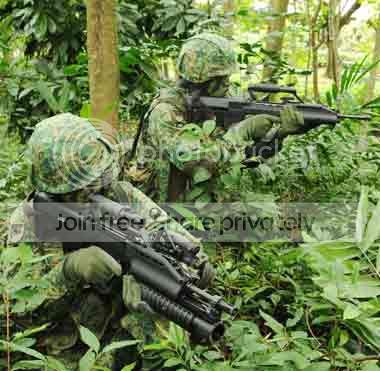
Digital Camo. Why?

I have a closet full of camo and have seen a demo on the ASAT camo that impressed me. I just wish it was more available. I like to try my stuff on.

 
Digicam works very well in the enviroment its disigned for

B3A73B911027CA73119D7017731E.jpg
 
Another point to remember is that the cost of Realtree and other must be higher than that of Digicam. Just for simple ease of printing square dots rather than a branch or leaf. Also how many colors are there in Digicam compared to Realtree, I would say far less which again leads to cost saving. Cost is probably the reason the dots are square rather than round to. I was always told there are no straight lines in nature so make sure there aren't any in your cam, so square dots don't really figure into that. I suppose the size would negate them forming a straight line the eye could see though.

Additionally I find that most armed forces go for generic cam so you get a woodland a desert and an arctic cam mostly. Woodland cam then does you for the jungle, coniferous, deciduous, arboreal, temperate and rolling grassland. While not being 100% in all woods it does work well in most. Same goes for desert and arctic, although there is less change in colors in the arctic obviously. It just wouldn't be logistically impossible to buy and equip the troops with more area specific camo.

So a combination of cost, durability and multi area use are the reasons I think Digicam is dominant in the armed forces today. I know the British are due to replace the Combat 95 pattern kit with digicam but a date has not been given. Probably the date will be delayed due to the cost of the Afghan war and the current world financial crisis. I expect we'll get it around 2012 and it will be crap. Then we'll spend double the initial cost getting something almost as good as the US guys first got issued. Rather than getting some that we know works and just slightly adjusting the colors. (Think the SA80 against M16 debacle or the current issue radio)
 
Well, that really depends on whose digital camo and which patterns you're talking about. The Finnish M(20)05 digicamo was designed specifically to hide the soldier more efficiently than the older M(19)95 in typical Finnish terrain. The color pattern of the camo is designed to blend in as well as possible in the terrain colors and patterns typically seen in Finnish woods. And it does its job noticeably better than the old camo patterns. Everything else is just bonus, and really not as efficient as some people make it sound (as if the thing was freaking magic or something).

Personally, I don't think digi camo is all that. Sure, it's the latest and greatest as they say, and it does work better than the old stuff. But does that matter, when the old stuff works well enough for hunting and similar things? For active military folks, the new digi patterns are a good thing, but the rest really needn't bother - it's not that much better.

Yeah, I dont know about the Finish stuff. I was refering to the ACU patern, or the digi-cam the USMC uses.:thumbup:
 
I like multicam but I don't really know if it's all that much better than others.

img11b.jpg


It does have a certain cool "depth" effect from having the colors fade out into the lighter areas - kind of like light appearing behind foliage. Kinda reminds me of a faded woodland camo too - which I like! :D

Multicam%20Shirt.jpg
 
ACU is a compromise pattern, the Army was playing catch-up to the marines, and their budget could only support one pattern , where the USMC produced the 2 colors.

Camo patterns can be active or passive. Google for explanations.

The MARPAT digital is uncanny stuff. I was skeptical when it first came out, but it made a believer of me very quickly. The pixelated pattern disrupts our ability to See and moreover, process what we are seeing. My best explanation is that our eyes actually see the shape and pattern, but the difficulty comes as the sight receptors try to pass the info to your brain, the brain has trouble processing the information it's being given. MARPAT "confuses" your sight.

My friends and I have done tests on military camos. We sent some guys out in Woodland Camo and some others in MARPAT. At a given range, the guys in the MARPAT started fading in and out of "focus" (best word I can describe it as).
At the same distance, the guys wearing woodland (and one wearing Tiger Stripes) were still easily recognized. The guys in the MARPAT got to a certain distance where you were tying to convince yourself you still saw them, but, you just weren't quite sure if you really saw them, or if it was just your memory of where they last were.

MARPAT also covers movement better than something like the old GI Woodland or commercial Realtree, etc.

The head-neck-shoulder outline is what we are programmed genetically to see.
Break up that outline, and it can help your chances to stay hidden.

The best camoflauge is a physical barrier to sight.
In a hole, behind a fallen tree, etc.
 
Though I like the digital camouflage I think it was ABSOLUTELY STUPID for each service to have its own pattern.

I remember hearing stories from USMC Vietnam Vets, back when the USMC had a distinctive uniform, who were offered some new Army BDUs to wear because their USMC field uniforms were rotting through in the jungle environment. They had to pass on this offer and continue wearing their rotted uniforms because it was service specific.

God forbid we ever have a big war again and the services end up having to supply each other occasionally. Heck the liners for the service-specific gore-tex jackets don't even interchange. Stupid!

I am a former Marine BTW.
 
RealTree and the other civilian camos were made to look good on a hanger up close.
Yes, they look just like trees and leaves.
Can you see trees and leaves in the woods?
Of course.
So what you end up with is a human shaped tree that is very visible.
The human shape is what we need to avoid.

The new digi-camo(s) hide the human shape effectively.
As do/did some of the other older patterns.
The old Italian Army stuff was wonderful in the woods of the NE.
Italian top and tigerstriped bottoms really hide well here in Upstate NY.
allthreebayo.gif

Notice the large blocks of color that break up the human shape.
:D

One benefit of the digicamo was apparent when I saw a group of troopers (photo) huddled together... you couldn't tell where one started and the other began.
From a distance it could have been a big hedge.
 
I have emailed Guy Cramer of hyperstealth several times.
Incase you would like to know he has a new product coming out for the civie market called optifade, its a hunting camouflage that actually works.
http://www.optifade.com/

Realtree and similiar camos suck, they fade to grey or brown after 20 yards and if you are not in the idea enviroment for it you will stick out like a sore thumb.

If any of you are interested here is a thread I participated in way back when, lots of good info here.
http://www.militaryphotos.net/forums/showthread.php?t=106738
 
One benefit of the digicamo was apparent when I saw a group of troopers (photo) huddled together... you couldn't tell where one started and the other began.
From a distance it could have been a big hedge.

Or when you see someone in ACU camo with an ACU backpack and pouches on, and it takes you a while to notice the backback.
 
No black in MARPAT? Isn't meant to camoflage you, but meant to confuse? The myths in this thread are insane...

First off, there is black in the woodland MARPAT, period. Look at the pattern! Secondly, yes, the new pixelated patterns (and that is the actual term; Multicam is digitial too, it's just not pixelated) "confuse the eye" much better than the traditional patterns but that doesn't mean they don't camoflage you. Millions of dollars were spent deciding what color to use in the MARPAT uniform, that wasn't done for nothing.

Black doesn't occur in nature often. It is still there and it is neccesary to immitate depth. As another person posted, it was asinine for the Army to cry about black in the pattern and then continue to issue black rifles and black insignia (and I'm not even going to begin with the ACU itself). The Universal Camoflage Pattern that the Army is using (and Air Force in its modified pixelated Tiger-Stripe variant) is not perfect for all environments as has been demonstrated ad nauseum. However, it does a pretty good job where it is meant for: Afghan mountains and Iraqi cities.

The current uniforms are superior to previous ones in that the don't turn into a big blob of black when wet and viewed through NVG's and have a low IR signature.

Mossy Oak and the like work for one enviroment in one season. Military patterns are meant to be more flexible than that, you're not going to find oak leaves in the PI.

Good reading here:

http://militarymorons.com/misc/camo.html

http://www.hyperstealth.com/allhyperstealthnews.html
 
The story I heard was this:
The pattern was designed on a computer screen where a bloke is 5 inches tall.
They copied the pattern created, enlarged it and printed it - of course the pixels where enlarged and printed too. Then to save money some bright spark said it was proof against electro-optical devices that relied on screens.

course it's probably a myth.
 
I agree with Stanley about the various services not having interchangeable gear and patterns. If anything, in the big picture, it might save "we the tax payers" some dollars, but that wold make too much sense.
 
Multicam is the best stuff I've used. MARPAT came out after I left the Marines but I'd prefer the Multicam if given a choice. The funny thing is, Multicam was developed under an Army program and they STILL went with the ACU. Duh.
 
Digital pattern camo uniforms have been around for a while. Even the Soviets had a version of it long ago in a time when the word digital was only used to refer to electronic circuits.
 
Back
Top