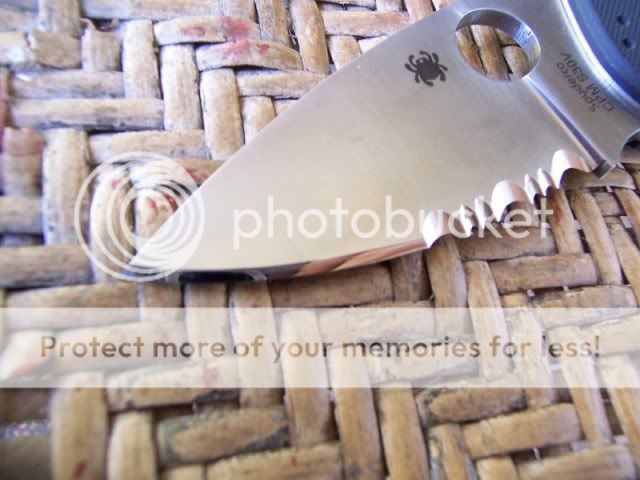
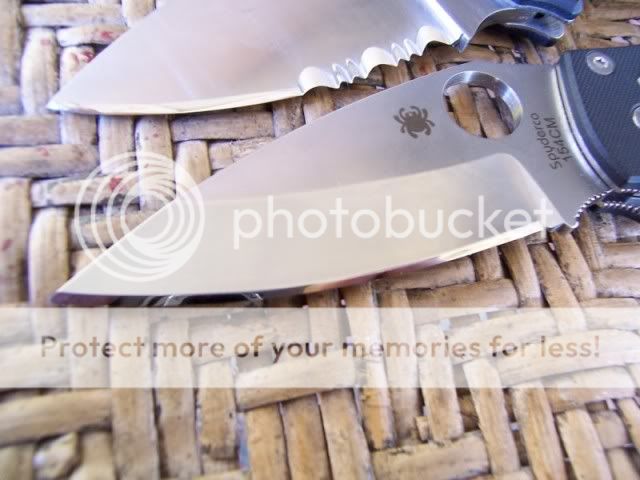
-
The BladeForums.com 2024 Traditional Knife is available! Price is $250 ea (shipped within CONUS).
Order here: https://www.bladeforums.com/help/2024-traditional/
You are using an out of date browser. It may not display this or other websites correctly.
You should upgrade or use an alternative browser.
You should upgrade or use an alternative browser.
DMT continuous and mirror finish questions
- Thread starter prime77
- Start date

Looks great!
Thanks zyhano.

Jason B.
Knifemaker / Craftsman / Service Provider
- Joined
- Jun 13, 2007
- Messages
- 11,225
Those strops still have lots of life left, when the finish starts to become effected by the build-up or the surface takes a gray glossy metal shine then its time to sand and re-apply. Some of my balsa and leather strops are completely black and still work. You can also apply small amounts of compound to re-fresh the strop.
Nice looking edges, it you touch-up on the 1 micron daily you will always have a sharp knife and it will continue to improve the finish.
One last thing, these stones will hold metal swarf and you will NOT be able to see it. Clean after every use with soap and water, use barkeepersfriend every few sharpenings to remove the imbeded swarf. To see just how much work these stones do use your EF with soapy water like a water stone. After several passes rub your fingers on the stone to "stirr" the swarf, you will be amazed at how much is really there.
Nice looking edges, it you touch-up on the 1 micron daily you will always have a sharp knife and it will continue to improve the finish.
One last thing, these stones will hold metal swarf and you will NOT be able to see it. Clean after every use with soap and water, use barkeepersfriend every few sharpenings to remove the imbeded swarf. To see just how much work these stones do use your EF with soapy water like a water stone. After several passes rub your fingers on the stone to "stirr" the swarf, you will be amazed at how much is really there.
Those strops still have lots of life left, when the finish starts to become effected by the build-up or the surface takes a gray glossy metal shine then its time to sand and re-apply. Some of my balsa and leather strops are completely black and still work. You can also apply small amounts of compound to re-fresh the strop.
Nice looking edges, it you touch-up on the 1 micron daily you will always have a sharp knife and it will continue to improve the finish.
One last thing, these stones will hold metal swarf and you will NOT be able to see it. Clean after every use with soap and water, use barkeepersfriend every few sharpenings to remove the imbeded swarf. To see just how much work these stones do use your EF with soapy water like a water stone. After several passes rub your fingers on the stone to "stirr" the swarf, you will be amazed at how much is really there.
Thanks again for the advice knifenut.:thumbup:
For me I just take the Aligner up to EF level, then it's on to 1000 grit and 1500 grit sandpaper, followed by metal polish on a mousepad.
I bent my DMT aligner rods to reprofile lower, which somehow gave me a convex profile. I like it- the edge blends quite seamlessly into the primary grind.
I lost my 2000 grit sandpaper. Am going to get more soon.
I bent my DMT aligner rods to reprofile lower, which somehow gave me a convex profile. I like it- the edge blends quite seamlessly into the primary grind.
I lost my 2000 grit sandpaper. Am going to get more soon.
- Joined
- Dec 18, 2009
- Messages
- 783
I just want to say that I found this thread immensely helpful.:thumbup:
Thanks knifenut and wongki gave me an idea of how to get decent results on my Spyderco Forrester. Think I gotta make up some longer rods for working on a few of my blades.
Thanks knifenut and wongki gave me an idea of how to get decent results on my Spyderco Forrester. Think I gotta make up some longer rods for working on a few of my blades.

- Joined
- Dec 29, 2008
- Messages
- 1,647
Did you use the Aligner or how did you keep that exact angle?After reading many threads praising the DMT continuous stones I decided to give them a shot and see what I could get out of them. I got the coarse, fine, and extra fine stones and went to work on reprofiling my Manix2 to 15 degrees per side. Let me throw my praise out there for these stones. They make sharpening so easy. They cut fast and clean. The scratch pattern is very nice and even with all three stones and make for a short time of sharpening. I was able to bring the bevels to the edge with the coarse stone much faster than I anticipated. Even just with the coarse I was able to make the Manix2 nice and sharp. I then followed with the fine and extra fine. All three stones made for a really sharp knife but I wanted it sharper and with a mirror finish. I don't have the extra, extra fine DMT stone so I used my Spyderco Ultra fine stones, then used strops with white, and green compounds and then finished with Mothers mag and aluminum polish on a leather strop. After all this I got the Manix2 amazing sharp. I can shave hair with ease off my arm and treetop really well. I can get it to whittle hair too. but still no mirror finish. Any advice? Did I just not use the fine and extra fine stones long enough? Do I need the EEF stone? I have used the same stropping process after using my Sharpmaker and got a nice mirror finish. Here is some shots to show the experts what my finished result was. Any advice would be appreciated. Thanks
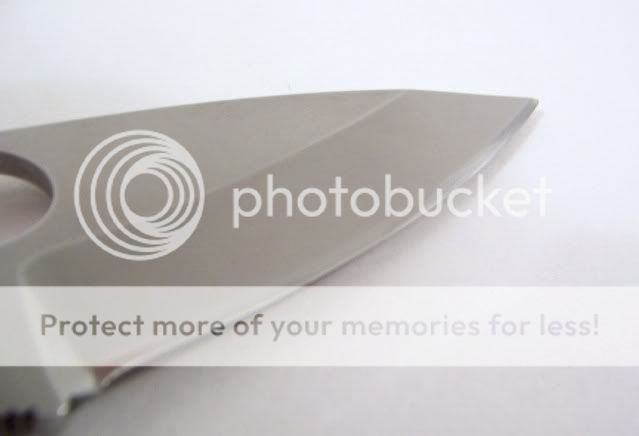
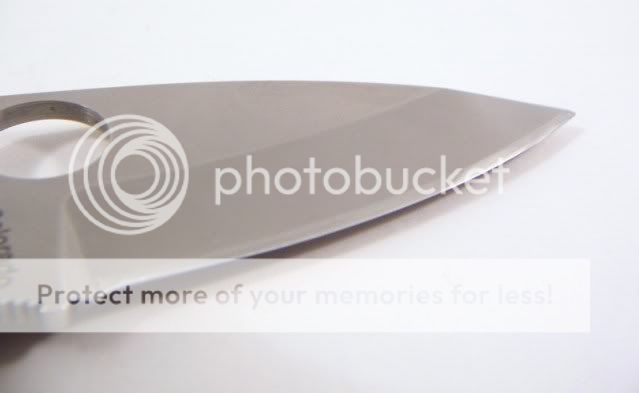
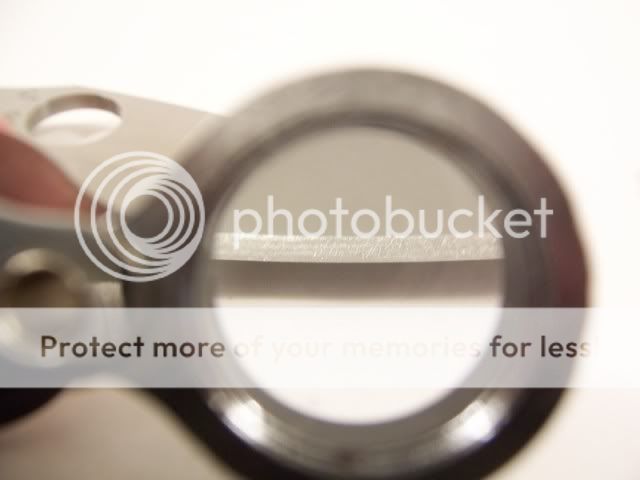
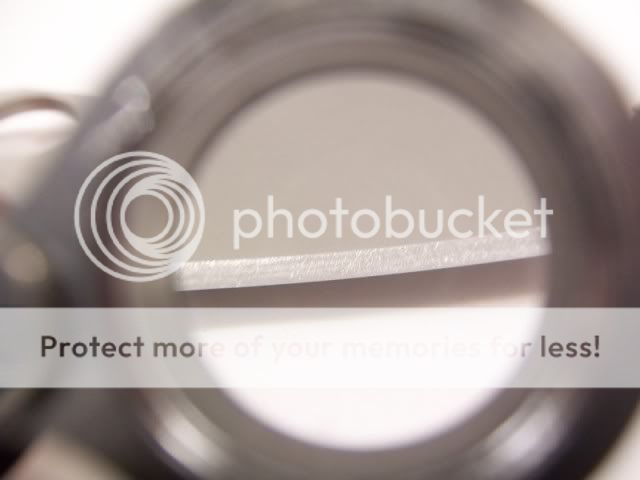

Thanks!
Did you use the Aligner or how did you keep that exact angle?
Thanks!
That was me freehanding. It's not as exact as I would have liked. You can see in some of the pics that I had some trouble at the base of the edge.

- Joined
- Jul 22, 2009
- Messages
- 11,409
You guys are nuts . My freehand on my Duosharp stones never look that neat and perfect. More of a sloppy convex with a hell of a lot of scratches.
. My freehand on my Duosharp stones never look that neat and perfect. More of a sloppy convex with a hell of a lot of scratches.
- Joined
- Nov 24, 2005
- Messages
- 10,038
You guys are nuts
Agreed! But I'd like to get that. DMT makes little cheater bar clips that you can clip to the spine of the knife to hold various angles until the muscle memory gets honed. I just saw them in a video yesterday. It's not as manly but hey, they work!
Agreed! But I'd like to get that. DMT makes little cheater bar clips that you can clip to the spine of the knife to hold various angles until the muscle memory gets honed. I just saw them in a video yesterday. It's not as manly but hey, they work!
I used to make my own using short lengths of thin plastic tubing. Just slice the tube along its axis and slide in the blade. Stiff tubing works best.
Stitchawl
- Joined
- Nov 24, 2005
- Messages
- 10,038
I used to make my own using short lengths of thin plastic tubing. Just slice the tube along its axis and slide in the blade. Stiff tubing works best.
Stitchawl
Where's you get it and what diameter sizes? Just buy a few and eyeball 'em? I'm looking for tubing to get 30 and 40 degrees?
Where's you get it and what diameter sizes? Just buy a few and eyeball 'em? I'm looking for tubing to get 30 and 40 degrees?
That's all I did. I have no idea what the number of degrees they were giving me. I didn't care about numbers. For heavy duty choppers I used a larger diameter tube. For fillet knives I used fish tank tubing. I'm math challenged (I use "Viking Math," one, two, three, many) so I didn't bother to try to figure out the geometry (or would it be trig?) to get the numbers. I did experiment with different materials though. PVC, copper, softer plastic, etc. Obviously, the harder materials lasted a lot longer than the soft. And thick walled tubing worked better than thin.
Stitchawl
- Joined
- Nov 24, 2005
- Messages
- 10,038
That's all I did. I have no idea what the number of degrees they were giving me. I didn't care about numbers. For heavy duty choppers I used a larger diameter tube. For fillet knives I used fish tank tubing. I'm math challenged (I use "Viking Math," one, two, three, many) so I didn't bother to try to figure out the geometry (or would it be trig?) to get the numbers. I did experiment with different materials though. PVC, copper, softer plastic, etc. Obviously, the harder materials lasted a lot longer than the soft. And thick walled tubing worked better than thin.
Stitchawl
I'm sorry to have asked that question. Your knuckles must be raw from typing the answer. I'll get a 1, 2, & 3 many to start with.