Do your linerlocks "wear out" ?

I rotate new knives frequently enough that no one model ever gets worked for a long time.

I would assume any material / part has a life expectancy. I don't pull and use my knives that often during the week, so I assume my wear rate will be substantially less than someone who works building maintenance or construction and is required to have their knife out a lot more.

After 30+ years of buying and carrying knives - I don't think I'll ever find that "perfect" one that will sit in my pocket for years and years.

I'll never know.
 
This thread was probably started because of my comments in another thread so I will share my opinion here as well.

I have had one frame lock knife wear out to the point the lock would touch the other scale and there was blade play because it didn't touch the blade tang anymore. This was an assisted opening knife that wasn't used that much and happened in less than a year. I have had other knives move across the tang fairly quickly and go from about 30% to 75% lockup in a somewhat short amount of time. I don't know if it is because I use my knives quite a bit and for more than just opening mail. I might put more force on the blade tang/ lock interface and cause increased wear with my uses. I also 'play' with my knives quite a bit by opening and closing them. I don't slam them open and I don't abuse them and only use them for cutting.

I do not like the fact that they start wearing out from the first time they are opened. And once the lock bar does move to the other scale and is 'worn out' there is nothing that can be done to fix it. It is caused by metal wearing away from the lock bar from repeatedly rubbing against the very hard blade tang for the most part. This metal can not be put back and the only way to fix it is to replace the lock bar. It is my opinion there are much better engineered knife locks out there.

I have also had a few liner locks where the lock would move towards the unlocked position when force is applied to the blade. I actually had one close on me and cut a finger. And you can't just look at a knife and tell which ones will suffer from this as it seems completely random. They have all been on knives that most would consider a quality knife as well. Just another reason why I do not like this type of lock and try my hardest not to buy them anymore. It is a shame because there are some great knife designs that use these types of locks but I just don't trust them or feel the need to spend my money on them when I can buy a better engineered lock. I think they are easy to make which is why they are on so many knives.

This is all just my opinion based on my experiences. If they work for you that is great, but I have had bad luck and choose to buy and use other lock types that I feel are stronger and will last longer.
 
I won't open it crazy like but I will probably play around with it constantly for a few day till my family yells at me then it will be on my dresser till I go out so it will be safe for a while . Sorry to be a bother but as a guy who makes crap money I can afford to buy a 500 dollar emerson and 50 bucks for a folder is my price range, 50 - 70 is about where I look for a good folder
 
When metal wears away or is deformed I'm not sure how it would wear 'in'. So would repeated sharpening and removal of blade metal also be wearing 'in'? Regardless, if it wears so that at some point down the road it no longer works then it is not something I want if the time frame is somewhat short.

I guess everything degrades with time so how long or how many cycles it takes to degrade to a point that it starts to fail or work incorrectly is what is important. As this thread shows failure can happen and fairly quickly or not as much. But if the possibility exists then I will choose something else that seems to be more consistent and longer lasting.

In my experience liner/frame locks wear out quicker than the other lock types so I personally will not buy them. If the way you use your knives or the frequency you use them causes wear to not be an issue for you that is great. I don't like to watch a knife wear 'in' and wait for it to fail when my body parts could be put at risk when it does fail.
 
Can't you send it to BM for warranty repair?

I probably could send the knife in. But to be honest, I don't want to. The knife has a lot of sentimental value as is. I wore that knife for a long time. I carried it all the way through graduate school, was carrying it the day I received my master's degree, and the day I was married. I made it the way it is, and I like it the way it is. I certainly don't consider it a "defective product"- I would buy another in a heartbeat. Things wear out. Nothing lasts forever. It wouldn't mean as much if I sent it in and had it returned to "as new condition".
 
I agree that the liner lock is not my favorite but I've been pleased with several Spyderco liner locks such as the Military, Sage and Gayle Bradley. Lots of pressure when cutting does not cause these liners to move and I haven't noticed any wear.
My Kershaw Storm, Leek and Whirlwind all had liner/frame locks that moved over more when lots of cutting pressure was applied. When that occurred the liner/frame was difficult to disengage. In the case of the Storm, the frame moved all the way to the other side from heavy cutting pressure.
 
There are a ton of variables. Surface area - a small lockbar will wear faster than a thick one? Geometry - I can't say what would wear faster/slower, but I'm sure that's a factor. Surface hardened/not - a lockbar that's surface hardened will wear slower than one that's not. Materials differences - titanium on steel would, all other things equal, wear faster than steel on steel (e.g., Gayle Bradley folder). I would guess it's hard to generalize about all linerlocks.
 
There are indeed lots of variables. Old school liner locks don't wedge against the blade tang at all. And when a lock touches the opposite scale, it does not necessarily mean it has failed, or will fail at a critical time. Wedging keeps the blade immobile. But even if loose, the lock physically blocks the blade. If anything, the angled mating surfaces of the lock and blade tang might theoretically make a blade more prone to disengaging unintentionally. Also, I'm not sure how much "wear" happens universally on wedging-type locks. This notion of wear came into doubt when a couple well made liner/frame locks began touching the opposite scale almost immediately out of the box. It occurs to me that wedging type locks demand pretty tight tolerances, which may be easily defeated by even small tolerance variables at the blade pivot and/or screw points.
 
I had liners wear out on

an Emerson Commander
Spyderco Lum (original run)

and that's about it.
 
There are a ton of variables. Surface area - a small lockbar will wear faster than a thick one? Geometry - I can't say what would wear faster/slower, but I'm sure that's a factor. Surface hardened/not - a lockbar that's surface hardened will wear slower than one that's not. Materials differences - titanium on steel would, all other things equal, wear faster than steel on steel (e.g., Gayle Bradley folder). I would guess it's hard to generalize about all linerlocks.

Very true, JN.

There are indeed lots of variables. Old school liner locks don't wedge against the blade tang at all. And when a lock touches the opposite scale, it does not necessarily mean it has failed, or will fail at a critical time. Wedging keeps the blade immobile. But even if loose, the lock physically blocks the blade. If anything, the angled mating surfaces of the lock and blade tang might theoretically make a blade more prone to disengaging unintentionally. Also, I'm not sure how much "wear" happens universally on wedging-type locks. This notion of wear came into doubt when a couple well made liner/frame locks began touching the opposite scale almost immediately out of the box. It occurs to me that wedging type locks demand pretty tight tolerances, which may be easily defeated by even small tolerance variables at the blade pivot and/or screw points.

Good post, shecky. My own experience is that once a LL seats in, it tends to be quite stable over time. Most of the knives that I have are either liner or frame locks and I have yet to experience trouble with any of them. In fact, any minor annoyances I have had are due to a LL being too hard to release. Go figure.
 
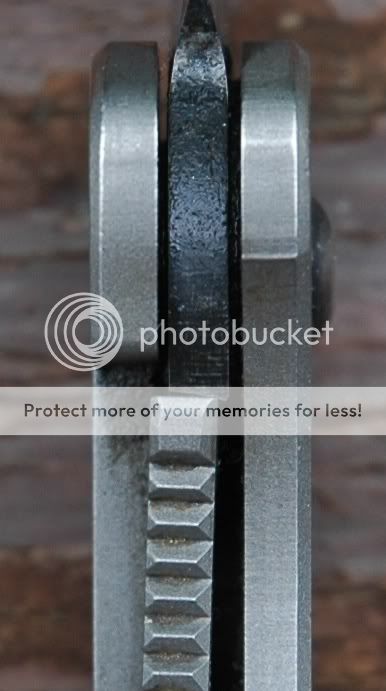
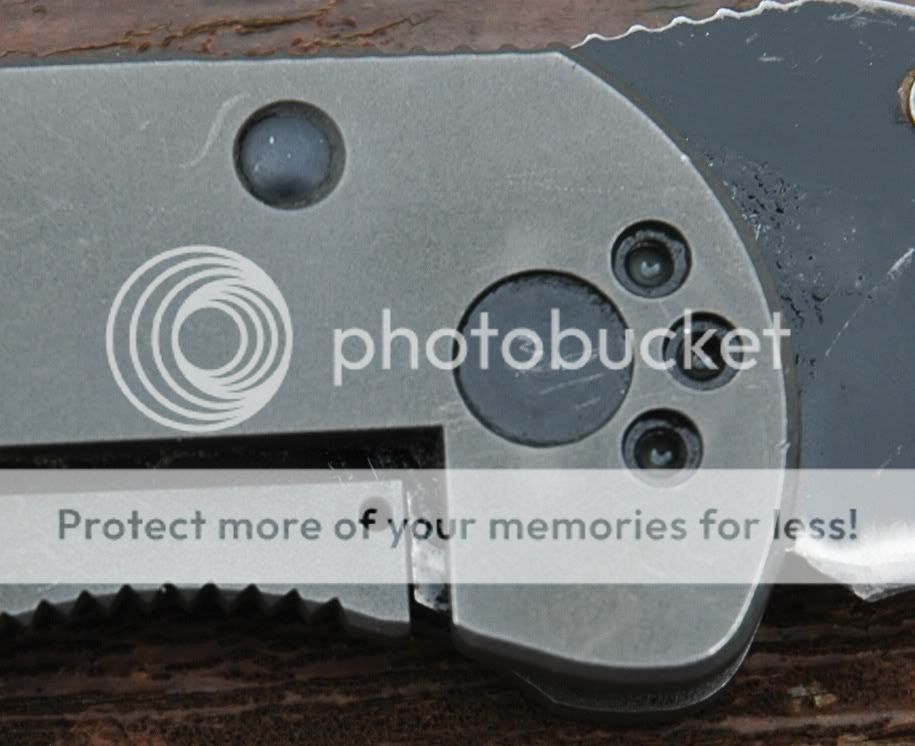
Here's my Pinnacle. As you can see, there's not a lot of room for wear left. It still locks fully and hasn't failed, but some play has started to develop.

Nothing lasts forever if you use it constantly, I guess.

DSC_4528.jpg


DSC_4530.jpg
 
I have a very cheap German linerlock knife (Herbertz in 420 steel) that is probably one of my most carried knives ever! The linerlock has worn away to the point where there is permanent blade play but even then the knife remains useable.(if you use it for cutting that is :D)
 
.....

In my experience liner/frame locks wear out quicker than the other lock types so I personally will not buy them. If the way you use your knives or the frequency you use them causes wear to not be an issue for you that is great. I don't like to watch a knife wear 'in' and wait for it to fail when my body parts could be put at risk when it does fail.

Not trying to be argumentative here, just want to know what you mean.

On the other hand the AXIS lock wears in and the lock up actually gets better with use.

Honestly, a spring would start wearing out as soon as you start moving it.
And yes, I do like the Axis lock. I have an HK/BM sitting right here on my desk so I'm not knocking the lock at all.

I started this post to get an overview of why/where/when liner/frame locks would wear.
From the previous posts it looks as if very hard use (pressure and movement) against the bar would wear it out. I can understand that.
Also, "over flicking" your blade open would wear faster too I think.

I have/had some knives wear quite a bit but I'm talking about knives I've had for over a decade. Some, not so much.
If I can buy a nice knife (IMO) :) for $100 and it lasts me 10yrs I'm happy.

Appreciate all the responses fellas.
 
Back
Top