
-
The BladeForums.com 2024 Traditional Knife is available! Price is $250 ea (shipped within CONUS).
Order here: https://www.bladeforums.com/help/2024-traditional/
You are using an out of date browser. It may not display this or other websites correctly.
You should upgrade or use an alternative browser.
You should upgrade or use an alternative browser.
Does anyone like to pack ultralight when going outdoors.
- Thread starter dd61999
- Start date
Am I an ultralight hiker? Not at all. Do I take lighter loads than most? Often. Heavier loads? Sometimes. Do I cover ground like an ultralighter? Pretty near. Am I prepared for severe conditions and bush emergencies? Totally. Is my habit of posing rhetorical questions and then immediately answering them annoying? Probably.
I like some aspects of ultralight camping, but if I was looking to shave a few grams off my load I would start with myself. I am plenty big enough and strong enough to haul around a forty to sixty pound pack at a fast walking pace, as Elen says - over most ground.
I can see a few interesting points here misanthropist... I consider myself fit enough to haul heavier backpacks as well (sometimes I had to carry two of them at the same time because someone else screwed up... pretty common in summer camps with people not used to do anything outdoors) but the thing is that while I can haul them... I enjoy much more if the pack is ligther! You take fewer chances of getting injuried (ankles, knees, you know...) if you carry ligther loads.
Mikel

- Joined
- Jan 28, 2007
- Messages
- 1,236
Elen and Misanthropist I would really like to see your gear list.
Obviously I can't speak for Elen but my gear is heavily dependent on the trip as I live in one of the most varied-terrain parts of the world.
Within two or three hours of here, I could be in extreme alpine conditions, arctic conditions on one of the icefields, desert conditions east of the mountains, prairie on the river flats, ocean beaches, rainforests...
Couldn't give you a gear list because I have to plan seperately for every excursion! But this is partly why ultralight stuff has not taken off around here, even though wilderness camping and activities are extremely popular - conditions tend to be complicated and help is generally not coming.
But usual for me would include a down bag - from a really light one in the desert areas in the summer to a serious one for icefields in winter - a silnylon tarp, a couple of cutting tools (trip dependent again, don't take the axe to the desert much) a lightweight aluminum pot and a base layer and a shell.
What goes between the shell and the base layer of course varies a lot!
I also generally take a topo map(s) and a baseplate compass - no button compasses for me. For first aid stuff I mainly use duct tape or hockey tape (I'm Canadian.) I roll about ten feet of tape onto a short pencil with a drill. I also usually have a bit of stainless steel wire for emergency gear repair.
I will generally take one pair of wool socks and two pairs of polypro liners, and I just change out the liners and wash them often.
I used to take just a little ensolite sleeping pad but after ten days up in the rocky mountains one year I bought a thermarest prolite 4 - heavy but so comfy!
That pretty well covers everything I can think of that comes on every trip...there is probably more but that's what springs to mind.
Obviously I can't speak for Elen but my gear is heavily dependent on the trip as I live in one of the most varied-terrain parts of the world.
Within two or three hours of here, I could be in extreme alpine conditions, arctic conditions on one of the icefields, desert conditions east of the mountains, prairie on the river flats, ocean beaches, rainforests...
Couldn't give you a gear list because I have to plan seperately for every excursion! But this is partly why ultralight stuff has not taken off around here, even though wilderness camping and activities are extremely popular - conditions tend to be complicated and help is generally not coming.
But usual for me would include a down bag - from a really light one in the desert areas in the summer to a serious one for icefields in winter - a silnylon tarp, a couple of cutting tools (trip dependent again, don't take the axe to the desert much) a lightweight aluminum pot and a base layer and a shell.
What goes between the shell and the base layer of course varies a lot!
I also generally take a topo map(s) and a baseplate compass - no button compasses for me. For first aid stuff I mainly use duct tape or hockey tape (I'm Canadian.) I roll about ten feet of tape onto a short pencil with a drill. I also usually have a bit of stainless steel wire for emergency gear repair.
I will generally take one pair of wool socks and two pairs of polypro liners, and I just change out the liners and wash them often.
I used to take just a little ensolite sleeping pad but after ten days up in the rocky mountains one year I bought a thermarest prolite 4 - heavy but so comfy!
That pretty well covers everything I can think of that comes on every trip...there is probably more but that's what springs to mind.
From the sounds of it I am not missing or sacrificing anything that you carry except I am lighter.
By the way I spend many of my outdoor times in Canada as well (My wife is Canadian). What areas do you frequent
- Joined
- Jan 28, 2007
- Messages
- 1,236
That could well be true...most ultralighters I have met need to carry the same kinds of stuff that everyone else does, they just have lighter and less durable versions. For example, mostly I have seen them in trail running shoes that would last a few weeks in some of the places I go, but no doubt they are great for places that are frequented regularly and have good trails and emergency help available. It would be extremely foolish to climb some of the shale mountains I have in anything but heavy leather.
I am all over BC, from Ashcroft to the Bugaboos to the Coast. I am not in parks as often as I am just out in the bush on crown land somewhere, so not a lot of trails where I go! That is part of the reason I can't be skimping on durability.
I am all over BC, from Ashcroft to the Bugaboos to the Coast. I am not in parks as often as I am just out in the bush on crown land somewhere, so not a lot of trails where I go! That is part of the reason I can't be skimping on durability.
Elen and Misanthropist I would really like to see your gear list.
I don't normally make such lists, since I carry different items depending on where I'm going and what I'm planning to do. Sometimes I'll go with nothing except the clothes on my person and some food and drink to eat while out. I don't have any "this is something I always carry" items. And I don't count grams or kilograms for that matter when I pack or choose gear. I'm far more interested in actually getting out to the wild and enjoying my time, as long as the pack isn't so heavy it annoys me.
But for the heck of it, I'll make a quick list of what I brought the last time I went backpacking. It was two days, and winter conditions.
- backpack, obviously
- clothes on person, slightly more obviously
- skis
- Fällkniven F1
- Fiskars hatchet Handy 600
- Ranger Knives RD9 (for clearing a rather annoying fallen tree and for testing it for the fun of it)
- SAK Ranger
- a lighter, and a lot of matches in a waterproof container (nothing fancy that I'm not going to use anyway)
- first aid kit
- some extra/spare clothes, as warm as they come (and quite heavy)
- ridiculously large ancient towel (I love that towel, and often bring it when I intend to go ice swimming outdoors or even just a quick wash in winter time)
- heavy sleeping bag
- heavy tent
- cooking gear, not that heavy, no stove though
- FDF lusikkahaarukka (military issue "spoon/fork" combo, fun little thing)
- some drinking water
- some tasty but simple food
- a bottle of Koskenkorva for drinking by the fire
- Nokia cellular phone for making annoying calls to mates with (yeah, there are few places in this country where you can't get a GSM signal, no matter how middle of nowhere you are)
Actually, I'm pretty sure that was it. I didn't bring a compass or map, since that would have been rather ridiculous in such familiar terrain. The pack could have been heavier, and it could have been lighter, but it really doesn't matter to me as long as I'm not in a race or a military operation. The pack was comfortable to carry. That's what matters to me, not how many grams it is.
 I guess my packing "strategy" should be called "minimalist indifferent", if anything.
...By the way I find it easier to climb with lighter shoes. Plus my wife and I tackle some heavy duty mountains...
Footwear deserves a whole different thread on its own... there is a lot that can be said about it.
I have been climbing an mountaineering for a while now and I have seen an evolution in the footwear used. Not so long ago people always carried sturdy boots whenever they headed outdoors... Now there is a tendency to carry light hiking shoes (even trailrunning shoes).
I have like three pairs of boots and a pair of ligther trekking shoes. Depending of what I intend to do I chose my footwear:
- Light pack or not pack at all: Trekking shoes
- Fair pack but paved roads or dirt roads: Trekking shoes
- Aproaching climbs that don't involve snow at all and where I will be climbing with specific shoes as soon as I rope up: Trekking shoes (ligther on my back)
- Easy climbs / areetes: Trekking shoes (good grip depending on the model)
- Anything else: boots
Mikel
- FDF lusikkahaarukka (military issue "spoon/fork" combo, fun little thing)
With four "k"'s in the same word it sure has to be fun...
Kind of a spork, uh?Mikel
It's also known as "the mysterio" in the military.
Looks like this: http://fi.wikipedia.org/wiki/Kuva:Luha.jpg
- Joined
- Jan 28, 2007
- Messages
- 1,236
I agree, I would never skimp on durability. But you can have durable and be lightweight.
By the way I find it easier to climb with lighter shoes. Plus my wife and I tackle some heavy duty mountains
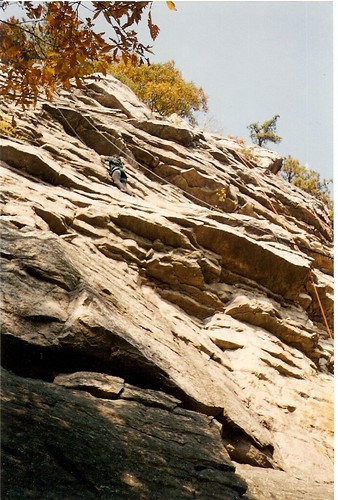
Naturally it is easier to lift less weight...but if you should find yourself doing serious mountaineering twenty kilometers from the closest path with a person on it fifty from the nearest road and a hundred from the nearest place with cell phone reception, it does not pay to be wearing lightweight footwear! Too dangerous by far.
Everyone will of course agree that when you get into serious mountaineering, you don't see people still wearing their approach shoes! That is really only for well-travelled places with mild terrain.

I was looking for something else and saw this image and remembered this thread.
Is he packing everything but the Kitchen Sink?

The scary thing is I have seen the 10th Mountain Division geared up like that and they are supposed to be the "light Infantry"
I know the Army has been trying to lighten up for over 2 decades but Bureaucracy has hampered progress
...Everyone will of course agree that when you get into serious mountaineering, you don't see people still wearing their approach shoes! That is really only for well-travelled places with mild terrain.
Just sometimes...
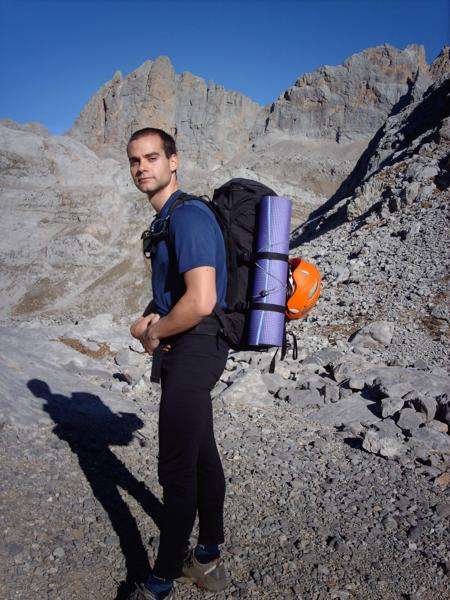
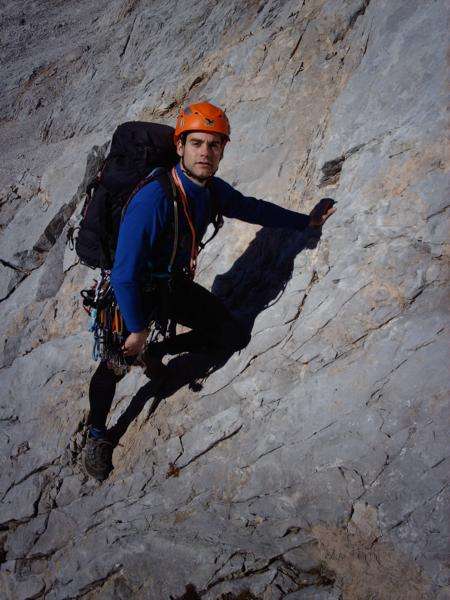
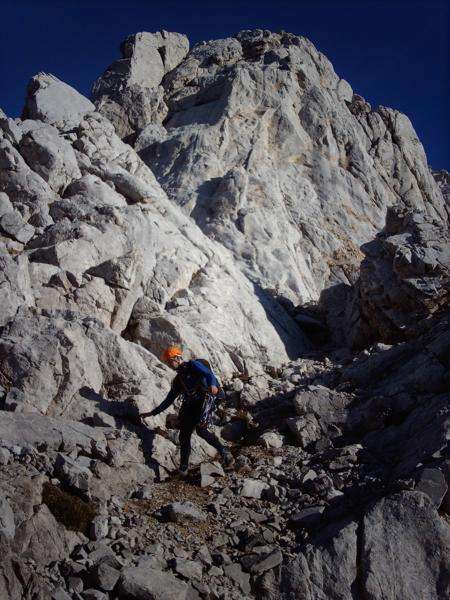
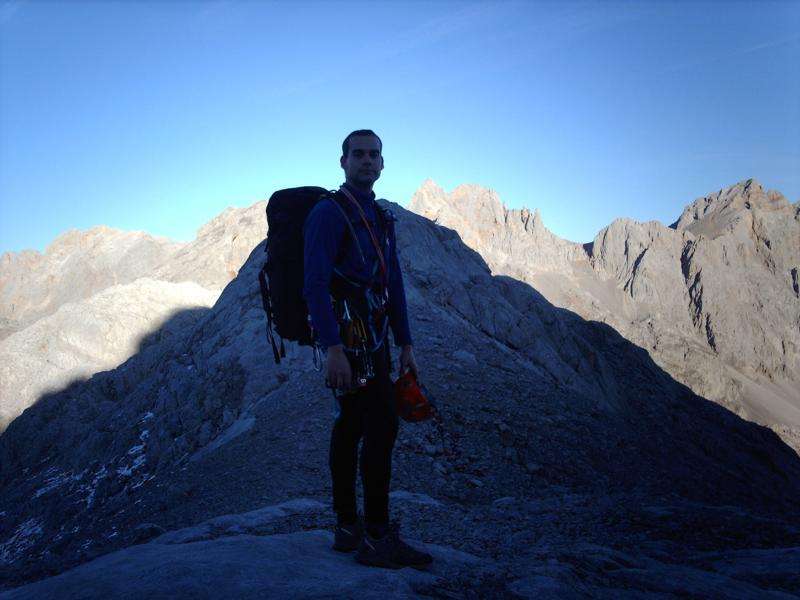
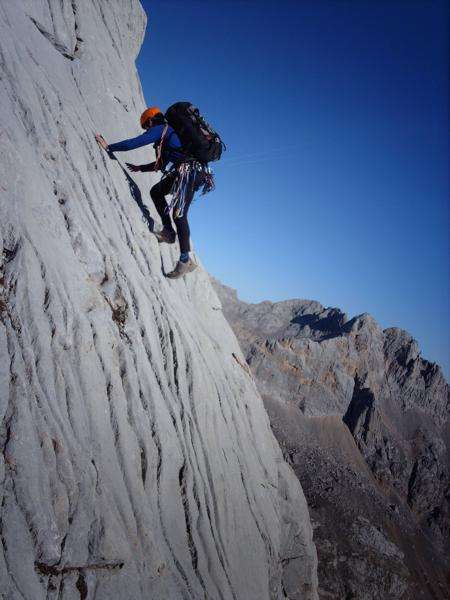
Ok ok... we cheated a little bit (just a little bit)... the camera is tilted to the left like 20 degrees or so
And the chosen footwear is...
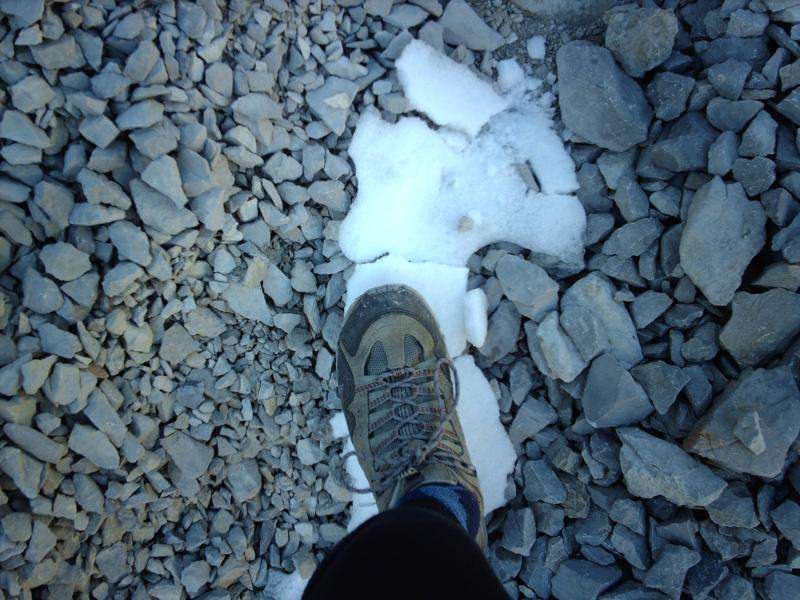
I was packing climbing shoes but I didn't even take them out of the backpack. Those aproach shoes grip quite well.
What I want to show is that you need to match the fotwear to the activity you intend to do. Sometimes you will be better off in winter with aproach shoes and in summer with heavy boots. There are no fixed rules though, so you have to make your own.
We climbed there areete from the Madejuno Peak to Tiro Llago Peak in the "Picos de Europa" mountains. We only used our ropes to abseil like four times. Good weather, grippy rock and just my partner and me.
Mikel

Brian Jones
Moderator
- Joined
- Jan 17, 1999
- Messages
- 7,560
I train everyday by hiking and/or walking with at least 110 lbs on my back. I load my climbing pack with hardcover books, some weights, and anything else that adds bulk. I was doing one of these walks in the dark one day while talking with Scott Gossman on my cell phone, and he heard me breathing heavy as we talked.
I train with extensive weight so that when I go on an excursion, anything I pack is ultralight compared to my training pack weight.
I train with extensive weight so that when I go on an excursion, anything I pack is ultralight compared to my training pack weight.
I train everyday by hiking and/or walking with at least 110 lbs on my back. I load my climbing pack with hardcover books, some weights, and anything else that adds bulk. I was doing one of these walks in the dark one day while talking with Scott Gossman on my cell phone, and he heard me breathing heavy as we talked.
I train with extensive weight so that when I go on an excursion, anything I pack is ultralight compared to my training pack weight.
Lucky you! I wish I could train that way every day... I go to the gym like 4 days a week and have to be very carefull with what I do some days... I can't go work out my back on Friday if I plan on climbing Saturday... I can work out my legs if I plan to go diving... You know what I mean.
Brian, I heard about some guys who train almost the way you do. They take water loads instead. They carry loaded bottles on the way up and then dump the water so they preserve their knees on the way down.
How much do you weight anyway? Those 110lb are like... uh... 50kg. I weight only 65kg
so that would be like... 83% of my bodyweight. I guess that's just too much. The heaviest pack I have carried for extended periods was like 32kgs... 70 lbs. Mostly food for two weeks. A few months later I found out about freeze dried food... duh...Mikel
Brian Jones
Moderator
- Joined
- Jan 17, 1999
- Messages
- 7,560
Mikel,
I'm 6 foot, 3 inches - you do the metric conversion. Weight is 185-190 lbs.
When I am carrying that heavy load, I mostly walk on flat ground at close-to-sea-level elevations. As I am sure you know, the better winded I am at sea-level, the better I'll be at altitude.
When I get to elevation in the mountains, I am much more prepared for acclimation at altitude, because of the ridiculous weight I train with.
What's funny is that when I filmed Ron Hood's video, after training like that, I outpaced the rest of the team even though they were more acclimated to the altitude. Didn't hurt that I was much younger than them, too. On that trip, my pack started at 120 lbs, and ended up at 90 lbs. Thank God I did the workouts!
My knees have never complained. Usually, people who get bad knees are walking wrong. It's not the weight, it's the technique.
I teach proper wilderness walking techniques to folks. They never expect it, but then I show them the various ways of walking -- depending on terrain, physical fitness, and weight, plus more. I never announce it ahead of time. I always move into this lesson after they've experienced some failure (not critical or life-threatening).
Most folks say that, if the subject of walking were announced, they'd have written it off as, "Been there, done that." When I surprise them in class, they are blown away with the different variations of walking. The method make ALL the difference in the world, as far as calorie consumption, and economy of motions goes.
I'm 6 foot, 3 inches - you do the metric conversion. Weight is 185-190 lbs.
When I am carrying that heavy load, I mostly walk on flat ground at close-to-sea-level elevations. As I am sure you know, the better winded I am at sea-level, the better I'll be at altitude.
When I get to elevation in the mountains, I am much more prepared for acclimation at altitude, because of the ridiculous weight I train with.
What's funny is that when I filmed Ron Hood's video, after training like that, I outpaced the rest of the team even though they were more acclimated to the altitude. Didn't hurt that I was much younger than them, too. On that trip, my pack started at 120 lbs, and ended up at 90 lbs. Thank God I did the workouts!
My knees have never complained. Usually, people who get bad knees are walking wrong. It's not the weight, it's the technique.
I teach proper wilderness walking techniques to folks. They never expect it, but then I show them the various ways of walking -- depending on terrain, physical fitness, and weight, plus more. I never announce it ahead of time. I always move into this lesson after they've experienced some failure (not critical or life-threatening).
Most folks say that, if the subject of walking were announced, they'd have written it off as, "Been there, done that." When I surprise them in class, they are blown away with the different variations of walking. The method make ALL the difference in the world, as far as calorie consumption, and economy of motions goes.
- Joined
- Jan 28, 2007
- Messages
- 1,236
Just sometimes...
Ok ok... we cheated a little bit (just a little bit)... the camera is tilted to the left like 20 degrees or so
And the chosen footwear is...
I was packing climbing shoes but I didn't even take them out of the backpack. Those aproach shoes grip quite well.
What I want to show is that you need to match the fotwear to the activity you intend to do. Sometimes you will be better off in winter with aproach shoes and in summer with heavy boots. There are no fixed rules though, so you have to make your own.
We climbed there areete from the Madejuno Peak to Tiro Llago Peak in the "Picos de Europa" mountains. We only used our ropes to abseil like four times. Good weather, grippy rock and just my partner and me.
Mikel
Nice pics! I guess if you are mostly climbing on bare rock in decent weather, approach shoes wouldn't be too bad.
I 100% agree with the bold statement - you CAN sometimes get away with grippy approach shoes, but if you are on a long expedition in this sort of terrain most people will probably be best off to go with the boots!
I am slowly evolving into lighter gear...
All through my 20's I carried an old ALICE large pack with the bulky steel frame. As I hit forty I began to wonder if I was getting too old, until I finally bought a nice Gregory internal frame. SO much better.
But now, approaching 50 I did my first tarp and blanket outings in 2006 and they were just fine, even better that tenting.
The Gregory pack I like so much is 7 lb.s empty so my experiment this summer is to go out 4 days with what I can carry in an ALICE medium pack without frame (ok, maybe a shoulder bag for my food). My wife bought me a mountain hardware 32 degree sleeping bag and my folks got me a silnylon tarp. I'm really looking forward to trying them out. They pack down to the size of a coffee can each. For me, sometime bulk is as much of a problem as weight.
I'm just trying to go light weight, not ultra light. In one of the books I read, the guys who go with packs under 10 lbs are known as "psycho lite".
Clint Hollingworth
The Wandering Ones webcomic
http://www.wanderingones.com
All through my 20's I carried an old ALICE large pack with the bulky steel frame. As I hit forty I began to wonder if I was getting too old, until I finally bought a nice Gregory internal frame. SO much better.
But now, approaching 50 I did my first tarp and blanket outings in 2006 and they were just fine, even better that tenting.
The Gregory pack I like so much is 7 lb.s empty so my experiment this summer is to go out 4 days with what I can carry in an ALICE medium pack without frame (ok, maybe a shoulder bag for my food). My wife bought me a mountain hardware 32 degree sleeping bag and my folks got me a silnylon tarp. I'm really looking forward to trying them out. They pack down to the size of a coffee can each. For me, sometime bulk is as much of a problem as weight.
I'm just trying to go light weight, not ultra light. In one of the books I read, the guys who go with packs under 10 lbs are known as "psycho lite".
Clint Hollingworth
The Wandering Ones webcomic
http://www.wanderingones.com