
Does ironwood shrink?

Joined
Jan 4, 2016
Messages
5,666
I finished this small bowie with an ironwood handle and copper guard. Completed it about 6-7 weeks ago.

The piece of ironwood was sourced online from a seller with a full website, deals in Arizona ironwood almost exclusively. (Not an eBay store/merchant, but a legit .com domain).

I only had the material a few weeks before starting the project. I did not age the material at all.

I don't recall this when I competed the handle, but now there is an ever-so-slight ridge at the point where the copper and ironwood meet. It's maybe the thickness of a sheet of paper. You can just tick your fingernail on the edge of the copper all around the perimeter. There are zero gaps at the joint, and you can only feel it going on the copper, not going on to the ironwood.

The ironwood is finished with a few coats of Tru Oil and then waxed.

Since completing, it has been in my hot garage, in Colorado with like 13% humidity.

Thoughts? Does ironwood shrink?
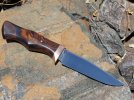
20180622_122636~01.jpg
 
Last edited:
All wood contracts and expands. Stabilizing can fix this in some woods (but will do almost nothing to ironwood). You can minimize this problem by ensuring that you acclimate the wood before shaping the handle. A moisture tester is a good idea. Enev the cheap ones work well enough in relatively thin sections. Test the handle material before selection. After selection and rough shaping test again. Figure out if the wood is at equilibrium moisture content (or within one % of EMC) where you are. If so, go ahead and finish the handle. If not let it acclimate for a bit.

I wouldn't even use a piece of wood that was more than 2 points off EMC for my area. I would wait a few months (I live and store wood in a very dry area. if you live/store wood somewhere with high humidity, it may take longer; Hotter, dryer is better, colder, damper worse). If it was at 2 or so points, I would get it roughly shaped and give it a couple of weeks before final finishing. If this becomes a persistent problem, you could very easily build a low temp kiln with a cheap PID, some simple insulation, and a heat lamp. SUch a kinl can cut down drying times to a couple days for the relatively thin stuff we use for handles.

Calculators online will tell you expansion and contraction amounts by species at various humidities. If you are going to use a wood that moves a lot, I would stabilize.

In the case of the ironwood, unless the knife needs to move quickly, let it sit for a few months and redo the transition. Should solve the problem.
 
if it shrunk, it probably had more moisture when it was installed than it ended up with after some time went by. i also use a moisture meter, or make sure i have the handle material for at least a year. 5-8% is what you are shooting for. also, if you do not use a hard sanding block on that junction, its easy for the ironwood to get sanded down more than the metal. if it was not apparent when the knife was finished, it is due to moisture loss for sure. even if it is fully acclimated at the dealers house, it may not be acclimated your area. years ago i had some scales actually peel up from the tang because they were too wet. a $30 moisture meter from woodcraft and it has not happened since.
 
Your sure you didn't just miss that when you finished it? It is really easy for the metal to rise over the wood and have a ledge where they meet because of the softness/hardness of wood and metal. Did you sand with a hard sanding stick?
 
The whole thing depends on it's history . Poorly dried it can have stresses that will warp the piece .There can be differences in moisture between surface and center .A thick piece can be put in the drier along with thinner ones and the wrong drying schedule can cause problems ..
Compensating ? I built my rifle in CO then brought it home to NY. Dry to humid it warped the forend - it was still as accurate !!
Be patient when drying ! :rolleyes:
 
Your sure you didn't just miss that when you finished it? It is really easy for the metal to rise over the wood and have a ledge where they meet because of the softness/hardness of wood and metal. Did you sand with a hard sanding stick?

It is possible, but I don't think so. I've made a fair few different knife handles and followed generally all the same methods. I have seen where a sanding belt will dig into the wood, more so than the adjacent metal, with poor technique. In this instance it is a uniform ledge, and the adjacent wood is not undercut. It is just a step change, uniformly around the entire perimeter.

After belt grinding/shaping, this was sanded with several progressive grits of hand paper. Just 3-folds of paper and my fingers, no backer stick or block. This is how I've always done it. On other instances where it is poor technique, you can easily see the lower-grit sanding marks that have not been polished out yet adjacent to the higher surface. That's not the case here.

I suppose my question is along the lines of the stability of ironwood. I would have thought if it was well glued, it would have cracked with any shrinkage. The ironwood did not crack. If it was not well glued, I would have pulled back and left a gap at the interface. It didn't do that either. It's just a strange end result that looks like it shrunk.
 
All wood contracts and expands. You can minimize this problem by ensuring that you acclimate the wood before shaping the handle. unless the knife needs to move quickly, let it sit for a few months and redo the transition. Should solve the problem.

Agree
 
As a rule, I let any handle woods I buy sit in my shop for 90-120 day’s or more.. Depending on how it rings on the Moisture tester.. I want 12% or less. 10% preferred ... And this includes Stabilized woods.. Have Fun, Stay safe!
 
I got an aged Gyuto from a well known Japanese maker with western Ironwood handle. The wood def shrank a bit. The pins and spine stand proud enough to easily feel it.
There is some good advice here on aging the wood. The problem is when you ship it off to another state, well who knows how it might react to a different climate.
I use something similar to boose block board cream on mine. That's it. Mineral oil and beeswax. The idea is that the oil will help stabilize it.
I have my first knife I made in Cali a few years back, been in AZ now 2 years. You can barely feel the pins are a slight bit higher than flush. Not bad.
 
I got an aged Gyuto from a well known Japanese maker with western Ironwood handle. The wood def shrank a bit. The pins and spine stand proud enough to easily feel it.
There is some good advice here on aging the wood. The problem is when you ship it off to another state, well who knows how it might react to a different climate.
I use something similar to boose block board cream on mine. That's it. Mineral oil and beeswax. The idea is that the oil will help stabilize it.
I have my first knife I made in Cali a few years back, been in AZ now 2 years. You can barely feel the pins are a slight bit higher than flush. Not bad.

http://www.woodweb.com/cgi-bin/calculators/calc.pl

http://owic.oregonstate.edu/wood-shrinkswell-estimator

http://www.csgnetwork.com/emctablecalc.html (this will allow the calculation of equilibrium moisture content)
 
Minor expansion and contraction is just the nature of the beast when using wood, even professionally stabilized. I think as makers, all we can do is take all of the precautionary steps as mentioned above and hope for the best. To be frank though, I'm surprised you haven't run into that issue sooner not using a hard backer for final surface mating to the guard.
 
Incidentally, I would highly recommend against using something like tru-oil as a finish on dense hardwoods like ironwood. Oil based build finishes like tru-oil (really an oil/varnish mix) like to have a bonding layer that absorbs into the substrate. When used on a dense/oily wood, the first layer starts to build without any significant penetration, and I find the finish to be prone to damage.

These woods take a fine polish in the absence of a build finish, I recommend a saturation in BLO or similar, followed by buffing on a wheel with tripoli, white diamond and finally carnauba. If you get to the very dense/oily end of the spectrum (lignum, ironwood, some rosewoods), you can completely eliminate the oil as you will get no appreciable absorption. If you do use oil, let it cure first, I like 72 hrs for BLO prior to buffing. Tung will take weeks or months.
 
Minor expansion and contraction is just the nature of the beast when using wood, even professionally stabilized. I think as makers, all we can do is take all of the precautionary steps as mentioned above and hope for the best. To be frank though, I'm surprised you haven't run into that issue sooner not using a hard backer for final surface mating to the guard.

Well.... This was the first hidden tang with a guard I have ever done. All others have been scales (pinned & epoxied, or fasteners) on full thangs. So, "dang it! This happens to me every time!" Lol.

I appreciate everyone's comments immensely. I attempted this knife solely to learn how/if I could pull it off with my very limited tools. I have succeeded in learning a few things if nothing else.
 
Last edited:
I have a kitchen utility knife I made. I've used it for several years now. It has Ironwood scales.

Every winter, the scales shrink ever so slightly and the edges of the tang and tops of the pins can be barely felt.

And every summer, the scales return to true and no pins or tang can be felt. Its done it for years now......very predictable.
 
You could try using the "antique fit" or "heirloom fit" (or whatever the term is) on your next one TRfromMT. Many of the great makers know this minor expansion/contractraction can potentially happen and will account for it in the build. They'll intentionally leave the handle material surface proud of the guard/collar surface. At least, I'm assuming that's why they do it.
BTW, I hope I didn't offend you with my comment. It wasn't my intention.
 
You could try using the "antique fit" or "heirloom fit" (or whatever the term is) on your next one TRfromMT. Many of the great makers know this minor expansion/contractraction can potentially happen and will account for it in the build. They'll intentionally leave the handle material surface proud of the guard/collar surface. At least, I'm assuming that's why they do it.
BTW, I hope I didn't offend you with my comment. It wasn't my intention.

Not in the slightest!

I've thought about ways to treat that interface to hide any possible shrinkage. I'll consider it on the next one.
 
Thoughts? Does ironwood shrink?
That's a beautiful knife Tony!
All your scale work has been gorgeous and Ironwood with high figure & Burl just can't be beat can it?
I too have been hoping to be able to make a handle from a block of Ironwood burl.
Thinking about your question, I had a set of scales and I attached a liner to it and epoxied them together but then let them sit for a few days before bolting them to my blade. They both curled and 1 scale cracked on one end. As I thought about it I concluded that the epoxy was so strong it pulled on the wood forcing the curl and the crack. I'm thinking or wondering how much epoxy if any is inside of your handle and if the epoxy pulled on the wood from the inside out. In that case what I'm getting at is enough epoxy when dried it would shrink pulling the wood in towards your Tang.
Just my two cents.
Again nice looking piece.:)
 
I'm surprised you get away without using a backer when sanding. As everybody said, all wood can move, even stabilized wood. Just the nature of the beast. Beautiful knife.
 
Back
Top