Does super sharp mean less durable???

Yeah, it does.

Derp. Totally skimmed over the part where you actually said that the first time. :foot:

I think that a lot of the confusion comes from folks trying to fit one geometry inside the other without realizing it can also be done the other way 'round, so it goes both ways. A convex can be more or less robust than a V of same thickness. A saber grind can cut better or worse than a full flat grind. Etc, etc, depending on if A goes in B or if B goes in A. :p

The thing I find to be the advantage of convex edges isn't that they're more durable, but rather that the elimination of a shoulder makes for a smoother stroke and more controllable energy transfer, which increases user performance rather than the performance of the knife itself per-se.
 
Derp. Totally skimmed over the part where you actually said that the first time. :foot:

I think that a lot of the confusion comes from folks trying to fit one geometry inside the other without realizing it can also be done the other way 'round, so it goes both ways. A convex can be more or less robust than a V of same thickness. A saber grind can cut better or worse than a full flat grind. Etc, etc, depending on if A goes in B or if B goes in A. :p

What's killin' me bro ... is the fact that I skipped class to much and can't grasp the fact of where to place an angle in a curve.

If you take a given ground blade and then convex it ........ for sure, it's been thinned, has less angle, has less material behind the edge and possibly cuts better.

What happens when two knives are blanked out, same spine and blade height, same flat grind ...

If the tangent between the primary/secondary grinds and the edge apex are at the same points on those blades ...

How can a curve not have more material?

I've never thought about a convexed final bevel being thinner.

I can add a micro convexed bevel to zero edge.

If we throw out the angles .... what happens if we say the curve has more material behind it than a flat bevel?
 
The problem is that you're keeping the top point of the bevel at the same place for the convex and trying to draw a curve between those points, so you naturally arrive at a thicker bevel than a V. Slide the top point up a little and THEN draw your curve. That's what's happening when you convert a V to a convex.

In terms of keeping the two points fixed, then yes the convex will always have more material, but will also result in a more obtuse edge angle. A V edge is a straight line between the two points, and a convex curve will result in more mass; a concave, less.
 
Last edited:
Exactly.

I'm not talking about conversions.

When I've heard talk about convexed edges having more mass behind the edge they never say the angle is the same.

The talk is that it is more durable because of the mass.

And if we are talking tens of thousandths then I'd say the durability is more of a plus than a fraction of penetration.

On a super thin edge, that flat V doesn't set the world on fire as much as the extra mass gives added durability and keeps on cutting.
 
My heads going to explode :). Ill come back to this thread in a week and read the conclusions
 
True, but to your point, the "sharpness" of the edge can be the same on both examples. Both can, in theory, be taken down to the minimum edge dimension that the particular steel will permit, right? But as the convex edge in the picture would be considerably "thicker behind the edge" as the kitchen knife guys are fond of saying, it likely will not cut as well.
Your convex has a more broad angle than the V.
 
A convex put on a V ground blade will always be thinner than a standard V edge. As per the picture a few posts back you would be adding metal to achieve that geometry.

Only a blade ground convex from the start has infinite possible geometry.
 
Doesn't sharpness just mean the thickness of the apex of the two planes of the edge? Everything else is geometry, If I'm not mistaken. Cutting performance is a result of a combination of these two plus maybe edge finish(coarseness).
The real problem is that there isn't a solid answer for what sharpness is. We can measure how much sharpness a blade has, but what the heck is 'sharp' to begin with? Being sharp has to do with cutting - but what is cutting? Cutting is the separation of material with a sharp implement. I can separate material without something sharp, by tearing, ripping, breaking, etc. I can do the same with a dull knife. The dull knife tears, the sharp knife cuts. But what is the difference between the two actions? A clean cut is only clean to the naked eye. We do not split molecular bonds with a sharp knife, the material still tears at a much smaller scale. It's still a matter of focusing forces at a point to permanently deform the material. So making a knife sharper means making the tear finer. But then a piece of flat bar has a measurable 'sharpness' when you can beat it through a phone book. What we need is a measure of force from dull to sharp. But we probably won't get that across the board, because dull for some people and blades is just below-hair-splitting, while others is just below paper tearing.

But yeah, the primary flat grind on a blade is just a few degrees. Taken to the edge in a zero grind, that would cut with low effort. But since it is left several thousandths thick before applying the edge bevel, an unsharpened blade at that thinness is still dull. There again, I said unsharpened. The barstock was ground at an angle, reducing the distance between the two planes near one edge of the steel, so it was actually sharpened a little bit. Just not sharp enough to 'cut'

If we throw out the angles .... what happens if we say the curve has more material behind it than a flat bevel?
larger angle. Same as comparing two v-edges, the one ground at the larger angle has more material behind it. Same as a scandi grind versus v-grind. Without the primary grind, the edge bevel reaches full stock thickness at a faster, unchanged rate (slope of the bevel) That's why convex bevels are always thinner, the convexity means a continuous change in slope, which means the angle approaches that of the spine at a faster rate as you move away from the edge.
 
So, what BePrepared basically said is blade with same thickness and height, when convexed will be more durable than making the flat primary grind fully apexed because the convex grind will result in having wider angle at the apex.
For thin blades this increase durability while keeping the slicing ability (example: convexed SAK blades).

Sharpening & reprofiling can only reduce metal, not add it. The conversion might result in reducing the height of the blade if final angle is bigger than original edge angle, or thinning the shoulder if final edge angle is the same with original.

The second example is why HH, Knifenut and 42blades stated convex will be thinner, as material is removed to create the continuous flow of surface.

It starts making sense now.

Sharpness = apexity (if there's such term) to initiate the cut,
Cutting ability = apexity + geometry + edge surface smoothness,
Edge holding/durability for the application = blade material + heat treat + geometry + edge surface smoothness vs material being cut + the manner it's being cut, assuming it's fully apexed.
 
Last edited:
When i ment sharp, my test is always ; to cut a piece of notebook paper from the top to the bottom and to see how easy it glides thru. My thin william henry and swiss army knives ,need no pressure.....but my ontario thick survival knife struggles. Now if i were to sharpen the ontario to a razor blade, the edge might be so thin ,that if i were to chop,it could dull easy ,due to no real meat on the bevel. Does accute mean weak? an axe isnt accute and it holds up great
 
That may not be the best test because paper kind of falls away a bit as you cut it as opposed to possible causing "wedging" more like a big piece of starchy food like a large potato might.
When i ment sharp, my test is always ; to cut a piece of notebook paper from the top to the bottom and to see how easy it glides thru. My thin william henry and swiss army knives ,need no pressure.....but my ontario thick survival knife struggles. Now if i were to sharpen the ontario to a razor blade, the edge might be so thin ,that if i were to chop,it could dull easy ,due to no real meat on the bevel. Does accute mean weak? an axe isnt accute and it holds up great
 
Chris "Anagarika";10688164 said:
So, what BePrepared basically said is blade with same thickness and height, when convexed will be more durable than making the flat primary grind fully apexed because the convex grind will result in having wider angle at the apex.
For thin blades this increase durability while keeping the slicing ability (example: convexed SAK blades).

Sharpening & reprofiling can only reduce metal, not add it. The conversion might result in reducing the height of the blade if final angle is bigger than original edge angle, or thinning the shoulder if final edge angle is the same with original.

The second example is why HH, Knifenut and 42blades stated convex will be thinner, as material is removed to create the continuous flow of surface.

It starts making sense now.

Sharpness = apexity (if there's such term) to initiate the cut,
Cutting ability = apexity + geometry + edge surface smoothness,
Edge holding/durability for the application = blade material + heat treat + geometry + edge surface smoothness vs material being cut + the manner it's being cut, assuming it's fully apexed.

Pretty much nailed it as far as I'm concerned but I have to point out something about the section I highlighted. One of the important things that edge angle effects--even if it's a very small final bevel--is the angle at which you can approach material during the cut. So if you if you have your blade sharpened at 15 degrees per side that means you can approach the cut from any angle more obtuse than 15 degrees. If your angle of approach is any less than that you actually are making contact with the shoulder rather than the edge. This is not a huge issue with soft materials, as they will deform under pressure in such a way that the edge will often still contact the material anyway, though the cut can be a little rough due to the tugging caused by the deformation. Where it's a big issue is on hard materials like wood, especially when chopping. Try making a felling cut at too acute an angle with a machete or axe and that's when you get glancing blows, because you're impacting the target with the "cheek" of the edge rather than the edge itself. This is different from glancing blows during splitting.
 
When i ment sharp, my test is always ; to cut a piece of notebook paper from the top to the bottom and to see how easy it glides thru. My thin william henry and swiss army knives ,need no pressure.....but my ontario thick survival knife struggles. Now if i were to sharpen the ontario to a razor blade, the edge might be so thin ,that if i were to chop,it could dull easy ,due to no real meat on the bevel. Does accute mean weak? an axe isnt accute and it holds up great

Weak and strong are as subjective as coarse and fine. Strong is "strong enough to display an acceptable amount of damage when being used in a planned manner". A scalpel is plenty strong enough to what it needs to do, an axe is thicker because it needs to be. A thicker blade will be stronger, but will also exhibit limited cutting characteristics (what you're seeing with paper cutting). For best results your blade should be as thin and sharpened as acute as the intended task will allow. I keep my machetes at approx 30-35 degrees inclusive - they chop and cut very well and hold up to a lot of abuse, but a lot of this has to do with how thin the back bevel is and how broad the blade.
 
Marc, your math is over my head.

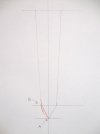
That's my fault, not yours. If a had a scanner or camera handy I would have just drawn a great picture like you did. Instead I tried to put together graphics from the net and geek speak.

But your pic is perfect. The convex grind (the red line) has a more obtuse angle than the flat grind, and has more material behind the edge. If the convex had the same angle, like in 42Blades' pic...it would have less steel behind the edge than the flat.

It's all kinda obvious when you draw the pictures. Again, despite what certain convex-edged knife manufacturers say.

And, again, I take all my flat ground v edge knives and convex the edge. I love that configuration, they are super easy to maintain, and it makes for a great cutter. It stands on it's own merits without having to make cockamamie claims that go against simple logic and geometry. I've never quite figured out why some convex-edged knife manufacturers feel the need to make those claims.
 
That's my fault, not yours. If a had a scanner or camera handy I would have just drawn a great picture like you did. Instead I tried to put together graphics from the net and geek speak.

But your pic is perfect. The convex grind (the red line) has a more obtuse angle than the flat grind, and has more material behind the edge. If the convex had the same angle, like in 42Blades' pic...it would have less steel behind the edge than the flat.

It's all kinda obvious when you draw the pictures. Again, despite what certain convex-edged knife manufacturers say.

And, again, I take all my flat ground v edge knives and convex the edge. I love that configuration, they are super easy to maintain, and it makes for a great cutter. It stands on it's own merits without having to make cockamamie claims that go against simple logic and geometry. I've never quite figured out why some convex-edged knife manufacturers feel the need to make those claims.

Bingo. I find that the true advantages of a convex edge are often not mentioned or overlooked and instead inaccurate claims are often made because they are simpler for a consumer to absorb. Heck--a lot of this stuff is probably difficult for even the knife nuts here to absorb! While the reality of convex edges is very simple in practice or in visual demonstration the description of it can be a bit of a headache. :p
 
Sharpness is a perception created through experience. It is a individual knowledge that is only gained through time. Trying to measure it and standardize it would be impossible unless all knives were made exactly the same with the same steel and heat treatments.

Convex,

Sharpening is a destructive action and you can in no way add metal when doing so. If you convex the bevel of a flat ground blade that has a V bevel it will be thinner. The middle of the bevel slopes will now become the maximum height of the bevel slopes and the shoulder of the bevel is technically brought closer to the cutting edge. The round curving geometry added to the "shoulder" that's now closer to the apex means the buil-up of friction is reduced on the overall thickness and length of the sharpened bevel.


Durability is NOT something you can gain by thinning a blade and convex does NOT make a edge more durable, only making the apex angle more obtuse will increase its resistance to deformation. The perception of durability comes because though convex often makes the overall bevel thinner it makes the apex angle much thicker.
 
Sharpness is a perception created through experience. It is a individual knowledge that is only gained through time. Trying to measure it and standardize it would be impossible unless all knives were made exactly the same with the same steel and heat treatments.

Convex,

Sharpening is a destructive action and you can in no way add metal when doing so. If you convex the bevel of a flat ground blade that has a V bevel it will be thinner. The middle of the bevel slopes will now become the maximum height of the bevel slopes and the shoulder of the bevel is technically brought closer to the cutting edge. The round curving geometry added to the "shoulder" that's now closer to the apex means the buil-up of friction is reduced on the overall thickness and length of the sharpened bevel.


Durability is NOT something you can gain by thinning a blade and convex does NOT make a edge more durable, only making the apex angle more obtuse will increase its resistance to deformation. The perception of durability comes because though convex often makes the overall bevel thinner it makes the apex angle much thicker.

Personally I think that there's a difference between sharpness and "perceived sharpness," as discussed earlier in the thread. :)
 
All of the above re convex edges is true for the most part. I have hand-ground a few overly thick sabre grind knives into full convex with reasonably acute apex angles - 28-30 degrees inclusive. The edge sweeps away at almost a flat grind but arcs back to accommodate a thinner spine than would have been on a flat grind or Scandi. They still don't perform as well as thinner edges, convex or otherwise, but are a good compromise for having such thick back bevels. The fact that one can convex even relatively thin edges without producing failure-prone results just goes to show that most knives are way overbuilt. I recall reading in an old camping book a sentiment that I believe is from Sears about how poor the geometry is on most hatchets, and how one needs to grind the shoulder completely off to get acceptable performance from them (convexing). Not only do they hold up fine, but they cut better and longer without maintenance. To me this is a defining statement in some respects - convex edges make thicker blades perform substantially better - on blades with a relatively thin back bevel I honestly haven't seen any real advantage - it all comes down to how thin the stock is and how acute the apex until your edge is too thin to hold up, something that can only be determined through use and experience.
 
Bingo. I find that the true advantages of a convex edge are often not mentioned or overlooked and instead inaccurate claims are often made because they are simpler for a consumer to absorb. Heck--a lot of this stuff is probably difficult for even the knife nuts here to absorb! While the reality of convex edges is very simple in practice or in visual demonstration the description of it can be a bit of a headache. :p

Yup. A good picture, like yours and Brian's is worth a thousand words. Especially when they are the nerdy math words I was spitting out!

I also hear the claim that convex edges are, by nature, "sharper" or cut better than v-ground edges. I don't buy that one.

My convex edges are sharper and cut better than my v grind edges, but only because I can maintain my convex edges much easier by hand than I can maintain my flat ground edges by hand (even with a Sharpmaker). Again, no magic to it. My theory and I'm sticking to it! :)
 
Back
Top