Easy blade collar fabrication

We should lick their backs...... it is less dangerous than french kissing them, I hear.

 
Awesome, thanks for the pictures. I'll give this a try once I attempt a hidden tang knife. Would an electric soldering iron work okay for this?
 
lol, talk about a thread wandering off into the bizarre. :D

Sorry... my fault.

Tai, I have always wondered how makers solder up copper without leaving lines. Does silver solder patina along with copper, brass, bronze? I apologize for the ignorant questions but I really know little about soldering outside of grade 10 electrical. I would ask Wally but he makes me do stuff before passing on knowledge... like "sand da floor" and "paint da fence"..... "Aaaap, Dowwwwwn".... lol.

Rick
 
heheh, I wasn't complaining, this place wouldn't be nearly as fun without this kinda detour. It was worth a good chuckle. :)
 
It's high temperature silver solder. I used a Mapp gas torch.

You can play with the patina etc., to get a good color match if you think it’s necessary.
 
Last edited:
Rick,

You can make a solder joint just about invisible by making
sure that the pieces fit VERY closely together.

I fit stuff closely, tin both pieces, using graphite as a solder "stop",
spring clamp together, reheat to flowing temp, and cool slowly.

Good fit=almost no solder line.

Dad was a plumber, taught me to solder at an early age. A messy
joint was a no-no.:eek:

Bill
 
Thanks Bill... I always figured solder needed to be in a thin but ample layer between the pieces, like epoxy. It must really thin out when heated properly.
 
Rick,

The joint should be so close that capillary action will draw the
solder into the joint. If you tin the joint up front and clamp snugly
all the excess solder will flow out of the joint. Think metal super glue.
Ideally, the solder layer will be just about invisible.

If I can get my camera up and working I'll try to post some photos.

Bill
 
Good point Bill.

You can also use "depletion gilding" on silver soldered silver to hide the joint, and use copper plating on silver soldered copper. However, getting a nice tight fit, like Bill said, is the most important.

The term depletion gilding is usually used when referring to gold, but the process will also work on silver.
http://en.wikipedia.org/wiki/Depletion_gilding

The same process, sometimes called "depletion silvering", is used on sterling or coin silver to prep it for reticulation.

I like fabrication because it’s fast and direct. It also tends to be more durable than cast, because of milling, work hardening etc. However, I usually expect to see some very faint solder seams, which don’t really bother me as long as the seams are clean and tight.

...The placement of the seams is also a factor to consider. I try to plan it out so that the seams are in areas that are the least noticeable or distracting.
 
Last edited:
One last thing on the seams,… High temperature silver solder comes in 3 grades, low, medium and high. The high (sometimes called hard grade) is the most pure with the least alloy content, so it shows the least. A good tight fit with high grade is nearly invisible. That’s what I used on the collar.
 
You bet Nick!

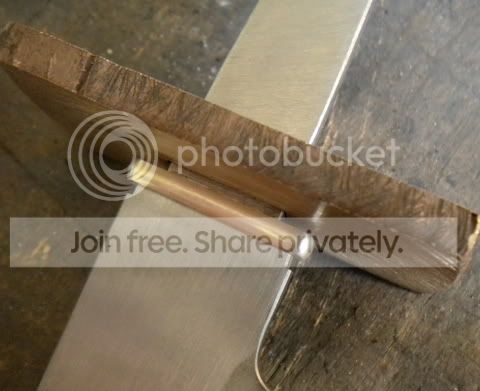
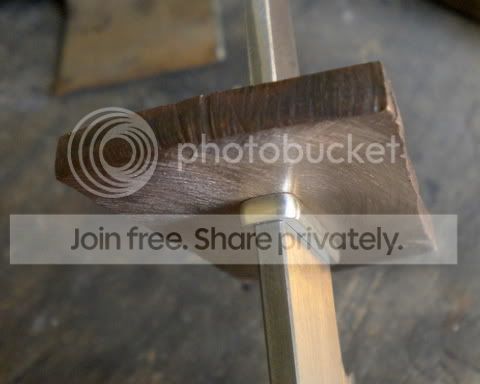
Here's a couple shots that show how it'll fit up with the bronze gaurd and lock the collar in place.

DSCN2718.jpg


DSCN2721.jpg
 
An added note on soldering copper. If we are talking about hi-temp soldering, it's not much of a step up in temperature to brazing heats, in which case there are several bronze alloy rods that color-match pretty well with copper. We learned to braze copper pipe in pipe-fitting apprenticeship, it's pretty easy to do with a handheld MAPP torch. O/A works well too, with a brushy flame. They taught us to braze copper pipe without even using flux...

By the way Tai, nice work and thanks for the info. I'm doing a cable blade with a habaki soon, this is good inspiration.
 
Back
Top