Easy blade collar fabrication

You're right Salem, you can braze copper with bronze for a closer color match. I've been thinking about using some rich shibuichi (silver bronze) for solder on the copper, not sure about temps., though. Alloying in general does lower the melting temperature. High temp., silver soldering is “brazing” as opposed to welding (at the melting point of the base metal). Some of the bronze rods might even be lower temp., than the hard silver solder. I'd have to check on that.
 
Cool, I really only make the distinction between hard silver soldering and brazing here because of the filler material, and the (often) slightly higher temps for brazing with bronze/brass rod. Thanks for adding that for clarity, people get all kinds of confused with torch welding, soldering, and brazing nomenclature.

I'd love to try making some Japanese copper alloys. Shakudo is beautiful stuff, too.
 
Yeah, the terms "soldering" and "brazing" are often used interchangeably in silver smithing. At any rate, the high temperature solders are generally much stronger than the low temp., ones.

http://en.wikipedia.org/wiki/Brazing
 
Last edited:
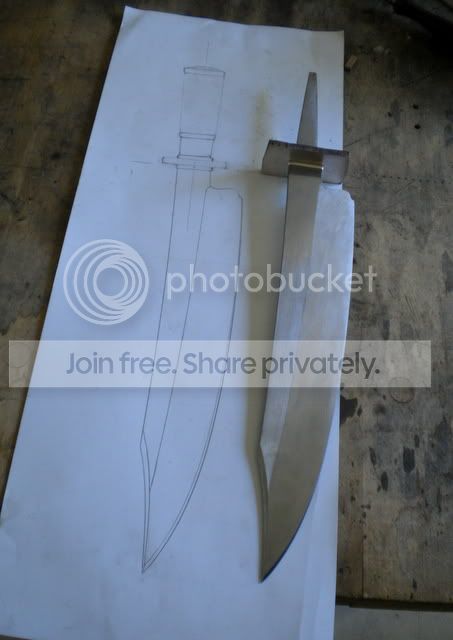
Here's sort of where I'm going with it, basically, but it'll have a semi octagonal wood handle wrapped with Turks head knots and capped off with metal on the ends. I'm not a good enough drawer to draw that.

DSCN2724.jpg
 
Still a very good drawing, I couldn't draw that.. That's gonna be a really nice knife when you're done! Thanks for sharing your techniques
 
Thanks.

I had an idea of what I was going to do, (it's for someone), then forged the blade. Once I had the blade, I used it as a template for the drawings and just fiddled with the proportions until it sort of balanced out.

I may still tweak it a little.
 
Last edited:
How strong of a bond is HH silver solder? I remember that Ring Chopper you made for Curtis (way cool).... was that soldered on?
 
Rick, Yes that was soldered on.
(copper to copper)

Here's what Wikipedia says under "silver brazing", but I think it varies like anything else:

"The standard for braze joint strength in many industries is a joint that is stronger than either base material, so that when under stress, one or other of the base materials fails before the joint."

It's a very strong joint. :)
 
Last edited:
Thanks Tai.... I didn't know that. It really changes my perspctive on the durability of soldered/brazed fittings.
 
Many times small race car and airplane frames have been brazed together as a method preferable to welding for strength.

Nice plan with the Turk's head knots, Tai.
 
Another soldering factoid- a good silver soldered or brazed joint resists deterioration from vibration better than a weld, generally speaking.
Andy G.
 
Another technique is to TIG weld the copper using a thin cut copper sheet ribbon for filler. Have welded up many very thin copper vessels this way. No seams at all. Make sure you have excellent vapor removal in place if welding copper...

Really appreciate seeing how you do this so elegantly Tai. Thanks!
 
Last edited:
Tai

I'm curious how you get such a sharp crisp bend at the corner.

Can you explain that a bit?

Some sort of very thin chisel & dapping block - like a press brake die to help form the corner?
 
I think he files those V-notches in the strip and hammer forms them directly on the blade. Then fills the gaps with solder. At least that's how I follow the pictures.

Rick
 
Rick has it basically right.

I just bent it on the notches by hand first and then used the blade itself as a mandrel. The notches should be about 3/4 of the way through the strip for nice crisp bends at the corners. The notches are then filled with silver solder. If you get too much solder on the inside of the collar, in those corners, just file out the excess. Since one end of the collar is opened at this stage, it does tend to spring apart a little on that end. So, I cut the piece that goes in the end to size first and then, with finger pressure, spring the collar shut a little on the opened end, so it holds the end piece in place with spring tension. Then solder the end piece in. An alternative method would be to just put a pair a cross lock tweezers on the opened end to hold it tight while soldering.
 
Last edited:
Tai, awesome thread, thanks for sharing!!! One question...You are a pretty artistic fella, why not carve the knot work into the wood? I am sure you could do it. Just curious..Not trying to be an ass lol. I can barely tie my shoes...let alone cool knots.

Mike
 
Last edited:
I appreciate that Mike, but that might be beyond my skill level.

At any rate, it will be faster and easier for me to wrap it. Keep in mind that it's going to be around a semi octagonal eight sided handle. The woven cotton wrappings also will add strength to the handle. After I wrap it real tight, I'll make some thin shellac, that will bleed through to the wood core, totally saturate the the fine woven cotton fibers and form a super strong all natural composite after many coats.

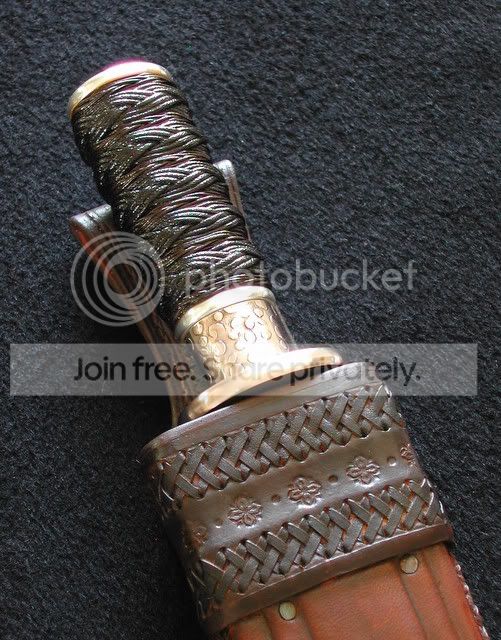
It's styled after this one. I wish the semi octagonal cross section showed better in the pic. It's a subtle detail, but I really liked how it worked out geometrically with the knotting on this one.

19WildGoobowiewithsheath011.jpg


It's also an order, so the wrappings are part of the deal.

The ferrule and end cap, (handle fittings) will also fit over the wood to hold it all together on the ends. I might change the texture on the ferrule a bit, not sure yet. All fabricated non ferrous smith work... cut, bent, forged, brazed etc.

I often do my own alloying, ingot casting and milling on the silver as well... sometimes make the solder too.

The collar strip in this thread was "home cast and milled" from some sterling spoon scrap.

... Glad there's some interest in the non ferrous smithing. :)
 
Last edited:
I knew I kept all those nipped copper rivet pin ends for a reason! "Coppahagane"
 
Ok,i will admit that the wrap is every bit as awesome as if it was carved! Very cool stuff Tai.
 
Back
Top