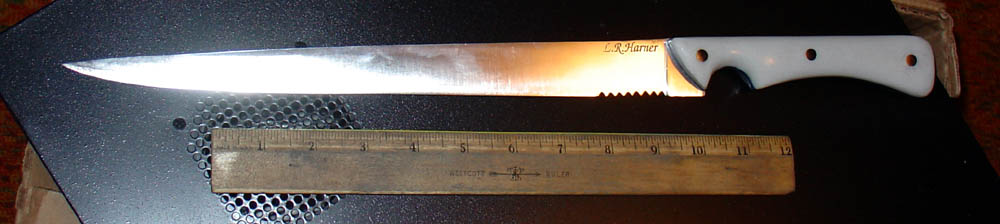
Edge holding ability of ATS 34

sunfishman said:
Dan, I think you are putting words in my mouth ;)
naww Don
I wouldn't do that, would I:rolleyes: :D

as you all say it's what's right for you and the customer for sure..
I personally use O1 in the woods hunting and fishing, and I do feel
154CM/ATS34 will hold one of the best edges in the world..even over O1
but still I'm not really sure why that is the one knife I take with me hunting, it could be that I've used it on so much game , it's a good luck charm or maybe because it's one of the first knives I've made..many a moon ago..in 74
working o1 for over 32 years now and 154CM for a bit over 8 years now..

steel is truly in the eyes of the beholder..I really would hate to see the steel ATS34 go down the tubes for guys that don't know it's capability if all is done right with it..not saying I have it perfected yet, but I feel I'm getting there..

this is from one of my customers, the knife was a little short 3 1/4" blade 154CM..and again very close to ATS34.. the only reason I use 154cm instead is, I'm a bit old school and want to use the US stuff not the Japanese version of it..
check it out..
----- Original Message -----
From: Ron Green
To: D.G. Gray & Sons
Sent: Thursday, October 24, 2002 5:39 AM
Subject: comments
Two years ago, my best friend had Danny Gray build me a custom knife. I appreciated the knife because it was made
specifically for me and it was the only one of its kind. The first time I used it to clean some fish and later to gut
and skin out a deer, I realized what a great knife it is but never realized the true value and what an exceptional
knife it really is until I used it to gut out a 766 lb. moose. While getting ready for moose hunting, The Maine Moose
Hunting Guide, and a friend said to make sure and take extra knives as they would dull very quickly. The
only knife I used was the Gray knife and even used it to cut through the pelvic bone when I realized I didn’t have a
saw or axe with me. I bent the blade just a little but the knife is still sharp. Thanks Danny, this is one remarkable
knife. Ronnie Green Plymouth, Maine

Hi Dan, My daughter shot her first deer yesterday, she really didn't want to gut it out herself but agreed to watch and
maybe try it next time. My knife http://www.kynd.com/~graydg/knife148.html did one more job and is ready for
the next. Do your knives ever get dull? Actually, it will probably need a touch up by the end of the season.
Love that knife......... Ronnie Green
gray148.JPG


MIke (Miden)
I think your blade steel or the H/T some how went south on you in it's trip to the finished product.. it's one good reason I want to do the H/T myself it takes one unknown factor out..
 
i like ats34 and now cpm154 (the cpm154 seems to work much nicer)
but as said its al about heat treat
right now im happy with the way mine has been comming out so im sticking with it
my .02
butch
 
miden said:
Hi Guys,
I have only made a handful of knives, all but one are made of ATS 34.
My very first knife was a carving knife for my wife.
I sent it to Crucible for the heat treatment so I assume it was professionally done, however, it does not seem to hold an edge very well.
I know there are a lot of opinions regarding the best steel for a blade but this is all relative and it is not what I am asking because this mule has been beaten to death and the debate always gets ugly.
I sharpen with a Lansky sharpener.
Can anyone who uses this steel please share their experience regarding edge retention?
Much appreciated.

Mike

What are the angles you are using and what technique do you use? What is the finest grit you sharpen to? Do you use a hone? Do you dump the knife in the dishwasher or wash and dry it by hand? I'm trying to figure out why it dulls so quickly and thinking maybe the bevels are too accute (to razorlike). Is it being used to chop veggies on on a hardwood cutting board or something?

http://www.ajh-knives.com/metals.html
 
So many replies, thanks guys.
Mike (Lovett), the cutting board is a hard plastic, not stone but sometimes things get cut inside the pot. Okay, steel on steel is not good.:eek:

Mikxx1, I take great care to not overheat the steel after heat treatment,in fact, I only hand rub.
Crucible do a really good looking job, vacuum oven and all so there is no decarb whatsoever. In fact, I finish grind the blade and just have to polish it up afterwards. Really neat looking job but then I do not really know what went into the treatment.
Anybody know anything about Crucible? I have never heard anything negative about them,quite the contrary actually by some reputable makers who have their knives done by them so I would hate to give them a bad rap.

Will52100, I think some of the above answers your question.
Care to tell me more about the brass rob test? I hollow grind by the way.
I requested 60 HRC.

Dan your friend Ronnie Green just about says it all. No better proof than a field tested knife by a satisfied customer.
I do not have HT facilities and I have read that HT for stainless is quite complicated compared to that of high carbon "simpler steels". (ducks instinctively):D

DGG, I sharpen to 25 degrees.
The knife is normally used to carve meat and chop veggies on above mentioned plastic board. Well, okay as also mentioned, occasionally something gets cut inside the pot too.
Trouble is, I seldom get an edge that can shave, even before it hits the pot and the cutting board.

I made a knife for a friend too and he complained it could not cut his jerky too well, he would put a razor edge on it but it got blunt too quickly.

I have seen so many good things said about this steel and the likes of Misters Lovless and Lovett have pretty much made their solid reputations with the help of ATS 34 so it cannot be a bad steel!!
Baffled I am!!
Thanks for all the input and interest gents. Sorry if I did not thank everyone by name.:)

I edit to add, I generally finish sharpening with medium stone.

Mike
 
to me it just doesn t sound like it was fully hardnend but i can belive that is the case least i wouldnt bet on it
maybe have it tested the ats34 i have is 60-61 and not fun to finish grind after heat treat
butch
adding if you want to try some ats34 i did and you think it will make it over the border i have a test knife i did fro the hell of it but i do need it back at some point for a friend to use on some big fish
227862293_68b0261a27_o.jpg
 
sunfishman said:
I souldn't knock ATS-34, it isn't so bad, there are a bunch of great knives made with it. I just personaly don't like it, but like I said before, I don't like any of the stainless steels for knife blades. So ya'll need to take what I said as a personal opinion :)
I think we need to hook you up with some AEB-L. ;)

Back to the original question: as for the edge retention of ATS-34/154CM, Phil Wilson got around 100 cuts with 154CM at 60 Rc and he got around 130 cuts with S90V at 60 Rc. I don't know about you, but the distance between the two steels in edge retention suddenly doesn't seem so great, not to mention 154CM is much easier to sharpen.
 
Miden, If I may, I would like to suggest a deralin, Or nylon cutting board. Hard plastic will turn a very fine edge. If you sharpen to the point that you have very fine directional teeth in the steel edge, such as done on a very fine diamond hone, Hard plastic will smooth them over almost instantly on any type of steel . if honed to the point that you have a shaving sharp smooth stroped edge, hard plastic will make it show light on the edge in no time. Mike
 
miden said:
Hi Guys,
I have only made a handful of knives, all but one are made of ATS 34.
My very first knife was a carving knife for my wife.
I sent it to Crucible for the heat treatment so I assume it was professionally done, however, it does not seem to hold an edge very well.
I know there are a lot of opinions regarding the best steel for a blade but this is all relative and it is not what I am asking because this mule has been beaten to death and the debate always gets ugly.
I sharpen with a Lansky sharpener.
Can anyone who uses this steel please share their experience regarding edge retention?
Much appreciated.

Mike
made a knife for your WIFE?:confused: Thats the problem right there!:D As was mentioned early, I am sure she is using a corian or other synthdic cutting board that is too hard. Out cutting here rose bushes? Plus washing it In the dish washer relentlessly! I have use ats-34 for over 700-800 hundred culinary knives, (Paul Bos does the HT) ATS-34 holds a great edge with just a few practices, NO dish washer! the sulfates in the soap will dull the edge. use a butchers steel to stroke the edge gently a couple of time to straighten the edge before use. knife edges don't go dull as much as the roll over. from hitting bone or the user twisting their hand. Also I tell my buyers endlessly;) that the reason its called a dish washer is that it is for dishes! not knives, otherwise they would call it a knifewasher!:D I love Stainless Steels like 440c. ATS-34, and my two favorites BG_42 & S30V I use the last two on hunters and one OF art knives. I lives two blocks from the ocean and I can really watch my carbon steel inventory 1095, 01, rust before my eyes:eek:
 
Damn, that really riles me.
Just typed a reply and for some reason I bombed as I posted it.

Butch,
thanks so much for your offer but I could not possibly accept.
You know how things are at the border and if the package were to be opened that knife would certainly be "confiscated". It is a very nice business-like looking piece and looks like it can do the job.
Much appreciated anyhow.

Larrin, that is an interesting test especially given the difference in price of the steels.What did Phil cut?

Mike (Lovett), is nylon less nasty with an edge?

Rhinoknives, yes, a knife for the wife.:D
If you think of it that is not such a bad idea. What more brutal testing ground can you think of?
Yes, it has been through a few cycles in the dishwasher and it has spent a few nights in the kitchen sink fully submerged. Handle scales have been replaced once because of the above.

Regarding the edge bending during use, I would however have thought that steel hardened to 60 Rc would chip, not bend when hitting bone etc. Interesting.

Thanks again for all the replies guys, I appreciate it. Looks like the root cause of my woes is probably more the user than tool. There is still a lot of blade left on that knife of the wife's. Some more practice seems in order.;)

Mike
 
Yes Nylon is much easier on the edges. For an edge to bend at higher Rc, is the mark of good heat treat, and great steel. One of the problems that is showing up with SV30 is chipping at the higher Rc's. Not a good thing. A slightly turned edge can be trued up quickly. A chipped edge requires a lot of sharpening, or a light re-grind of the edge. Something you don't want in the field. Mike
 
miden said:
Larrin, that is an interesting test especially given the difference in price of the steels.What did Phil cut?
Some type of rope, I don't remember what. If I remember right, these numbers were taken from Cliff Stamp's website from his review of a Phil Wilson 10V knife.
 
Larrin, Miden and all, I am not sure what reference you are referring to as far as comparing 154CM to S90V but since I saw my name mentioned maybe I can at least give an update on where I am now with some of the steels mentioned. I do my cutting tests on manila rope, usually ½ inch diameter strand taken from a larger woven pc of rope. I use this rope because it is a very close approximation to Deer/Elk hair or wild pig bristles. I use Wayne Goddard’s method with a few modifications of my own. I cut on a scale against a clean pc of Alder wood. I tape off a portion of the blade so am not cutting with the whole length. This lets me compare a longer blade against a shorter blade. Also a longer blade, if you cut with the full length like a 9 inch fillet knife takes a lot of work and uses a lot of rope. I use a slicing stroke with down pressure. When the scale reads 25 pounds of down force I quit. At this point the blade is still sharp enough to skiv leather and would still be useful for skinning a deer for example. A fussy user like myself would want to do a quick re sharpening at this point. I admit there is a lot of feel involved here. This is not as precise as what Cliff Stamp is doing, but after you do this for a while it is very easy to determine right at the start how a blade is going to cut and how long it is going to last. The other things I want to point out are that the sharpening method, blade geometry and heat treating and hardness have more influence on how a blade will cut than the steel grade. I sharpen with a medium silicon carbide stone, free hand using Windex ( not oil) to keep the stone clean. I then back stroke at a larger angle on a loaded leather strop to take off the burr. A polished shaving edge will not cut rope very well, you need the micro teeth from the medium stone to provide enough grab to get efficient slicing. In addition to the above test method I have used my knives in the field on deer, elk and wild pigs and this pretty much confirms what the rope tests tell me. I heat treat my own blades and have a hardness tester so I don’t have to guess at the hardness of the blades tested. Given all the above this is how I would rank the steels I have tested. The hardness values are what I consider to be optimum for the given steel grade. My test blades were all flat ground. I consider all the CPM steels to have adequate toughness at the hardness shown for a slicing type knife. For choppers hardness should be reduced. Steels are listed with longest edge holding first.

CPM 10V (63/64), CPMS90V (60/61), CPMS30V (60/61), CPM154 (61/62), D2 (60/61) 12C27 (59/60), 154CM/ATS34 (60/61), AISI 420 at .5% carbon (55/57)

I don’t use 154CM/ATS34 any more for hunting knives since S30V is easier to heat treat (for me) and my field tests show that it performs so much better. I like CPM 10V best for a hunter-utility, and 90V for a stainless hunter-utility. S30V is my favorite for fillet knives and it also makes a great hunter-utility. I have just started to work with CPM154 and like it very much for fillet knives and am just now making an 8 inch Chef’s out of it now. I think it will be a great choice for all around multi use blade. I have worked with CPM3V some but if I am going to make a non-stainless knife my first choice is going to be 10V. I did not list number of cuts on rope because it is all over the map depending on the rope, blade geometry and hardness. These are my results and other makers with different blade shapes and hardness may get different results.

Another note. I saw reference to the brass rod test. IMHO all this test tells you is that the blade is heat treated. You will get pretty much the same results over a wide range of hardness. The edge will flex the same at 55 as it does at 60...

PHIL
 
Phil,
thank you very much for taking the time to do the post.
Your testing info is welcome to me and probably to a lot of other guys too.
You also threw a few more points of confusion in for me!:confused: ;)
Good to have many points and facts to ponder. It is particulatly interesting what you say about "the sharpening method, blade geometry and heat treating and hardness have more influence on how a blade will cut than the steel grade."

May I shoot you an e-mail sometime?

Thanks again, I really appreciate it.

Mike
 
Phil Wilson said:
Larrin, Miden and all, I am not sure what reference you are referring to as far as comparing 154CM to S90V but since I saw my name mentioned maybe I can at least give an update on where I am now with some of the steels mentioned.
I hope I didn't mis-quote you, I simply went off of Cliff Stamp's site.
I do my cutting tests on manila rope, usually ½ inch diameter strand taken from a larger woven pc of rope. I use this rope because it is a very close approximation to Deer/Elk hair or wild pig bristles. I use Wayne Goddard’s method with a few modifications of my own. I cut on a scale against a clean pc of Alder wood. I tape off a portion of the blade so am not cutting with the whole length. This lets me compare a longer blade against a shorter blade. Also a longer blade, if you cut with the full length like a 9 inch fillet knife takes a lot of work and uses a lot of rope. I use a slicing stroke with down pressure. When the scale reads 25 pounds of down force I quit. At this point the blade is still sharp enough to skiv leather and would still be useful for skinning a deer for example. A fussy user like myself would want to do a quick re sharpening at this point. I admit there is a lot of feel involved here. This is not as precise as what Cliff Stamp is doing, but after you do this for a while it is very easy to determine right at the start how a blade is going to cut and how long it is going to last. The other things I want to point out are that the sharpening method, blade geometry and heat treating and hardness have more influence on how a blade will cut than the steel grade. I sharpen with a medium silicon carbide stone, free hand using Windex ( not oil) to keep the stone clean. I then back stroke at a larger angle on a loaded leather strop to take off the burr. A polished shaving edge will not cut rope very well, you need the micro teeth from the medium stone to provide enough grab to get efficient slicing. In addition to the above test method I have used my knives in the field on deer, elk and wild pigs and this pretty much confirms what the rope tests tell me. I heat treat my own blades and have a hardness tester so I don’t have to guess at the hardness of the blades tested. Given all the above this is how I would rank the steels I have tested. The hardness values are what I consider to be optimum for the given steel grade. My test blades were all flat ground. I consider all the CPM steels to have adequate toughness at the hardness shown for a slicing type knife. For choppers hardness should be reduced. Steels are listed with longest edge holding first.

CPM 10V (63/64), CPMS90V (60/61), CPMS30V (60/61), CPM154 (61/62), D2 (60/61) 12C27 (59/60), 154CM/ATS34 (60/61), AISI 420 at .5% carbon (55/57)

I don’t use 154CM/ATS34 any more for hunting knives since S30V is easier to heat treat (for me) and my field tests show that it performs so much better. I like CPM 10V best for a hunter-utility, and 90V for a stainless hunter-utility. S30V is my favorite for fillet knives and it also makes a great hunter-utility. I have just started to work with CPM154 and like it very much for fillet knives and am just now making an 8 inch Chef’s out of it now. I think it will be a great choice for all around multi use blade. I have worked with CPM3V some but if I am going to make a non-stainless knife my first choice is going to be 10V. I did not list number of cuts on rope because it is all over the map depending on the rope, blade geometry and hardness. These are my results and other makers with different blade shapes and hardness may get different results.
Can you elaborate on the performance of 12C27?
 
"" The other things I want to point out are that the sharpening method, blade geometry and heat treating and hardness have more influence on how a blade will cut than the steel grade."" By Phil Wilson

Truer words were never writen. :thumbup:
 
Phil -

Good post.

Since you are hardening to HRC 60 +/- do you experience any brittleness issues? VG-10 Spydercos are notorious for snapping off tips with any torsional stress even though they are well hardened and hold an edge.

Here is another guy who knows knives opinion.

http://www.bladeforums.com/forums/showthread.php?t=368828

Bottom line seems to be both from your post and Joe's that there are lots of different things that go into making a good reliable knife other than the steel.
 
Larrin, DGG, To elaborate more on 12C27. I got some 2mm stock that]came heat treated. It was RC57. I went ahead and made an 8 inch fillet knife with it but re heat treated it. With a 2000 F soak, 2 hr in LN2 and 400F tempers was able to get it up to an honest 59. It is a flexible blade but at this hardness I can bend it 90 degress with 5 lb force on the handle. I consider this to adequate bending strength for this type of knife. I did not get any edge chipping cutting rope or cardboard or whittling pine. As I reported this blade holds an edge a little better than 154CM/ATS 34. This is based on one blade and as I said there is a lot of feel in these tests but I like how this steel cuts.

As far as toughness is concerned on all of the steels I listed at RC 6o+, I have made fillet knives out of all of them and they will do the 90 degree bend just fine. This is bending strength not impact toughness. If dropped point down on concrete most likely there would be damage. This is impact toughness and these steels would have to be RC 55 or so to survive this kind of treatment. I made a staking tool/chisel out of 154 CM and had to go down to this hardness to prevent chipping when cutting brass or soft steel.
Midden
Back to the original question of why the ATS 34 did not perform up to expectations here are some thoughts: ATS34/154cm does best at 60/61 hardness. It is hard to get it there. It takes a high soak temp, oil quench a cryo cycle and a 400 temper. With an air quench the higher temp temper (975) is necessary to get it to that hardness. Crucible was mentioned as the heat treater. I am sure this is not Crucible Materials Corporation, the maker of the CPM steels. It is most likely a heat treater with the same name in Canada (?). Anyhow it may be that the blade was actually softer than 60/61. Paul Bos does this steel right and has a lot of experience with it. That’s why the blades he does get good reports. I think you get the point…. If you want to send the blade to me I will do a hardness test and we can check this out. 1 PHIL
 
Back
Top