ESEE (RAT Cutlery) RC-4 terrible handles

RONIN21

Platinum Member
Joined
Jun 24, 2007
Messages
728
I originally posted this in the General forum but I think I will get a better response in this forum from which I learned so much.

Gentlemen, I have a RAT RC-4 knife that I really like, except for the handles. I find that they are too thin. I was wondering if anyone knows someone who could "rehandle" the knife with thicker and more contoured Micarta handles.

Any help would be appreciated.

Thanks in advance.
 
I originally posted this in the General forum but I think I will get a better response in this forum from which I learned so much.

Gentlemen, I have a RAT RC-4 knife that I really like, except for the handles. I find that they are too thin. I was wondering if anyone knows someone who could "rehandle" the knife with thicker and more contoured Micarta handles.

Any help would be appreciated.

Thanks in advance.

You could always ask John of JK Knives although I believe he is away this week !
 
Thank you Doug and "pitdog" for your responses. I will look into both of the gentlemen
you mentioned.

Tony
 
I like the handle scales the way they are, but be sure to post up pics if/when you get new ones made! Ought to be super-mega-ultra sweet. :cool:
 
I like the handle scales the way they are, but be sure to post up pics if/when you get new ones made! Ought to be super-mega-ultra sweet. :cool:

After some research, I am going to take a shot and have the knife rehandled and then I will definitely post the results.
 
i felt the same way at first but im starting to like them more and more the way they are
 
i felt the same way at first but im starting to like them more and more the way they are

Me too, I have an RC-4S and at first I was just sure the scales would be too thin, and the handle to be too short for me also to be perfectly honest. But then after using it a good bit...cooking, making components for bow drills, whittling, you name it, and carrying it a lot...I am really starting to like them just as they are. The handle doesn't seem too thin at all to me in use, and any more length would just be extra material sticking out of my hand and extra weight that served no real purpose in the field. Also I happen to like the sheath, and it's retention, just the way it is...or the way it is now, I did drill a couple of extra holes in it for a couple of the carry options I use (though wouldn't mind it it were more of a rectangle or bi-symmetrical but that's a personal thing with me)...and to go and make the handles any thicker would mean changing sheaths. My RC-4 has become one of my most used knives, and all in all I am extremely happy with it.
 
Yep, I'm with the other two. Not that I really want to change your mind or anything. What I do suggest is that you actually use the knife for some long term cutting chores. Much like Mistwalker, what I have found is that thin handled knives work better for me. They produce less hot spots and less fatigue.

I have to admit that they are less comfortable to hold onto. When I first started using knives, I always gravitated to big, fat handles. They feel very nice when you hold them. What I wasn't doing is whittling and carving with them. What I found out when I did that was those fat handles made my hands tire out quickly. So thin is for me even if it doesn't feel super great when just holding the knife. Its what I find works during the using that counts.

Of course, others can be totally different, but I'd say give the knife a chance and start to use it. Don't think to hard on it, just use it for a bit. Grap another knife where you like the handle and use the two of them for a large carving chore. Hey, why don't you shape a baton out of a nice piece of oak or hardwood block from your firewood cache. Don't think on it, just use the knives. See which one you naturally keep coming to. That will give you the best clue as to what your body wants. Often, our brains get in the way of the best choices!
 
......Of course, others can be totally different, but I'd say give the knife a chance and start to use it. Don't think to hard on it, just use it for a bit. Grab another knife where you like the handle and use the two of them for a large carving chore. Hey, why don't you shape a baton out of a nice piece of oak or hardwood block from your firewood cache. Don't think on it, just use the knives. See which one you naturally keep coming to....

Yep, that's how it worked for me. I used it for a while whittling, and then switched back to another knife for a while, and back and forth during the first of the working with the fire bow project, The more I cut and whittled the more I gravitated to the RC-4 and the more I liked it. I like how the shape of the handle gives me a good grip, a lot of control, and good leverage for the stuff I do and things I make in the field. Also I noticed that when someone brought up a "how-to-do-something" question I was reaching for the RC-4 more often than any other knife on hand to do/make whatever explain it. Other than chopping it really does handle all the tasks I do on a regular basis very well (and why I want the 6), and does better at chopping than most might think for it's size. At this point I'm thinking the only way I'll ever have a knife and sheath system I like any better all around will be to just make both myself or be very hands-on at the time of making because it would only be subtle changes and mostly in the choil and guard areas geared to my overly-large diameter fingers.
 
Like the others have said use it first as I find slim handles to be better for most things. The only time thick handles are better to me would be a chopper
 
I like my 4's grip and I got biggish mitts, but if I wanted to thicken it just to try,I'd probably do a paracord or shoelace wrap.Depending on the style of wrap it should improve the grip a bit.
 
Now that everybody tried to convince you of the handle itself, I'll go on to recommend that if you still don't like your RC-4 then perhaps you should just sell it and go with a different knife. The reason I say that is that the RC-4 is great, but it is so because the combination of micarta slabs, blade and sheath. I'm not so sure the blade alone is that unique and once you fiddle with the scales you won't be able to use its sheath any longer.

Some other options to try out are the BRK&T Bravo-1, it definitely has beefier handles. The Ranger Afghan, BK-2, or maybe you would want to step on up to the ESEE-5.
 
Lamont Coombs rehandled my BK2. Black canvas micarta he also used pins instead of screws, beadblasted the black coating off and milled some thumb serations in. All for a very reasonable cost.

theknifemaker@hotmail.com
 

Attachments

  • lamont.JPG
    lamont.JPG
    77.5 KB · Views: 59
Handle fit is a very personal thing.


Not only is everyones hand different,

...how we hold/use a knife also varies.


A knife that seems "wrong" at first might feel just "right" after some hard use.


I have had many knife handles feel too big/small, contoured/slab sided, rough/smooth when first inspected, that actually worked quite well for their intended tasks.


My advice is to use that RC-4 (or any new tool) for a while before having mods made.


Big Mike
 
For me it depends. (the handle)

For me a handle that is deeper top to bottom has to be thinner to not feel clumsy.

A handle that is narrower top to bottom I want to be wider relative to it's depth.

For when I am whittling thru something to avoid pain on the backward pressure I want it to be wide across the spine.

However in order to avoid feeling clumsy I want the scales to taper both toward the ricasso and also taper toward the part where your fingers curl around the handle.

I find that I can have a wide handle that has great finesse and control as long as the slabs taper top to bottom too.

For instance:

Of these 4 knives I find the far left is great for fine work but not as good for whittling thru something thick because the rear of the handle is both square and thinner.

The third from the left is fantastically comfortable for extended whittling thru thick wood but a bit clumsy for me on fine cutting due to the overall diameter.

The second and fourth from the left are the best overall because they have enough swell and rear width but taper.

sbc3.jpg


The shape of the top knife here in this pic for me requires a thinner handle because it is deeper. The bottom knife a wider and more round handle.

minitony5.jpg


Not sure if this pic shows it well but the slabs taper to not much wider than the actual tang on this knife so it has good control

koster3wk9.jpg


Maybe you can see it a bit better on this one:
arctic4.jpg


Or maybe this shows it better, wide across the back so it is flat on your palm but narrow for control where your fingers go round
arctic5.jpg


So for me it sort of goes beyond thin versus thick scales and more dependant on the actual shape of the handle and knife and how they are contoured.:thumbup:

 
Just make sure your new scales go on with the ESEE torx screws, then you can swap scales when you want to.
are you thinking of more palm swell or overall?
 
I agree re: the size/shape of the ESEE 3/4 handles. Just not appropriate dimensions for a general purpose bush knife, for my uses. However, I'm not sure that the dimensions of the handle would be very amenable to changes. Meaning, I don't think thicker scales would necessarily solve the whole problem.

For good contours, Fiddleback and Brian Andrews are tops. The BCNW handle is superb too.
 
ESEE4mod001.jpg


ESEE4mod002.jpg


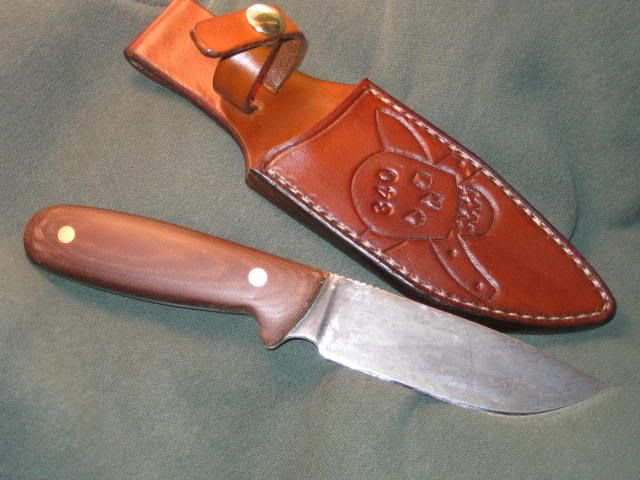
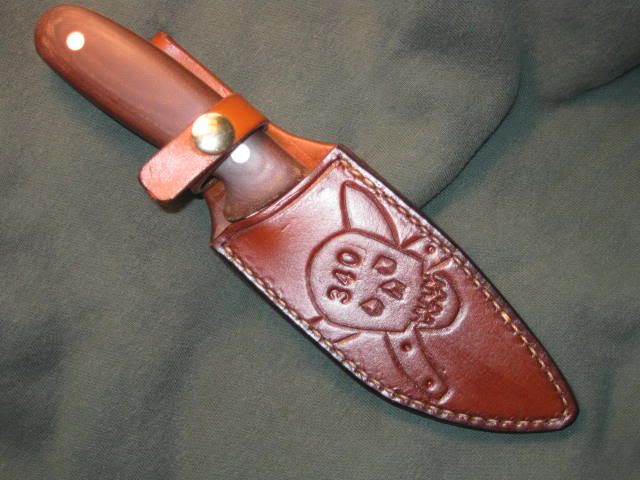
This one was improved with some Shade Tree stuff by a member on a different forum. Dunno if that's the kind of thing you have in mind. The guy is principally into leather but says he's a knife tinkerer. If you like it perhaps negotiations can be had.

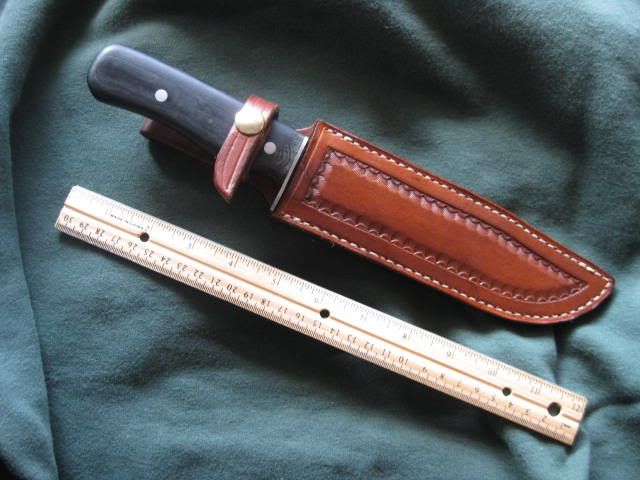
Just for clues - here's a KA-BAR he did too.

KaBarmod007.jpg


Here he is

.
 
one thing to try before spending a lot of $$.
pick up some thin spacer material (or cut up a plastic bucket and make your own) to use as "handle shaped" shims to try under the factory scales - ths way you can figure out how thick you actually want the handle before you talk to anyone about the job. (1 layer on both sides, 1 layer on 1 side, 2 on the other, etc...)
 
Back
Top