UPDATE #2: 2/3/2026
All's well that ends well... or so they say.
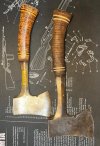
Meet Carver...
I don't name tools as a general practice, but as I age, it comes as a bit of whimsy to my aging self.
Ref: My previous posting above, I said I had an idea. Such idea has been floating around in my mind for a time now, and this axe, at this time, just seemed to fill the bill for a mini-adventure at my workbench.
Sparked by my recent encounter whittling a couple of small wooden spoons, combined with a goodly amount of negativity floating around the internet regarding the Estwing Sportsman's Axe as a viable Carving Axe, I wondered if one might just be able to turn a Sportsman's Axe into a functional Carving Axe.
While perusing one of the axe groups over on FB a while back, I ran across a posting regarding a "Mini-Axe Contest". One of the requirements for entry was that the axe presented must be 25cm or shorter. Well, that sounded interesting, and seeing as how I sometimes feel the urge to accept a challenge, I chose to accept this one, but only as a personal challenge. Not only am I too late for entry to that contest, but I'm not one for joining contests as a general rule.
Since I had recently used one of my stacked leather Estwings to trim the handle form down on the wood knocker, aka Froe Club, or Beetle as I've recently learned it is also called, and found that it worked quite well, I also recognized one of the issues folks had with using the Sportsman's Axe as a carver. Even with heavy leather gloves on, that shank bit into my aging hands more than I cared for.
So here I was, with a neglegted axe, dated 6/9/81, and a desire to try something new. I really wanted to use Walnut for the new handle, but it seems small, dry, walnut wood was not to be had around my town. And since I wanted to see what grain I might be working with, I chose to go with a Red Oak drop I had on the shelf, leftover from a kitchen project. I try to not use power tools any more than I have to anymore. I simply don't care for the noise, but in this case, I broke out the sabre saw and disc grinder for assistance.
View attachment 3095038
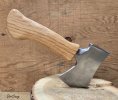
This piece of Red Oak, albeit quite miserable to inlet, certainly does display some handsome grain patterns. A very generous volume of 5-minute, clear epoxy and a firm clamp-up in the bench vise brought the two halves together to form what looks to be a solid handle grip. I chose to not pin these slabs on. After all, this is destined to be a light-duty cutter, and I didn't want to risk splitting a handle scale with peening. Time will tell if that was a valid decision or not.
View attachment 3095037
After three applications of Boiled Linseed Oil, Carver is ready to get to work (or play, in this case - I don't call my hobbies work). I left the handle a bit robust because it seems to allow for better control with my aging hands, with or without gloves. If I find it to be too robust as I use it, I can always break out the files and sandpaper once again.
View attachment 3095039
The more robust handle however, has negated the possibility of using a stock, Estwing leather sheath, so it was back to the box of bike stuff for a piece or two of old innertube and the other shelf for a length of round leather cord leftover from a recent hiking stick project. Note! I doubled up the innertube where the bit settles in.
View attachment 3095036
Disclaimer:
I am not a woodcarver, nor am I a spoonmaker, but I do read a lot. Therefore, I chose to re-profile the bit on this axe, in an effort to improve cutting action for its intended purpose. The edge certainly was in need of some attention, so I got to work with my files. Don't let anyone tell you that is soft steel! I chose to cut the angle back on both sides, with the inside (workpiece side) extending up the head more than the outside (chip side). I'm a right-hander. I also tried to add a bit more curvature to the cutting edge in hopes of improving slicing action when in use. The result seems to work well in conjunction with the factory, extended hollow grind and overall thinness of the head. It cuts well using both a chopping action, as well as simply pushing as one might do with a knife blade.
View attachment 3095040
Here, Carver checks out the working height of the newly added legs of my "axing block" as they call it, to do some final dressing of the handle of the Beetle. Note! I call that one Bailey, for obvious reasons of course. The axing block went back out to the backyard upon completion of installing the legs.
View attachment 3095035
Happy axing everyone. Be well. Be safe.
What have you folks been doing for your Estwing Axe of late?