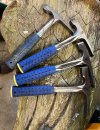
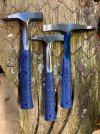
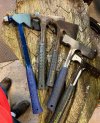
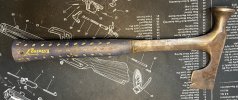
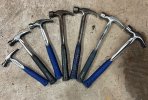
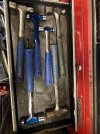
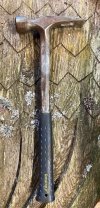
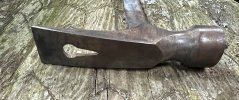
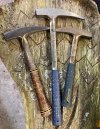
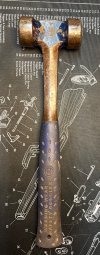
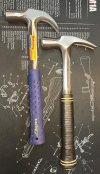
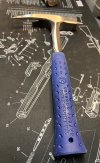
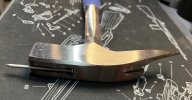
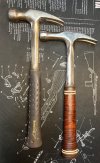
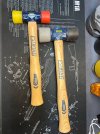
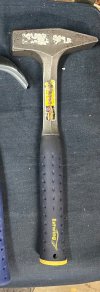
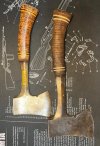
Photos Estwing

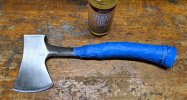
Much like with wooden axe handles, the purpose of the lacquer is not as a permanent finish, but as a form of "shrink wrap" to protect the material against moisture/humidity changes in storage. Scrapes off easy and feels SO much better once it's removed and the treatment of your choice put on (if any.)
I imagine that it's more comfortable to use for hours with less chance of blisters?
 
The major drawback in Estwing axes and hatchets is the slim concave profile which makes them too sticky for chopping work.

Totally agree - for the medium to large diameter cutting, i.e. moderatedly sized trees, logs, etc. Even large amounts of firewood can be challenging. But for under say 6" diameter type small trees, branches, kindling, shaving wood, camp chores, etc, works great and fairly easy to sharpen, given the 'softer' metal / HT.
 
The Mulchmaker...

or:

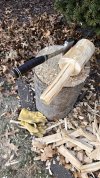
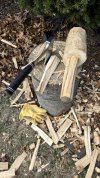
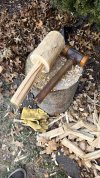
The making of a mallet...
I have a really old plastic mallet that works great, but have always wished for a wood knocker. Maybe it's time to make one, eh? Note! The dings on the poll were there when I got it.
20260113_165856-DDS.jpg

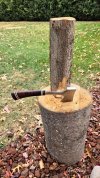
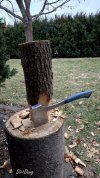
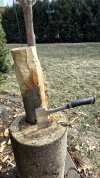
Poor man's mulching machine.
20260113_170227-C-DDS.jpg

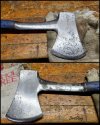
Me: "That one looks like it's seen some salt water at one time or another."
Ebay Seller: "Well, your right, we live at the beach, it's not really pitted tho."
20251121_135411-Collage-DDS.jpg
 
Much like with wooden axe handles, the purpose of the lacquer is not as a permanent finish, but as a form of "shrink wrap" to protect the material against moisture/humidity changes in storage. Scrapes off easy and feels SO much better once it's removed and the treatment of your choice put on (if any.)
How would you recommend removing the lacquer? And what would you then choose to refinish/condition with?
 
How would you recommend removing the lacquer? And what would you then choose to refinish/condition with?
A card scraper makes quick work of it. You can then give the leather a quick buff with some fine sandpaper or steel wool if you want.

For leather treatment I'm obviously biased, but I'm a fan of my own Desert Whale leather balm, which I formulated based on extensive research after discovering that the common neatsfoot and mink oils used on leather are what are chiefly responsible for the leather's eventual hardening and cracking as the oil polymerizes, and the manner in which mineral oil (the most commonly available non-drying oil) can negatively degrade leather over time. The Desert Whale leather balm is a blend of high-purity refined jojoba liquid wax esters, cetyl alcohol, and cetyl palmitate, all of which are wholly plant-derived but are structurally identical to the primary constituents of whale oil, which was prized for its resistance to oxidation/polymerization, and spermaceti wax, which was used for many important functions. Refined jojoba is a true liquid wax, and is even more resistant to oxidation and polymerization than many mineral oil fractions, not to mention other natural oils like coconut oil or castor oil. The overall end effect of the blend is a balm that is remarkably similar to human skin oils (hence jojoba's popularity in skin care products, and what is leather if not skin?) that applies smooth and restores luster to the leather while effectively resisting water and dirt, with effectively no risk of eventual hardening of the leather from oil polymerization, as all of the components are true waxes.
 
A card scraper makes quick work of it. You can then give the leather a quick buff with some fine sandpaper or steel wool if you want.

For leather treatment I'm obviously biased, but I'm a fan of my own Desert Whale leather balm, which I formulated based on extensive research after discovering that the common neatsfoot and mink oils used on leather are what are chiefly responsible for the leather's eventual hardening and cracking as the oil polymerizes, and the manner in which mineral oil (the most commonly available non-drying oil) can negatively degrade leather over time. The Desert Whale leather balm is a blend of high-purity refined jojoba liquid wax esters, cetyl alcohol, and cetyl palmitate, all of which are wholly plant-derived but are structurally identical to the primary constituents of whale oil, which was prized for its resistance to oxidation/polymerization, and spermaceti wax, which was used for many important functions. Refined jojoba is a true liquid wax, and is even more resistant to oxidation and polymerization than many mineral oil fractions, not to mention other natural oils like coconut oil or castor oil. The overall end effect of the blend is a balm that is remarkably similar to human skin oils (hence jojoba's popularity in skin care products, and what is leather if not skin?) that applies smooth and restores luster to the leather while effectively resisting water and dirt, with effectively no risk of eventual hardening of the leather from oil polymerization, as all of the components are true waxes.
Thanks so much for taking the time.
 
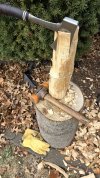
More Mulchmaking...

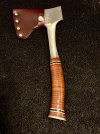
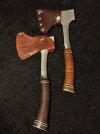
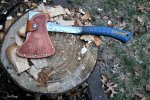
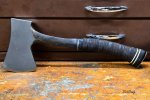
This Estwing E-24A was in pretty good condition upon receipt. A little cleanup on the head and shank, followed by sanding and conditioning the leather, got this back into top form. Oh, and I did re-profile the bevel on the cutting edge too. I gave it more flat than convex form. It really works quite well for this type of axe work. Note the updated, thicker end cap/butt plate. I still haven't found out when they brought that on scene. I also might note that I like the leather grip on this one better than the blue handled grip model I showed above. This is heftier and seemed to give me better control.
20260120_094641-DDS.jpg
 
Last edited:
Graduation Day...
From Mulch to kindling.

That plastic mallet looks like it would be more at home in a machine shop than a woodlot. But it's still better than whackin' that axe with a steel hammer.
20260122_135341.jpg

Now that's more like it for a woodlot mallet. I've wished for a wooden knocker for some time.
20260122_143046.jpg

It works quite well too.
20260122_140911.jpg

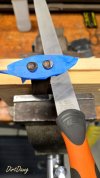
I'll likely dress it up a bit more when the weather warms up some, but I'm pretty pleased with how it turned out. First attempt at axe carving of any sort.
20260122_143256.jpg

Time to retire the old plastic job to the bottom drawer of the toolbox.
20260122_143117.jpg

Be well. Be safe.
 
New arrival - Estwing 24A Sportsman's Axe
I didn't have one quite like this yet. And it didn't break the bank to acquire.

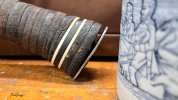
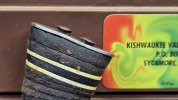
No nail nick & thin steel end cap. Note decorative black and white discs on butt end of handle only. I find that interesting.
View attachment 2986824

I believe this to be the driest leather handle I've received to date.
View attachment 2986825

24A
View attachment 2986827

A quick sanding with 60 grit to remove the laquer residue patches and right down to trying to revive those leather discs with Neatsfoot Oil. I'm really hoping it's not too late.
I'll see if I can get the leather to swell a bit before I continue with sanding. Most of the discs are actually loose on the steel core at this point in time.
I suppose it's a good thing I stopped at the boot-shoe-leather shop for a fresh bottle of oil this past week.
View attachment 2986828

Followed up this morning again with a bit of hand sanding and another generous application of oil. Let that set until evening and repeat twice a day.
That's my plan of attack at this point anyway.
Yes, I could just strip the leather off and re-stack with new, but I like a challenge. And there is something about keeping a tool in near original condition that appeals to me.
Be well. Be safe. Stay sharp.

UPDATE: 1/24/2026
It could be said: "Well that didn't work".
So, after the initial going over, I decided to try soaking the stacked leaather and sealing it up until at least Christmas. That was in November 2025.
20251109_062936-DDS.jpg

Well, Christmas has come, and Christmas has passed. It was time to open up the packaging and see what a good soaking of Neatsfoot Oil did to this handle over the last month or so.
20260120_075341C-DDS.jpg

Umm? Seemingly not much.
20260120_075410-DDS.jpg

Not only did it not swell the leather any, but the leather discs are all still very hard. So... I could simply peen the pins more and see if I can tighten things up a bit.
20260120_075510-DDS.jpg

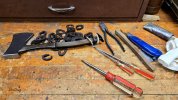
But I chose to go whole hog and do a complete replacement instead.
20260120_100555-DDS.jpg

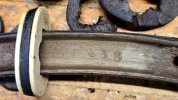
43 B - That's an interesting marking.
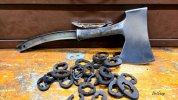
Those decorative discs looked in quite good condition, so they will be saved.
20260120_100635-DDS.jpg

Proceed with caution.
20260120_132220-DDS.jpg

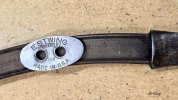
6-9-81... Hmmm? Nothing special about the date, except it may explain why there was only one set of decorative discs installed on this one. After all, the US was in a recession at the time, and many companies were conserving where they could. Maybe that is why? Maybe not?
The end cap/butt plate stampings seem to be all over the map on these tools. I for one, find that interesting.
20260120_135659-DDS.jpg

OK, where to go from here?
I have an idea. Standby, I'll be back with updates as I progress.
20260120_135916-DDS.jpg
 
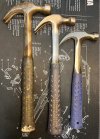
Linesman hammerIMG_9837.jpegEnglish patternIMG_9838.jpegGerman “Latthamer”IMG_9839.jpegIMG_9840.jpeg
A discontinued Electrician next to a similar size normal IMG_9841.jpeg
Soft face IMG_9842.jpeg
Cross pein
IMG_8127.jpeg
Size comparison of the 2 hatchets the bigger one seems far more commonIMG_9843.jpeg
 
Last edited:
Back
Top