On Estwing Stacked Leather Handled Knives… My Humble Rundown
(You may wish to grab your reading glasses at this time)
It seems there is not much information available on-line regarding Estwing Stacked Leather Handled knives, and what is out there is sporadic and somewhat muddied. I’ve been misled by false claims and opinions so much that I found myself passing said information on as truth. For that, I apologize, and I believe I’ve updated and corrected my past errors to the best of my ability. I have since, quite thoroughly researched Estwing leather handled knives and compiled what I have learned to date. I now present it here. I’ve also provided reference photos to support my findings.
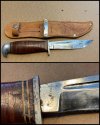
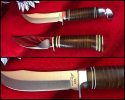
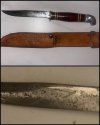
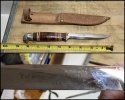
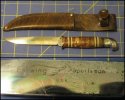
I have determined that the first knife offering from Estwing would be the Camp Knife.
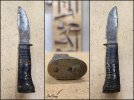
The Camp Knife had no pommel as we know it, but was made with a peened on end cap like the stacked leather Sportsman’s Axe has. Of the examples I’ve found on-line, all have brass guard and end cap, with the end cap being stamped as follows: ESTWING (over) ROCKFORD, ILL.
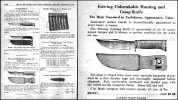
The Camp Knife measures in at about 9” overall with about a 5” blade length, and came with a leather sheath. Mine looks to have seen some use and measures in at 8-3/4” & 4-9/16” respectively. A left-handed sheath is shown in the old ads. However, I’ve seen some pictures showing various right-handed sheaths as well. I’m not sure that any are original to the knives though. Worthpoint however, shows what may be an original left-handed sheath.
The clip point (or would that be a skinner?) blade is forged of carbon steel, with a generous swedge, and has what some may consider an exaggerated choil. With a thickness measurement of .127” about halfway from the tip to the guard, and tapering to .158” at the guard, the blade on mine sports a flat grind from spine to cutting edge – no parallel flat except the ricasso area.
All of the examples of this knife I’ve seen look to have decorative discs made of leather. I know mine are. I believe production of this knife ceased before they went to plastic decorative discs.
I cannot pinpoint exact years of production, but to date, I’ve determined that the Camp Knife was likely offered Circa 1930’s-40’s. Of course, that is subject to change as updated information surfaces. See photos for additional information regarding my Camp Knife.
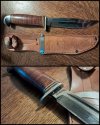
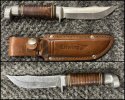
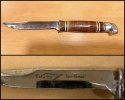
Next up is what I call the Scout.
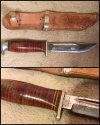
Not because it was made for scouts necessarily, but rather that it simply looks to be the same knife that is made by Iisakki Järvenpää of Finland, the Järvenpää Scout Medium Knife, which measures in at about 9” overall with a blade length of about 4-1/2”. I do not have one to visibly inspect, but comparing photos and specs on-line seem to place the two knives as near identical. Keep in mind that with that statement, I’m referring to the Finnish made model of the Estwing Scout knife. It seems the USA version is missing the fuller (aka blood groove) that the Finnish knife has. The blade on either version of this model seem to lack a swedge. However, with what appears to be a Scandi grind (with micro-bevel), and the resulting profile of the tip, that feature may substitute as a swedge. Note! Just thinking out loud here. I’m no expert on grinds.
Along with the fuller, or lack thereof, other differences between the Finland version and the USA version of the same Estwing knife are as follows:
USA - Ricasso stamping of Estwing (block lettering partially enclosed by a wing outline) (over) U.S.A.
Note! After I originally put this writing together, I discovered that said knife would have been manufactured by Camillus, and patterned after the Longmont-Coleman-Western Model L66 sometime between 1991 and 2007 when Camillus closed their doors. The Camillus-Western L66, as well as the Estwing branded version (and seemingly identical knives with the exception of tang stamps and decorative leather discs) is distinctively different than the Western or earlier versions in that it has an extended aluminum finger guard and threaded tang. The pommel is secured to the tang by a brass nut and ground flush with the pommel end (no pins).
Finland – Ricasso etching of Finland in script lettering and etching of Estwing (block lettering partially enclosed by a wing outline) on the blade. Looking down from the top of the spine, the USA version is marked on the left side and the Finland on the right. I cannot comment at this time as to blade steel of either version.
One other difference between the two knives lies in the sheath. The USA version looks to be much more robust than the Finnish sheath, yet both have the Estwing name stamped on them. A similarity between the two is that both seem to have decorative discs on the handles. I can only assume at this point that they are made of plastic.
Now might be a good time to bring up the fact that the Finnish made Iisakki Järvenpää Scout knife series includes four variations as follows:
The Jahti Scout Knife, listed as their biggest Scout knife.
The Kolkka Scout Knife, listed as their smallest Scout knife.
The Children's Scout Knife, listed as having a blunt tip for safety.
Finally, the Scout knife I’m talking about, simply the Scout Knife, listed as their mid-size Scout knife, and in my opinion, just an all around good choice to pattern after and hang the Estwing name on. Not too big – not too small.
Now to the Sportsman…
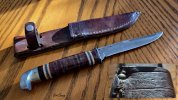
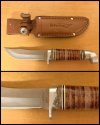
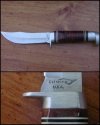
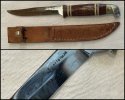
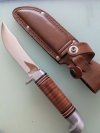
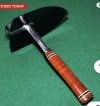
Being the runt of the litter, and coming in at about 8-1/2” overall length, with a blade length of about 4-3/8” (that’s what my example measures anyway), the blade, with a noticeable swedge, measures .095” thick from the swedge terminus to the handle. The combination of an apparent Scandi grind and swedge offer a pleasing taper to the tip of the blade. The spine on this knife is pretty much flat, yet with a hint of clip dip to the leading half of its length.
Called the Sportsman, I’m not really sure of just what pattern or style this knife is considered. Some may call it a Small Hunter. I’ve even heard it referred to as a Bird & Trout knife, but it seems a bit large for that to my eyes. I’ve always understood the Bird & Trout pattern to be a smaller knife.
The handle, although maybe a bit small for some larger hands, fits my hand very well. It has a nice palm swell and along with an aluminum pommel. The leading edge of the stacked leather of the handle is formed to blend completely with the aluminum guard. As with the Scout knife, all of the examples I’ve seen have decorative discs on the handles, and I’m assuming at this point that they are made of plastic of some sort.
Looking down from the top of the spine, the blade markings will show as etchings on the left side of the blade as follows: Estwing (block lettering partially enclosed by a wing outline), followed by Sportsman in block lettering (over) U.S.A. As with the Scout Knife, I cannot comment positively as to blade steel, but mine looks like it could be stainless steel. I am however, not going to leave it out in the rain to find out.
I have yet to find any examples (contrary to many claims in the bay and other places on-line) of any of this model Estwing knife with a fuller, or made in Finland for that matter. It seems I have been known to be guilty of spreading erroneous information about this model having Finnish roots as well – corrections have since been made. Rumors have it that this model may have been made by Camillus or Coleman-Western, but I cannot confirm that. Note! It is my understanding that Western used two pinss and a bifurcated tang, whereas the Estwings of this model use only one pint to secure the pommel.
At this point in time, I’m inclined to believe that this Estwing Sportsman knife was manufactured by Camillus as well, and may well have been patterned after the Camillus 1007 - sans fuller.
Sportsman Sheath…
Of the sheaths I’ve seen on-line, there are at least two that I believe to be authentic Estwing Sportsman sheaths, one made of leather and the other made of a synthetic canvas-backed type of material. Mine is made of leather and looks to be a quality piece of workmanship. The name Estwing may or may not be marked visibly on the sheath.
Axe/Knife Combos...
As most are aware by now, the Axe/Knife combos came with the Sportsman’s Axe (I believe to have been only the 24A) and the Scout Knife. Whether or not it ever came from the factory with the Sportsman knife I am unable to determine at this time. Even though I’ve spotted one set on-line that shows the two together in a gift box, I’m not sure that box contained both from the factory, or if the two were joined together as an aftermarket gift set. One other thing I noticed is that the gift sets seem to have come with either the Finnish or the USA made Scout.
So, there you have it, all I know and assume about Estwing knives to date.
Photos to follow in my next postings.



.....I remember seeing some of em back in the 70's in magazines my.old man read!!!!