"Everything You Always Wanted To Know About Martensite..." by the intrepid Mr. Cashen

Tai, when I first started reading some of your writing on other sites around the internet, I got the impression that there was very little we would ever agree upon, but after studying your wording over the years, I have come to the conclusion that it would be a mistake to ever underestimate you! The phrase “crazy like a fox” comes to mind ;) While I can understand some of your methods, words or actions I may never comprehend the motivation, but this is the case with all human beings. I have a guiding saying that I have lived by for many years now- “no matter who they are, or how close, one can never truly know the heart of another human being”. Nor should we, not only would it make the world very boring, it could make life unbearable. Of all the characters on the show “Heroes” the cop that can read minds is the most tragic to me, I would not burden a man I hated with such a curse.

I personally don’t see metallurgy as a method to make better knives, in fact the reason I started studying it and buying gadgets was not for the knives but to overcome and combat the handicap that the traditional “wisdom” in knifemaking had burdened us with. I don’t see scientific fact as a tool as much as I view it as a cure. It is the best antidote to the garbage that bladesmiths have been consuming and regurgitating for too long. When a famous icon tells you that the grass is blue and the sky is green, and all of your common sense protests fall upon deaf ears because you are in no position to argue with an icon, then the cure is to start stacking up facts. Eventually, with the help of science, you can build enough of a solid foundation that the column of knowledge can be seen by the general public just as well as the pop idols. When enough people have a sound education in how light wavelengths make the sky blue and the grass green, the nonsense is received as such no matter who spouts it.

The way I see it we haven’t even started laying the foundation for a future of metallurgical bladesmithing, as we are still in the process of clearing the building site of years of useless debris. But then facts are such a powerful tool that we may have some structure up before the old rubble is entirely cleared.

Metallurgy is not the end all of end alls, last word, final authority or holy grail... It's just another tool for expression.

This is a huge sentence. I agree entirely with the first half and adamantly disagree with the second half. Once again metallurgy can be a powerful tool, an effective antidote to ignorance, but it still takes the human hand and the human mind to implement it, but by itself it is little more than cold lifeless equations, and it can be misused to perpetuate mistruths if the people being misled are not versed enough in it to recognize the abuse. However I see expression as an entirely subjective thing and relative concept thus metallurgy, or any other scientific discipline, can contribute very little to it. Expression has no place in science thus science has little to offer expression. When we view facts as just another form of expression we diminish them to relativism and the natural world becomes meaningless to anybody but the one observer to whom those particular feelings apply. To me that is the beauty of science, it is not right or wrong, good or bad, it just IS, and objective facts are a constant. Regardless of how we feel about gravity, Newton’s observations will always apply and every person who ever stepped off a cliff “expressed” themselves in exactly the same way – “SPLAT”. Everybody is entitled to their own opinions but not their own facts.

Science has it’s time and place but it is worthless in something as unfathomable as the human heart. Metallurgy can predict exactly what the internal structure of a knife will be depending upon what the smith does to it, but it is entirely powerless to predict whether the majority of the public will see the knife is beautiful, or butt ugly. Working with just science that knife would be just a cold and lifeless hunk of well tempered steel, but when one includes art and expression with it a very beautiful and functional tool tool can be made. 100% martensite will not make you feel good when you hold a knife, but an artist who is capable adding expression to the science can.

Tai I have to confess to liking chatting with you, you cause me to think deeper than the same old iron-carbon structures;).
 
Thanks Kevin!

I think the more things we can find to agree on the better. It will have a positive influence and impact on the community,.. I believe.

We don't have to agree on every little detail,... but just be honest.

Good communication is not always easy in this medium.

However, there are some things that you say that just strike so close to home. I'm just guessing that our methods are not really much different and am excited about chatting more with you. :)
 
Metals are a fascinating medium,… especially steel! That's why I've spent most of my life learning about them and working with them. Although, most of the time I'm mainly interested in the actual working properties and information that is immediately applicable, there's nothing wrong with studying them just out of curiosity and interest either. It's not always easy to find the information I'm curious about though, because much of the information seems too technical and dry and I end up having to weed through so much of it. That's why I'm looking forward to having some good discussions with Kevin and others.

In high school, math and science were always my strongest subjects and I didn't really get into art until I got to college. Although, I don't push science in my work,… I am always reading literature and watching educational shows about science. It's still one of my favorite subjects.
 
I have always had a very odd split on math and science. As long as I can remember even basic mathematics has been a challenge for me, while science and history just came naturally. I was a notorious school skipper in high school which resulted in D- and E in anything involving math, but it infuriated my science and history teachers when the only day I would show up was test day and I would ace their tests. From grade school on, if it interested me in any way all I had to do was be near it to absorb the information straight out of the air, if I found it irrelevant to my current interests or boring, every little bit of learning was a Herculean task and then I wouldn't retain the information afterwards. This led several of my teachers to conclude that my school skipping was the result of boredom and frustration with the curriculum rather than my bad grades being the result of my absence. Some teachers who felt this way allowed me to "customize" my assignments in order to peak my interest, and almost overnight brought my grades up in their classes. Such teachers are a very rare and valuable commodity.

Today I can often read metallurgy texts almost as fast as I can turn the page until I encounter an equation… then I stop dead and either just skip over it or struggle with it for 10 minutes and lose my train of though on the interesting stuff. Indeed I often find myself losing focus on the number crunching because the back of my brain is still visualizing the fascinating diffusion based reaction I was working with before encountering all these %@#*& numbers! It is not that I can’t do math, once I actually force myself to focus it is all very basic and logical, just it is so damned boring that every moment spent with it is like tweezing nose hairs! I have always loved Einstein for giving me curved space to visualize and freeing me from all of Newton's miserable equations. Readers can rest assured that any book I ever write will not include nerdy assed, drier than a popcorn fart, equations!

The problems are intensified due to how I have always handled the opposite, the stuff that I am interested in. When I find something interesting I don’t just study it, I obsess over it. I am not a multi tasker, but instead single mindedly focus on one thing until I have exhausted it or it has exhausted me. I am incapable of learning just a little bit about something that interests me, if I cannot immerse myself in it, I will simply ignore it and put it on a shelf until I can. These are good tendencies if you have the luxury of a single pursuit, but it is quite a handicap if you wish to function in our modern multitasking society.

These issues become problematic in the shop when something catches my interest and I have other work to do. And the real miserable situation is having to work on a God cursed CUSTOM ORDER, when you have all these great ideas that will have to wait until the phone quits ringing.

As my knives sit on the show table there is very little science evident in them. Metallurgical savvy can draw attention to the maker but only artistic quality can draw eyes to a knife. The customer cannot see a lack of pearlite or retained austenite sitting on your table, but they can see elegant curves and crisp lines. 60HRC martensite will not compel their hands to lift the blade from your table in a need to feel it, well placed textures and a flowing design will. Heck even when they use the knife nothing I have seen under the microscope will ever be visible to the user, but a poorly designed handle will give them blisters. I will always prefer to have my knives sell themselves rather than relying on gimmicks, sales pitches or tall tales.
 
Kevin, your last post is terrifying to me... you might as well have just described me in the first few paragraphs!
My struggle with mathematics has always been something I've been ashamed of, yet my applied understanding of the same concepts can border on autism.
...but we've already had this conversation, haven't we?;)

Tai, my greatest lacking has forever been in my inability to express myself in a creative or artistic method. I can recognize it in others, but have never been able to properly connect with that part of my brain. It's funny, but following your posts on this forum and others has got me pondering things... please check your private messages!
 
Kevin, your last post is terrifying to me... you might as well have just described me in the first few paragraphs!
My struggle with mathematics has always been something I've been ashamed of, yet my applied understanding of the same concepts can border on autism.

Same as me. I struggled all through school with being bored to tears, and when one interesting subject did come up i was ignored due to large amounts of kids in one class(small district), it was hard for on individual to get help. Through until 9th gade it was all Ds and Fs with an occasional C(except in art class with straight As). I was helped by my principal, who saw and recognised the problems i was having and at great cost to the district(something to the tune of $5,000 for each student each year) i was enrolled into an "alternative school" program. There was kids who'd been in jail, teen moms, "nerds", all had similar problems of not being able to cope in the regular school program for obvious reasons. No more than 10 kids to a class, customised projects like Kevin had mentioned to make things sinteresting to each person seperately, it was an amazing program and I would not have made it through to get a Diploma without it.


To me Science and art go hand in hand, both accent each other and are beautiful and creative together, almost to the point that they are the same entity. If you look in a telescope at a cloud of super heated gas, yeah it's beautiful but when science explains just what is going on, that that cloud was formed by gravity over however many millions of years it becomes even more beautiful.
 
I've always thought that their must be a strong connection between math, science and art.

Math was always my strongest subject, then science. I was straight A in math,... always the very top of my class. They put me in the accelerated programs, for "gifted freaks". I was doing algebra and geometry since grade school. It came easy for me, but my teachers hated me! I used to get my kicks by catching the teachers mistakes on the blackboard,… and then embarrassing, humiliating them and rubbing their noses in it. The other kids thought it was pretty cool watching the teachers turn beat red. One time this teacher got so frustrated, he called me to the front of the class and said, "I challenge you to a duel!". He picked up a couple chalk erasers and handed me one, and said "You stand over there and I'll stand here, and we'll each take a free shot O.K.?" I said "Sure, you go first." So, he took a shot. I ducked and he missed. So then I nailed him real good right in front of the whole class! He had chalk power all over his suit and face. The others kids cracked up as he turned red and stormed out the classroom. :)
 
I personally don’t see metallurgy as a method to make better knives, in fact the reason I started studying it and buying gadgets was not for the knives but to overcome and combat the handicap that the traditional “wisdom” in knifemaking had burdened us with. I don’t see scientific fact as a tool as much as I view it as a cure. It is the best antidote to the garbage that bladesmiths have been consuming and regurgitating for too long.

Undoing the mistakes and correcting the falsehoods of the past just gets us back to even.

With a sound metallurgical foundation, bladesmiths will be able to elevate the craft to the next level. I do see metallurgy as a method to make better knives, as do the people who poured out their buckets of goat piss and bought some parks 50, built digitally controlled salt tanks, and bought dewars of liquid nitrogen to cryo treat their high alloy steels.

And who knows, when a few forward looking bladesmiths incorporate contemporary metallurgical knowledge to elevate their processes up to modern industrial standards, they may emerge as pioneers, discovering new knowledge or developing new processes to make even better knives than have ever been made before. And if they're really good, these products of scientific method and discovery will at the same time be beautiful expressions of art.

It wouldn't be the first time that has happened. Think Enzo Ferrari.

But there's a lot to be said for human instinct and intuition... and there's always that nagging thought that maybe we lose something when we get too scientific.

Interesting discussion...
 
I've always thought that their must be a strong connection between math, science and art.

Math was always my strongest subject, then science. I was straight A in math,... always the very top of my class. They put me in the accelerated programs, for "gifted freaks". I was doing algebra and geometry since grade school. It came easy for me, but my teachers hated me! I used to get my kicks by catching the teachers mistakes on the blackboard,… and then embarrassing, humiliating them and rubbing their noses in it. The other kids thought it was pretty cool watching the teachers turn beat red. One time this teacher got so frustrated, he called me to the front of the class and said, "I challenge you to a duel!". He picked up a couple chalk erasers and handed me one, and said "You stand over there and I'll stand here, and we'll each take a free shot O.K.?" I said "Sure, you go first." So, he took a shot. I ducked and he missed. So then I nailed him real good right in front of the whole class! He had chalk power all over his suit and face. The others kids cracked up as he turned red and stormed out the classroom. :)

Shouldn't that be "beet" red? :D
 
I was always lousy at math, too. I can add, subtract, and multiply fairly well, but long division addles my brain. English, spelling, science, and reading comprehension were my best subjects. I was getting post high school scores in fifth grade in most of those. But my math scores were embarrassing...
 
Undoing the mistakes and correcting the falsehoods of the past just gets us back to even.

With a sound metallurgical foundation, bladesmiths will be able to elevate the craft to the next level. I do see metallurgy as a method to make better knives, as do the people who poured out their buckets of goat piss and bought some parks 50, built digitally controlled salt tanks, and bought dewars of liquid nitrogen to cryo treat their high alloy steels.

And who knows, when a few forward looking bladesmiths incorporate contemporary metallurgical knowledge to elevate their processes up to modern industrial standards, they may emerge as pioneers, discovering new knowledge or developing new processes to make even better knives than have ever been made before. And if they're really good, these products of scientific method and discovery will at the same time be beautiful expressions of art.

It wouldn't be the first time that has happened. Think Enzo Ferrari.

But there's a lot to be said for human instinct and intuition... and there's always that nagging thought that maybe we lose something when we get too scientific.

Interesting discussion...

Metallurgy can be very helpful, but I've already pointed out what I see as two of the main drawbacks to some of the more "metallurgical" approaches.

Probably the main reason I don't push metallurgy or talk about it more, is that I really get tired of hearing false metallurgy, incorrectly applied, incomplete, inapplicable "gibberish" in regards to promoting bladesmithing or certain bladesmiths. So, I've just kind of strayed away from talking about it in general, and don't want to be associated with those people, or add to the confusion.

I like to think of myself as being more grounded and practical from a metallurgical standpoint.

However, I do think that Kevin's metallurgy is very good, logical and practical, and I don't lump him in with some of the others. We have a lot of the same pet peeves and I like the way he tries to straighten things out. He does a good job at it. :)

Although, I will keep an eye on him,... just in case. :D

... and I hope he keeps an eye on me too. :)
 
Thanks Don!

My my work goes through a lot of changes, as does my state of mind...
 
Have you folks seen the work of Tai Goo :eek::D:cool:;):thumbup:

I was lucky enough to handle about a half dozen of his knives at Wulf's Hammer In last July. They ranged from polished and elegant to bush knives with hollow conical handles and pinion pitch. WOW:eek::D One or two were from Wulf's great collection, most of the others were from one guy who's clearly a major Goo collector.
 
Seems like all of the views expressed in this thread share the common thought of improvement over fanatical belief or mantra, which I think is the 'common evil' we all feel holds too much reign over bladesmithing. Good science analyzes why art holds power, and good art is based on understanding.
 
Well,... since I'm in the lime light at the moment, due to my mathematical genius, metallurgy, and acute understanding of the physics of plasticity... Ha Ha HA !!! LOL

Although I can't spell worth krapp...

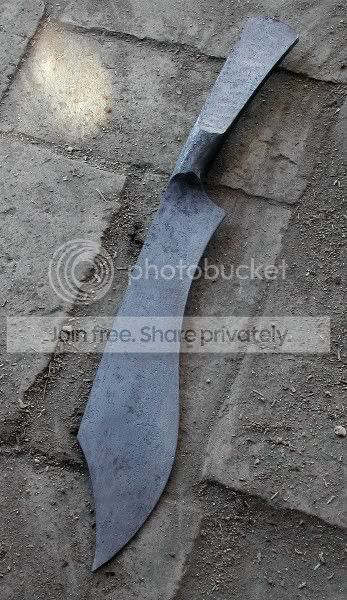
Here's one I'm working on right now.
It's 16-1/2 inches long from a piece of 7/8 inch round W2 I got from Don. I filed it out and it's in the tempering cycle right now.

I'm wanting to try something different with the construction,... a "hidden full tang". I'm going to cut the tang off a little short, slot the wood and rivet it on, so the tang doesn't run all the way back. Then, I'm going to wrap over the joinery with Turk’s head knots, so none of it shows, and do a washer and stud on the back end.

It's all just freehand forging, accept that I used a little filing and stock reduction around the profile to clean up the lines. The plunge and shouldering are done over the edge of the anvil with a long nosed Mexican raising hammer.

I started by partially forging the tang to hold it from. Then I put a point on it and tapered it towards the point. Then I worked the shoulders down at the choil transition area and flattened out the blade from there. Getting the sharp drop down to the edge in that area is probably the hardest spot, not sure I could explain that on paper. The amount of force, placement of the blows, and geometry of the hammer faces has a lot to do with it though.

I start the shoulders with the long nosed raising hammer (a face similar to a cross peen) in that area, over the edge of the anvil. Then I switch over to a very rounded faced hammer to get more width. It is important to hit the area with enough force to minimize or eliminate mushrooming over the edge, and to keep the blows "focused" on that spot. I also use heat placement and establish a geometry so that the path of least resistance is towards the edge at that spot, forcing the metal they way I want it to go. The integral bolster part is driven over to one side in stages.

2-08.jpg
 
Back
Top