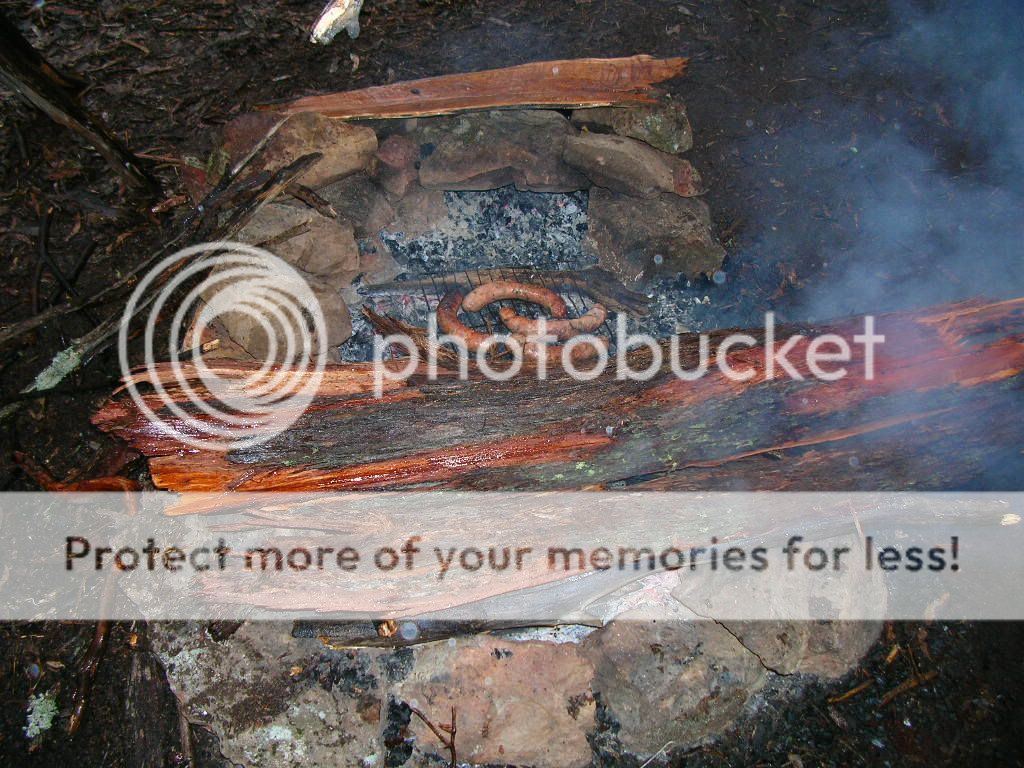
Failure to make fire in the snow

I would agree with the others in just looking at the picture...The tinder seems a little to rough for a spark ...I stick to the 3 f's when sparking a fire fine, fibrous, or fluffy
ex. fine being sawdust obtained with my sak or punky wood dust
fibrous being roughed out just twine, or oakum or similarly teased plant fiber or old mans beard
fluffy being the material from inside a milkweed or cattail pod

Great pics, Nice blades, looks like a fun day wish I was there....also sometimes if the stars are wron a fire jut won't light


if its raining I try to split the wet wood to get to the good stuff.. if it's real bad, I make a little shelter for my fire oout of rocks or bark or whatever is clever
 

What are the tips from you more experienced guys on making a fire in driving rain? Do you make a small debris hut and build your fire in there, letting it be consumed when your fire is hot enough? How do you guys do it?

Personally I build a roof over the fire with sections of bark.
Barkshingles.jpg


I turn them every once in a while so that they don't burn through, they are way too useful to burn :D


Hope this helps.


Kind regards
Mick
 
Great thread. I learned a ton. I just moved to a snowy area and I have a lot to learn about surviving in this region. Firemaking in snow is one of them. I will be going snow shoeing soon! Can't wait but I need some tips like this thread.


Thanks
 
here is my recipe for cold fires, like everyone said gather 3X as much tinder as you think you will need as well as the sqwaw wood. then i take the grass and other fine stuff, and like one of the other guys posted i take my neckercheif and open it on the ground then rub the fine tinder over the neckercheif between my hands or gloves rubbing briskly grinds up the grass and makes the tinder more spark friendly do this with 2-3 hand fulls fo grass. i make a ball of grass about the size of a cantaloup or soft ball, put the ground up stuff in the middle of this birdnest, spark that and it tends to burn enought to dry and light the grass birdsnest, then pile to matchstick wood and then the larger wood on top, if there is snow or the ground is wet i build a base of sticks to keep my fire off the ground. this has workede better for me. i think you did a good job but just need to try to have more and finer tinder available.

alex
 
THIS is the kind of post that made me join this forum to begin with.

Amen and same here. I joined when I went to buy my first new knife in forever (Grandpa's Buck and my Dad's SAK lasted for decades) and wanted to know what all the fuss was about with S30V, 154CM, etc. I've learned TONS from this forum, including why my father-in-law could really put an edge on a blade, while I just did OK.

Think it might be possible to split this forum into two -- Bladeforums "Let's make a better knife and hit the trail" and Bladeforums "Need to lose a lot of weight and find me someone to stab today?" :D

I bought one of the firesteels and given the choice between it and trying to rig a "bow and drill," I'd be deleriously happy to have it. Honestly though, I'd be even happier to have a disposable Bic still sealed in the wrapper. They're about the same size/weight.

I will grant, though, that a new firesteel would last for a few years if you were lost in the wild, as opposed to the Bic which would only last weeks.
 
Maya dust is sold in a little tin with LMF firesteels. I believe it is fatwood sawdust. Well I'm too cheap for that. On a lark today, I decided to shave up one of those Coglans firesticks. They behave like fatwood, IMO, better than fatwood because they are easier to scrape dust off of then the genunine thing. Anyhow, I took the thick curl shavings and ground them up in an older coffee grinder. Made a nice dust that I filled a Pill box tin up. Lights very nicely!

DSC_0001-1-5.jpg
 
Maya dust is sold in a little tin with LMF firesteels. I believe it is fatwood sawdust. Well I'm too cheap for that. On a lark today, I decided to shave up one of those Coglans firesticks. They behave like fatwood, IMO, better than fatwood because they are easier to scrape dust off of then the genunine thing. Anyhow, I took the thick curl shavings and ground them up in an older coffee grinder. Made a nice dust that I filled a Pill box tin up. Lights very nicely!

DSC_0001-1-5.jpg


That sir, ROCKS!!
 
Yes a Mag Rod, ...I have one that has a small diameter Ferro rod built into it also.


"If you're not living on the edge, …you're taking up too much space."

Big Mike
 
Think I came into this thread a bit late, but it's a good one! Great points made and good tips. I love that "3 F's" tip, Riley! That's a good way to pass on knowledge in a memorable way.

I like to take stuff out into the backyard on that nastiest days that appear, the wet, cold, and snowy ones. It gives lots of practice and really tells you which pieces of gear aren't worth it.

Jute wrapped over fatwood is definitely an item on the 'keeper' list. It's too easy and reliable to leave at home. I haven't tried too many of the commercial firestarters.

Wind is often one of the most difficult demons to fight. I always grab a couple of logs to place on either or all side of my fire. This is a benefit in the cold, too, since it will give a little bit more reflective insulation. This method can work fairly well in the rain, too. You just have to use taller 'walls' and then add some flat pieces to make a partial 'roof'. Then lay your tinder under the roof portion when you light it, it'll at least let you get some heat brewing before adding kindling.
 
not sure if someone mentioned it yet, but caragana is a real bitch to burn most of the time, I've found. we have lots of it at my parents place, and it seems to hold a lot of water, probably why its so hard to kill, ever, with anything, only plant that will survive a napalm strike I'm sure. I've never had good luck with it even on hot days without either a propane torch (80,000BTU variety) or lots of accelarant. Jet B works well.......
 
Great post.
Thanks for sharing your experience with us.
I agree with Gurthang, this is a great way for us to learn from each other.
I have been trying out various natural tinders in varying conditions. I want to be prepared if my PJCB run out.
 
Wind is often one of the most difficult demons to fight. I always grab a couple of logs to place on either or all side of my fire. This is a benefit in the cold, too, since it will give a little bit more reflective insulation. This method can work fairly well in the rain, too. You just have to use taller 'walls' and then add some flat pieces to make a partial 'roof'. Then lay your tinder under the roof portion when you light it, it'll at least let you get some heat brewing before adding kindling.

There is some good advice here :thumbup: Something worth mentioning in practicing on firesteel is position. Okay, striking a firesteel on a work bench or counter or on the table like you will inside the home for a test is not like what you will be doing in the field. Particularly when there is wind and or rain, you are hunkered down and have your pile of tinder in a little corner somewhere. Often times, that is in a corner of a little fire pit which means you have to lean over the walls of the pit and strike, all while trying not to scatter your tinder.

Just keep this in mind and again vary in the manner in which you practice striking the fire steel so that it will be effective when you do it. I find that before I even try to strike the firesteel for lighting purposes. I just strike it in the air a couple of times until I get good sparks. This will clean off any coating if present or oxidation. It also helps you set the best angle of the striker.
 
......Wind is often one of the most difficult demons to fight. I always grab a couple of logs to place on either or all side of my fire........

I like to do this with three short logs laid in a triangle with one corner pointing in the same direction of the wind. In this corner, I build my "twig fire" and build the rest of the material over it so 1) it is ready, and 2) so that it helps shelter the tinder and finest kindling initially. As the pencil-diameter kindling gets going and has some glowing ends, I remove the "bottom" of the triangle to let the wind IN. The remaining two logs form a funnel and increase the velocity of the air moving through the fire. The wind is as much a helper as not and you may even have to replace the "bottom" log to block the wind after things get going or you burn too much fuel too fast. If you need "wind" on your tinder bundle or some minor coals after you have placed the tinder bundle, a "straw" lets you blow into it without sticking your head in the triangle. Blowing coals can make you dizzy enough - doing with your head hanging upside down can make you dizzy enough to pitch over, head-first, into your would-be fire and scatter your work. You'll "come-to" soon enough but you'll be colder and have to start over.:D

Unlike any other animal, we are dependent upon carrying "stuff" with us to survive, be it a lighter, ferro-rod, flint & steel or matches. As we face that fact and realize, that without these basic elements in fire-making, we can more easily rationalize carrying some other "stuff" as well, such as emergency tinder. It's great fun and necessary practice to try it with what's available, in a controlled environment, but there should ALWAYS be some form of back-up emergency tinder on our persons and in multiple locations throughout our "layers." Generally, the less it weighs, the better it is for starting a fire, so there is no reason not to have several ounces of back-up on our persons at any time. Experimenting is a blast anyway. My wife's lap-dogs, which supposedly do not shed, leave whispy balls of fine hair under my woodstove, and although they STINK when lit, they WILL light.:thumbup:

The "straw" idea, for blowing embers which are already safely sitting in the base of the potential fire came from a British site I found once. The fella was carrying part of an aluminum arrow shaft for this purpose and I thought it was a great idea. Like I said - we have to carry stuff. May as well look for ways to carry any means that will help assure a fire. Granted, just having a ferro-rod is a huge step in the right direction and it's great to practice without the benefits of the "niceties," but having PJCBs on-hand when it's "for real" is NOT "cheating." Best to practice with that stuff too though.

I have an idea that I want to try for this, and maybe someone already has a defunct portable "pocket" radio from the days when they had telescoping antannae which could be collapsed to about 4" in length (try THAT with your MP3 player:D). With the tip and solid end portion removed, and the bottom cut off at the base, one might have a dandy little, telescoping "blow-poke" that would fit in a fire kit? If someone beats me to it, and is inclined to try it, please post your findings. I would blow from the larger end to increase air velocity, thereby decreasing effort and conserving energy. This would focis the remaining oxygen from your lungs right where you want it and decrease the potential for pitching over into your work.

 
I like to do this with three short logs laid in a triangle with one corner pointing in the same direction of the wind. In this corner, I build my "twig fire" and build the rest of the material over it so 1) it is ready, and 2) so that it helps shelter the tinder and finest kindling initially. As the pencil-diameter kindling gets going and has some glowing ends, I remove the "bottom" of the triangle to let the wind IN. The remaining two logs form a funnel and increase the velocity of the air moving through the fire. The wind is as much a helper as not and you may even have to replace the "bottom" log to block the wind after things get going or you burn too much fuel too fast.

A picture's worth a thousand words??? :D

If you need "wind" on your tinder bundle or some minor coals after you have placed the tinder bundle, a "straw" lets you blow into it without sticking your head in the triangle. Blowing coals can make you dizzy enough - doing with your head hanging upside down can make you dizzy enough to pitch over, head-first, into your would-be fire and scatter your work. You'll "come-to" soon enough but you'll be colder and have to start over.:D

Keep in mind there are lots of hollow stem plants available. Phragmites communis (don't know any common names :( ) is one that comes readily to mind, and the flower heads are tinder!!! - that dual purpose survival thing again! :D

Doc
 
Good post!

I carry tinder in a spy capsule. Other items to get a fire going: solid fuel tabs, alcohol gel hand cleaner (works really good with the fuel tabs), alcohol wipes from your first aid kit, insulation pulled from your clothing and fuzz pulled from your clothing (socks work well).

I live in an area with a lot of evergreens. The dead lower branches tend to be drier than those on the ground and shaving down to the wood underneath get sot some really dry stuff. Then its a process of getting really fine shavings. As others said, take some time to get a good selection of fuel as the light stuff goes quick.

The ultimate fire starter is a road flare. It will get wet punky wood going and you have a 15 minute window to work with. And you have an excellent signaling device too.

One of my Holy Grail wishes for survival gear is for someone to make emergency fire starters like a short road flare. It should have a good self life, be waterproof, burn hot and bright, and be compact and light weight. Something with a 5-10 minute burn time would work for me. You would be getting a fire starter and the first couple layers of tinder in one package. Imagine something that looks like a big firecracker.
 
Back
Top