
Finished my first kitchen knife! Lessons learnt and some new methods...

Joined
Mar 12, 2013
Messages
1,167
Hey guys!
It's been quite a while since I made a knife that wasn't a 'Resolute' model, and it was nice to have a bit of a change!
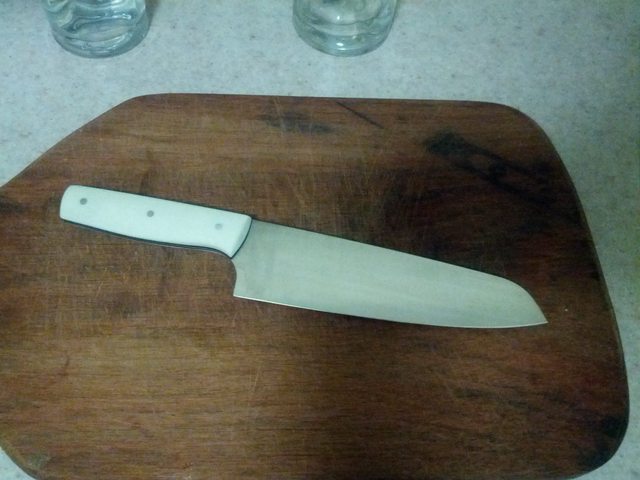
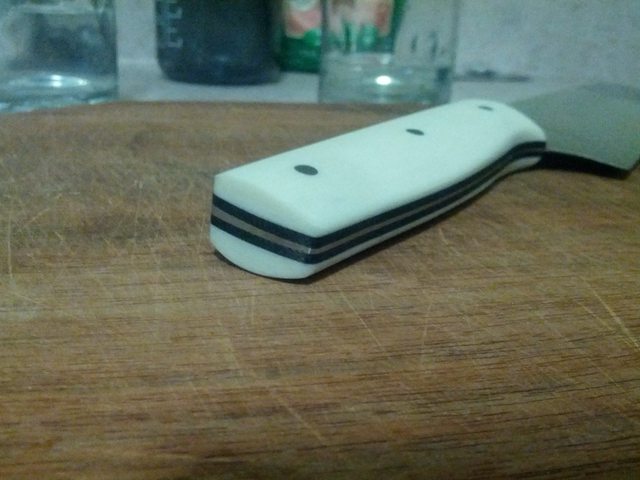
TQ9aQjhl.jpg


roLSlCal.jpg


Sorry for the poor photos!

Specs:
Blade: 1/16" thick AEB-L @ 60HRC
Handle: White G10 with black G10 liner (chosen because they're my least used colors!)

There's a bunch of stuff that I'm unhappy with in this knife, but it's already served to teach me a lot which was the main purpose.

Things I don't like:
* The edge profile doesn't feel quite right to me, it doesn't rock the way I'm used to, not sure if I'll get used to it or not
* The edge is thicker than I'd like (~0.012") but I didn't want to take it thinner as I'm unfamiliar with this steel
* The heat-treat seems to be not as good as it could be
* The handle isn't anywhere near as comfortable as I thought it would be
* Grinding AEB-L after heat-treat is gross! Lots of long stringy 'steel wool' that was constantly burning and going EVERYWHERE

The heat-treat that I used for the AEB-L was:
* Coat blade in anti-scale and put in foil envelope
* Ramp to 1995ºF, hold 5 minutes
* Plate quench
* Temper 400ºF, 2 hours, twice

Result: 60HRC as tested on my hardness tester

I didn't have any dry ice on hand, I think a sub-zero quench would have made a big difference. The steel 'feels' weird compared to my normal A2. It's harder to sharpen (as in takes much longer, which is weird because it's softer) but also doesn't take a fine edge as well or as easily as A2 does. I've gotten spoiled by how well I'm able to heat-treat A2...

Grinding AEB-L after heat-treat was very different from A2 as well. A2 produces a fine fine 'dust' when it's ground after heat-treat, whereas AEBL felt 'gummy' and produced long strings of 'steel wool'. This was with a fresh 120 grit blaze belt.
 
Things I did like:

* New water-thin CA (superglue) that I'm using is awesome and has many uses
* Temporarily gluing handle scales together into pairs for drilling and rough shaping, super convenient and fast
* New handle glue-up method

One of the big things that I did differently on this knife was the handle glue-up. Normally I use epoxy, but I was in a hurry given that this is just a prototype and I think I accidentally stumbled on a new method that I like better than epoxy:

* Drill and rough-contour handle scales, counter-bore the holes for the corby bolts
* Finish the front of the handle scales
* Put some thread-locker on the corby bolts, bolt the scales to the tang tightly
* Put a tiny drop of water-thin CA on the point where each corby bolt meets the scale, the glue wicks in around the corby
* Run a small amount of water-thin CA (super glue) along the edges of the tang. The glue wicks into the minuscule gap (miniscule as in impossible to see) between the tang and the scales, spray the excess glue with accelerator
* Grind off the heads of the Corby bolts, finish grind the edges of the handle.

The CA seemed to wick all the way under the scales very quickly. I applied it to the top of the handle and you could see it appearing on the other side pretty much straight away. At the ricasso it formed a tiny (super tiny) little fillet that didn't require clean up. Just the tiniest hint of shiny surface at the point where the tang and scales intersect, about the same as what you'd see with epoxy after judicious clean-up.

So in less than 5 minutes of gluing up I was ready to finish grind the handle. I've done destructive testing with CA glues in the past and they were very strong, but I always had trouble with how to apply them neatly. This new super low viscosity CA that I'm trying seems to introduce a bunch of new possibilities! The brand is 'Hot Stuff' and it's the 'original' formula.

One of the nice things is that it's possible to clean up CA after it's cured using the solvent supplied with the glue, with epoxy this is pretty much impossible and can cause serious problems if you ever miss a spot.

The glue lines that this method produced are literally impossible to see. With epoxy well applied you can't see a glue line, but with this method it's like there just isn't any glue at all, can't quite describe the difference. The final results looks very clean. I will do some destructive testing with this method in the near future and see how it holds up.

I've also been using this new CA to hold handle scales together in pairs for drilling and rough shaping. A few dots of CA and they're bonded together, then when they're done I hammer an OLFA blade in between the scales and they pop apart in just a few seconds.

I ground the knife with a straight bevel from tail to tip (after heat-treat), and to hold the knife on my grinding jig I again used the same CA. A few dots on the blade, then some accelerator applied to the jig. Hold them together for a second and they were stuck. The after the grind was done one one side I used a piece of scrap G10 and a hammer to pop the blade off the jig. Worked very well!

Anyway, just thought I'd share what I learnt! Let me know if you have questions!

Feedback on the knife design is welcomed too, kitchen knives are a new thing for me. I'm signed up for the Culinary Arts 1 course next year at George Brown college here in Toronto so that I can get more exposure and experience with kitchen knives and serious cooking in general. I think that should help a lot with my ability to design kitchen knives.

-Aaron
 
I can't believe a knifemaker of your caliber hasn't made a kitchen knife until now! I see a little bit of the Resolute in that handle (Where's the window breaker?! In case of emergency tactical kitchen exfiltration!). I'm a relatively recent convert to knifemaking thanks to your videos, so I can't really say anything constructive, other than it looks like it wants a bird's beak at the butt. I tried using thin CA/super glue to seal up the miniscule gaps in my first knife, but ended up making more of a mess than I was trying to fix. I'll have to revisit it given your success with the method.
 
Grinding high carbon and stainless steels before and after HT requires a ddifferent approach even IMHO different abrasives, for high carbon cheap zirconium bands do the work just fine, for stainless and specially after HT I found that zirconium overheats a lot and dulls pretty fast so I switched to ceramics.

I tend to use thicker stock, from 2 to 3mm (3/32" - 1/8" ish) because I like leaving a ricaso and a distal taper all the way to the end of the blade, a 3mm blade allows to do this. And when I use thinner 2mm stock I leave no ricaso like you did on your model.

The shape you choosed is traditional, I found that adding a slight change on a traditional model add a lot more of interest to my work, in my case I clipped the point a little instead of dropping it, slight change, more eyeballs :)

Regarding pins, I use 2mm nickel silver (alpaca) they look better IMHO than the traditional 1/4" rods used by manufacturers. And finally about adhesives I use epoxy, never had a problem, maybe if I ever find corby bolts here I will try CA, good idea!


Pablo
 
Aaron,

For your first kitchen knife, I would say you did a very nice job. Concerning the profile, if you want to improve it for "rock chopping" adding a very slight belly starting about 1.5 - 2" from the heel will help. Currently, the profile looks fantastic for push cuts and pull cuts, so keep in mind, different users have different styles of cutting.

Cheers,

Pete
 
I can't believe a knifemaker of your caliber hasn't made a kitchen knife until now! I see a little bit of the Resolute in that handle (Where's the window breaker?! In case of emergency tactical kitchen exfiltration!). I'm a relatively recent convert to knifemaking thanks to your videos, so I can't really say anything constructive, other than it looks like it wants a bird's beak at the butt. I tried using thin CA/super glue to seal up the miniscule gaps in my first knife, but ended up making more of a mess than I was trying to fix. I'll have to revisit it given your success with the method.

Haha 'tactical kitchen exfiltration' I like that :)

I was a little surprised the thin CA worked as well as it did, can't say I'm unhappy about it! As I said though I'll have to do more testing with it before I start using it on customers knives.
 
Grinding high carbon and stainless steels before and after HT requires a ddifferent approach even IMHO different abrasives, for high carbon cheap zirconium bands do the work just fine, for stainless and specially after HT I found that zirconium overheats a lot and dulls pretty fast so I switched to ceramics.

I tend to use thicker stock, from 2 to 3mm (3/32" - 1/8" ish) because I like leaving a ricaso and a distal taper all the way to the end of the blade, a 3mm blade allows to do this. And when I use thinner 2mm stock I leave no ricaso like you did on your model.

The shape you choosed is traditional, I found that adding a slight change on a traditional model add a lot more of interest to my work, in my case I clipped the point a little instead of dropping it, slight change, more eyeballs :)

Regarding pins, I use 2mm nickel silver (alpaca) they look better IMHO than the traditional 1/4" rods used by manufacturers. And finally about adhesives I use epoxy, never had a problem, maybe if I ever find corby bolts here I will try CA, good idea!

I think next time I would use slightly thicker stock as you mentioned, likely 3/32" or so. I think 1/16" is a bit thin but it's what I had lying around!

Corby bolts are definitely hard to source in the right size. I would like to try the 'acorn bolts' that are made by Jephco at some point, they look like they'd be stronger than corby bolts.
Pablo

Hey Pablo!
I was using mainly a Norton Blaze belt for this knife which I believe is a ceramic belt. I really have no idea why the steel was behaving so differently, I guess maybe because I normally harden my A2 to 62.5HRC which likely makes it behave a bit different. I'd be curious to harden some AEB-L higher and see how it grinds!
 
Aaron,

For your first kitchen knife, I would say you did a very nice job. Concerning the profile, if you want to improve it for "rock chopping" adding a very slight belly starting about 1.5 - 2" from the heel will help. Currently, the profile looks fantastic for push cuts and pull cuts, so keep in mind, different users have different styles of cutting.

Cheers,

Pete

Thanks Pete!
I'm very used to rock-chopping but I've been wanting to try learning the 'guillotine and glide' method for a while so perhaps this is my chance :)

I'm looking forward to learning more about kitchen knives, I like that there's a lot of nuances to their making and use!

-Aaron
 
My question to the group: Is it feasible or desirable to go higher on HRC with AEB-L? And would the AEB-L behave differently if it were HT'd to a higher HRC?
 
I get 61 with a 250 degree temper. Without cryo that seems like a pretty high hardness for a 400 degree temper. I've only made 3 blades of AEB-L so far though but I have tested them with my handheld and had one tested in a professional shop.
 
I think AEB-L could be run up higher for sure, like 62-63 easily. And due to it's very fine grain structure, can take edges at very low angles and hold them well. I had Peter's run a batch at 61.5 for me, and the test knife is superb! 25 degree total angle, could probably be taken down to 15 total!
 
I use Rc62 with AEB-L. Performs superbly at that hardness. I use dry ice as part of the HT. I use 15deg/side for most kitchen knives, with a 0.005 to 0.007 edge. If the user is experienced with high hardness knives, I go to 0.003" at the edge, and 11deg/side.
 
I have used CA on many handles after watching Steve Johnsons video and talking with knifemaker Mike Lovett about it. Steve goes into detail on how to use it for handles and his video is the best knifemaking vid I have seen.

I now prefer to use it mainly with the handle/liner glue up and use epoxy for the tang handle. The epoxy is better at gap filling and easier clean up at the ricasso.

No matter what the case I would only use Loveless or Corby bolts with CA.
 
Last edited:
Good stuff. I'm interested in your long term opinion of this water thin CA.

I shall make sure I create a thread after doing more testing, whenever that might be!

My question to the group: Is it feasible or desirable to go higher on HRC with AEB-L? And would the AEB-L behave differently if it were HT'd to a higher HRC?

I think so, many kitchen knife makers recommend running it at higher hardness!

I get 61 with a 250 degree temper. Without cryo that seems like a pretty high hardness for a 400 degree temper. I've only made 3 blades of AEB-L so far though but I have tested them with my handheld and had one tested in a professional shop.

What austenitization temp & hold time are you using? I used 1995ºF for 5 minutes as per the alpha knife supply website. The hardness I got looks bang on according to their graphs...
 
I use Rc62 with AEB-L. Performs superbly at that hardness. I use dry ice as part of the HT. I use 15deg/side for most kitchen knives, with a 0.005 to 0.007 edge. If the user is experienced with high hardness knives, I go to 0.003" at the edge, and 11deg/side.

Oooh. 0.003" at the edge is something I would like to see! That would be amazing!

I want to try a kitchen knife made with A2 and using my normal heat-treat, I could easily go to ~0.006" and still have it be really tough! I used AEB-L mainly cause I happened to have a piece kicking around the shop.

I have used CA on many handles after watching Steve Johnsons video and talking with knifemaker Mike Lovett about it. Steve goes into detail on how to use it for handles and his video is the best knifemaking vid I have seen.

I now prefer to use it mainly with the handle/liner glue up and use epoxy for the tang handle. The epoxy is better at gap filling and easier clean up at the ricasso.

No matter what the case I would only use Loveless or Corby bolts with CA.

Good to hear others are using CA with good results! It would be great if it turned out to be usable for me in all my knife glue ups, would make life so much easier!
 
1960. That looks like the difference. Did you have any warpage issues?

I plate quenched this very quickly out of the kiln with BIG quench plates as well. It was cold to the touch in less than 20-30 secs, probably not as fast as an oil quench still though I guess.

It came out slight crooked at the transition from the handle to the blade after heat-treat, but I know the steel wasn't dead flat even before I started so I'm not sure what the primary cause of that was. I flattened it out when I was grinding...

When I was grinding it warped in a pretty amazing fashion actually, I did all my grinding on one side then on the other. After grinding the first side the whole blade was curved a huge amount. If you laid it on a table the middle would have been nearly a 1/4" off the table. After grinding the second side it returned to perfectly flat... I'm sure that's a common occurrence, I just wasn't expecting it!
 
Craziness. I oil quench mine then chase straightness in multiple temper cycles. Frustrating to say the least.
 
Back
Top