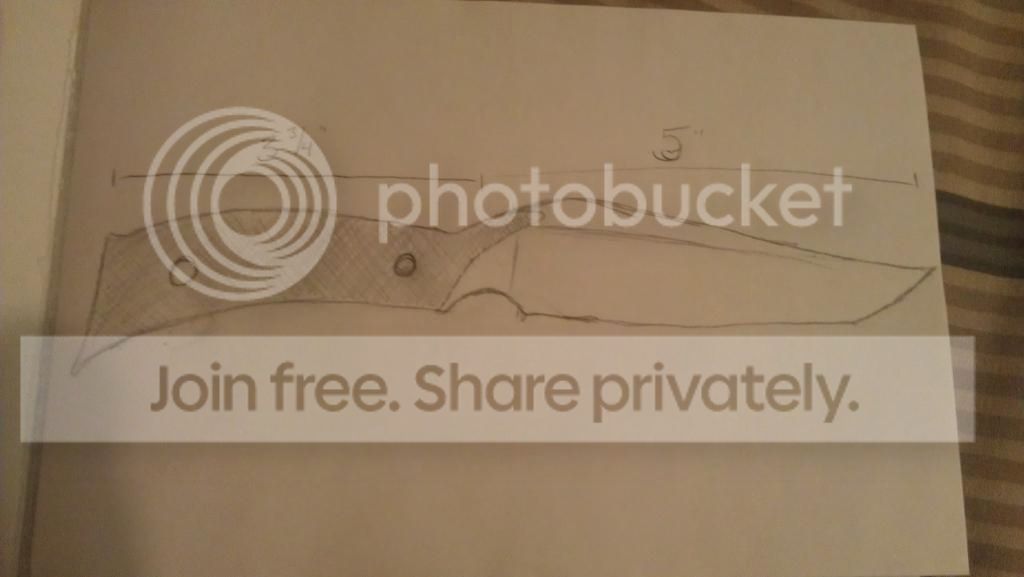
first design, opinions?

Joined
Dec 9, 2012
Messages
654
Hey guys finished my first design idea last night. may not be my first knife since this would be hard as a first with a file, but any criticism is welcome and appreciated!


I know the handle is odd, but I kinda like it and was going for something different, but please state your opinion! thanks guys!
 
Very interesting design. My recommendation would be to increase your handle length to 4 1/4". In my experience handles should be at least that long unless its a neck knife. You also may want to drill a couple extra holes in the handle to improve balance.
 
vNzc8aF.jpg
here's my interpretation.
 
Cut out the pattern into cardboard and see how she feels before you start cutting any steel. Very intriguing, but it looks like a more difficult pattern, especially with only hand tools. I'm sure you could do it with perseverance, but something simpler may be better for your first.
 
I like coops interpretation a lot. It retains your design elements but refines them. A few thoughts on your original. The handle material at the front sticking out onto the blade is a potential issue as the thinner narrow area there could be week causing those from bits to chip or break off. Same is true for your pommel as the pointy edges will be a potential chipping problem. The thumb ramp should be a smooth transition rather than the abrupt direction change. Lastly the swedge running that far back could cause discomfort if any pressure is needed on the spine for cutting tasks.
 
vNzc8aF.jpg
here's my interpretation.

this looks more like what I was going for, im just not much of an artist lol. And again I don't plan on this as a first knife, just my first design, I will be doing something a little more simple with hand tools as my first. The area of the handle that sticks out onto the blade was a big area of opinions, and I didn't think about the fact that it would significantly weaker, and I don't want it breaking so I think I will omit that. I am just going for something different, thanks for opinions so far guys! and by all means keep it going. And Chris I will draw to scale from now on as I can see where it would be more helpful
 
TIP:
Cut out the metal without the dip in the spine. Just go from the high spot on the blades spine to about the middle of the handle spine in a smooth arc. After you cut the profile in steel, and file the basic bevel, then slowly start removing metal from the thumb dip. I would be willing to bet that you don't even go as far as Coop drew it. The biggest thing to learn is that excess metal is fairly easy to remove from the blade, but impossible to put back on.
 
TIP:
Cut out the metal without the dip in the spine. Just go from the high spot on the blades spine to about the middle of the handle spine in a smooth arc. After you cut the profile in steel, and file the basic bevel, then slowly start removing metal from the thumb dip. I would be willing to bet that you don't even go as far as Coop drew it. The biggest thing to learn is that excess metal is fairly easy to remove from the blade, but impossible to put back on.

I agree completely! Thanks for the tip! I can't wait to get going on my first. Also while I have everyone's attention, I will not be heat treating my own knives, I will be sending them off. with that in mind what steel would you guys recommend for my first knife and eventually this knife?
 
here Is a revised design, almost exactly like Coop's with a couple subtle changes to the handle, the blade shape I am keeping I may try a different handle I am going to cut it out of cardboard and try it out

 
May I ask what the hump on the blade is for? Just a design aspect for visual identity?

honestly it is personal preference. My Pm2 has a very aggressive bump in around the same area, and it is one attribute about the knife really love
 
All I needed to know. That's the first thing I thought when I saw it was Spyderco. And my old military had the bump and I loved it to.
 
All I needed to know. That's the first thing I thought when I saw it was Spyderco. And my old military had the bump and I loved it to.

Yeah I don't want to copy anyone, which is why mine is not a aggressive, but it is a feature I love. Whenever I choke up on my PM2 and really dig in to something, it just has a fixed blade feel which is why I has the idea to incorporate it into my own design
 
If you like it, then by all means put the bump there. My suggestion will help you determine how much bump you actually need by holding the blank as you slowly remove the excess metal.

Personally, I don't like the look of your sketch....mainly because of the bump. It is too high on the blade spine and too deep over the ricasso ( which makes the ricasso a bit thinner than al the rest). A smaller thumb rest will work as well and look much better.
Also, there is a visual disconnect between the handle and the blade. Draw a line along the centerline of the handle, and another along the centerline of the blade.....see how far off they are? I would re-draw that sketch with a continuous (but shallow) curve from butt to tip on the spine, and then draw the blade edge and handle bottom to fit. You will now have a sketch of a knife with "flow" from end to end. From that drawing, modify the handle drop, butt shape, add a hump, etc. ....but always try and keep the end to end alignment visually ( and functionally) pleasing.

TIP:
When starting a knife drawing ( or most any drawing) set up two reference lines. On vertical and one horizontal ( x-y axes). Draw the knife with the tip on the x axis, and the ricasso on the y ( graph paper helps a lot). This will greatly help you see the balance of handle to blade ratio, as well as alignment of the blade and handle. It will also show a lot about the ergonomics and physics of how well the blade will handle and cut. The more the handle and blade stay on the same x axis plane, the smoother the transfer of energy from one to the other. If there is more blade on the negative x axis ( left side) than there is handle on the positive side ( right), the more energy can be transferred from the blade from the handle...and your hand ( as in chopping). If there is more handle to the positive side, then more energy is transferred from the handle to the blade ( as in a whittling knife).
Next, lightly draw a curved line from tip to where the butt will be. This provides a basic "flow" line for the blade. Use this line when placing the spine. Draw a reverse of this curve below the x axis. This should show the basic blade curvature. Us this line to determine the blades tip curvature and edge shape.
By fitting all the features you want into these parameters, you can keep the "flow" of the knife smoother.
The lines are not barriers you can't cross, but lines to guide you in placing the knife features.

 
The more the handle and blade stay on the same x axis plane, the smoother the transfer of energy from one to the other. If there is more blade on the negative x axis ( left side) than there is handle on the positive side ( right), the more energy can be transferred from the blade to the handle...and your hand ( as in chopping). If there is more handle to the positive side, then more energy is transferred from the handle to the blade ( as in a whittling knife).

I'm hardly new at this anymore, but I hadn't thought of things this way even though it's pretty obvious once pointed out. I find it helpful. Goes to show, there's always more to learn.
 
If you like it, then by all means put the bump there. My suggestion will help you determine how much bump you actually need by holding the blank as you slowly remove the excess metal.

Personally, I don't like the look of your sketch....mainly because of the bump. It is too high on the blade spine and too deep over the ricasso ( which makes the ricasso a bit thinner than al the rest). A smaller thumb rest will work as well and look much better.
Also, there is a visual disconnect between the handle and the blade. Draw a line along the centerline of the handle, and another along the centerline of the blade.....see how far off they are? I would re-draw that sketch with a continuous (but shallow) curve from butt to tip on the spine, and then draw the blade edge and handle bottom to fit. You will now have a sketch of a knife with "flow" from end to end. From that drawing, modify the handle drop, butt shape, add a hump, etc. ....but always try and keep the end to end alignment visually ( and functionally) pleasing.

TIP:
When starting a knife drawing ( or most any drawing) set up two reference lines. On vertical and one horizontal ( x-y axes). Draw the knife with the tip on the x axis, and the ricasso on the y ( graph paper helps a lot). This will greatly help you see the balance of handle to blade ratio, as well as alignment of the blade and handle. It will also show a lot about the ergonomics and physics of how well the blade will handle and cut. The more the handle and blade stay on the same x axis plane, the smoother the transfer of energy from one to the other. If there is more blade on the negative x axis ( left side) than there is handle on the positive side ( right), the more energy can be transferred from the blade from the handle...and your hand ( as in chopping). If there is more handle to the positive side, then more energy is transferred from the handle to the blade ( as in a whittling knife).
Next, lightly draw a curved line from tip to where the butt will be. This provides a basic "flow" line for the blade. Use this line when placing the spine. Draw a reverse of this curve below the x axis. This should show the basic blade curvature. Us this line to determine the blades tip curvature and edge shape.
By fitting all the features you want into these parameters, you can keep the "flow" of the knife smoother.
The lines are not barriers you can't cross, but lines to guide you in placing the knife features.

Ok, I am going to try and redraw this using the tips you gave me. I did cut it out and don't like the hump as much as I thought I would, I am going to use the reference lines and try to keep somewhat true to what I am going for but in a more functional manner. Thanks for the help so far!
 
I buy trim wood at Lowe's and make full on prototypes out of em. Complete with handles and rivets to see how they feel. Gives me grinding practice on my 4x36 sander and lets practice finishing. Plus the kids love em.
 
Back
Top