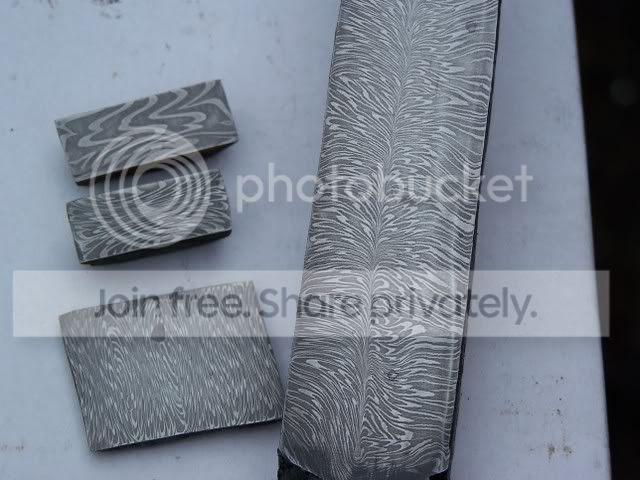
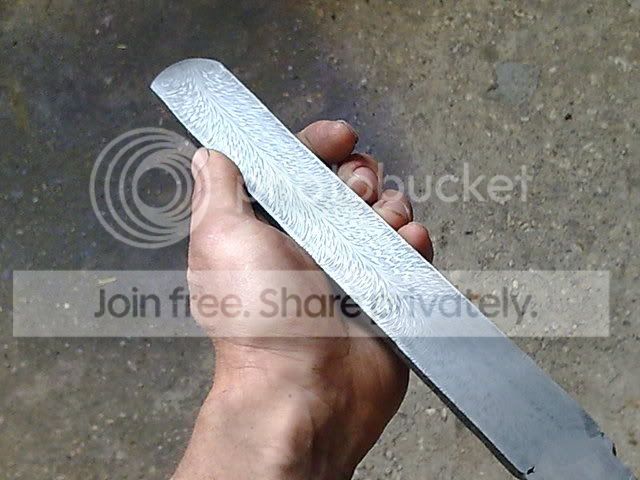
First Feather Pattern

I don't know Phil, I can still see them just fine. I've got them hosted through a paid account at fototime.... so they shouldn't just disappear. :confused:

I had never heard anyone describe mosaic layer count like Mick did with "bits" and "layers," but it makes great sense and is a very good way of explaining it.

I often see folks describe mosaics with numbers like "3500 layers" and I think, "What???? It's a mosaic that was only folded 5 times." Whereas something like 3500 bits in 250 layers (just an example) would make much better sense.
 
I've got to say its the first time I have described it like that myself. But I was struggling to find another word for layers, but in this context it needed to be something else, pieces would have been a better word to use, but it gets the point across.
For anyone that makes damascus, layers is a word thats used from day one with random and twisted type patterns. Its difficult to get out of the habit.

Mick.
 
Don't know either Nick, I can't see them anymore. Maybe they'll show back up for me later?

Ya, I see what you guys mean; it's completely simple in all its complexity. I'm getting a bit of handle on understanding some of it.

Chuck...100 layers
Bruce...57 layers
Mick.....100 layers

Even though Chuck and Mick both used the same methods of construction and seemingly were both 100 layers, they look quite different. Presumably that is due to differences in drawing out, as Chuck drew his final slices out quite a bit into his blades?

My orig billet was 1.5 wide x 4 tall x 11.5 long. I used 1/4" 1084 and doubled .062 15N20. I forged the billet into the standard W pattern. Folds were done 5 stack. I cut the stack into 5 sections and re-welded. I did this 4 times so 5-25-125-650. When cutting for the feather I pushed through to within .25 of the bottom of the billet. I still had a lot of V left so for the smaller knife I cut a bit off the end to reduce the V effect. After the cut I then essentially cut slices off the loaf, tig welded the seam and dry welded the piece back together.
The [final] billet was 2.5x2.5x4. The first slice I took off did not turn out either. I had to get all the flux and scale out of the center cut. After trying wet welding it, I just cut the seam with the band saw then pressed back together and dry welded. One of those unexpected positives that happen once in a while.

Each piece would make from 1-3 knives depending on the thickness of the slice. i did draw out the final slices quite a bit. The small billet in the photo made one knife, the one shown, which has a 4.5" blade. The larger billet was over 12" long 1.24 wide x .25 thick. Since the billet is being drawn so much the layers do not seem as compact. now that I am totally confused myself I hope it is clearer than mud to you all.
I'm still trying to understand other aspects, particularly the final billet size, orientation and loaf slices. I'm not used to looking and working from the end of the billet. (Well, actually I only did a few days of basics with Indian George, so "used to" might be a stretch (no pun intended.)) I drew out long and fairly thin to create basic random stock for blades. But, with this feather pattern the "final" billet needs to to be tall (a loaf), not thin. Mick's seems just about the obverse of how my final billets were. Chuck did his at 2.5"x2.5", but had to draw out the slices quite a bit for his blades. Could you explain this a bit?

Also, are you slicing off your working pieces after the whole billet is cut down the middle and reforge welded? Or, are you cutting off your working slices first, then slicing each of them down the middle and reforge welding them individually?

I'm starting a spread sheet so I can try and get a handle on the thickness, verses length, relative to cut and stack, relative to draw down thickness and length and numbers of time to repeat to get to a final billet dimension, but it's complicated. Does such a tool (calculating spreadsheet) already exist?

 
Last edited:
Phil, the final layer count in my piece was 160 layers. Have a look at post No 96. Although its only 60 more layers than Chuck's the pattern is far more compact.

The slice that is used for a blade is cut off the final bar. This final bar has been cut down the middle with a blunt chisel, then rewelded. The blunt chisel draws the layers down as it cuts through and gives the Feather Pattern.
Its a very hard pattern to get your head round with limited experience. I have been messing about with this stuff for around 16+ years and the biggest single thing you get from experience is a knowlegde of whats happening inside the steel as you work it, to the point of being able to look at a piece of steel and "back" engineer how it was done.

Trying to understand the final billet size is very difficult, with many factors involved. Make a piece alot bigger than you need and you won't be dissapointed. The piece we made before we cut down the middle was probably 2 x 2 x 6" tall. You get alot of compression and distortion as you force the chisel through, so that made the billet wider, fatter and shorter.

An idea has just sprung to mind. Get some modeling type clay or plastercine in contrasting colours. A rolling pin and a knife and try copying Steve Dunn's recipe.

Mick.
 
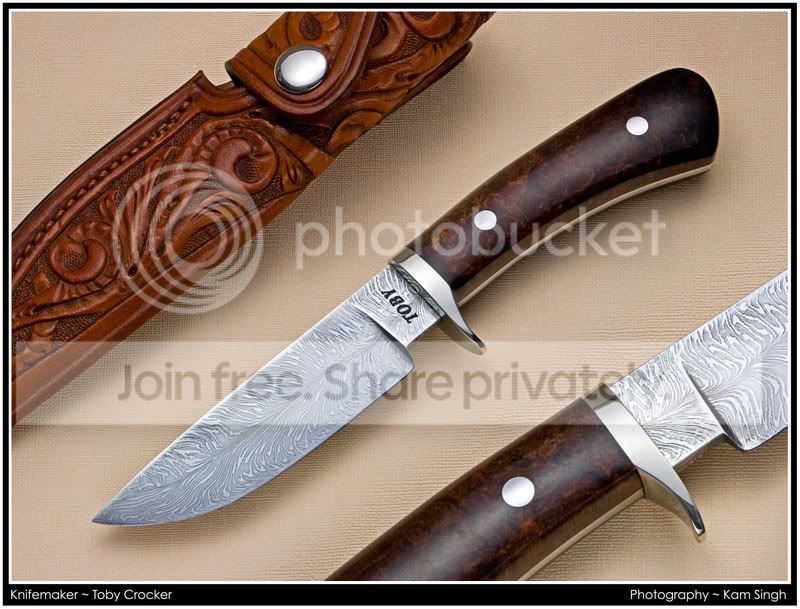
Mick gave me the heads up on this thread, this was the first of my attemps of a feather pattern
IMG_5066-2large.jpg

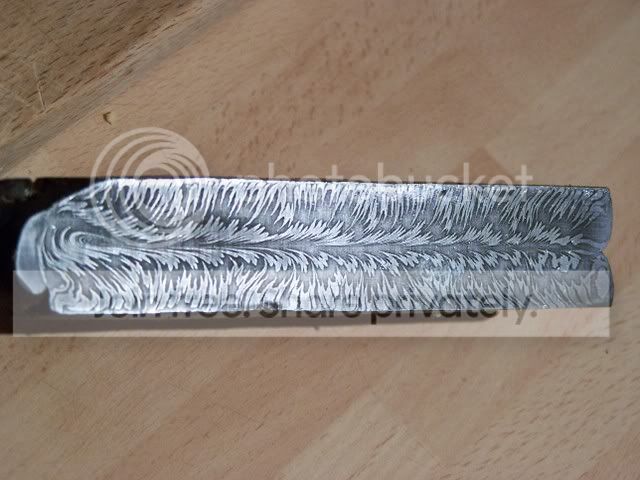
this was my second - called it a "fern pattern" rather than a feather. not made anything out of it yet
100_0050.jpg

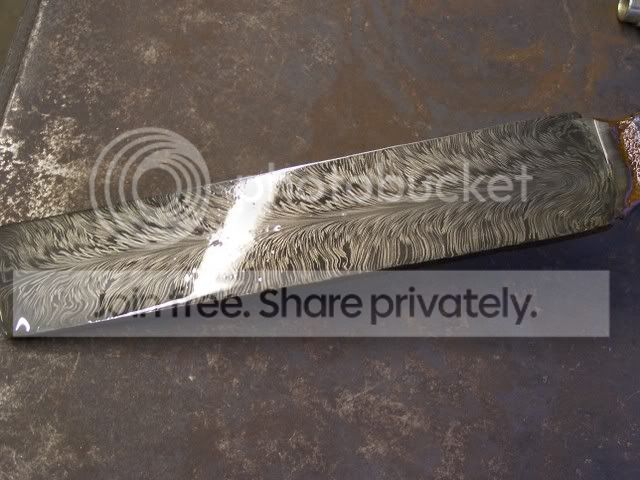
and this was my fourth
IMG_5078-2large.jpg

made a few others but have yet to make them into anything yet
100_0124.jpg

100_0045.jpg

Image008-2.jpg
 
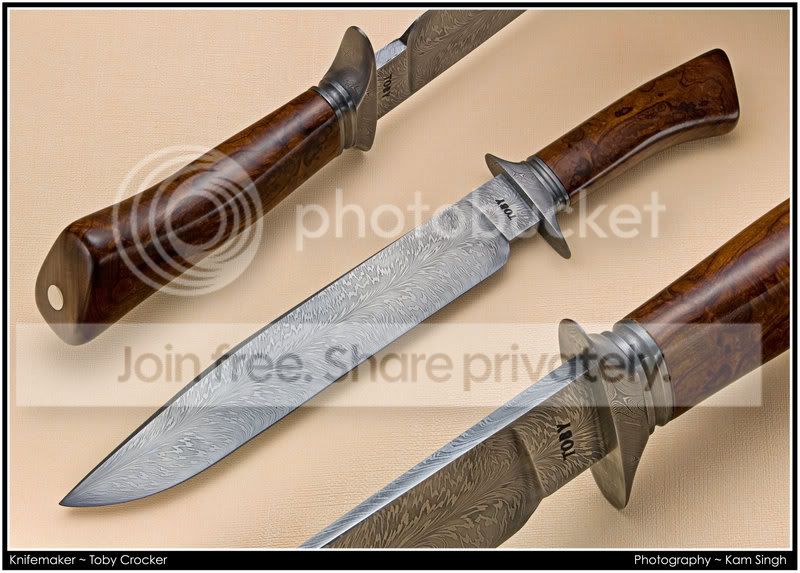
Thats good lookin steel Toby. The two finished knives are awesome man. The 4th picture down has some real depth to it. Looks 3D almost. Thanks for showing them.

Oh hey, first post here? Welcome!
 
Those are the types of patterns we strive for. Phil I cut down the center then slabbed off the tiles for the blades. Some just use one piece and forge a blade out of that while those with large tools (aarrugh, Tim the tool man Taylor) forge bigger billets.
 
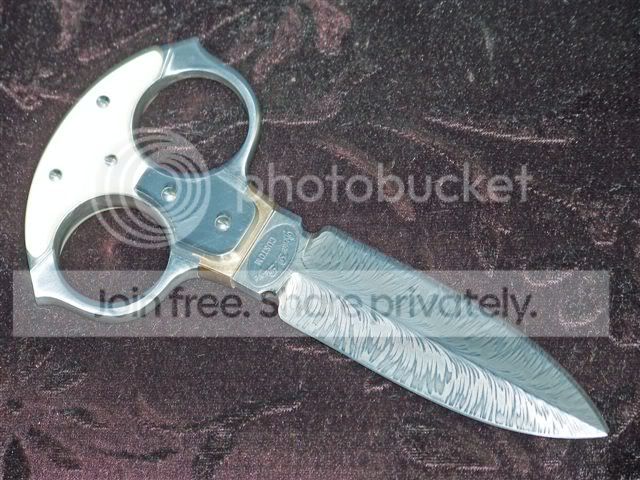
I have shown this around before but I still like it. Its about #3 and came out short so I made a push dagger. The guy that bought this one sent it off to Sam Welsh for engraving and then to Pete Mazur for french grey finishing. I wish I could get a picture of it when Pete is finished. Sorry for this cheapass shot.

Mavrick.jpg
 
Wow Toby, that's GREAT. Not a typical first post. Talk about advanced stuff. I'm liking the look of that sheath too.

Okay guys, now tell us the secret of getting a tall narrow billet forge welded. I often had trouble with a stack just a few inches high racking over. Five or six inches stacked up sounds damn near impossible. What's the secret???
 
Soak the billet well. Make sure it is up to proper temp. If you are using a press then light press or gentle taps with a hammer, hand or power. Back in for another soak then a little harder. After the second soak wail on it. It should be stuck together very well. This is still best done dry. If you do use flux the first weld must take. It can be fixed but it is harder. Also making sure your press or hammer is set up properly ie square. If it is out then the billet is going to be out. This can mess up the pattern. A set of squaring dies can help with this also. If you are doing all this by hand then I would stay with smaller billets. Then it is a matter of hammer control.
 
Something that I am wondering is how much of the smeared cut do you grind off? I played around with a billet today and the finished bar has a group of lines equal to the layer count running down the center of the bar. I am not seeing this in the photos posted.

I used a 1/4" cutter that was pretty sharp to make my cut so I am guessing that much of the inside on the photos posted here is ground off before rewelding?

Thanks
Brian
 
Brian, The cutter needs to be very blunt. I put a radius on the edge of the SS 1/4" plate which would equate to about a 1/8" rad. I did not remove that much material when I cut out the scale from the failed weld. My band Saw has a .032 thick blade. The pattern is made by the drag of the layers down to the flap remaining. If you have a picture of your billet it would help troubleshoot your situation.
 
That center weld is a tough one to reweld. I dont know why it would be differant than any other weld but somehow its a pain.

I also had real trouble slicing the billet. They say to use a dull chisel with a 1/4" radious on it but my billets would just smash and bend instead of cut so I sharpened it pretty good. The dull chisel would even delam some of the tender welds with that much pressure. My billets werent as big as your 20 pounder and maybe that adds to the tearing and bending.

I had dreams of bowie sized blades and only got folder size. Youre right about the loss from grinding scale and cutting off ends.

Ya gotta love Bruce Bump:) He's a "delicate" guy:o I love his "tender welds" statment:D
 
Chuck

This is a shot of what I am talking about. notice the band of "lines running down the center of the billet. I am also wondering if it is how I worked out the billet, squeezing too much on the sides.

Please excuse the slag, I did a quick grind and etch. The billet is still a little over 3/8" thick so I didn't get too fancy since it needs to be thinned down yet.

W ex 001.jpg


Brian
 
Last edited:
Brian,
I am seeing a couple of things. It looks almost like you got a couple of layers oriented wrong. I am seeing W's but I am also seeing a lot of straight pattern. Also did your cutter actually cut or did it just create a U. It almost looks like it bent rather than cut the billet or it did drag too much. I had to do my cut very hot, just below welding temps. This also helps prevent tearing the "tender welds". I took my time getting the cutter through, Like 5 heats. You have an interesting looking billet anyway. That is what I like about Damascus, As long as the welds are solid most all have interesting patterns.
 
Yes its true, I'm just a delicate guy with a .45 caliber pistol knife :D


Whoa!! Easy there big fella, I was just josing ya:eek:

Seriously, I have about 3 or 4 heros on this forum, and Bump-man is one of them. He's always showing us new ideas, techniques. I hope to run into him one of these days, but it's a long way from Uvalde, Texas to the North Pole or wherever he resides:)
 
Back
Top