First Feather Pattern

Does the weld material get ground off, or scale off through further processing, or...???

Mike

Yes because the mig weld is on the outside it will just get ground off as the process continues. I will sometimes grind off the excess weld after the first forge weld so the foreign metal is mostly gone and doesnt get pressed into the pattern from the drawing and squaring process. I do this with a 9" angle grinder when its still red hot but extremely hot sparks fly and its dangerous. I once started a fire 20 feet away so I made a corner in the shop for rough grinding.
 
Bruce and Nick explained the dry welding process quite well. If you can use a TIG machine and fuse the seam, adding no filler material, then grinding is not required. Another benefit of TIG is you can use the same filler material as one of your steels in the billet. This will prevent mild steel contamination. But it can cause pattern disruption. Grinding away the weldment before any serious processing is the best bet.
 
I wish I had a TIG welder. Maybe after my mortgage is paid and daughter is out of college. You lucky dog.
 
If you can use a TIG machine and fuse the seam, adding no filler material, then grinding is not required. Another benefit of TIG is you can use the same filler material as one of your steels in the billet.

Chuck,

If you took what I know about welding and stuffed it up an ants butt, it would rattle around in there like a BB in a box car...

I've got a friend with a nice TIG welder who is a helpful sort. What kinds of parameters in machine set up do you find better for the fusing you mentioned?

Mike
 
Here is a piece of feather pattern that Owen Bush and I made on one of our "messing around in the shop, days". Credit for this must go to Steve Dunn for a how to he posted on a forum a few years ago, that we followed.


DSC_3959-copy.jpg


DSC_3983-copy-copy.jpg


The effect and movement you getting from simply cutting down through the billet is excellent, something I would never have thought about. The swirl area on the photo above is the hinge that was left to keep it all together for welding back up. This was welded back up using flux. I have never tried the dry welding idea, something else to try.

Mick.
 
This is freaky, because I'm a dyed in the wool grinder. But can someone tell me where to get a small quantity of 1084 and 15N20? Thought I'd seen it in the maker's supply places but don't seem to be having any luck. Also, the smaller dimensions the better, as I'm going to be trying this with a poor iron anvil, and a hammer. It's gonna have to be a small billet... :D

Now then. I'm really confused about how this works once you weld the cut piece back together. Seems to me the blade would have to go 90 degrees to that cut. Is this why some makers use a cube? Flip it on end after the weld and draw that out? Sorry I'm so dense.

I know what you mean about this, the mind gets hold of what you want to have happen, and won't let you rest. Mercy. Just what I need: another obsession. :rolleyes:
 
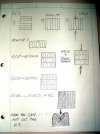
Someone tell me whether this is even in the ballpark. I know it's too simplified but it's what I imagined reading the referenced thread.

The picture is looking at the "end" of a cube. Is this generally the idea? I literally drew this on the back of an envelope, sorry for its crudity! I can't draw either. :)
 

Attachments

  • feather.jpg
    feather.jpg
    47 KB · Views: 66
Dave, you can do a feather pattern that way, but it won't have much character or pattern.

To do it like the ones in this thread:

Get it forge welded like you have drawn in step one.

Next, turn the whole billet 90 degrees and crush the layers (this is the start of "W's").

Draw the billet out (longer and thinner) then cut and stack it up.

You have to do the draw, cut, and stack, several times.

THEN you can move on to your step two.

This would be a ridiculously hard pattern to make completely by hand without a press or power hammer.
 
Dave, your drawing is on the right track. The piece in my photo is about 5" tall by 1 1/2 wide by about 1" thick. The dimensions you see here are the height and width, so what you do is cut slices off the thickness, the depth from front to back in the photo. So you will get about 4, 1/4" slices that will be 5" x 1 1/2", with this pattern on the front and back. You can draw this out some but you run the risk of compressing the pattern and loosing the effect.
I hope this has made it a bit clearer, although it does sound confusing. Wait till you try making the pattern, that can get confusing.

Mick.
 
Thanks for Kelly Cupples' address, Eric!

Nick and Mick, I'm having a hard time understanding how the stacking will make a difference, but I just need to think about it a while I'm sure. Given all the labor involved it's probably not something I'd do twice ... but I think I have to at least give it a try. Nothing's captured my imagination lately the way this has.

Thanks!
 
Here is a link to the original thread, go to post No 24 for Steve Dunn's "How to". http://www.knifenetwork.com/forum/showthread.php?t=26707
This is what Owen and I followed. Toby is mentioned earlier on in this thread for his piece on Don's site. This is what he followed as well.
Dave, the reason for the stacking is to get lots of bars of W's, one on top of the other. About 8 if I remember correctly. One thing you must remember is to orientate the plates in the same direction and before you slice down through the stack, it would pay to clean up 2 sides just so you know which face to cut down. I know this from experience as the first time I did this I cut it the wrong way and when I polished it all up, the pattern wasn't there.
This is a hard core pattern to do by hand, best of luck. Even with a power hammer, its hours of work.

Mick.
 
Dave, this was REALLY quick and dirty, but hopefully it will shed some light on it. :)
 

Attachments

  • W's for Dave.jpg
    W's for Dave.jpg
    44.2 KB · Views: 67
Last edited:
Thanks a million guys. Nick that drawing was worth a thousand words; now I get it. Mick, I'll save the post to keep Steve's process. I sure understand how difficult this will be by hand. Presumably it can be done on a "miniature" scale with small enough stock, which is what I'll try to accomplish if I can find the right material. I don't think there's any way my desk jockey arms could do all that forging even in a week, which is how much time I hope to devote to my experiment. Now is when I rue working alone... :D

We'll see! If nothing else, you guys have lit a serious fire under my dead and dying keester.
 
Nick

Thanks for the drawing.

I have a much greater understanding now.
(I reeds n rites real good, but pitures help)
 
I got 1084 and 15N20 from Kelly that worked real fine for some small simple random and twist billets I made up at Indian George's with his press. Kelly will cut stuff to fit in flat rate priority mail boxes too. He'll shear the 15N20 to the same width as the 1084 too, at least that's what I did. The 1084 was 1/8" thick and the 15N20 1/16". I initially thought I'd double up the 15N20 so it was the same thickness as the 1084, but didn't end up doing that.

Try

Kelly Cupples / octihunter@charter.net
2807 Butterfield Rd.
Yakima Wa. 98901
509-949-5231

Good guy to deal with... Eric
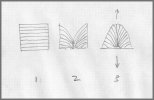
 
Good picture Nick. I saved it. hehe

Mick thats awesome!


Guys, One thing I still have trouble with is how many layers to stack up to get the right amount of feathers. That sounds easy enough but its not for me. I have had billets with so many that the feathers dont show just a thousand thin ones and some that had huge not so pretty feathers. Mick seems to have the magic number. Mick can you shed some light on how many layers you have there? Its very cool.
 
Back
Top