
First go at San Mai. Pics added

Joined
Nov 28, 2014
Messages
1,864
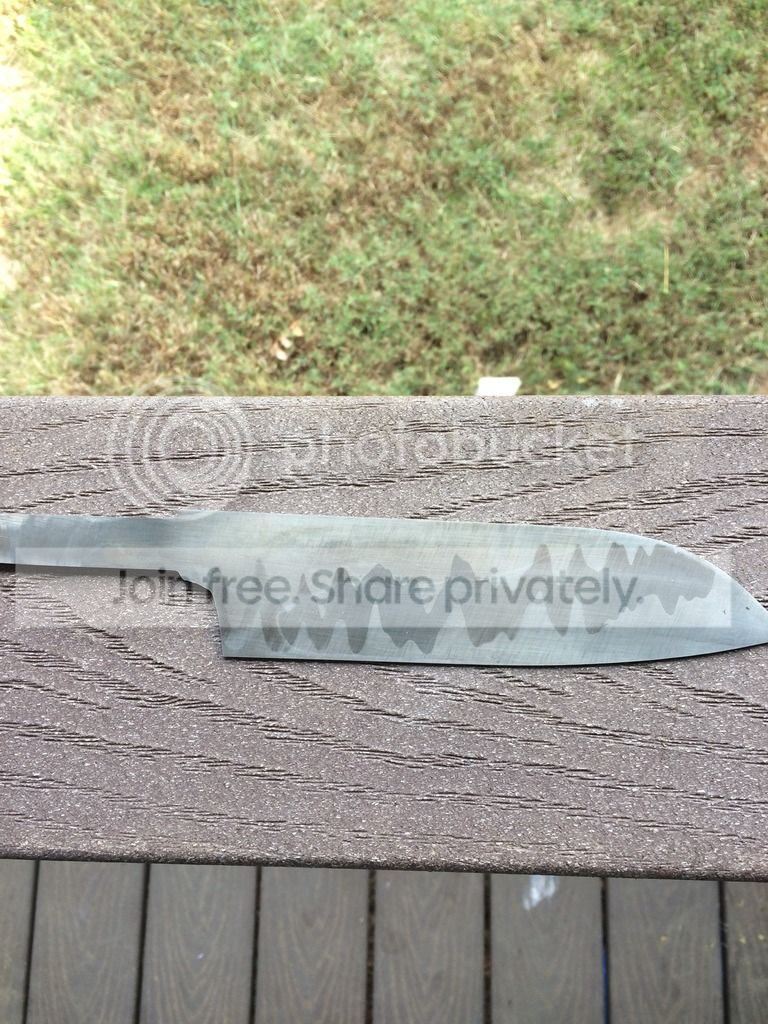
I tried my first go at some San Mai yesterday. It's 15n20 with 1095 core. I need to clean it up, profile, and rough in the bevel this afternoon and see what I have. This is the first I've worked with carbon steel that I will be heat treating. Do I need to normalize it from the laminating process? I will get some pictures up later.

Edit: I did a quick etch after roughing it in and this is what I have. Is It seems I have both steels on the edge. The edge is still .035" or so. I started with 2 pieces of 15n20 on each side of a 1095 core. I'm assuming the darker part is the 1095? So, what went wrong and any tips on what not to do next time?Will this be ok since both steels will harden?
 
Last edited:
Yes you need to normalize and thermal cycle it before heat treating. Otherwise your grain will be huge from all of the time at welding temperature.


Sent from my iPhone using Tapatalk
 
Thanks Jeffery. I will do that. I forgot to mention we were using a forging press. Not sure if that matters just throwing it out there.
 
Never used a forging press unfortunately but the end product should be the same [emoji41] it may even be helpful to forge a small test coupon of sanmai the exact way you do your blades, harden it, and snap it to see the grain structure...and it's gonna take some work to break it. It took me about a dozen hits with a 3 pound sledge to break a sanmai blade that wasn't even tempered! Tough stuff.


Sent from my iPhone using Tapatalk
 
And this is where things get a little confusing to me. Normalizing is to heat it up to aust. temp and let air cool to black? Do it a couple times and this reduces the grain size. As for thermal cycling I don't understand it completely. It seems to be similar to normalizing but does something different?
 
After some more grinding this is where I'm at. Looks like I didn't have the core centered or something. Next time I will use a thinner core and make a taco with the sides and maybe I'll have better luck.
 
It helps me to count my hammer blows as I'm forging sanmai. If I do 10 on one side I do 10 on the other side. If you do this your core should be centered without much trouble. Before you grind into it make sure you check to see if it is centered...grind the edge free of scale and crap and wipe it with some ferric chloride.


Sent from my iPhone using Tapatalk
 
Thanks Jeffery. That makes a lot of sense. I also am going to use stock closer to the length I need so I don't have to stretch it as much. This started at 5" and ended at 10".
 
What kind of press dies where you using, it looks like you where using aggressive drawing dies. How thick was your core and sides? When using a press you should not have s problem keeping the core in the center as long as the press dies are the same on the top and bottom. I also flip my billet over on the next heat. If you billet comes out of the press with a curve then it's stretching it more on one side then the other. Also make sure when using a press you keep the scale knocked off the billet. The scale will build up creating very thick sections and even though your billet looks flat it's not because the scale. Usually a quick press on the edge will cause the scale to pop off. If not then go to the anvil and give it a once over with the hammer. If that fails the flux it and get it nice and hot and brush it off.
 
If done right you don't have to worry about drawing it out and messing it up. You can start with a thick core and sides and as long as you stretch it evenly it will stay in the middle. This is a stainless San-Mia blade I made.

1/2" thick layers of 304SS and 52100
Photo%20May%2003%2C%2010%2008%2034%20AM.jpg


All forged out. I use aggressive drawing dies so I can get a ripple affect in the core.
Photo%20May%2003%2C%2012%2011%2052%20PM.jpg


A quick etch to check the core is centered.
Photo%20May%2003%2C%2012%2012%2010%20PM.jpg


And here is after heat treating and a quick etch.
Photo%20May%2005%2C%205%2054%2010%20PM.jpg


So keep working at it and you will get better. I would still finish that knife, the pattern looks very unique and 15n20 is an amazing steel so don't wory that it's on the edge.
 
Thanks JT. The billet did curve and yes I was using drawing dies. The core was .125" and the 15n20 was 2 pieces of .100" per side. I am going to finish it anyway because it looks pretty cool. I will try and see if the drawing dies are even and see if I can true them up if not. How much different is welding say 416 and white paper? That's what I would like to try once I figure this out.
 
I have never worked with any of the white paper steels but welding stainless is not as hard as it sounds once you get the basics down. The trick is to grind everything very clean and then weld the layers together all the way around so no air can get between the layers. I don't know of a flux that works with stainless, not saying there is not one but I have not seen one or even looked for one. The welding works like a charm and gives me no problems. I think one trick you have to learn on your own is later thickness. Different steels are harder to forge then others. This means in order to control your later thickness you need to play with the steels and see how thy forge out. Most any aloy steel is harder to forge then simple carbon steel. Even with 15n20 and 1095, I have been doing some 15n20 and 1075 and if I'm going with a high layer count I need to go allmost double the thickness of the 15n20 with the 1075.

Here is a good exzample of the thickness problem. This started as 1075 and 15n20 that where the same thickness. You can see the 1075 is a thinner line (black lines) compared to the 15n20 (silver lines). Not that it's bad looking it's just something to keep in mind what planing out billets.
Photo%20Mar%2016%2C%2011%2043%2052%20PM.jpg
 
Thickness is where I'm not sure what to start with. This billet I had came out at .240" and took a lot of grinding to get it to .170". I did grind some distal taper so we will see how it works. If I wanted a .125"x 2 x 12" billet after welding what size stock should I start with?
 
The thinner you want your finished billet to be the more tricky it becomes. If I was going after something that size I would start at the size I wanted. So cut strips at least 2" wide and 12" long. I would then use a carbon steel core that was not thicker then the sides. Your core is going to need to be rather thin if your wanting a 1/8" finished billet. I would start with some thin 15n20 sides at around .072 (thinnest I curently have) and then find some core material that's at least that thin if not thinner. Your not going to do a lot of forging on this but rather just set the weld a few times and call it good. After the welds are set I would run down the length with the drawing dies lightly so I get some activity in the transition between the core and sides. Won't take much so don't go crazy. If you can't find core material that is thin enough then just make the sides thicker and forge it down. Keep and eye on the core by letting it cool off a little and grinding the scale away and looking at how thick it is. I'm guessing if your going after a finished billet .125 thick your going to want your core .020-.03 thick but this depends a lot of the style of knife your making and the grind profile. If your doing a kitchen knife with a crazy thin grind then the core might need to be thinner then that. Rule of thumb is core needs to be thicker then the thickness left behind the edge. So if you grind till the edge is .010 thick and then sharpen your minimum I would say would be .015-.020. The thicker the core the higher up the bevel the weld line will be. So it's what ever you want really. Just have fun and learn as you go.
 
You've been a ton of help buddy, thanks! The thinnest piece of white paper I can find is .177" so I may try something else for the core until I get the hang of it.
 
Last edited:
JT when you drew out your 304 billet how did you keep your weld from popping? Everyone I tried the carbon steel eventually squeezed out faster than the 304 and I lost the weld there.
 
The carbon will squish out faster. This started as a test knife to see the ratio between stainless and carbon thickness that's thy I made all the layers 1/2" thick. I was then going to forge the billet down to 1/4" thick and measure the core. By knowing the starting thickness and ending thickness of each layer I could calculate a ratio. Well it ended up right where I wanted so I called it good. But yeah the carbon acts like the jelly in a sandwich. I left the arc weld beads on the billet till I was completely done forging it to thickness. Then I ground the sides till it was cleaned up.
 
Maybe that was my problem. Where my edge welds broke is where I lost my forge weld. Next time I'll actually lay a bead with filler instead of just a non filler TIG weld. Did any of your edge welds break?
 
Back
Top