Flash your anvils

KnifeHead

Knifemaker / Craftsman / Service Provider
Joined
Apr 5, 2006
Messages
5,575
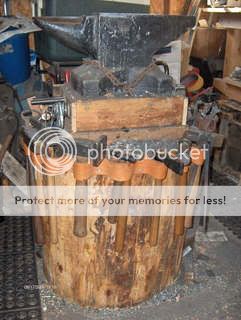
After looking at Ray Richards new shop pics I was straining to see how he had his anvil mounted. I have a 100# Fisher :o that is mounted on a log section with a small vise and a 150# Hay Budden that is currently unmounted. I think it would be neat to see pictures of your anvils and how they are mounted.

Gone unmentioned, I would expect to see at lease one pic of someone "mounting" their anvil. Not that kind of mount please :D
 
Mine is mounted on a large stump from a stone maple tree. At the moment, i just have it fastened with large bent nails, but plan to use RR spikes once i get a few more. I also use two very powerful neodymium magnets on the horn to ruin the harmonics of the anvil, which takes 90% of the ringing sound out of it. Ill post pics tonight.
 
No pics, and no time to get them for a few days, but mine is mounted on a "stump" made of 2x4's stacked and screwed together. Fastened to said base by 2 pieces of 2x2 angle iron lag bolted to the base. That plus being a 335lb EuroAnvil make it pretty steady.

-d
 
Mine is on a 22" dia doug fir round with some 4x6's which were easier to level then the round.

anvilmount.jpg
 
Home made 'stump' from some 2x12s I picked up cheap and drove some 12" carage bolts through.. It's being held on with some heavy nails currently, about as large a nail as i could get in a 2x12 without splitting it.

anvil.jpg


It's not a 'bad' stump, but it's far too light and bounces around on the shop floor. I really need to get a big heavy log. Several actually. I have a nice 55lb large bickhorn that needs a good stump base for it to be driven into as well.

bickhorn.jpg
 
I tripped over this one in an antique store....I had to buy it :D
155.jpg

The ratchet straps came off after the liquid nails set up.
 
Heres mine.... Doesnt move an inch. I drove wedges under the sides of the stump and its been in the same spot ever since no matter how hard i hit it.

Anvil is a 200 pound Peter Wright

anvil.jpg
 
Valimas,

Does your Kohlswa ring or "thud"? I have a friend with one that rings like a bell and my blacksmith guild has one that doesn't ring at all. It rebounds like mad and is a fantastic anvil, but just doesn't ring. IMHO it's the perfect anvil :)

-d
 
Deker,It rings like a bell. I gotta get some magnets for the late hours. I like the sound but my neighbors probably dont want to hear it.
 
Deker,It rings like a bell. I gotta get some magnets for the late hours. I like the sound but my neighbors probably dont want to hear it.

Joe, Did you just use the Liquid Nails where the anvil joins the 4X4's? Both the anvils I have set up at this time rang horrible before I went with the construction adhisive althought I used the adhisive to hold the bases together as well. On my Made in Sweden anvil the base is stacked 1' square 3/4" plywood pieces that were glued and then nailed individually with ring shank nails. Then I glued the anvil to the base. With the Trenton that I set up over the weekend it sets on 6X6's that run vertically. The 6X6's were glued and then bolted together. After I had the base made I then glued the anvil and the lag bolted it to the 6X6's. I went with the cheapest construction adhisive Home Depot had and I'm not sure if I had gone with maybe Liquid Nails it would have done more. The Trenton will let out alittle ring if struck on the horn or heal but the noise for both when struck on the face is a low thud.
 
I always had questions when i read threads like this. Lets say you set your anvil on a nice cusion of liquid nails or something with some give (like a stump)....isnt the whole idea behind a study mounted anvil to preserve as much of your hammer power above the anvil (ie, on the steel)? If you cushion an anvil to take out the ring, arent you being counter-productive by absorbing your hammer blow rather than returning it to the underside of the steel you are hitting?

I thought the ring in a hardened anvil was really the harmonics of the piece of steel producing the ring. Am i confusing things here? Would an anvil cast into concrete perform better than an anvil set on sand? What about an anvil set on a cusioned rubber mat? Can someone clue me in here...
 
As far as the base goes, For the most part the break between the base of the anvil and whatever base the anvil is sitting on is enough to stop any actual reflection of force through that transition in materials. However you want a massive base (massive as in mass, not just 'large') so that the anvil itself does not move at all, and thus transfers all the force back to the hammer blow, and not into translational force moving the anvil / base.

A concrete platform is a very bad idea, as a good anvil will essentially strike it's base with an equal amount of force to what you hit the top of it with, and you will crumble / shatter the concrete in a very short amount of time.

The ring is all energy which is not being sent back into the hammer blow in the first place, so dampening it does not have any real apreciable effect upon the performance of your anvil. So you are correct, a sturdy base does help preserve the transfer of force back into the hammer blow, but not 'directly' as having a more massive anvil would, but indirectly, by helping to preserve and controll the direction of work being done. (work in the physics sense, force times distance)

EDIT: To add. It is possible with an anvil with a nice flat bottom, to get a good amount of added force rebound by placing the anvil ontop of another solid object with good rebound (ie another large block of steel) if the contact surface is regular enough. The return isnt nearly as good as just having a larger anvil, but there can be some benefit.
 
David, I'm really not cushioning the anvil with the adhisive. What I think is happening is instead on having seperate pieces I have one piece with things glued together. I feel like the ring is being absorbed threw the base of the anvil into the wooden base when everything is glued together. I still have the hammer rebound.
 
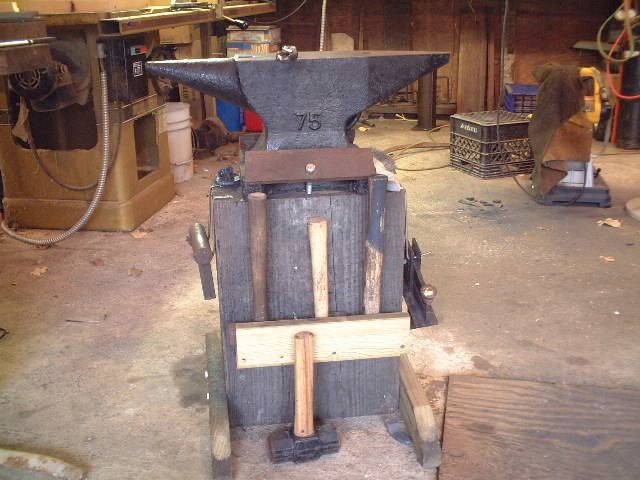
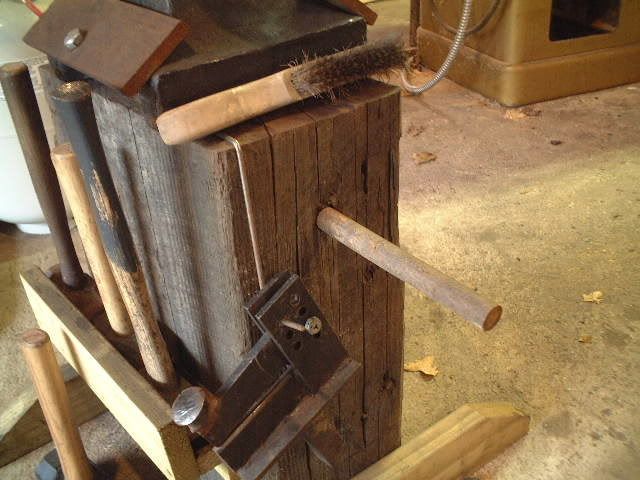
Two shops = two anvils!
Honestly, I was down behind my house here in the woods, setting some bank poles for some night-time catfishin', and what did I see??!??! Looks like and old piece of bridging or something that had floated up during some flood in years past. It was totally creosote soaked, so maybe part of a railroad trestle? Actually, I didn't care! I tied a rope around it and dragged it back to the house and cut it up into two pieces just perfect for my anvil stumps.
On both of them, I drilled in two holes to accept a wrought iron "handle" for lifting, (with two people) or simply adjusting of position.
Two straps of wrought iron and two looooooooooong lag bolts hold it firmly in place.
All I need to do is back one bolt out and I can remove the anvil for taking to hammer-ins and such.
The idea of permanently attaching an anvil with construction adhesive seems absurd to me.
What if you want to move it?

gasanvil.jpg


gasanvilhandle.jpg


coalforge.jpg


coalanvil.jpg
 
Back
Top