Flint and

I once used Old Man's beard for tinder, but the old guy kicked the livin snot out of me for setting his beard on fire! Boy was my jaw sore when i came to.

So, for the steel, we are talking good carbon steel, just like when we use a ferro rod, right??
If this is the case, might I also suggest those round files for sharpening chainsaws.
pretty cheap, and if annealed as described above, they are already in the cylinderical shape.

Could you strike a carbon bladed knife's spine against the flint and still get spark?
Just a thought.How about hardness? leave it in the annealed state is OK?
Or does it need to be heated and quenched to bring back it's hardness?
 
I just ordered a bunch of sets (striker, flint, char cloth, jute and tin,) for my little outdoor buddies for xmas after reading this thread thanks for the idea...oh of course I had to get 1 for myself too LOL
 
I once used Old Man's beard for tinder, but the old guy kicked the livin snot out of me for setting his beard on fire! Boy was my jaw sore when i came to.

So, for the steel, we are talking good carbon steel, just like when we use a ferro rod, right??
If this is the case, might I also suggest those round files for sharpening chainsaws.
pretty cheap, and if annealed as described above, they are already in the cylinderical shape.

Could you strike a carbon bladed knife's spine against the flint and still get spark?
Just a thought.How about hardness? leave it in the annealed state is OK?
Or does it need to be heated and quenched to bring back it's hardness?

Good carbon steel is correct, it throws good sparks.

I have used a nicholson metal file as is right out of the tool box to strike flint with ok results. Old files were commonly used to make flint strikers. I have been meaning for the last month or so to forge a few strikers from old files I have.

Yes, you could use the spine of a good carbon blade and get a spark.

As far as hardness, I have been searching for info on this. One maker I asked said it was good to go after quenching in oil. I'm still researching this. I do know from playing around with any steel I could find in the garage the harder the steel the better it works. Example, I could get a few sparks with that metal file, but when I tried to use the tang of the file I really did not get any.

If anyone else has any info on these please let us know.
 
Army surplus stores sells a flint rod mounted on a chunk of magnesium. I took some dryer lint out of the dryer, put it on the tile kitchen counter, struck the back side of my knife blade, and ignited the dryer lint on first try. I was a hero to my kids, and a goat to my wife. The looks she gave me. I have to remember, time and place for everything.
cj
 
Army surplus stores sells a flint rod mounted on a chunk of magnesium. I took some dryer lint out of the dryer, put it on the tile kitchen counter, struck the back side of my knife blade, and ignited the dryer lint on first try. I was a hero to my kids, and a goat to my wife. The looks she gave me. I have to remember, time and place for everything.
cj

hahahaha, nice. I tried dryer lint once, but there were too many synthetic fibers and it mostly melted instead of burned. I've been wanting to do a huge load of jeans and see if I can get any good lint off of that.
 
So, for the steel, we are talking good carbon steel, just like when we use a ferro rod, right??

Skunk, ferro rods do not need carbon steel, in fact, they don't need steel at all. Sparks can be created with glass, sharp rock, etc. It's the ferro rod that luminesces (that the word?). With flint and steel, it's tiny steel slivers that luminesce. (that the word 2?)

Doc
 
hahahaha, nice. I tried dryer lint once, but there were too many synthetic fibers and it mostly melted instead of burned. I've been wanting to do a huge load of jeans and see if I can get any good lint off of that.

run a few loads of wet, big thick cotton terry bath towels thru the dryer and bunch of times.

linty burning goodness!
 
Here's one more thought on the subject; you can hold the flint still and strike it with the steel, or you can hold the steel and strike it with the flint. Both work, and the only difference is your own comfort, and THAT will be a result of the style of steel striker, how you are holding it, and the size of the flint! With a properly made striker and good flint, you should get a shower of sparks with each strike. If your char is dry, one or two strikes should give you an ember.

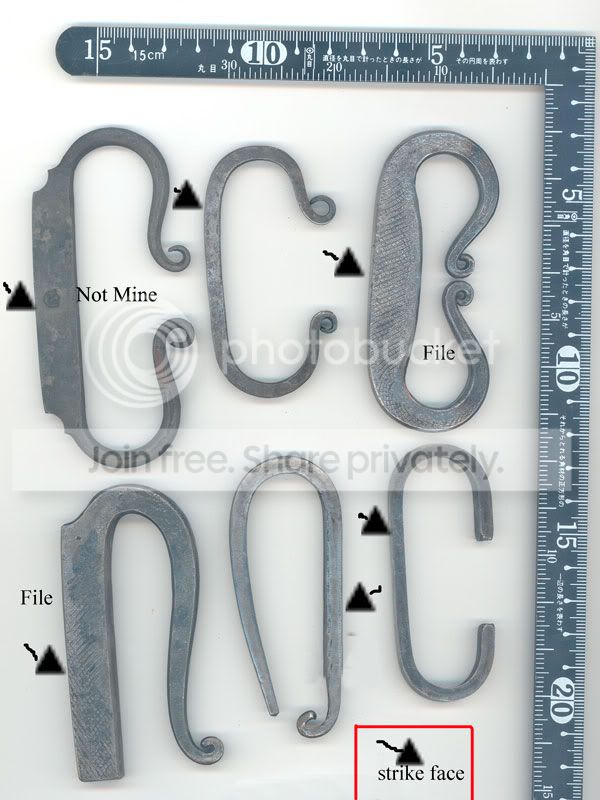
Just remember that the flint needs to be sharp, and that you are moving your soft fingers quickly and hard in the vicinity of a very sharp edge. I prefer strikers that allow you to hide your fingers BEHIND the steel.... I have a nice collection of strikers, some that I bought and some that I made, but most protect my fingers. I like my fingers even more than I like my strikers.

FlintStrikers.jpg


This is a pretty old photo. I've since gotten a few more different styles from different cultures and countries. Interesting to note the difference between the styles from the 1700's fur trappers to the style used during the American Civil War.

Stitchawl
 
[SNIP]
If anyone else has any info on these please let us know.

Here's what I found out when I began making them...

For my forge, I used my BBQ grill most of the time. :o A couple of times when showing friends how to make them, we used #10 tin cans with the ends removed and some holes in the bottom, and filled with ordinary charcoal. I used my wife's hair dryer for forced air, and ordinary pliers to lift the metal out of the fire. I used a large rock for an anvil and an ordinary framing hammer to fold the steel.

It should be very good quality high carbon steel to begin with, such as you'd find in old, well made files. (Best source is old flea markets and yard sales!) The lower the quality, the fewer the sparks. New files, if they are good quality work fine too. One of the best steels are the tines from old tractor rakes, but watch out for old farmers. :p

For the ones I made easily without any special equipment, good quality rat tail files worked well. They don't need to be round or flat. Any shape is fine, but you do want to anneal them in a fire to grind or file off the teeth more easily. A flat, smooth surface is what is needed for the strike face. The wider that surface, the more sparks can be thrown, but if you use a very thick file the resulting striker will be heavy. 1/8" - 1/4" is fine.To anneal it, just heat it to bright red and let it cool without quenching.

After smoothing and shaping the striker to your liking, you MUST harden the strike face. If it isn't hard enough it will not throw good sparks. To do so, heat the metal to a dull cherry red color. At this stage the metal is called 'martinsite' and it will no longer be reactive to a magnet. Use a magnet rather than trying to judge the color unless you're a blacksmith... Once the steel is no longer attractive to the magnet, quickly quench in cold water. Use a file or emery paper to remove the fire scale and try to strike a light. If it works, and you have a good shower of sparks, you're done. If there isn't a good spark display try reheating the steel and quenching again. On a couple that I've made in the BBQ grill, I had to re-heat several times. On some, I never did get a good spark and deep sixed that piece of steel. Use good steel, use the right heat, and you should have a fireworks display every time you strike a light.

Stitchawl
 
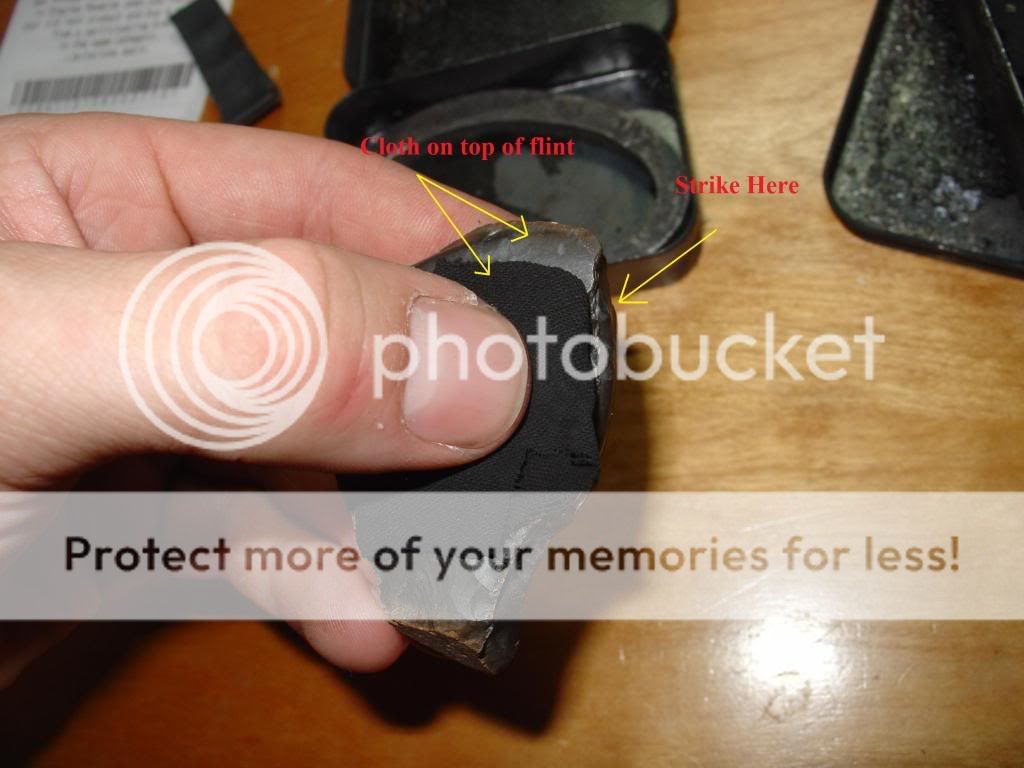
Doc is dead on in his sketch, I took this pic to for ya too. The cloth lies on the top of the flint, you strike the edge (make sure it is a sharp edge) of the flint where it and the cloth meet. The cloth catches the sparks. Don't be afraid the tear the cloth, you can even lay the cloth over the edge of the flint then strike it through the cloth. In my above post also shows video bearthedog took this past weekend of me lighting char cloth with my steel. Hope this helps. Took me over a month of constant trying to figure out how to do it properly. I was laying the cloth on the ground and stiking the steel over it hoping a spark would land on the cloth ***this method does not work well at all*** After a TON of searching online and I finally figured it out. The cloth goes ON TOP of the flint lol, I felt really silly.

DSC03274.jpg


Now hold a tiny bird nest of tinder on top of the char and you can light and get flam with out setting any thing down. I can light my pipe while walking with a flint & steel.
 
I have always a bit of trouble with flint and steel, probably need more practice.

Another cool old school fire starting method is a fire piston. Do a google search if you haven't heard of this one, it is very cool as well.

I like fire pistons but not nearly as much as a good piece of flint and a steel striker. I don't know why...
They are pretty easy to use, and work well once you know how. She doesn't know how to use mine... She was getting ready yo make dinner for herself and her brother and was going to light their fire with (ugh!) a Bic. They use fatwood as a matter of course, as they cook all their meals over an open fire outside the hut.

Karen48.jpg


Sometimes I have difficulty getting the ember out of the end of the piston once it's burning. It's just too small!!

Stitchawl
 
Good carbon steel is correct, it throws good sparks.

I have used a nicholson metal file as is right out of the tool box to strike flint with ok results. Old files were commonly used to make flint strikers. I have been meaning for the last month or so to forge a few strikers from old files I have.

Yes, you could use the spine of a good carbon blade and get a spark.

As far as hardness, I have been searching for info on this. One maker I asked said it was good to go after quenching in oil. I'm still researching this. I do know from playing around with any steel I could find in the garage the harder the steel the better it works. Example, I could get a few sparks with that metal file, but when I tried to use the tang of the file I really did not get any.

If anyone else has any info on these please let us know.
Heat to orange and beat to shape, quench at cherry red, polish one side to see some shiney metal, back to coal and heat to blueish color moving thru steel, quench quickly in water, polish striking side and check with flint. It should throw sparks half way to ground, sometimes you can hear them fizzle. Use a good used Nicholson file as suggested. The carbon content, and tempering are the variables, if not sparking repeat tempering. Works for me.
 
I really enjoy using flint and steel to start a fire. Tony, take your flint and use the back of your hatchet to start one. Another good practice!

I'm going to forge a bunch of these up too.

Spooky, a piece of flint as large as tony's will last a long time.
 
Guys, thanks for the answers.

It's sounding like the harder the steel the better?

So, it would be good to heat it until glowing orange, then quench. I use motor oil, heat a small batch to approx. 150 degrees for quenching.
 
Thanks for all the info / instructions and pics - I've learned a lot from this one. :thumbup:
 
Great thread Tony. Just wanted to add that several styles of handmade, traditional strikers are available at Ragnar's.
 
Last edited:
I've found that old garage doors springs are the perfect size for forging strikers.

Jeff
 
Awesome thread!!! I know Matt of ML Knives makes fantastic strikers. Both of mine are from him, very reasonably priced to boot!
 
Back
Top