For those that own a Canadian?

Joined
Mar 19, 2007
Messages
7,443
I own standard bushcrafters in the form of a Kosters Bushcraft and a Bark River Aurora. I was looking at BrianS's Canadian:

SANY0008-8.jpg


What do you feel the advantages of this shape are? Why do you like them? I think they look cool - but I don't know if I 'get' it? Help me out - sell me!

TF
 
I think that's actually a Grohmann DH Russell No. 1, with the original grind (as opposed to the flat ground version). It's definitely a classic Canadian knife.

The advantages: It's a really great slicer with a comfy handle and good balance. I have heard that they are particularly good at skinning, though I have not used mine for this purpose yet. Mine gets used for food prep (where it excels), woodworking, and general camp chores. The grip is very reliable, and I have often used this knife in the winter, wearing gloves. Paired with an axe for chopping, it makes a great outdoor knife.

This is what Grohmann says about the design:

This is the Original Design Award winning D.H. Russell Canadian Belt Knife in production since 1957. Grohmann and D.H. Russell teamed up to design a truly Canadian outdoor knife and through trial and testing with hunters and trappers came up with this first design in the line. By our last count, our knives have been copied by more than 16 different companies over the years that have come and gone, ours is still the only one in production after 50 years. High quality materials, along with outstanding designs and talented craftspeople, made in the traditional way.

General Purpose fixed blade outdoor knife, ideal for dressing game. Extremely comfortable grip for any application from small game and birds to large game. Unique elliptical blade to lessen cutting drag. Palm & finger fitting "offset" handle for safe grip.

Blade approx. 4" x 1", of 1/8" stock, total knife length 8 1/2".

If you opt for one, consider getting a flat ground version. Mine cuts like a razor and holds a decent edge.

All the best,

- Mike
 
I've never given them a second thought because the handle looks so small. Maybe I should seek one out and give it a test-run. If it's been popular all these years, there's got to be something I'm missing.
 
The handle is offset such that when you hold them you can slice efficiently without your knuckles getting in the way. Not as efficient in this regard as a chef's knife, but similar idea. The handles are very comfortable and offer a lot of control.
 
PB Wilson, you do have a point about the small handles. It really doesn't cause as much of a problem as you would think, as the wider back of the knife fits snugly in the palm of your hand - only the first two fingers extend to the thin area behind the blade.

That being said, I have re-handled several of my Grohmann knives using thicker wood, and with a more pronounced palm swell. This works nicely. You can purchase several of the models in kit form, which gives you some handling options and - as an added benefit - is a bit cheaper.

Best,

Mike
 
I've only used one 'Canadian' style knife before, the BRKT CS, it just wasn't for me. I use a blade mostly for 'bushcrafty' tasks, lots of woodwork. I also use mostly a 'hammer' style grip, or thumbs down, for control. The canadian style does not at all agree with this type of grip. It seemed, in my hands, that it only comfortably allowed a 'thumbs up' grip, with the thumb tracking along the spine. I don't often use or prefer that style. Anyway, I sold it off quite quickly. Maybe it'd work better if you did primarily food/game prep?
 
I love the design I just don't like the ricasso. This is the reason I like Breeden's pathfinder so much. Similar design without the ricasso/choil/plunge line.
 
I love the design I just don't like the ricasso. This is the reason I like Breeden's pathfinder so much. Similar design without the ricasso/choil/plunge line.

I agree that there are definite similarities with the Breeden pathfinder. Although Bryan's pathfinders very in the degree of curvature around the handle and blade. Some of his handles are more straight like the peacemaker. When I had my pathfinder made I asked Bryan to accentuate the S-curvature a bit. You can see the similarity here. Also full flat grind (which can be had on the Grohman's) is desirable IMO.

DSC_0007-20.jpg
 
Exactly what I was thinking. That to me is a comfortable, practical Canadian.
My Nova Scotia relatives might object but I prefer that to the Grohmann.
 
You silly Americans. Slavery is illegal up here too. :D

Not sure what the advantage of the blade shape is, but it is quite comfy. I don't own either of the pictured knives, but I do have a BRKT Canadian Special.
 
I was about to argue that you should not for any reason own a Canadian for moral reasons, but then I remembered Leviticus 25:44

As for your male and female slaves whom you may have-- you may acquire male and female slaves from the pagan nations that are around you.

I guess we probably count as a pagan nation so I guess it's okay.

Damn it! Well, you can be sure my trigger finger is going to be set on "itchy" when your slave-trading delegations come for me, damn Yankees!
 
I own Bark River's mini-Canadian and Candian Camp. They are similar to that Grohmann and Breeden's Pathfinder, but (like Breeden's), they don;t have quite the "upsweep" as does the Grohmann.

I really like the Grohmann #1 and their Survival knife (I can;t think of exactly what it's called right now). I'll eventually buy one or the other....or both. If you think they look nice, Talfuchre, I'd say you're spot on. They're beautifully designed knives, but they do take a bit of getting used to.
 
Yup, that's a Grohmann #1 in carbon, original grind. Got it for $50 bucks at the Scout Shop - figured it was a good blade and the money going to a good cause. It field dresses well and is excellent for food prep. The blade lies below your fingers, so I find it excellent for precise cutting tasks. It's nice and light for backpacking and doesn't seem to scare the sheep.

It's a soft carbon, which has it's advantages and disadvantages. I heard that some Canadian trappers requested the carbon so as to enable quick field sharpening. When camping, I enjoy refreshing it's edge on my little ceramic stone whilst relaxing by the fire :)

It's my best slicer and can push-cut paper by almost weight alone.

Can someone let me know how to properly shape/form the sheath for a tighter fit?

SANY0003-9.jpg
 
Last edited:
ruger.jpg


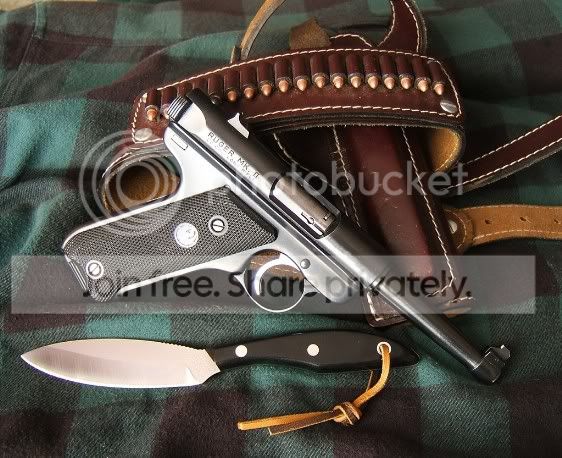
I love mine. I have had it on several camping trips. It has also field dressed quite a few deer. Slices like a laser :thumbup: This one is SS with black micarta.
 
I've handled a Grohmann, and the handle is really not that comfortable for me as well. I really like Bryan Breeden's interpretation of that line of design in the Pathfinder. You could also have him do that blade shape (Which is a very useful design) with a handle that suits you better.

I like the blade shape for its versatility. You can skin, do food prep, and bushcraft. You can technically do that with about any knife, but I think the leaf-shaped Canadian design is really versatile.
 
Can someone let me know how to properly shape/form the sheath for a tighter fit?

Shaping is really easy - you just need to wet the sheath and form it to the contours of the knife. It will retain the shape as it dries. To make things a bit more durable, I recommend adding a few coats of neatsfoot oil to the finished and shaped sheath - this hardens the leather a bit, and helps it to retain the formed shape.

For a carbon steel knife, I recommend either taping the blade or wrapping it in plastic wrap before forming, to protect against rust.

Soak the sheath in water until the leather is thoroughly penetrated. Pour out any excess.

Insert the knife into the sheath and shape the leather around the contours of the knife using your fingers.

Leave the knife in the formed sheath for a while. There are different schools of thought on this. I have left knives overnight and allowed the sheaths to dry around them. I have also gently removed the knife after just a few minutes, and allowed the sheath to dry on its own. It should hold the formed shape anyway.

You can speed the drying process by putting the sheath in the sun or by a radiator, or by using a hair drier. I usually let it dry on the windowsill.

Once the sheath is totally dry, you can give it a coat of neatsfoot oil (I get mine from Texas Knifemaker's Supply) if you want.

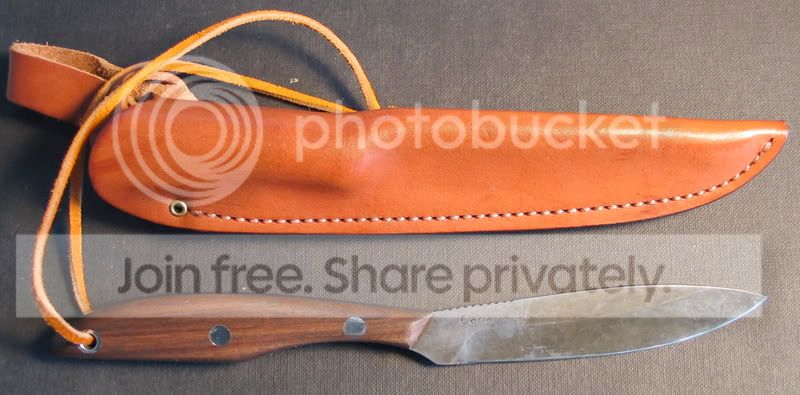
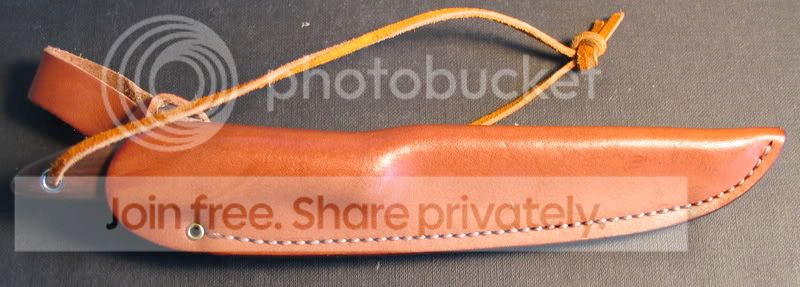
Here's a shot of my Grohmann Bird and Trout knife and formed sheath. This blade gets lots of use and has developed a respectable patina.

IMG_2850.jpg


IMG_2848.jpg


All the best,

- Mike
 
Yep, Bird & Trout. I love this knife. It's a great fishing companion. I recall a few outings where I used this knife to cut line, cut a cigar, clean bass for a shore lunch, cut onions and potatoes, and whittle a fuzz stick to get the fire started. Definitely a good all-around user. Not much of a chopper, though!

Best,

- Mike
 
I really like the handle on the Grohmann, you get a lot of control over the knife for delicate tasks thanks to it being thin and barrel like at the front so you can roll the knife around between your fingers, as opposed to a lot of knives handles with a rectangular profile. The continuously curved blade cuts really nicely, though mines gotten pretty flat over the years.
 
Back
Top