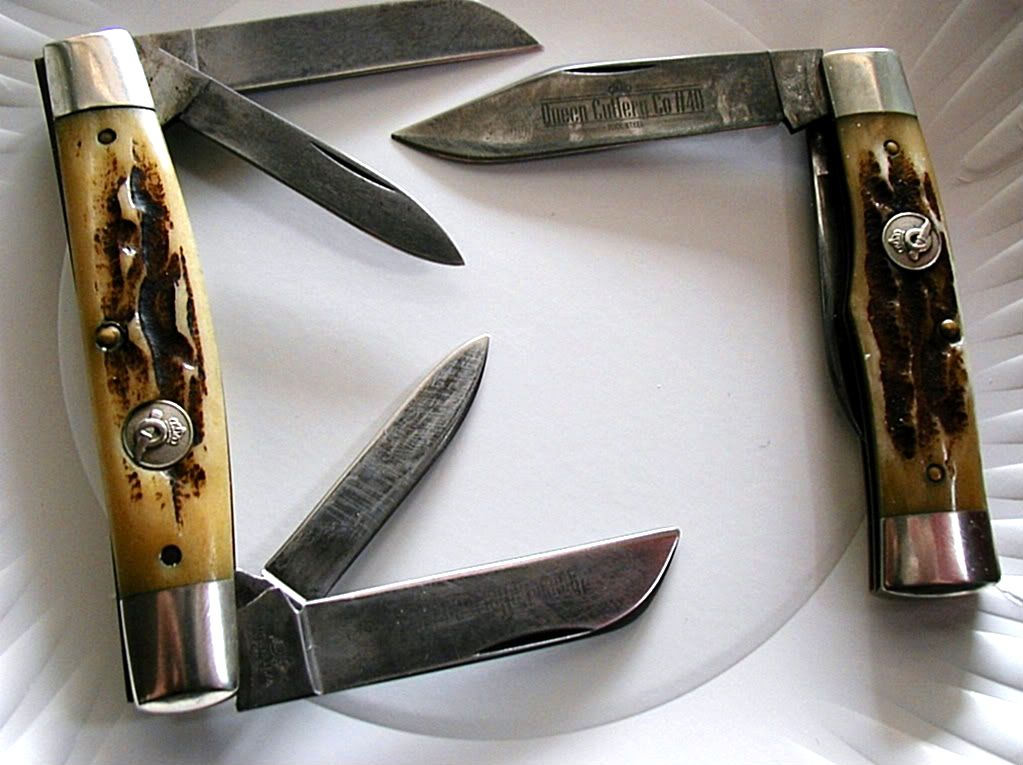
Forcing a patina

I use my EDC for eating and by forcing a patina all at once it lessens the metallic taste that non-stainless blades can impart when used with certain foods.

That makes sense for 1095 and similar high-carbon steels. I do the same thing with my high-carbon kitchen knives to aviod the metallic taste.

I've never noticed that taste on D2 from Benchmade, Queen, or Dozier though, the three makers using D2 that I own (I have Northwoods D2, but since Queen is the maker on the steel, I didn't count that).

If you like the look, go for it. Eventually most (but not H1 and others) steels reach a "patina equilibrium" anyway. If you force a dark patina, constant use will lighten it. If you don't, constant use will eventually darken it. Depending of course on the type of steel and the finish on the steel.
 
Yeah, I just really like the look of a patina, also, doesn't it help protect the blade from other corrosion? Any way, will forcing a patina dull the edge of a knife? If so, I will wait untill I get a sharpmaker.
 
Peanut - I don't think D2 takes a patina like a Mora Carbon blade. But, to get an even looking patina use vinegar. I fill a tall, narrow cup enough to completely cover the blade when dipped into it. Then I leave it overnight.
 
Teague
When you immerse the blade do you get a more uniform patina? Were you working with "carbon steel" or stainless?
Thank-you for your time.
 
Last edited:
abey67:
I have a C70 Carbon steel knife, and like the sound of your vinegar patina. What type of vinegar do you use, how long do you let it sit and do you ever completely immerse the blade? Do you, by any chance, know if I could achieve the same effect on my C70?
Thank-you for your time.
 
Sorry to ask a newb question but what is a patina? and what is it for? Any pics of it?
 
Why would mustard be better than plain white vinegar? Seems to be a more expensive way to achieve the same results.
 
BTT because I'm thinking about trying to patina my D2 Para and this thread is the best I've found so far.
 
BTT because I'm thinking about trying to patina my D2 Para and this thread is the best I've found so far.

I've also thought about this for knives that I've had in the past. Interesting thread, now I have a project to do :p
 
I found that a greenish patina developes, very fast on the carbon steel knives (in 1095 and CV) that I've cut apple (granny smith) with. Not sure how it would turn out on D2, but if you like the look of a patina its worth a shot. One other thing, I would not worry about dulling out your knife by forcing a patina.
 
Another pic of some patinaed D2...

P1260135.jpg


Some other good pics in this thread... http://www.bladeforums.com/forums/showthread.php?t=623008&highlight=patina
 
Last edited:
I found that a greenish patina developes, very fast on the carbon steel knives (in 1095 and CV) that I've cut apple (granny smith) with. Not sure how it would turn out on D2, but if you like the look of a patina its worth a shot. One other thing, I would not worry about dulling out your knife by forcing a patina.

I wouldnt be doing it for looks. I'm having rust problems so doing a patina seems like a good idea.
 
Teague
When you immerse the blade do you get a more uniform patina? Were you working with "carbon steel" or stainless?
Thank-you for your time.
I get an even patina when using vinegar. But, when I bury my high carbon steel blades in an onion or orange, I get a more mottled appearance. BTW, It works well on ax/hatchet heads too.
 
Not to hijack but what about A2 steel. Will it develop a patina?


EDIT: Tried it, now I have a nice patina starting on my Canal Street ring opener. By the way, the backspring on these is also carbon steel and took a real nice dark patina thay looks great contrasting with the brass liners.
 
Last edited:
A kiwi put a patina on one of my CV blades almost right after I cut into the badboy, the only problem is kiwi's can be difficult to find.
 
Why would mustard be better than plain white vinegar? Seems to be a more expensive way to achieve the same results.

Maybe because the consistency of it holds the vinegar in place against the blade and doesn't let it evaporate?

Sort of like how you can make a tawing paste with flour when you're doing home tanning of deer hides. The flour just serves as a reservoir for the active tanning ingredients and as a barrier to drying out too quickly.
 
years a go, i colored 2 fixed blades using aqua regia .old formula,using a mix of hcl and nitric acids .coat the edge with 3 applications of clear finger polish .go to pharimist or computer for formula nitric is powerful dont do this in house color can go from gray to black .stop reaction with h2o and baking soda .remove finger polish with laquer thinner. pharmist
 
My thread survives! Lol, I thought it was long dead...cool :cool: .

A kiwi put a patina on one of my CV blades almost right after I cut into the badboy, the only problem is kiwi's can be difficult to find.

You stabbed someone from NZ! :eek::D Couldn't help myself.

Not to hi0jack but what about A2 steel. Will it develop a patina?
Hijack to your hearts content. From what I know (limited) it should take one just fine. Does the BRKT canadian use A2? Jeff (cutlerylover) has a video about forcing a patina on a canadian on youtube.

Edit: Watched it again, yep A2 in the canadian. Took a nice patina in an hour. Unfortunatly it also reminded me how much I want something from BRKT...
 
Last edited:
Back
Top