Forging Positions and Setup

Rick Marchand

Donkey on the Edge
Moderator
Joined
Jan 6, 2005
Messages
9,680
I have been browsing the interwebz lately regarding smithing. (American, European, Eastern, etc...) The Japanese along with many "primitive" smiths are often seen in seated/kneeling positions. The Eastern cilture in particular seem to do everything in a seated manner... from forging, grinding sharpening to fitting. This really hit home for me.

I am currently apprenticing with a primitive living and wilderness survival instructor and his teachings follow this principle, too. Whenever you can afford to do a task sitting, take advantage of it. I had a problem at first and complained that it was harder to maintain a seated position and still have the leverage to accomplish certain tasks. My mentor told me not to give up on the concept and try to adjust my technique. He said once you learn the correct posturing, the advantage of not having your legs working so hard to keep your body up makes a huge difference in endurance and longterm comfort. Also, the reason why it seems so difficult at first, is because our legs allow us to cheat and over-reach our effiecient working zone, so to speak. This inadvertently puts us at risk should we lax in our technique and expose ourselves to undue strain.

I see these "jungle" smiths poounding on car springs while sitting on a log and think "How can they do that?" but these guys aren't limited to sitting... they prefer it! and most are in far better shape than I.... even the dried up old guys are rocking the seated/kneeling position. The ancient Japanese have a long standing reputation in striving for perfection in everything they did from crafting a sword to making tea.

I can't help but think there is validity to this, after seeing how many half-crippled western smiths are hobbling around their shops. This may be a skewed position due to the fact that I am much more immersed in Western smithing than Eastern and admittedly, I am a bit caught up in romance of the Japanese culture.

I try to set up as ergonomic as I can (and space will allow) but am seriously considering this Eastern approach. What are your thoughts and how are you currently set up.


Here is mine...
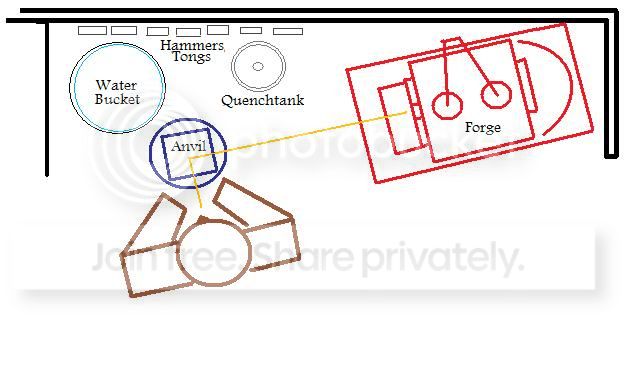
forgingarea.jpg
 
Mine is pretty similar to your set up with the exception of having a "normal" anvil behind me. My primary anvil is a Japanese style anvil and I do use the horn and hardy tools with my other anvil.

In my travels it seems that the non-caucasian races use squatting positions to rest or work if possible. Not sure why this is but just what I've observed. I know Tim Lively used to forge sitting, I think he had a hole dug in the ground next to his in-ground forge. I've had multiple knee surgeries and an ankle rebuilt (thank you US Army) so I'm not going to squat or kneel unless I have to. You would have to exert more energy standing because you have to keep your entire body stabilized while standing.
 
Thanks Will... I have seen Tim's set up. He does have a hole he sits his legs in.... as do many Japanese.

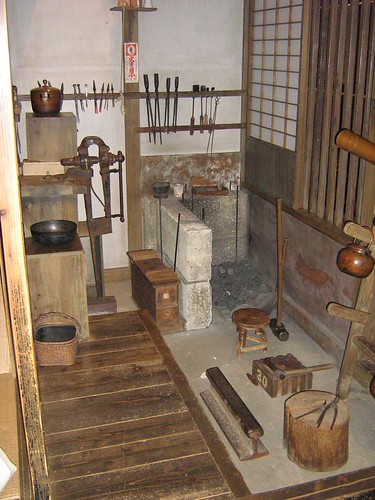
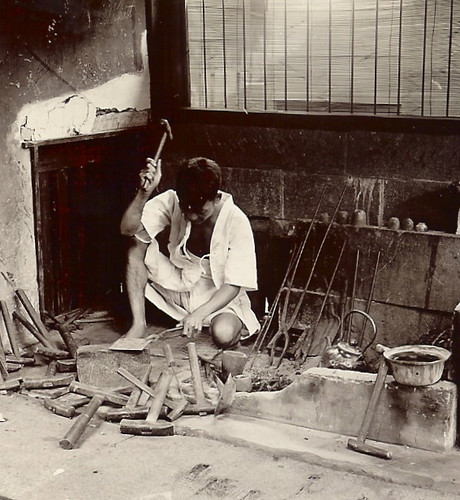
here are a few examples of some of the setups I have seen...

1362815601_a494221196.jpg

2311914100_266abd8a1c.jpg

japan05-070.jpg

shim.gif


here is a mix...
4525707967_bbb183b101.jpg
 
Neato thread Rick. I try to make myself sit to do operations that can be done seated as much as possible, but its not easy. Also, having to walk a few steps to reach things again and again is tiring I find. Eventually I'll bring them in close enough to reach, but it seems to take my dim witted self a while to figure this out. I wish I had mentors like you do. I'm very jealous of this.
 
Andy, I totally agree... when you are seated, you really learn which are your "go to tools" and how often you travel to get them. It forces you to become very organized and plan out your work process even more. It also begs for more workstations which, if it translates to less fatigue, I would consider.
 
I forge and grind sitting down about half the time. I have a sturdy stool with strong legs to brace myself on. When at the anvil, I place my feet on the anvil base. I find it more efficient most of the time to work seated.

As to the western situation of bigger and more is better, most places in the word work the blade over about 4-8 sq.in. of anvil surface, and use a 2# hammer. The need for a 300# anvil with a 4X12 face is not readily explainable in these cultures....and a 4-6# hammer is just folly. It is all about control.
 
My anvil is 4x4x18, the face is 4x4. I've switched from my 4# hammer to a 2.4# Japanese cutlers hammer.

I do a lot of my drawfiling and other file work sitting.

Since I forge in shorts I'm not sure I'd like to be sitting with my legs around an anvil face.... ;)
 
My main concern about sitting while forging is a red hot piece of steel landing in my lap. I have lost most my super powers but I still feel I can get out of the way quicker when something creates a problem if I'm standing up.
 
Are you saying you can't levitate, bend and move metal with your mind? I'm shocked!!!! :D I'm thinking that's the concern most of us have.

If I remember correctly a lot of the forging is done by helpers or apprentices, the "smith" mainly moves the steel as they hammer then does the finish hammering. It would make more sense to be sitting in that situation so you can watch the steel closely.
 
Lot's to think about here. I'm a plumber, and do a large percentage of my work from a kneeling position. I find it allows for less fatigue over long periods of time.(I buy my shirts in tall, and tuck them in well:D) I do find that there is a stigma about sitting to work, especially in jobs that are traditionally done standing. It's viewed as slacking... My main concession to kneeling is an ErgoKneel rubber pad that has eliminated bursitis in my knees. I forged my first knife last week with my new anvil, and due to the lack of stand for the anvil, did it kneeling and managed quite well.

Looking forward to seeing what info you have Sam.

I'm setting up my shop at my Dad's and might have to mount my forge and anvil down low to start.
 
When I started I was sitting on the ground and forging on a piece of railroad track. I now stand. But...... now I am going to have to try sitting or kneeling again thanks to Rick. Thanks a lot Rick!!!!:mad:
 
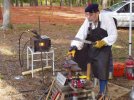
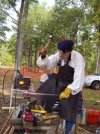
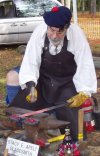
Look underneath me and you will see the stool. Also, see how I brace one foot on the anvil stand.
 

Attachments

  • stacy forging 2.jpg
    stacy forging 2.jpg
    61.2 KB · Views: 101
  • stacy forging 1.jpg
    stacy forging 1.jpg
    87.5 KB · Views: 97
  • stacy forging 4.jpg
    stacy forging 4.jpg
    101.2 KB · Views: 86
  • stacy forging 3.jpg
    stacy forging 3.jpg
    71 KB · Views: 84
  • stacy forging 5.jpg
    stacy forging 5.jpg
    44.1 KB · Views: 68
Stacy, a couple things of questions.

Do you have to get up to get the stock in and out of the forge?

Ummm do you ever get scale under the kilt? :(

This thread has made me rethink some stuff.... I may try bringing a stool out to the smithy. I can adjust my anvil height pretty easy.
 
interesting thread. i was forced to learn how to forge sitting down. not by choice - my garage ceiling is low!
 
Well from a blacksmiths perspective I couldent set and do the work required.Far to much movement, now just pounding on a blade I can see it being very helpful..Using slitters, drifts, twisting, bending all would be pretty hard to do setting down. A lot fo our work and I mean a lot requires forge welding. First you have to be fast from the forge to the anvil..Then it would pretty bad setting in front of a anvil with screaming hot molten slag spraying in your lap.
Now all what I have said is from a blacksmithing perspective..I can absolutly see where doing work setting down conserves more energy and would work for many tasks, espically if one were setting in front of a small bladesmithing anvil..A lot fo our work requires at least a 200 pound anvil and its been too small a few times..If your forging a big axe head or straightening plow blades then a little 100 pounder just wont do it..
Anvil to hammer ratio means a lot when your swinging a hammer thousands of times a day..
 
As you can see in the demo setup, the forge is right where I need it to put in and take out the bar of steel or blade. In the smithy, I have a similar setup.

For work that requires a lot of body positioning, or is dealing with a less controllable piece of metal ( drifting a hawk head, for instance) I stand and move about as a normal smith would.

And, No, I haven't had any hot scale under the kilt....but I don't usually forge weld wearing it...you can't be too safe on some things.
I wear my "Field Kilt", not my dress kilt when doing such tasks.
 
Back
Top