Forging Positions and Setup

James... you wuss! I thought it was funny... I do need to lose a bit of weight, get back down to a trim 220# (that's my Army weight.)

 
Talk about a picture being worth a thousand words. Thanks for those pics Stacy. I'm headed for the forge today and can't wait to try some changes. My time, (and attention span) is quite limited. Thus, I have a disturbing pattern of just flailing away with and on whatever's handy rather than spending the time to really set things up right. Partially this is because I have moved last spring and have been doing a lot of moving in, home improvement etc, but I think its time to give some attention to my set up.....If not Now, When? Thanks All for this thread!
 
James... you wuss! I thought it was funny...

Well I knew you'd get it, but I don't want everyone else thinking I'm a rude SOB. Of course, I am, but there's no need to prove it over and over :D

Anyway, it's an interesting thread and I've learned a good deal from some of the links. Thanks guys!
 
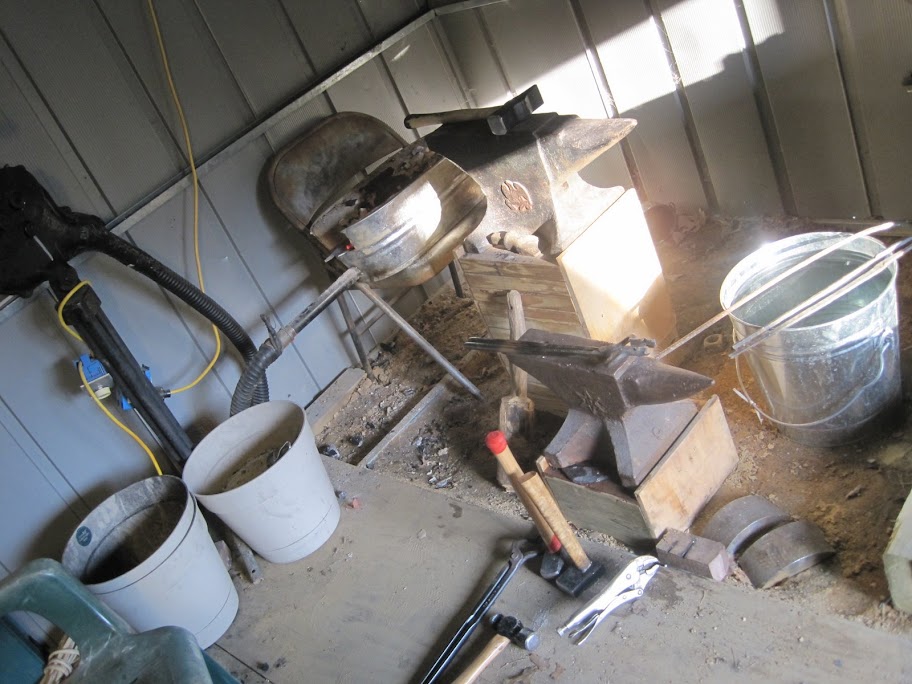
Here are some photos of my slightly cramped current setup.

You'll notice the larger Fisher is setup the traditional height. I stand behind and use a larger hammer for drawing out and rough shaping or in front for hot cutting, etc. I kneel/sit in front of it and work the smaller anvil for more precise work and for forging edge bevels. Seems to work really good, and I can work multiple pieces at a time in the "Tim Lively" style forge that way. I can crank that blower from the sitting floor no problem, although I do have a plastic lawn chair to sit in if I've got to crank it for a long time.

I normally turn the tail of the smaller anvil toward me, but I squared it up for the pic. ;)

Nothing fancy, but it works.

IMG_2449.JPG

IMG_2450.JPG
 
Talked to a smith in Japan who insisted on working the way you show in the second picture, working on a round straw mat with is left leg tucked beneath him and his right leg up foot flat on the ground. Since this was the most traditional. He said he had weak legs form 30 years of holding this posture. The way the right leg is posititioned it is also in the way of the hammer hand so the elbow has to be held way out away from the body in order to swing the hammer. Not very ergonomic at all.
The straw mat was also considered a clean surface, so he took off his sandals and worked on it in his Tabi split toed socks. Don't step off the straw mat onto the
dirty shop floor in your tabi socks before putting on your sandals though and getting your socks dirty.
Other smiths use a foot well or a short stool to forge seated . Then there are the smiths in Japan who work in a nontraditional standing shop. either with a open floor plan or standing in a pit with their forge anvil and powerhammer arrayed around them. You got to be a nimble old man to jump in and out of a hip deep pit all day.

Another old craftsman said his lower back was screwed up sitting crosslegged for much of his career chiseling out wooden plane bodies all day. So there seems to be
occupational hazards either way. I stand on a dirt and gravel floor in my forge feels better than a concrete slab to me.
 
Back
Top