GEC 73 Problem

Joined
Jul 6, 2005
Messages
206
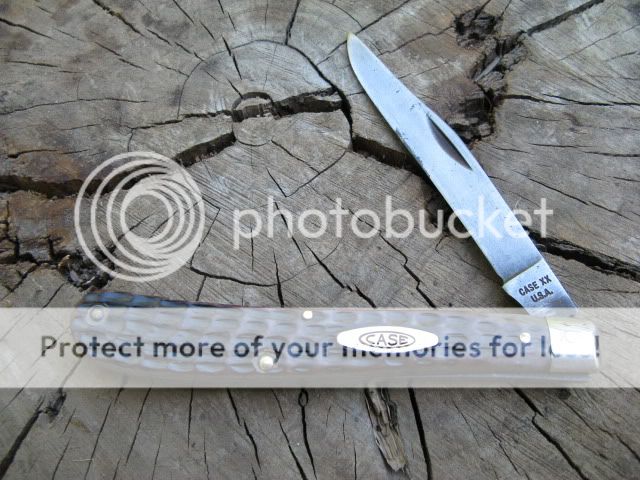
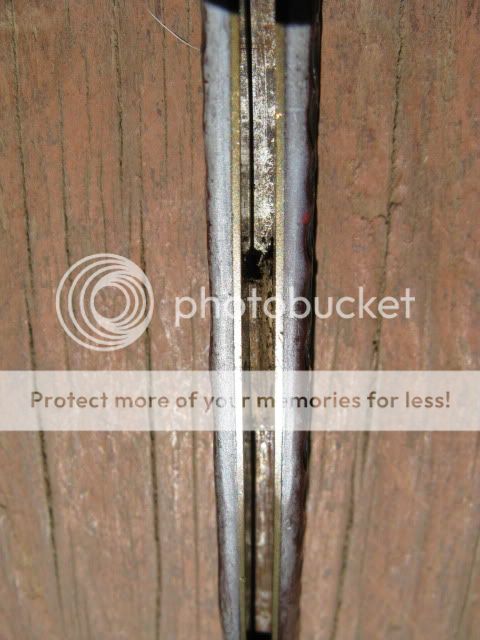
I absolutely love my GEC 73. Using everyday...a lot. The problem I'm having is that I believe the edge of the blade is contacting the "hump" in the spring when I close it one handed (fold it against my leg and let it snap closed). I'm developing a dent in the edge where the contact is occuring. Has anyone else noticed this? Am I just being too careless with my knife? Any suggestions on modifying the knife to prevent this?

Thanks in advance!
 
This doesn't have to do with the #73 itself but I've encountered this problem with one other knife (a custom) and my solution thus far has been to make sure to ease the blade down into the closed position rather than letting it snap. It seems that with less closing speed, the blade doesn't have enough momentum to hit the spring's protrusion on its way down (when resting in the closed position it doesn't actually contact the spring, but must be very close). It's certainly not as convenient as just snapping it closed and it does require two hands, but it saves my nice edge.
 
Very, very common. And my #1 pet peeve on my list of 'simple things that just should NEVER exist in folding knives'.

The vast majority of the time, this issue 'fixes' itself with some repeated sharpening of the edge. As material gets removed from the edge, it will eventually retreat enough that it won't contact the backspring anymore. The 'hump' in there is likely the place where the backspring's anchor pin is going through it.

In the short term, just be careful about closing the blade. Might take a very close look at just how hard the contact is, to see if simple sharpening might fix it. If it only contacts the backspring when allowing the blade to snap shut (HARD) on it's own, which BOUNCES the edge against the backspring, and not when lightly closed, then I'd guess it won't need much metal removed from the edge, to eliminate the problem.
 
Last edited:
Thanks for the replies.

I was a bit surprised that it was able to contact, as it seems to need to move 4-5mm to hit it. It also takes a bit of force for me to move it that much with my fingers, but I guess momentum is enough. I'll try resharpening it and see where it gets me. I really like to be able to close it one handed when I'm busy. Seems like they could have easily machined a little blade stop into the spring.
 
Thanks for the replies.

I was a bit surprised that it was able to contact, as it seems to need to move 4-5mm to hit it. It also takes a bit of force for me to move it that much with my fingers, but I guess momentum is enough. I'll try resharpening it and see where it gets me. I really like to be able to close it one handed when I'm busy. Seems like they could have easily machined a little blade stop into the spring.

The extended 'kick' at the base of the blade tang is supposed to take care of that (that's it's sole function). But, especially when allowing the blade to snap hard, there'll be some outward deflection of the end of the backspring (closest to the pivot), which allows the blade to momentarily sink a bit deeper into the handle. That's when the 'bounce' happens, allowing the edge to contact the spring.

If you have to squeeze the blade pretty hard to get that contact, that confirms what I suspected earlier. A little bit of sharpening of the blade's edge should take care of that, in time. I suppose you could also send it back to GEC to have them fix it (they'll probably do it the same way, by sharpening).

Some people have installed a plastic/rubber 'bumper' of sorts, underneath the blade's kick, glued to the inside of the backspring where the kick would rest with the blade closed. Serves as a 'shock absorber' of sorts. But this really isn't necessary most of the time.
 
I have a handful of 73's. Two are EDC's and I can close them as sloppy as I want and the edges will not contact the backspring.

I just checked ALL of my GEC's and none of them have this problem. I would say it is unacceptable on a GEC and I would contact the dealer or GEC and find out who can handle it in the most convenient fashion. It is not the dealers fault but they may offer help.

Sorry about it, I just don't see a reason to have to deal with something like this on a knife in the GEC price range. You should not have to sharpen away life from the edge just to resolve this issue. All IMO.

Good luck.
 
Also, GEC still seems to be a small operation. I would contact them either way so they can hopefully keep the level of complacency in QC to a minimum.
 
I would do what richstag said regardless. I just have one two blade #73 and it had and still has so much snap(a little less now that it's broke in) I never felt comfortable just letting the blades fully fall, so I pinch and ride mine close. I have let it fall fully a few times but it's not something I do routinely. I guess I've been a little overly paranoid that the bear trap like snap would start a crack at one of the four pins. My #73 never has had that problem and it is easily the best premium trapper I have ever had!
 
I would be very surprised if the blade was getting contact with the backspring when snapping closed if you have to push hard to make it manually do the same. The kick / front edge just do not allow for over-rotation on these stout backspring knives with half stops. It might be a soft spot on the heat treat that is allowing it to roll in that one spot more than the rest. But if it is contacting the backspring you would be able to see the scars on the backspring as well.
Either way you could shoot it to GEC and let them do a little investigation on it.
 
Once in a while back when I was a kid, somebody would end up with a new knife that did that. The simple solution if you like the knife, is to wedge a piece of wooden match stick down in the blade slot out where the blade tip come to rest. Then when the blade snaps shut, it contacts the wood match stick and no problem hitting the center of the back spring. The piece of match stick acts like a shock absorb er and spacer. After a few moths of steady use and some sharpenings, the problem cures itself. Then you take out the match stick.

Carl.
 
"I would be very surprised if the blade was getting contact with the backspring when snapping closed if you have to push hard to make it manually do the same. The kick / front edge just do not allow for over-rotation on these stout backspring knives with half stops.

Respectfully disagree. I have a whole bunch of knives with this issue, including some $300 - $500 customs (this is why it's a MAJOR irritant for me). It's one of those little things that goes unnoticed, for the most part, until the first time you see the tell-tale nick in the edge (and a tell-tale divot in the spring, inside the handle, at the contact point). In fact, knives with very hard pull (therefore strong closing snap) are all-the-more prone to it. The harder the blade snaps shut, the more it will over-deflect the spring when it hits. A lot of makers like to put as large a blade into a handle as possible, and it leaves very little room for error between the edge & backspring.

Some makers have even integrated a design change in their folders, with a 'stop pin' in place, under the kick and across the inside of the handle, to keep the blade (and the kick) from touching the backspring at all, when closed. They've done this, because they know it's a real problem.
 
Cut a little piece of cork or rubber to fit into the channel, to make sure the blade can't contact the innards. Those of us who use FHM balisongs (Filipino Hand Made) do it all the time, since those knives have blade edge-to-channel contact every time.
 
I would be very surprised if the blade was getting contact with the backspring when snapping closed if you have to push hard to make it manually do the same. The kick / front edge just do not allow for over-rotation on these stout backspring knives with half stops. It might be a soft spot on the heat treat that is allowing it to roll in that one spot more than the rest. But if it is contacting the backspring you would be able to see the scars on the backspring as well.
Either way you could shoot it to GEC and let them do a little investigation on it.
When the blade snaps closed, it has quite a bit of momentum... sometimes it's enough to push it past where it normally sits, if only for a fraction of a second. And sometimes, it's enough to carry it all the way to the backspring.
 
If you choose to put a 'bumper' inside the handle, I'd highly recommend putting it under the kick, so the edge of the blade isn't resting against it when closed. Especially if it's made of wood. Wood will absorb moisture and trap it against the blade's edge. All the more risky with a carbon steel blade, as with your GEC. Here's what I'm talking about:

( pics below linked from this thread ---> : www.bladeforums.com/forums/showthread.php/880104-Case-Slimline-Trapper )

Notice the stain/corrosion on the edge of this trapper's blade (seen on the portion below the nail nick):
IMG_8976.jpg


A wood bumper was inside the handle:
IMG_8972.jpg
 
I e-mailed GEC and they responded promptly with a request to send it back for adjustment. I'll be curious to see what they do.

Thanks again for all the tips.
 
Good for you bunghole. I know the guys with the band-aid fixes were sincerely trying to help you through this. I have used the same methods mentioned. For this one I am glad you are making a point of sending it into GEC for real attention.

I am interested to see how they fix it as well.
 
I e-mailed GEC and they responded promptly with a request to send it back for adjustment. I'll be curious to see what they do.

Thanks again for all the tips.

Good for you bunghole. I know the guys with the band-aid fixes were sincerely trying to help you through this. I have used the same methods mentioned. For this one I am glad you are making a point of sending it into GEC for real attention.

I am interested to see how they fix it as well.

I think that's not a bad choice, either. It's good to let a maker know where things could be improved a bit. This is one of those things that (I'd think) should be designed out of a knife, from the beginning. Even if they have to 'sharpen' it away, I'm betting it'll take minimal metal off, maybe a millimeter of the edge. Just enough to keep it from touching again. And with the 'ding' in the edge already, I'm betting they'll re-sharpen it anyway (they owe you that, at a bare minimum). I do think they'll make it right, either way. :thumbup:
 
I completely agree with you David. GEC seems like a company that cares and you might as well take advantage of that IMO. Most importantly to me, and like you said, its about really bringing it to their attention.
 
My older #73 user had the same problem. There're times when it's inconvenient to set aside your work and gently guide the blade into the handle when closing the knife, so it was snapped shut on occasion and the edge did hit the rocker pin hump. As others have said, sharpening eventually fixed the problem, but it was irksome for a while.

I've dealt with GEC's customer service (on another issue) with very satisfying results. I'm sure they'll make it right.
 
I would be very surprised if the blade was getting contact with the backspring when snapping closed if you have to push hard to make it manually do the same. The kick / front edge just do not allow for over-rotation on these stout backspring knives with half stops. It might be a soft spot on the heat treat that is allowing it to roll in that one spot more than the rest. But if it is contacting the backspring you would be able to see the scars on the backspring as well.
Either way you could shoot it to GEC and let them do a little investigation on it.

Gonna throw in with Mike on this one. And of course, it should be easy to see.

If the blade is under such compression that it over rotates as bunghole said, 4 - 5 mm to make contact, that's almost an 1/8 of an inch over rotation. That means when he pushes the blade down to make contact, it much certainly push the backspring out with the blade kick before the blade contacts the spring.

So, if it is the backspring that stops the blade by hitting the cutting edge after the kick hits the spring, remembering that we have an 1/8" over rotation to touch the blade, bunghole (really? bunghole?) can see for himself if it is the case.

If there is that much over travel (an 1/8" or so), then he should see the backspring protrude at the end of the closing cycle indicating that the spring has pushed the blade via the kick beyond what is necessary to close the knife. (Test this; push down the blade and watch the backspring move before the cutting edge of the blade hits the spring on a slipjoint.) That would be easy enough to see by holding the knife in one hand and letting the blade close in a manner that you could see the backspring/kick contact area.

It will interesting to see what GEC says.

Robert
 
Back
Top