GEC 73 Problem

Don't need much over-rotation at all, to make the central portion of the blade contact the raised 'hump' of the backspring. There's often barely more than a mm of space in between, at THAT point, with the blade at rest in the closed position. Even with a very tall kick on a blade, which keeps the BACK (heel) of the blade far away from the spring, the central portion, belly and tip of the blade are very often MUCH closer to the backspring/spacer.

Think of a lever, hinged at one end. Even a tiny bit of motion at the hinged (pivoted) end will produce a much larger deflection further away from the pivot. Most of the knives I have, with this problem, have the problem towards the far end of the blade, usually near the upsweep in the belly, where the end of the handle and spacer are also upswept. A handful of my knives also have the collision point at the 'hump' in the backspring. That 'hump', in itself, can be a major contributor to the problem, if it's just a little too tall.
 
Last edited:
That's right Midnight.

It does push the spring out when it rotates past its normal closing point. So I guess in this case, the kick is not the issue...perhaps just the spring tension? Or maybe I just need to be more careful. Either way, I'm going to send it in. I'll need something else to carry :)

Rather than use one of the many knives I own, maybe I'll use it as an excuse to buy another new knife. I really am lusting after a Lanny's Clip.
 
That's right Midnight.

It does push the spring out when it rotates past its normal closing point. So I guess in this case, the kick is not the issue...perhaps just the spring tension? Or maybe I just need to be more careful. Either way, I'm going to send it in. I'll need something else to carry :)

Rather than use one of the many knives I own, maybe I'll use it as an excuse to buy another new knife. I really am lusting after a Lanny's Clip.

Holy smokes.... that thing must be a bear trap! Since you are seeing the spring move then you know the likely culprit. If the blade was striking the hump in the middle area of the spring, it wouldn't push the spring out since it is too close to the spring pin. (That being said, the most likely culprit is usually as OwE described.)

The good thing is that you know GEC will take care of you, so that will be that.

And of course you need another knife; no reason not to have a backup or three, right? :D

Robert
 
Don't need much over-rotation at all, to make the central portion of the blade contact the raised 'hump' of the backspring. There's often barely more than a mm of space in between, at THAT point, with the blade at rest in the closed position. Even with a very tall kick on a blade, which keeps the BACK (heel) of the blade far away from the spring, the central portion, belly and tip of the blade are very often MUCH closer to the backspring/spacer.

Think of a lever, hinged at one end. Even a tiny bit of motion at the hinged (pivoted) end will produce a much larger deflection further away from the pivot. Most of the knives I have, with this problem, have the problem towards the far end of the blade, usually near the upsweep in the belly, where the end of the handle and spacer are also upswept. A handful of my knives also have the collision point at the 'hump' in the backspring. That 'hump', in itself, can be a major contributor to the problem, if it's just a little too tall.

If it were one mm from the backspring that would very well be a problem on such stout backsprings. And sounds like it may be the culprit.

I was going more on the measurements of the OP.

Thanks for the replies.

I was a bit surprised that it was able to contact, as it seems to need to move 4-5mm to hit it. It also takes a bit of force for me to move it that much with my fingers, but I guess momentum is enough. I'll try resharpening it and see where it gets me. I really like to be able to close it one handed when I'm busy. Seems like they could have easily machined a little blade stop into the spring.

4-5mm is a fair amount of real estate.... And if a significant amount of downward force is required it is hard to imagine the same spring forcing the snap close is going to give once the square end is sitting flush. 4mm in the middle would be a large movement on the end. Assuming an 85mm blade length from pivot and the backspring pin is at 45mm; a 4mm movement at 45mm would be closer to 8-9mm at the tip.... (mathematician needed)

But if it is sitting much closer, say 1mm in normal position, that makes much more sense. But again, the scarring would be obvious on the backspring.

This is interesting; I will ask Bill to give us the final cause / resolution so we can know for sure.
 
Last edited:
Another thing about the gap between edge & backspring, often the spring is thicker past the anchor pin, towards the 'butt' end of the handle. The gap between edge & spring is widest in the portion nearest to the kick. But, in the portion from the anchor pin to the butt, the inside face of the spring is elevated towards the blade's edge. Really narrows the gap between the two, from mid-blade to the tip. This is why just a little too much over-rotation can slam the central & tip portions into the spring so easily. I borrowed a pic from the web (it's a large trapper 'kit' knife, disassembled), to illustrate the point:

Notice the springs (center of the pic); they're thicker towards the butt end, narrowing the gap between the two, when the blades are closed:

bearclaw_fld_1_600.jpg


Even on knives that don't have this thickening of the entire butt end of the spring, there'll almost always be a thicker 'hump' in the vicinity of the anchor pin.
 
That's called a "striker" in cutlery terms, and it's quite common, often happening to a number of knives in a run. Can be caused by a kick that's been taken too far down (most common), over stiff spring (there are often variances in hardness), a bit too much material taken off the inside round edge of the tang when gauging, even a blade that wasn't edged enough. This is usually caught by the edger or inspector when they close the blades, and the fix is to re-edge the blade until it stops striking. Of course if the knife's apart you can also remove a bit of material from the spring above the pivot pin, but this runs the risk of weakening the spring if too much is removed.

You can also have this same problem at the butt end, where the blade strikes the upswept area of the spring. Re-profiling the tip of the blade is usually the fix for this one.

Looks like your knife managed to slip by the gauntlet :)

Eric
 
Another thing about the gap between edge & backspring, often the spring is thicker past the anchor pin, towards the 'butt' end of the handle. The gap between edge & spring is widest in the portion nearest to the kick. But, in the portion from the anchor pin to the butt, the inside face of the spring is elevated towards the blade's edge. Really narrows the gap between the two, from mid-blade to the tip. This is why just a little too much over-rotation can slam the central & tip portions into the spring so easily. I borrowed a pic from the web (it's a large trapper 'kit' knife, disassembled), to illustrate the point:

Notice the springs (center of the pic); they're thicker towards the butt end, narrowing the gap between the two, when the blades are closed:

Even on knives that don't have this thickening of the entire butt end of the spring, there'll almost always be a thicker 'hump' in the vicinity of the anchor pin.

That sounds reasonable; but is like saying if a bird is 10 foot in front of you at a 30degree angle he is the same height as a bird 100 foot in front of you at a 30degree angle. In reality the bird 10 foot in front of you is 6' off the ground and the one at 100 foot is 30' off the ground. (again mathematician needed)

Where a pivot is presented on a straight horizontal plane, no place is closer to the horizon than the pivot point (then the kick sets the angle for the rest of the blade). Since the distance grows through the length of the knife, they can build up the backspring (and the frame to cover the rising blade) from the backspring pin and back. But, again, if it is striking at the center backspring pin; then the rest of the blade is further away from the backspring than the striking point (or it would be striking instead). You can see by where the rear nail goes thru both the liners and spring that the spring sits well below the liner yet the blade sits nearly flush with it. Especially GEC's as most of them could be lowered a bit anyway in my opinion as the tip catches fabric it sits so high.

I have to agree with ea42. Since the blades are all stamped the same size with the excess to be hand shaped, this blade was probably just honed with too much steel left on it to allow for tolerances on a hard close. So I expect a cross-cut view would show the edge sitting less than 1mm from the backspring at the center pin. This might seem like a larger gap when pushing down on the blade as the tip would move much more than the midway point. If it were the kick, the tip of the blade would have sit well below the liner and would have been very noticeable. Since these are all square end (half stops), an error in this area would be very visible as well.

Again, good discussion; it will be interesting to hear the factory solution.
 
Last edited:
Just a quick update for those of you that are interested.

The knife was sent to GEC. They received it on the 11th. After two requests, I was told today that the repairs will be done within the next two weeks when they have a break in their production schedule. I'm not in dire need of the knife, but so far, I'm not very impressed with their customer service. Unfortunate, because I really like their knives.
 
In spite of the long wait, I'll keep my fingers crossed that they'll do right by you, when they send it back. Hopefully the repairs will be beyond reproach, which should ease the discomfort a bit. If they are going to disassemble the knife to fix it, I can somewhat understand the delay. I'd rather they do it right, than fast. Sometimes 'quick' repairs aren't so good.

A friend of mine used to say, when discussing shoddy repair work, "How come they don't have time to fix it RIGHT, but they do have time to fix it TWICE, after fixing it WRONG the first time?" ;)
 
One of the common repairs for a "striker", was to peen/cold forge the kick out a little, which raises the blade slightly. It can often be done with a punch. The kick is usually tempered back along with the tang, so it is softer than the rest of the blade. I've done it twice, and it is simple and works!
 
Respectfully disagree. I have a whole bunch of knives with this issue, including some $300 - $500 customs (this is why it's a MAJOR irritant for me). It's one of those little things that goes unnoticed, for the most part, until the first time you see the tell-tale nick in the edge (and a tell-tale divot in the spring, inside the handle, at the contact point). In fact, knives with very hard pull (therefore strong closing snap) are all-the-more prone to it. The harder the blade snaps shut, the more it will over-deflect the spring when it hits. A lot of makers like to put as large a blade into a handle as possible, and it leaves very little room for error between the edge & backspring.

Some makers have even integrated a design change in their folders, with a 'stop pin' in place, under the kick and across the inside of the handle, to keep the blade (and the kick) from touching the backspring at all, when closed. They've done this, because they know it's a real problem.

Couldn't have put it better myself! :thumbup:

I personally prefer the "striker pin" solution because not only does it allow large blades with less than 1/32" clearance to never "strike" the spring, but on multi-blade knives it prevents "squeeze striking", where the user squeezes the closed blade onto the spring while cutting with the open blade.
 
One of the common repairs for a "striker", was to peen/cold forge the kick out a little, which raises the blade slightly. It can often be done with a punch. The kick is usually tempered back along with the tang, so it is softer than the rest of the blade. I've done it twice, and it is simple and works!

That was a common repair solution at Camillus.
If the problem was discovered prior to assembly, the area of the spring contacted by the kick would be "stretched" with a pointed punch instead.
 
Just got a call from GEC. They said they will adjust the tang and reduce spring tension. Hope it works. They also said it would be shipped by week end.

I feel much better about the CS now. Maybe they read the forum...lol.
 
Well, I certainly hope they do!

I admire GEC a lot and the time I had an issue with one of their knives (the scale cracked around the pin day 3) they asked the dealer to replace the knife immediately, which he did. This was an international deal by the way.

I hope they fix it up to your satisfaction, they just seem to be able to produce more fault free knives than their competitors!
 
They really do not want to do anything to re-profile the blades on warranty work. Since the tip of the blade was where it was designed to be, they did not want to mess with the kick as then the tip would need adjustment to retreat below the liner. The blade sits much closer to the backspring at the center pin that one would expect. In re-reading the OPs posting I wonder if maybe the 4-5mm travel was an estimate for the tip instead of the contact point. Easing the snap seems to be a good solution for everyone.
 
Just got a call from GEC. They said they will adjust the tang and reduce spring tension. Hope it works. They also said it would be shipped by week end.

I feel much better about the CS now. Maybe they read the forum...lol.

They have had one of mine since 9/29, and I got told 2 weeks the same day you did (yesterday). I hope that means mine will be done this weeks as well :D.
I think I will ask them if they can just send my forum knife with it when it's ready:rolleyes:;)
 
Whaterver happened to using a narrow Jeweler's File to relieve the inside of the backspring just a smidgen where the blade edge touches it? Sure as heck a lot easier than sending the knife on a world tour and to me having GEC compromise the knife by making the backspring weaker.

The sharpening ideas to get the blade edge to retreat a tad given on page one of this thread would have worked too.

As cheap (price wise) as these GEC knives are, it doesn't hurt to experiment with one now and again.

My .02¢
 
Whaterver happened to using a narrow Jeweler's File to relieve the inside of the backspring just a smidgen where the blade edge touches it? Sure as heck a lot easier than sending the knife on a world tour and to me having GEC compromise the knife by making the backspring weaker.

The sharpening ideas to get the blade edge to retreat a tad given on page one of this thread would have worked too.

As cheap (price wise) as these GEC knives are, it doesn't hurt to experiment with one now and again.

My .02¢

A few of my 73's have tremendous snap. Reducing snap would not be a compromise IMO.
 
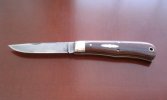
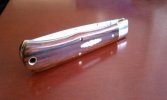
Knife is back! Looks like they did take some steel off the blade, but very little from looking at it. They left my beautiful patina on. I've been letting it snap closed and have done that maybe 50 times now and don't notice any deformation in the blade. I also can't tell any difference in the spring strength, but whatever they did seems to be working. Here are some pics of what is now my favorite pocket knife:

IMAG0146.jpg
IMAG0147.jpg
 
Back
Top