GEC Glow Bullnose problems

I don't know if I just received a Burke Barlow with an unusually thick blade but I really can't understand why people like the knife. I had mine sharpened by one of the pros here on Bladeforums and it was razor sharp after he was done with it... but it was a razor sharp crowbar.

Maybe it is a difference of perspective and personal definition. I understand what you are saying about how the knife if sharp, but not a good slicer. I think of the DB Barlow as a good cutter, but no necessarily a good slicer. In actuality, as far as good slicers go in my traditionals, the DB is good, but not great. I have an old CASE copperhead that has hollow ground blades on it that will shave the hair off a gnat's behind when it is sharp. It has a fine, thin edge that will slit through the toughest stuff. I have an old, old Puma Stockman that is the same way. The DB will never slice as well as either of those knives due to the blade profile. But that super thin slicing edge with little metal behind it is great for rope, apples, whittling, and any other slicing chores you put a knife through. The edge is thin and somewhat fragile, and although they have both seen a mountain of work I have been very careful with them.

A harder working knife for me has a more obtuse edge. If cut down a box that has a hidden staple in it and I go over with the the coppehead or Puma, it will damage the edge. I have chipped edges on my knives that have fine, slicing edges when something unexpected occurs. Not so with a knife profiled like the DB. A few weeks ago, I pulled out the DB to cut off a paint drip on some trim I was painting. I cut slowly, and thought the reason I couldn't get knife through the drip was because it was old oil base paint. No, I was trying to cut through a trim staple that caused a paint drip because it didn't sink properly so it caught paint.

The D2 blunted back evenly and there was no chipping or deformation. Too much meat behind the edge. After lunch I got a piece of 400g paper out of the truck and "sharpened" the knife to cut off the blunt edge. I found a scrap of 600 wet/dry and polished it up a bit. No damage at all to the blade, and it went out of rotation when I got home until it could get a proper sharpening.

I use the DB for all kinds of cutting needs that don't need a finely sliced outcome. Since I have a razor knife in my tool belt, that job falls to that tool.

But I think I understand what you are saying. The closer the blade profile gets to that of a razor, the better at slicing it is. However, I wouldn't think of using a razor to strip wire. If I had my DB in my pocket and nothing else handy, I would (and have) use it in a blink without a second thought to do just that. But I wouldn't shave with my DB, either. Back the correct cutter, the razor for that. Both cut, both are sharp, but they are designed with two different uses in mind.

In light of thinking of knives as tools, I think of them as cutting tools like a chisel. There are many grinds, styles, sharpening profiles, etc. Each one has a purpose, and some chisels just won't slice well even when they are sharp. They make good material removing choppers, though. So maybe a razor sharp crowbar is all the DB will ever be. Sharp as heck, but not a slicer.

Just my 0.02.

Robert
 
Robert, I appreciate your perspective and that you took the time to share it with me. It's honestly something that I've had difficulty wrapping my mind around. It wasn't the right knife for me but think I now have a greater understanding of why it works well for others.
 
I hear you Jake, but at half the price of a GEC I would toss that D2 up against my grinding belts and a few minutes later have a knife that will outslice any factory GEC Sodbuster.

I have queen D2 and actually prefer the edge I get on GEC 1095...polished 1095 just acts as I want it to, my polished edge D2 seems to disappoint me.
 
Robert, I appreciate your perspective and that you took the time to share it with me. It's honestly something that I've had difficulty wrapping my mind around. It wasn't the right knife for me but think I now have a greater understanding of why it works well for others.

All that was just based on my personal experience, so at the end, it's just my opinion. But it was also formed by talking over the years to some of my other knife loving buddies when we compared notes about how we felt about different knives. We couldn't understand why some of us loved a model of knife, and others just didn't care for the same knife and we finally narrowed it down to what we used the knife to do.

Robert
 
I have queen D2 and actually prefer the edge I get on GEC 1095...polished 1095 just acts as I want it to, my polished edge D2 seems to disappoint me.

I have the same problem, mostly I think its due to the blade grind. I think as midnight flyer mentioned Queen seems to have a different philosophy on how thin a pocket knife blade should be. I have 2 queen D2 knives, one of them (DB barlow) I had reground and I can get that knife as sharp as any of my 1095 knives. The other is a #40 gunstock jack and it still has the factory blade grind, it is significantly thicker behind the edge and much harder to achieve the same level of acuity at the edge, although I have had some luck with a microbevel.

Lately I have been using my 1095 knives more often. I use my knives for all manner of task, which might include cutting a steak on a ceramic plate or scraping something that might be metal, it's alot easier to get the edge back on 1095 after an encounter with a ceramic plate.
 
Robert and Vic,

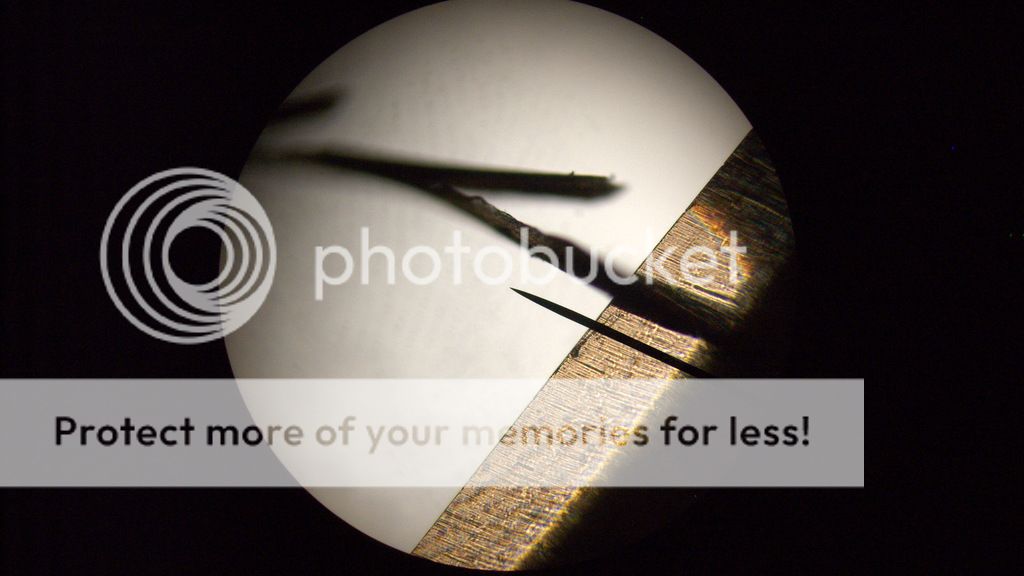
I think 1095 is about the easiest steel to sharpen. With that said, my D2 knives are not pocket knives, they are mid sized fixed blades so I finished them differently. As you can see from the following 100x microscope shot, they still get sharp enough to do a little cutting, and they slice abrasive materials well. For the photo I positioned the D2 blade and held a fine hair with tweezers and simply pushed it into the edge. You can see two cuts made into the fine piece of hair. Point of the story? You don't need mirror polish for sharp :)

L1020705.jpg


Kevin
 
That looks like VERY nice edge Kevin! Of course, I gotta ask...How'd you finish that edge??

I've been thinking of trying something like that, finishing on a 25 micron DMT diamond stone and stropping with 6, 3, 1 micron diamond paste. How much time do you spend on the stropping with 1095? How about D2?
 
Vic,

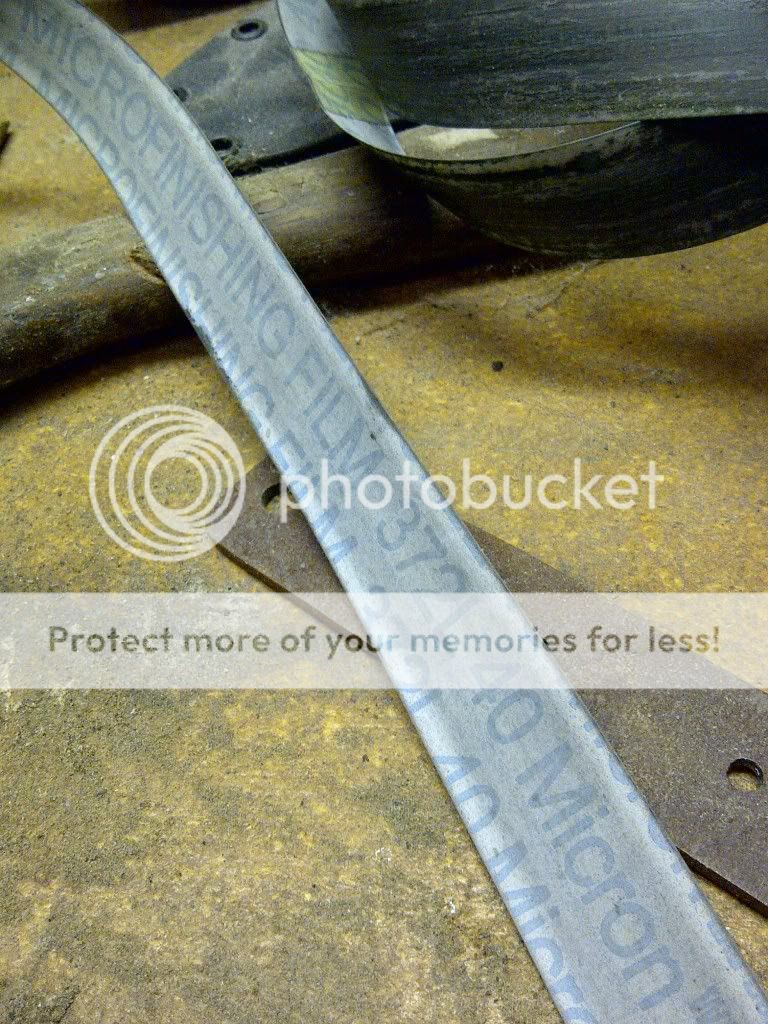
Thanks. That's a relatively sloppy edge I did quick. 3m grinding belt 40 was the number but I don't remember what that translates into grit off the top of my head. Green compound on the belt. Then leather belt with black and green compounds mixed. About a minute to strop the edge if that.

I believe if you get the edge right off the belts or a stone by hand, very minimal stropping is needed.

Kevin
 
Thanks Kevin, I think I've got an experiment for tonight. My DB barlow might be getting a new coarse finished edge :)
 
Cool! I just looked it up and the '40 marked belts' are 500 grit. '20 marked belts' are 1200 grit.

Keep us posted!
 
Loud and clear, I can see that curling you where talking about as well. Thanks for sharing brother, much appreciated as always.
 
Robert and Vic,

I think 1095 is about the easiest steel to sharpen. With that said, my D2 knives are not pocket knives, they are mid sized fixed blades so I finished them differently. As you can see from the following 100x microscope shot, they still get sharp enough to do a little cutting, and they slice abrasive materials well. For the photo I positioned the D2 blade and held a fine hair with tweezers and simply pushed it into the edge. You can see two cuts made into the fine piece of hair. Point of the story? You don't need mirror polish for sharp :)
Kevin

Nicely done!

I have always found 1095 and its carbon brethren easy to sharpen because it is always so soft. Even as a kiddo, I could get my knives shaving sharp on Dad's Arkansas and Norton stones. He had an Arkansas stone that was so doggone hard it would polish the blades and their edges. It was useless for anything but finishing.

These days, we all have great sharpening equipment and stuff that is easy to use, too. For my work knives I use a 12" chef's rod (600gr) to clean up the edges every couple of days. It takes a few swipes (unless something unexpected happened to the blade while in use) and it is back to just below shaving sharp.

I am a big fan of freehand sharpening and just found a 1200 grit 12" diamond to finish up my quickie sharpen jobs. This is what the doctor ordered for my smaller traditional patterns as I like to use the higher grits on them. D2 responds very well up to this grit, so my Country Cousin and my Kershaw JYD combo edge are in a for a real treat.

I think too Kevin, that in my experience different steels appear to respond best to different levels of sharpening. For example, there seems to be no limit to how far you can polish up the edge of 1095, 1084, 5160, etc. The higher the polish, the better the edge. But stainless seems to perform better with different levels of grits. For example, my AUS8 seems to perform better and a working edge last longer when sharpened up to 600gr. But my 12c27 Sandvik jack folder from AGR responds well all the way up to a mirror polish/stropped edge. So does my Boker "cattleman" in 440c.

I personally really like D2 and have many blades made from it from different manufacturers. I must say though, I have never seen anyone get that kind of edge (referring to you pic!) on D2. Good stuff.

Robert
 
Back
Top