Getting started on a 52100 wa gyuto, advice appreciated

This one? - https://www.researchgate.net/public...ling_Properties_of_a_Series_of_Vegetable_Oils

Just to be clear - are you referring to static or dynamic quench? Recently (my premature senior days) tripped(5 times) over PN in P50 (in big ammo can as tank) because of insufficient quench movement. I actually marveled how cool to see a smoke jacket around a blade for ~0.5s before small convection bubbles and then sub surface merged bubbles.

Yes there is vapor, but it isn't a jacket that must be breached or collapse. When I get to my desktop I'll link the study on using vegetable oils as a base for industrial fluid for quenching. It's not the only one, but it's the only one I've read recently. One reason to use them is the faster initial cooling rate as they tend to skip the vapor jacket phase of cooling during quenching. They have less chance of warp as the cooling is more even than if a vapor jacket is present.
 
That one is by the same authors, but the one I read was slightly different, using canola oil specifically. I'll have to find it. It likely is in the bibliography of this one. It's also been a while since I've read it and my memory could be spotty.
 
I was referring to the study that is number 19 in the bibliography of the one linked above. Also I was referring to static quenching.
 
Vegetable oils like canola don't suffer vapor jacket issues. Is this still 52100? If so, canola oil will be plenty fast enough unless you do something to generate extremely fine grain sizes.

Edited to add:. That small container may cause trouble due to small volume but it it holds an edge you likely got what you were after.
Container size?

Whoa,
The plot thickens.

Is there a quenchent to blade ratio?
Chris "Anagarika";16126037 said:
DBH, you'll like 52100 done well ;)

Bluntcut might be wrong about canola but he's done his homework a lot around 52100 his pointers would be useful :thumbup:
Hahaha you know it😁

Yea, Bluntcut is da man.👍

That thin 52100 would have been nice forge welded between 303 stainless lol

Lookin good keep going.
Haha indeed. I guess that's what it's for! 😂

Thanks brother
 

Ugly but functional


Cut 10 pieces of Manila rope, here's the edge on paper

Cut ten more. Took more force. Edge could cut paper.but was dull

Stroped back on 1 micron diamond compound

[YouTube]AJFjUgZdjE[/youtube]

Testing on food
 
Last edited:
I ordered a thicker piece of 52100. I think it's 0.130

I really want a Gyuto.

I'm thinking about buying another Map torch to get faster more even heat buy duel wielding them.

Probably not the best way to do things but I'm not very industrious with making things.

I've been reading Stacy's post about 52100 about it benifting from a sub zero quench after a snap temper.

But I'm still reading and researching.
How long is a snap temper?
How long for dry ice sub zero?

I've got some scrap pieces I can make coupons with too.

But I don't know how to test coupons.

Thanks guys for all your help.
 
Generally a volume of 1 gallon is recommended as a minimum. The small volume could warm significantly and cool slower. Tough to say without hardness testing. If quenching many blades in one session you definately want a larger volume.
 
Generally a volume of 1 gallon is recommended as a minimum. The small volume could warm significantly and cool slower. Tough to say without hardness testing. If quenching many blades in one session you definately want a larger volume.

Wow, thanks brother ☺
 
Deadbox, your posted location is "northwest". There are a TON of makers in the northwest. Perhaps if you were a little less general with your location, someone from your immediate vicinity will give a shout and offer to help you out with maybe the use of a proper forge or heat treat oven. Just a thought.
-Mark
 
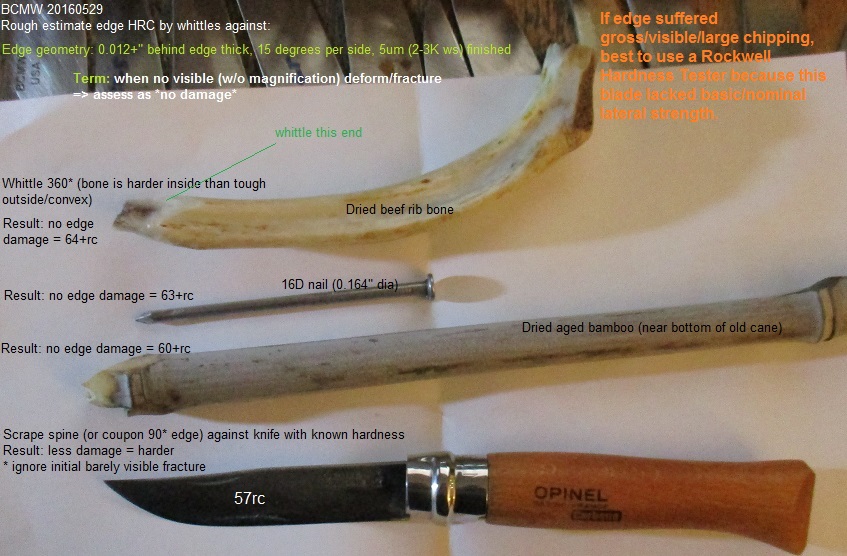
Shawn - don't fall too fast down the ht rabbit hole. Just in case, you need an idea of how your test coupons/blades rc & performance.

I usually can rough estimate hrc most of my test blades. At fatalistic time, I use 0.01"BET, 10dps edge geometry. Then I use the Rockwell to xref, if whittle result & tester reading don't matched. If actual hrc readings are lower than estimated -> my ht is going forward...

Ur0kvPu.jpg
 
If you please with your nakiri, do the same a gyuto except with a quench tank big enough to agitate the blade back/forth.

Depend on applicability of ht params, I subzero or cryo quench - holding at minimum when done boiling/gassing, longer doesn't hurt. For D2 and higher alloy steels, sometime I do a second cryo after a snap temper.

A 40mm ammo can makes a nice quench tank and also convenient to direct heat up on a gas bbq/burner/etc.

I ordered a thicker piece of 52100. I think it's 0.130

I really want a Gyuto.

I'm thinking about buying another Map torch to get faster more even heat buy duel wielding them.

Probably not the best way to do things but I'm not very industrious with making things.

I've been reading Stacy's post about 52100 about it benifting from a sub zero quench after a snap temper.

But I'm still reading and researching.
How long is a snap temper?
How long for dry ice sub zero?

I've got some scrap pieces I can make coupons with too.

But I don't know how to test coupons.

Thanks guys for all your help.
 
Deadbox, your posted location is "northwest". There are a TON of makers in the northwest. Perhaps if you were a little less general with your location, someone from your immediate vicinity will give a shout and offer to help you out with maybe the use of a proper forge or heat treat oven. Just a thought.
-Mark

Thanks Mark, didn't think of that.

Shawn - don't fall too fast down the ht rabbit hole. Just in case, you need an idea of how your test coupons/blades rc & performance.

I usually can rough estimate hrc most of my test blades. At fatalistic time, I use 0.01"BET, 10dps edge geometry. Then I use the Rockwell to xref, if whittle result & tester reading don't matched. If actual hrc readings are lower than estimated -> my ht is going forward...

Ur0kvPu.jpg

Very cool.😀
If you please with your nakiri, do the same a gyuto except with a quench tank big enough to agitate the blade back/forth.

Depend on applicability of ht params, I subzero or cryo quench - holding at minimum when done boiling/gassing, longer doesn't hurt. For D2 and higher alloy steels, sometime I do a second cryo after a snap temper.

A 40mm ammo can makes a nice quench tank and also convenient to direct heat up on a gas bbq/burner/etc.

Luong,

Thanks a ton man.

Truly appreciate the information.
 
Took me two months but this I'm at currently.

I used a piece of 80crv2 @.120 ish

Cut it out.

Heat treated it

Then started grinding

Took weeks on a 1x30 with the zirconia belts.

(Probably could have been done faster. But I'm a busy guy)

Hahaha not as easy as the thin stock. Was a total "Grind" hahaha

I still need to sharpen and finish it


Back
Top