Good (Woods) Survival Knife?

I still can't comprehend this whole big, chunky "survival" knife fad... You end up with a knife that is a mediocre chopper and a bad cutter.... If you can carry a pound and a half busse, you can carry a mora and a light hatchet or machete, which will surpass it about a hundred times over.
 
Goodeyesniper, I'm with you on this. Have questioned the use of a thick blade chopper many times. Lots of people prefer to go that route. It's just not for me. I'll take a good cutter anyday, along with either a hatchet or my good ole Laplander.
 
I could carry and get by just fine with a mora and a hatchet or machete, I just don't want to. I've just never cared for mora's. I've used machete's a lot though and still do. However I do like a fixed blade between 6 and 7 inchs for an all around knife camping or backpacking. I also usually have a esee3 with me for finer tasks. To each their own, its all about fun.

cricket
 
Becker bk2 for me is the best all around affordable knife out there. The options for customization and the brute strength of the blade is outstanding. I also recently used a mora bushcraft force and was blown away by the the sharpness and comfort of this knife. Highly recommended.
 
This knife has almost everything you are looking for except it is not 1095. I have been thinking about getting one of these Fox Comabt Jungle knvies for a couple months now. The picture is from MichiganKnives and they sell it for $155.

attachment.php
 
I still think the rodent 9 fits your needs, but maybe not.

Also, you said you've tried all the becker blades, and say they are too light (the longer ones at least). My thought here, is to find a Callimus produced BK9 (1/4in thick saber grind), that ought to be heavy enough for you.

Other thoughts are the ontario ranger series of knives, although I hear the handles on them aren't as comfy, but the rest of their specs seem like things you would like.

Good luck man.
 
Check out the Buck collaboration with the late Ron Hood - the Buck 060 Hoodlum. Go to the Buck subforum here and search 'hoodlum' for pix, etc. It has a 10" x .220 blade of 5160.

Stainz
 
I still can't comprehend this whole big, chunky "survival" knife fad... You end up with a knife that is a mediocre chopper and a bad cutter.... If you can carry a pound and a half busse, you can carry a mora and a light hatchet or machete, which will surpass it about a hundred times over.
Thats what I usualy carry; A Wetterlings, an Helle Viking, and a Custom. However, I would like to get another woods knife. I do like some of the advantages of having a "do-it-all" tool.
 
A Becker BK5

Fallkniven A2

Stromeng 8" Leuku

All good :)

I am just thinking about getting something large made up in Vanadis 4 or 3V or similar

Might look like this though:

397726748_tp.jpg


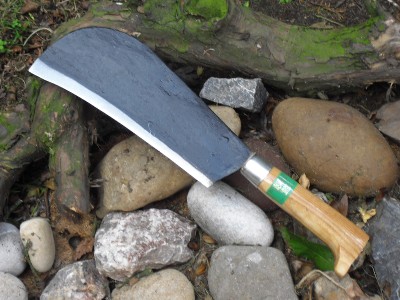
A knighton billhook. It is fn great for outdoors :D:D

I am kind of with goodeyesniper in general though. A variation on a nessmuk trio is good. A Roselli ax, a strong 4"-ish convex-ground stainless knife (of your choice from the squiilions there are) and a good folder (maybe a deli4 or a Moose). Possibly also pack along a light, 2" or 2 1/2" scandi blade for the whittlin' :)
 
Last edited:
I still can't comprehend this whole big, chunky "survival" knife fad
Fad? Survival knives have been a "fad" since the 1980's...EARLY 80's.
As to thick knives not cutting stuff well, tell that to all the people around the world who use 1/4" thick knives (and thicker) to cut everything from food, to wood, to whatever else needs cutting.
And OMG, they didn't even get the idea from the internet!:eek:

Not everything that one disagrees with is silly or a fad.
 
The thing I don't get is people's fascination with batonning through steel pipes and bricks.
It's quite confusing, as the woods aren't made of bricks and pipe, and both those materials seem to be piss poor choices for starting or maintaining a fire.;)
 
The thing I don't get is people's fascination with batonning through steel pipes and bricks.
It's quite confusing, as the woods aren't made of bricks and pipe, and both those materials seem to be piss poor choices for starting or maintaining a fire.;)

lol, steel pipes make terrible kindling.

it's my thinking that these unconventional tests are used to see how far past the normal user range a knife can go and to simulate a lifetime of use and abuse in an hour or two. most knives put through these destruction tests would last a long time being used as intended, so they kick it up a few notches.
 
The thing I don't get is people's fascination with batonning through steel pipes and bricks.
It's quite confusing, as the woods aren't made of bricks and pipe, and both those materials seem to be piss poor choices for starting or maintaining a fire.;)
I agree with Jimnolimit, they are performed to test there outright strength (even though I do cringe when i see it)! ;)
 
The thing I don't get is people's fascination with batonning through steel pipes and bricks.
It's quite confusing, as the woods aren't made of bricks and pipe, and both those materials seem to be piss poor choices for starting or maintaining a fire.;)
Sarcasm intended: The thing I don't get is people's fascination with starting and maintaining a fire with wood. What's with this "featherstick" obsession, honestly?

I was a Boy Scout, so a knife capable of such tasks seems like a bare minimum to me - anything but dedicated fillet and kitchen knives (reserved for flesh) should handle such tasks with relative ease, all that is required is a sharp edge with an acute bevel and sufficient lateral strength not to bend or fracture when a relatively low amount of pressure is applied to accomplish the cut. For these tasks, any blade thicker than 1/16" may be over-built.

But a knife capable of accomplishing these tasks and ALSO capable of cutting through sheet metal and impacting stone or concrete without significant edge damage? That impresses me. It may be over-built, but if that translates to significant increase in durability with minimal sacrifice in performance and weight/ergonomics, :thumbup: Obviously ascribing values (levels of importance) to various features (weight, edge retention, ease of maintenance, etc.) is highly subjective, but i think most would agree that an overbuilt knife is better than a broken knife when push comes to shove. *shrug*

Smacking a knife through concrete & metal is not an accurate way to demonstrate that tool's behavior on wood; and similarly using the tool on wood will not accurately demonstrate that tool's behavior on concrete & metal. And indeed, a tool which performs well on one medium may not perform very well on the other as the ideal attributes for such use are not identical from one medium to the next.

Soooo... if your situation may entail having the blade impact harder substances like metal, rock, or concrete (e.g. military), you may prefer a tool which performs well in that area of a destruction test. If your situation entails careful use of the blade on more pliable substances like wood, paper, flesh, hide, then you probably don't need to see a destruction test of any kind, maybe just some information on abrasion resistance and edge retention. If you anticipate batonning through materials with your tool, then you should probably take an interest in the ductility of your selection - i.e. how well it handles impacts and the lateral stresses a blade commonly encounters during such use.

 
knives-and-stuff, i don't know if the sheath is to your liking, but take a look at the ontario RD-7 or RD-9 (1/4" of 5160 steel and micarta scales). personally, i'm thinking about getting an RD-7 or an RBS-7 (3/16" steel) myself.
 
Last edited:
Smacking a knife through concrete & metal is not an accurate way to demonstrate that tool's behavior on wood; and similarly using the tool on wood will not accurately demonstrate that tool's behavior on concrete & metal.

the way i look at it, if you over strike the wood and hit a rock or hit into some tough knots every so often, over 10-15-20 years you'll might accumulate dozens of unintended "misuses". bashing a cinder block 30-40 times will simulate that and some in 10 minutes. i view a destruction test on a knife the same way i would for a car engine. a car manufacturer testing a new engine might have the engine run continuously for 100's of hours, even red-lining it for hours at a time. nobody is going to use the car engine in the real world that way, but it's the only way to simulate 200k miles in a reasonable amount of time. it also shows that if a product does well on a torture test, it will do even better while being used "normally". destruction tests aren't the end-all be-all, but they do serve a purpose and the more info we can get on a product, the better.


here's a video for jet engine testing, listen to what she says at 0:16-0:23.

[video=youtube;_jfXX7qppbc]http://www.youtube.com/watch?v=_jfXX7qppbc[/video]
 
Last edited:
Back
Top