Good (Woods) Survival Knife?

Soooo... if your situation may entail having the blade impact harder substances like metal, rock, or concrete (e.g. military)

No one I know who has been in the military ever had to impact metal, rocks or concrete with their knives.

It isn't a valid test of anything other than how well it will hold up to dumbasses who smack metal, rocks and concrete with their knives.
 
If you want beefy and none of the traditional offerings catch your fancy, you might consider getting a Himalayan Imports blade. You'll get everything on your list.
 
No one I know who has been in the military ever had to impact metal, rocks or concrete with their knives.

It isn't a valid test of anything other than how well it will hold up to dumbasses who smack metal, rocks and concrete with their knives.
EVERY marine and infantryman I've known HAS impacted metal, rocks, and concrete with a knife, and many a non-military user as well. Maybe Canadians are kinder to their tools or all Americans are just dumbasses? *shrug*
But your opinion has no bearing on the validity of any test. Clearly destruction-testing isn't your cup of tea. May you never learn nor need to know the limits of your tools! ;)
 
If the proper evaluation of a knife is how well it cuts concrete, let's evaluate which hammers are best for mowing your lawn too.
 
If the proper evaluation of a knife is how well it cuts concrete, let's evaluate which hammers are best for mowing your lawn too.

you're out in the woods, you over strike and hit a rock at full swing and your blade cracks, what goes through your mind? probably "i didn't expect that to happen"

pretty much any fixed blade with a full tang will provide years of service under "normal" use, should we wait 5-10-15 years to find out if a knife is truly durable? these tests aren't suppose to simulate real world use, they're suppose to simulate years of even harder use. think about it like this: if a knife can take 30-40 full on swings into concrete and/or steel and still be functional, nothing you will do in the woods will cause it to fail. i don't know about you, but that gives me a little more piece of mind.

pretty much all products and materials are abuse tested at the factory/lab, but that info is almost always kept under lock and key. we are lucky to have people willing to do these tests and share the results.
 
May you never learn nor need to know the limits of your tools! ;)
I know the limits of my tools, and stay within them.
If you enjoy watching silly folks in masks or whatnot bash apart perfectly good knives, that's okay.:)
Just don't mistake it for something useful...it's entertainment, not science.

Now when I was a moronic teenager, I sure did bash apart some good, as well as not so good knives...but like I said, that was when I was a moronic teenager. I was so stupid back then that I thought Skid Row was a good band too.:eek:
 
Last edited:
you're out in the woods, you over strike and hit a rock at full swing and your blade cracks, what goes through your mind? probably "i didn't expect that to happen"
Okay, I'll play.:)
I HAVE been out in the woods and accidentally hit a rock, and what went through my mind was "gee, I'll have to sharpen that nick out of the blade."
No cracks from such things, even in rather cheap, low quality knives.
Maybe it's because I buy knives made out of steel rather than glass.;)

Accidents happen, but needing to bash through cement, rocks or steel? Never.
 
you're out in the woods, you over strike and hit a rock at full swing and your blade cracks, what goes through your mind? probably "i didn't expect that to happen"

The last time that happened, I was 13 years old, and I learned from it. Haven't done it since. I'm a lot more careful now with my tools.

The knife BTW was some cheap piece of junk I bought at a flea market.

pretty much any fixed blade with a full tang will provide years of service under "normal" use, should we wait 5-10-15 years to find out if a knife is truly durable? these tests aren't suppose to simulate real world use, they're suppose to simulate years of even harder use. think about it like this: if a knife can take 30-40 full on swings into concrete and/or steel and still be functional, nothing you will do in the woods will cause it to fail. i don't know about you, but that gives me a little more piece of mind.

Nothing I have done in the woods has caused my circa 1989 Camillus "KaBar" to fail. It hasn't failed in the woods and rivers of southeast Ohio, the swamps of eastern Texas and Louisiana, the desert of west Texas, the Ozarks, the Smokies, the Everglades, and many other places. It's been there and done that, everything short of actual battlefield use, and never let me down.

Well, everything except trying to chop up a piece of concrete.
 
No cracks from such things, even in rather cheap, low quality knives.

The knife BTW was some cheap piece of junk I bought at a flea market.

cheaper knives tend to have pretty tough blades. low quality steel heat treated to a relatively low hardness will be tough, but won't hold much of an edge.


i never said that destruction tests are accurately depicting real world use. D-tests are done to push a knife past normal, to see how far from normal the knife can go. the tester only has a short period of time to subject a knife to a lifetime of use and abuse. how will we know if blade "A" is tougher than blade "B", by chopping thousands of pieces of wood? that would require tons of wood and time/energy. so D-testers up the ante, and move to harder, more abrasive materials. there's no way to tell how strong something, unless you push it to the breaking point.
 
Last edited:
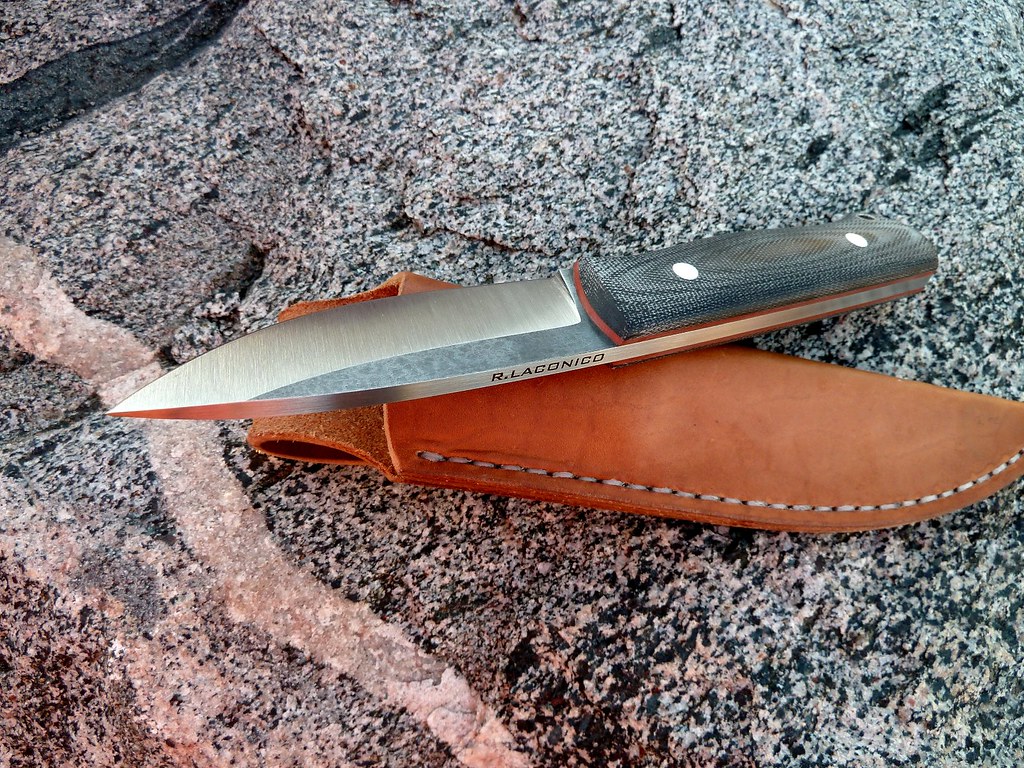
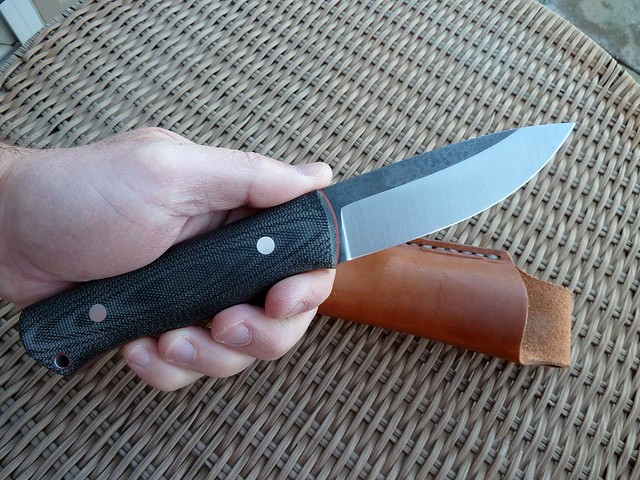
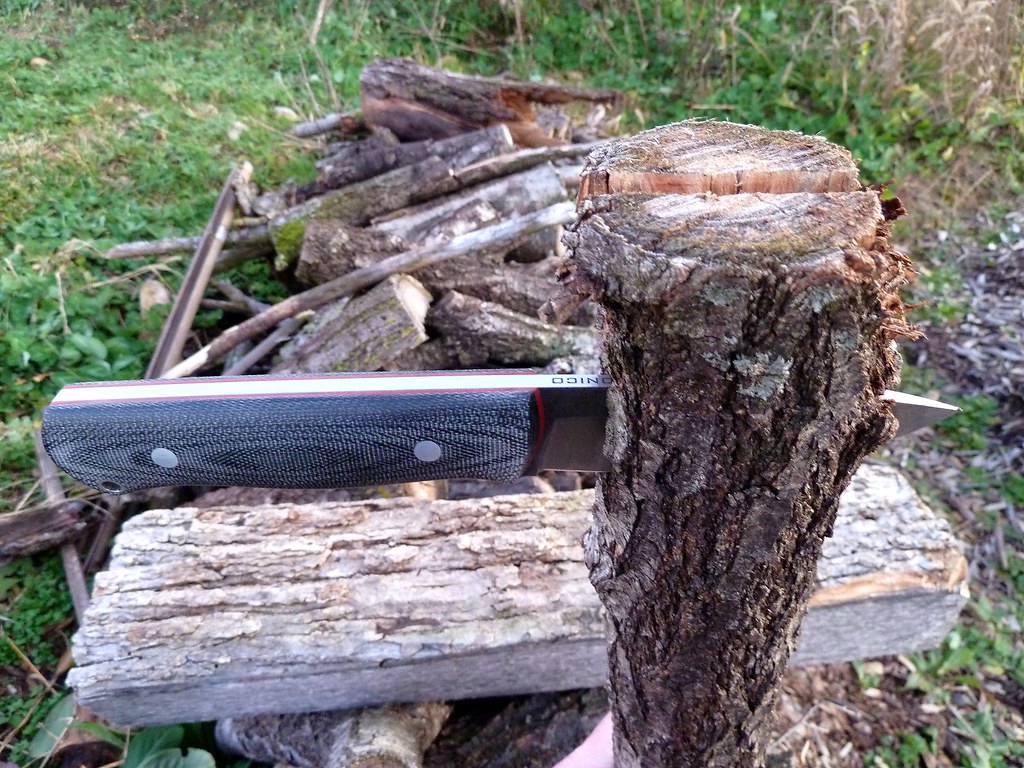
Did somebody ask for a good woods knife?? This one might only be a 4" blade of 3/16" O1, but it could just as easily be made in a 6". You'd be hard pressed to find a better woods knife than one by Ray Laconico...

6391962675_c0e8c5436f_b.jpg


6391955333_838c5d8a21_z.jpg


6391961469_3475d6d966_b.jpg


6391949513_1d8ab0428c_b.jpg


More Laconico goodness: http://www.bladeforums.com/forums/showthread.php/901843-Laconico-Perfection-...Warnin...
 
knives-and-stuff, i don't know if the sheath is to your liking, but take a look at the ontario RD-7 or RD-9 (1/4" of 5160 steel and micarta scales). personally, i'm thinking about getting an RD-7 or an RBS-7 (3/16" steel) myself.
Actually that's the main reason I didn't get an Ontario, the sheath. I love the knife design, but don't really want to spend $50+ for an after-market sheath. I think the best thing Ontario could do is design a new sheath made of Kydex, or my favorite, Leather. :thumbup:
 
you're out in the woods, you over strike and hit a rock at full swing and your blade cracks, what goes through your mind?

How about: "Wow, I'm an idiot who can't even hit what I'm aiming at." If you fail at using knives and you actually manage to hit a rock full swing, you probably deserve what's coming to you. But even then, the worst that's going to happen is probably a chip in the blade. If it cracks, it's probably a lemon, and you don't need to pound a knife through a concrete block to find that out. Not to mention, even out in the woods, there aren't that many circumstances where I'd actually even have the possibility of hitting a rock. If I'm going to full swing a knife, I'm going to be careful about what could happen, and move rocks from my chopping area.

I get a lot more peace of mind from knowing that I'm careful and safe with my tools than I get from relying on someone else's destruction tests on a knife not my own to protect me from the consequences of sloppiness and stupidity.

Destruction tests are fine--to a point. I'd much rather see how a knife holds up to actual knife use. A bit of prying perhaps, because that's something that people do. Cutting reasonable things (old carpet is a good test of edge retention). Batoning through wood is fine. Sure, accidents happen. But that's a FAR cry from the stupidity that some people put their knives through.
 
How about: "Wow, I'm an idiot who can't even hit what I'm aiming at." If you fail at using knives and you actually manage to hit a rock full swing, you probably deserve what's coming to you. But even then, the worst that's going to happen is probably a chip in the blade. If it cracks, it's probably a lemon, and you don't need to pound a knife through a concrete block to find that out. Not to mention, even out in the woods, there aren't that many circumstances where I'd actually even have the possibility of hitting a rock. If I'm going to full swing a knife, I'm going to be careful about what could happen, and move rocks from my chopping area.

I get a lot more peace of mind from knowing that I'm careful and safe with my tools than I get from relying on someone else's destruction tests on a knife not my own to protect me from the consequences of sloppiness and stupidity.

Destruction tests are fine--to a point. I'd much rather see how a knife holds up to actual knife use. A bit of prying perhaps, because that's something that people do. Cutting reasonable things (old carpet is a good test of edge retention). Batoning through wood is fine. Sure, accidents happen. But that's a FAR cry from the stupidity that some people put their knives through.

This :thumbup:
 
I know the limits of my tools, and stay within them.
If you enjoy watching silly folks in masks or whatnot bash apart perfectly good knives, that's okay.:)
Just don't mistake it for something useful...it's entertainment, not science.

To "know" the limits of your tools means that you have seen the same tool taken to those limits and broken/destroyed. If not, then you do NOT "know" the limits of your tools, plain and simple.

As for the rest, I'll try to repost what I wrote on another thread not so very long ago, because this keeps cropping up. It regards "science", a field I have been professionally involved in for over a decade - I ain't old, but I ain't teenage, and i certainly have no problem with the noss videos and no reservations about calling them "science". If you do, I must wonder why...

I write this respectfully as a member of the scientific community, myself a biomedical researcher.

To begin, "testing" is not a "scientific discipline", rather scientific disciplines employ "testing" i.e. experimentation to achieve empirical data (results) which are then subject to interpretation in order to reach a conclusion confirming or negating a predetermined theory regarding what the result will be and why.

ANYONE can perform a "test" along whatever parameters they like, with whatever precision and whatever level of repeatability, to conform or not with modern scientific standards. The first key element of performing any test is the rationale behind the test - why are you doing it? what are you trying to see/learn/discover/demonstrate? If you are not seeking to demonstrate anything, just performing the task for amusement, then it is not technically a "test" much less a scientific experiment...
The next key element is determining whether or not the endeavor will actually yield results pertinent to your rationale. If it will not, select an alternate method. Now this is important - you may not actually have a clue as to whether or not the method chosen will yield pertinent results, for indeed that can only be demonstrated empirically. You can draw up a theory regarding this by extrapolating from empirical evidence from other demonstrations, but a theory is not evidence.

So that should clear up whether or not Noss' lengthy demonstrations are "tests". As to whether or not his tests are "documented from start to finish", the videos speak for themselves. Noss does a better job of documenting than any contribution to any scientific journal on the planet. Accusing him of fraud in regard to documentation is utterly ludicrous from an objective stand-point, pure slander with no demonstrable basis whatsoever. One can say anything about anyone on the internet, I just hope that those "listening" will go to the primary source with an open mind and draw their own conclusions based on objective evidence.

But this still does not get into "tests" as a matter of "science".
I mentioned earlier the question of whether the techniques or methods employed by the tester are capable of yielding pertinent results. Many will state as a matter of course "No, hitting a knife with a hammer is not capable of yielding pertinent results regarding the durability of that knife! Any knife hit with a hammer will break!" But what evidence exists to support this? In demonstrable reality, the OPPOSITE is in fact the case, i.e. hammer impacts do NOT have the same effect on different knives, for a variety of reasons (most of which can be summarized into "knife design"). So, does this negate the objection? No, it only negates the rationale behind it and people continuing to spout that rationale can be ignored as ignorant of physical reality. And without the rationale of the objection to oppose him, Noss swings the hammer... repeatedly... over and over again. (Does anyone actually watch these videos straight through from start to finish?? Geez.)

Regarding measurement of the hammer impacts as important to proper interpretation of the data generated, that would certainly be more rigorous... but why do it? Again, you distrust the technician for objective reasons? You assume he has an agenda, that he is intentionally hitting some blades harder than others, or using harder materials for some than others, or perhaps the hammer for some knives is actually a rubber mallet painted to look like metal?
The mistake is applying a precise measurement to the technique (something Noss does NOT do) and then objecting to the technique when the data does not comply with hoped for results. If one had objective reasons for assuming that the hammer impacts performed by the technician on a variety of different knives did not average to similar amounts of stress, I can see where such measurement would be requested, but the integrity of the tests does not in itself require it, that level of precision just isn't called for. In my experiments on individual subjects (be they animals, cell cultures, etc.), many of the techniques employed for generating data involve subjective manipulation, e.g. trituration of cells in an enzymatic mixture, using an unknown/unspecified level of force. Why do I not measure this force? Because it has been demonstrated to be irrelevant to the procedure in that it cannot be measured every time with any degree of accuracy, and what truly matters is not knowing the level of force applied but rather the ability of the technician (myself, my predecessors, and those I teach the technique to) to accomplish the desired result. What is the desired result from Noss hitting the knife with a hammer? Well, when cutting into a medium such as wood, metal, or concrete, the desired result is indeed the cutting of said medium, it is NOT the failure of the knife (which is indeed the desired result when Noss finally puts a stubborn blade into a vise and performs side-impacts on the tang). And again, NOT every knife fails from this sort of (ab)use - again, for a variety of reasons which can be summarized into "design of the knife", some can handle this treatment better than others. Observe the video evidence for signs of unfair hammer impacts, or observe the medium being cut. Present these observations as data for discussion of how the knife performed at the task.

I could go into more detail regarding measurements and precision in regard to these tests but have already done so in other threads on the same topic. For my own purposes, which have yet to include hammering a knife blade through concrete, I do not require such precision and am surprised that anyone else would. I am more interested in precise measurement in comparisons of edge retention between steels (e.g. Jankerson's tests). But that is me.

On the issue of repeatability, namely the objection that Noss' tests are intrinsically unrepeatable... How so? What empirical evidence can be presented in this regard? Who has attempted to repeat these tests and can offer the same level of evidence? Okay, that is too rigorous, how about just a little bit of evidence, maybe a detailed write-up with accompanying photographs? Anyone? What about theoretical objections? Can no one else hit a knife with a hammer into wood, metal, and concrete?? If you are worried about performing the exact same techniques with exactly the same amounts of force, do not be so troubled, for it is not required! Indeed, Noss has repeated the procedure many times, and even includes repetition in each test (impact, impact, impact...). Are you concerned that unless you mimic his actions and forces exactly you will not achieve results validly comparable? Do not be so troubled, that level of precision is not required, and only through repetition of the experiment can the data generated truly be called into question.

In conclusion, Noss indeed performs "tests" (just as many others have), his tests have not been demonstrated as unrepeatable, they include sufficient measurement for rough comparative analyses between subject knives, and there is insufficient evidence to negate the integrity of the tests.

NOW, what OBJECTIVE CONCLUSIONS can be drawn from the data Noss has taken such pains to generate (at no cost to us and no profit to himself)? If you discount his method entirely (even without objective reasons for doing so), no conclusions can be drawn. End of story. If you admit the methods and evidence presented, you can discuss what caused each knife to fail in the way it did when it did, be it steel type or heat treatment or stock thickness or edge grind (all encompassed by "knife design") or a bad knot in a piece of wood or an accidental strike on the vise. The ultimate conclusion that can be drawn from a test (avoiding bad hits) is how well the design of the knife handles this particular treatment of it. How you extrapolate its performance to your own potential situations is up to you, and indeed such extrapolations can be done quite easily. But if you conclude from a single test by ANYONE that ALL similar samples will fair similarly, you are jumping to conclusions. This is data, not proof of something.
 
Last edited:
Scandinavian Leuku style knives are probably my favourite survival knives...Stromeng or Helle for example make quality knives. Check out their material.
 
To "know" the limits of your tools means that you have seen the same tool taken to those limits and broken/destroyed. If not, then you do NOT "know" the limits of your tools, plain and simple.

Okay scientist. I think you need to consider your statement more realistically here.

When I watch Noss go to town on a knife, that tells me bupkiss about how the limits of MY knife. The simple fact of the matter is that his "tests" are done on ONE single knife, and it's not my knife. We don't know whether it was a lemon or not, we don't know what batch it was, etc. Does that help me know how far I can take my knife? Of course not. It's a different knife. Maybe we can get some loose extrapolations, but any scientist should know that you have to have a larger sample size than 1 to draw any kind of meaningful conclusions. And that, I think, is the true measure of repeatability. It's not repeated hits with a hammer. It's repeating the test on multiple subjects. It matters not at all to the scientific validity of the test whether other people would do the same. It matters whether the same test is done to multiple knives. That doesn't happen.

Just because his knife does or doesn't break in one given test doesn't mean that mine will behave in the same way.

At the end of the day, you should probably do SOME basic tests to find out if it's a lemon and has bad heat treat. Aside from that, the true test as far as I'm concerned is whether you treat your tools with respect or not. If you're the kind of person to bang on a knife with a hammer until it breaks, you deserve what's coming to you in my opinion. But without a broader sample size, those videos are of strictly limited value.
 
My apologies for the long delay in reply. I have posted much of what I will relate before in other threads on this same topic:

When I watch Noss go to town on a knife, that tells me bupkiss about how the limits of MY knife. The simple fact of the matter is that his "tests" are done on ONE single knife, and it's not my knife. We don't know whether it was a lemon or not, we don't know what batch it was, etc. Does that help me know how far I can take my knife? Of course not. It's a different knife. Maybe we can get some loose extrapolations, but any scientist should know that you have to have a larger sample size than 1 to draw any kind of meaningful conclusions. And that, I think, is the true measure of repeatability. It's not repeated hits with a hammer. It's repeating the test on multiple subjects. It matters not at all to the scientific validity of the test whether other people would do the same. It matters whether the same test is done to multiple knives. That doesn't happen.

Just because his knife does or doesn't break in one given test doesn't mean that mine will behave in the same way.

At the end of the day, you should probably do SOME basic tests to find out if it's a lemon and has bad heat treat. Aside from that, the true test as far as I'm concerned is whether you treat your tools with respect or not. If you're the kind of person to bang on a knife with a hammer until it breaks, you deserve what's coming to you in my opinion. But without a broader sample size, those videos are of strictly limited value.

I do not disagree with any of this, and I doubt Noss would argue it either - in fact, he has said so many times. EVERY user should put their own tool through basic testing (i.e. use) up to their expected level of stress. Destruction tests are meant to go beyond that, to test the limits of the tool rather than the limits of the user's common activities. If a noss-tested knife performs poorly in a task where your own knife excelled, submit that data and feel confident in your own tool :thumbup:
But regarding the request for replicates:
Quality Control is the job of the manufacturer, NOT the user or the independent tester. In any large batch production, there will be poor samples, and it is the manufacturers job to minimize these (by improving manufacturing processes) as well as testing random samples from each batch themselves. How many should they test?
In production procedures in my laboratory, I routinely sample cultures for bacterial contamination. How many samples do I take? ONE. Why do I not take more? Because previous experience (experiments) have refined our asceptic production techniques such that a single test is now sufficient to catch a mistake that may permeate the entire batch (unless we have specific reason to suspect an error elsewhere), and taking more samples is wasteful. SO, with an n=1 we qualify an entire batch/lot of samples produced by a uniform procedure expected (based on previous internal experimentation) to evince identical (at our level of precision) quality. If that ONE sample fails, we scrap the entire lot assuming that the one is representative of the whole.
Now, that is one specific area of production, and producers/manufacturers should establish their own QC policies regarding how many samples must be tested (and in what manner) to ensure sufficient quality of the lot for distribution, whether it be <1% or 100%. If they test 5 random samples out of 100, and 1 sample fails to meet specifications, does that mean that 1% or 20% of the lot is below specifications? It means that 1% is below and there is a 20% probability of others in the lot also being below - there may not be any more lemons (80% probability), but it is up to them to decide how representative that single lemon is, what effort should be exerted to remove any other lemons from the lot, and what (if anything) should be done to prevent them in the future.

Bottom-line, every individual sample that the manufacturer decides to distribute SHOULD BE representative of every other (n=1). What a user experiences in ONE tool he can expect to experience in every other (n=1). THAT is good QC. In the case of "extreme knives", the makers should be "extreme"-testing their knives themselves prior to releasing advertising regarding their proposed use, especially if the product is relatively expensive and advertised for 'hard-use', then they will have data to present when an n=1 challenge is presented, lest they lose business should the n=1 test go against them. It is wiser for a maker to under-estimate the capabilities of his product and suppress hyperbolic hypotheses. Let the data speak for itself, and n=1 is data, however limited.

Noss recieves a single random sample to 'test' n=1. That single sample SHOULD BE representative of the entire batch if the individuals in that batch were produced in reliably repeatable fashion - every other sample from the same batch subjected to the same procedure by the same technician should give the same result (within a reasonable variance to cover the noise of different day, temperature, and other factors which should not drastically effect the performance of sample or technician). If that single sample performs badly, why should Noss bother with another one? QC is not his job (nor is testing knives, for that matter).

Since it is the manufacturer's job to produce reasonably identical samples, we should give them the benefit of the doubt and assume it is not a lemon (poor QC). So how repeatable is this test on another identical sample? Given the level of precision involved in generating data for each test (i.e. minimal), the levels of stress to which each sample are subjected (i.e. maximal), and the number of repetitions performed by this technician on entirely different samples coupled with extensive (rigorous) video documentation of each test, the tests appear to be quite repeatable in regards to the results they would generate. Would the testing methodology be more rigorous if more samples were tested? Of course. But it shouldn't be necessary (and no matter how many knives Noss tests he still will not have tested your knife). These are NOT precise experiments and should not be expected to be so. They demonstrate over the course of an hour what a user might expect to experience over the course of many years of such (ab)use without touching up the blade-edge (signs of poor care for an important tool). Such experiences are never precisely repeatable, esp. for different users, so the acceptable level of variance between each test result is quite large. These are destruction tests, the entire point is to find out a general level of stress the tool can endure before fracture, i.e. when fracture/failure be can expected, and fracture in a knife is not a small event requiring precise measurement of the stresses involved at the moment of incidence.

The take-away message is 'YMMV but don't be surprised if you have this experience'. Is the data of limited value? Yes, n=1. The danger of carrying conclusions from an n=1 demonstration too far - "All generalizations are false, including this one." But what makes these tests so valuable is that they go beyond the simple (light handling) user reviews full of hyperbole regarding hypothetical performance which comprise the VAST majority of knife reviews. Noss' 'tests' are not hypothetical. Need to know the limits to which your knife can be subjected? N=1 is a great deal more valuable than n=0.

 
I simply don't believe the "super duper indestructible survival blade" BS.

I once did, and bought my first Busse under that impression, and it was a real nice Steel Heart. All the articles and tests said it was the most indestructible knife out there.
Then, I found out that "indestructible" meant that when I accidentally dropped it from waist height on to a tin can when I was wiping it down, it put a hell of a deep dent into the edge of the Busse.
That was when I realized that any other knife I had bought would have done the same thing, and there are plenty of knives out there that will hold an edge, but will get a big deep dent in the edge if you drop them on to a tin can. End of the "indestructible, and nothing bad is going to happen to it after the SHTF, no matter what" fantasy.
Anything can break or be damaged.

Moral of the story?
Sometimes it takes spending a lot to realize that you might only have to spend a little.
Now I just look for a nice 1095 or 1075 carbon steel blade, get it good and sharp, and don't expect it to be indestructible, and I am happy.

I go along with the others on this thread who say get a Bushcrafter knife and a machete.
It's the sensible approach, IMO.
Some people might be amazed at what can be done with a 4" Old Hickory 1095 paring knife, and a 18" Tramontina or Imacasa machete, along with some knowledge, skill, and sharpening abilities.
Total cost, maybe 15-20 bucks.
 
Last edited:
Back
Top