We all have little tips and tricks that we use when out in the woods. Sure, everyone of us has probably built a shelter of some sort. We've tied the knots and set snares. How about the little things you've learned through experience. I'm one of those that stands firm that cleanliness (to a certain degree) in the woods is even more important than at home. Can't run to the drug store when you're 3 days into a hiking trip. Ever bring a tube of toothpaste into the woods only to find is smushed two days later, junking up your spare socks? :barf: How about finding it frozen after breakfast on a chilly morning? :grumpy: For the past 6 years or so, I've been using a Fuji film canister filled with baking soda and a pinch of salt. The salt helps by adding a little abrasion. Dip your brush in some water and then dunk it in the baking soda. Instant tooth paste. When you're done, don't forget to swallow. The soda helps digestion, acid reflux, heart burn and you don't make a mess. Be sure to use a Fuji film canister, the lids don't pop open when the sides are squeezed like Kodak will. The powder, being powder and not liquid in nature, won't freeze, so you don't have to worry about that either. It doesn't smell in it's nifty air-tight container, so no worry about it attracting critters either.

-
The BladeForums.com 2024 Traditional Knife is available! Price is $250 ea (shipped within CONUS).
Order here: https://www.bladeforums.com/help/2024-traditional/
You are using an out of date browser. It may not display this or other websites correctly.
You should upgrade or use an alternative browser.
You should upgrade or use an alternative browser.
Got any tips for the woods?
- Thread starter Darteres
- Start date
- Joined
- Sep 22, 2003
- Messages
- 13,182
Garbage bags are handy to put your pack inside if it is supposed to be a heavy rain.:thumbup:

- Joined
- Aug 30, 2007
- Messages
- 5,483
If you cut part of your finger off, wash it (do it before you stop the bleeding. You won't bleed to death fast through your finger so you have time to make sure it's cleaned right away. Most infection causing stuff will attach itself pretty quick so cleaning is very necessary.) and apply pressure immediately. While applying pressure, hold it up above your head. Being higher than your heart, it won't have as much pressure pushing the blood to your finger and will stop the bleeding much faster. Then wrap it up and continue on your way. I know this sounds random and funny, but this has been the most common thing I've heard about happening when off on a hiking or camping trip. Better to deal with that situation quickly and correctly. a simple cut finger can really become nasty by the end of a camping or hiking trip. Also, keep up with it. Don't neglect the wound. Just because you did the right thing right off the bat doesn't mean you're out of the woods. ..pun intended.
the heavy duty contractor bags, -8 mil i think- work better than the average garbage bag which is usually 2 or 3 mil. Ive cut the contractor bags open and used them to make a shelter. A marble sized rock wrapped into the corners and then tied with 550 cord works well for a tiedown. Cut head and arm holes and they make decent raingear.--KV
two contractor bags taped together at the opening with one of the closed ends cut open make decent emergency bivvy bags. use plenty of strong tape at the seam to keep it water tight. i have also read that if you start to develop little holes, keep them on the ground side to keep out airborne moisture. haven't had to do this yet.
carry a fair amount of duct tape (an entire roll if you can afford the weight) it works great for those repairs, and its handy for survival bushcraft (when primitive isn't a priority). great for tying things together, and can be made into cord if you need.
carry a fair amount of duct tape (an entire roll if you can afford the weight) it works great for those repairs, and its handy for survival bushcraft (when primitive isn't a priority). great for tying things together, and can be made into cord if you need.

- Joined
- Jun 14, 2005
- Messages
- 2,962
That kills me every time it see it.

Small metal coffee cans with the lids make perfect cook kits. You can carry a small photon stove, primer pan, wind shield, cooking utensils, spices, tinder and matches, or whatever else you can fit inside. Use the can as the pot. No wasted space, and perfect IMO for short trips/day hikes.

- Joined
- Oct 16, 2005
- Messages
- 7,499
Everything I have done, from shelter building to fire building, takes longer than imagined. Practive regularly with gear that you are familiar with and know where in your packs/bags the gear is. I spent a day in the pouring rain teaching a bunch of elementary kids the fun of the outdoors and it was a very rewarding day! (Pssst that darn lighter fluid I brought worked well!!!)
Carry ziplock bags for specimens.
As much as I hate plastic, from a young age I have carried ziplocks bags to the woods in order to bring home items
that I want to study further.
Everything from cartridge casings that I have found in unexpected areas, to unrecognized scat to odd fungi and mushrooms.
As much as I hate plastic, from a young age I have carried ziplocks bags to the woods in order to bring home items
that I want to study further.
Everything from cartridge casings that I have found in unexpected areas, to unrecognized scat to odd fungi and mushrooms.
BikeRider that is a great tip. I carry dry wall screws but now im going to add some of the eye screws in the pack... I do also belive that keeping as clean as you can goes a long way. Tack in there one or two shoping bags. Take very little room and there is always a use for one every trip i take. Carry some in the car in case i walked in the mud. I dont get the car dirty.
Sasha
Sasha
- Joined
- Apr 23, 2006
- Messages
- 265
I always carry regular store plastic bags in my field cooking set. A couple can be put together to carry out any garbage I accumulate that can't be burned and the others are used to wrap up my blackened cooking gear. That sure helps keep my pack clean, and they don't take up any space.
Oldman/Marty
Oldman/Marty

- Joined
- Mar 22, 2006
- Messages
- 5,944
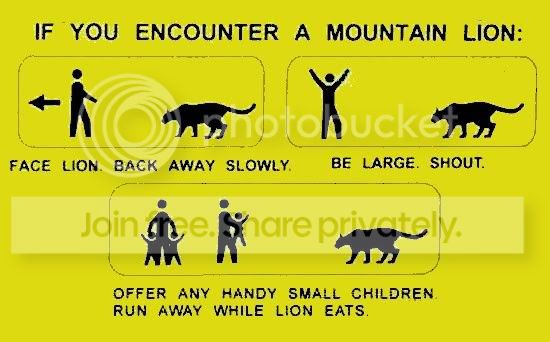
don't let your kids hike with poly math in lion country LOL

- Joined
- Feb 28, 2007
- Messages
- 9,786
Keep a small wad of toillette paper in your front pocket. Sometimes nature calls when you aren't near your pack containing the big roll. (Be kind and use a digging stick to make bury your waste). Also acts as tinder, kleenex and eyeglass cleaner (if your eyeglasses are like mine and have too many scratches to worry about mild abrasives).
kgd - Also learn to recognize Mullein which makes great natural TP. (And also has medicinal and foraging uses.)
RescueRiley - If I saw a mountain lion here in the ozarks I would probably play dead. Not on purpose...
I saw the tracks of one 3 decades ago, that was enough for me.
RescueRiley - If I saw a mountain lion here in the ozarks I would probably play dead. Not on purpose...
I saw the tracks of one 3 decades ago, that was enough for me.
- Joined
- Sep 12, 2007
- Messages
- 122
Keep a small wad of toillette paper in your front pocket. Sometimes nature calls when you aren't near your pack containing the big roll.
or
Bring an extra pair of socks. Apparently, other than use as emergency TP, they
can keep your feet warm and prevent blisters. Who would have thought

I always have my altoids kit, and a survival blanket. But I would say, do research of the area before you go out. Obviously we all have the internet here.
- Joined
- May 22, 2002
- Messages
- 1,485
I keep a few mid-size(6 inch )zip-ties in my kit. They weigh next to nothing.
SPAM SINGLES are really cool.
SPAM SINGLES are really cool.