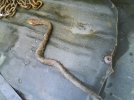
A while back when visiting my grandparents in North Texas, my grandfather showed us a snake he had killed. He said he wasn't sure what kind it was and wanted me to take a look.
He found the snake while on his hands and knees, using his arms to scoop out dead leaves under his shrubs. He took a scoop, saw and felt a movement, and then found himself staring at the snake.

Turns out it was one of the largest northern black tip rattle snakes I've ever seen at just a bit over 4 feet and nice and thick (average size for these is 3-3.5 feet). He's a blessed man for sure, and I'm not sure how he didn't get struck. At 80 years old, that would have been a tough one to bounce back from, most likely.
While we're on the subject, I thought this picture might give some a good case of the willies:
Having a hard time seeing it?

Let's take a closer look:
Every year in Sweetwater, they have an annual rattlesnake roundup. In the 51 years it's run, there have been over 123 TONS of snakes processed. The last several years they've averaged between 5000 and 6000 pounds of snakes. A number of years back, some yankee ecologists about busted a nut when they heard about how many snakes were getting killed. They threw a hissy about how it was destroying the rattlesnake population in the region. Of course, then they did a survey and found that it wasn't even putting a dent in the population. I want to say a fraction of one percent of the population were getting caught each year and were easily being replaced the next year with a growing population. There's just a few more snakes around the Abilene area than they thought.

--nathan