Grain growth

tattooedfreak

Steel mutilater is more like it.
Joined
Mar 12, 2010
Messages
1,016
Yesterday I finally got to HT some blades I was working on, they came out ok with just a touch of warp. After the quench but still warm, I put light pressure to try and straighten the warp in two of them, a straight razor style and a 8" hunter. The razor had a slight bend in the tang but with barely any pressure at all snap.. about 1/4 inch into the tang. Annoyed but still optimistic, I took the hunter and lightly bent it, then checked. It moved a little but not enough so I did it again, this time snap right in the middle of the blade. Yep very disappointed, however I can use this to learn (I tell myself). The razor tang has fine grain and is grey in colour, the hunter blade is larger and silver. I put the hunter handle in the vise and with a pipe over the stub start to bend until it cracks and breaks. I made sure the break was in the handle so I could check for differences. Both blades are 1084 by the way and I will put up pics when I get a chance. The handle break was the same colour and grain as the razor, different from the blade. I recall seeing grain pictures before but cant find them now. Can someone give me a quick idea of whats going on? Yes, I read Kevins stickys but it didnt really sink in.
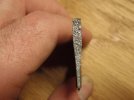
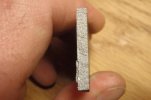
blade (640x480).jpghandle (800x533).jpgtang (640x480).jpg

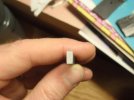
First pic is the blade where it snapped in the middle, second is the handle where I put it in the vise and broke it and the third is the tang of the razor. I notice that the tang and the handle both look similar, while the blade looks completely different from the handle of the same knife.
 

Attachments
  • tang.jpg
    tang.jpg
    34.3 KB · Views: 97
Last edited:
What were your Ht methods? How about temper temps and times? Was it using clay to make a wild hamon? The reason I ask is that there are lots ov variable reasons. I am sure someone else can offer more detailed answers.
 
I used an NC tool knifemaker forge, put the blades in after it heated up and let them heat to temp. Yes, I had to eyeball it but I was checking with a magnet. I know, I know. I had a coffee can of oil for quench and when they hit non magnetic I let them sit for about 2 minutes, then pulled and quenched starting with the smallest (the razor), with the hunter that snapped being the last. I quenched straight down tip first and the ends of the 2 hunters (about 3/4") were not in the oil. I pulled the Hunters from the quench after about a minute or so, they were still warm to the touch. Too hot to hold but not hot enough to cause burns right away so I know it was under 400. The other 2 blades were pulled just after that. I havent tempered the broken hunter yet but I plan on it to see how much of a difference there is. The other blades were tempered at 420 for 2 hours. The razor is now just a play blade now. Anything Im missing? Yes I would love to have actual temps and eventually I will get a pyrometer and TC (have any left Page?) but I will use this opportunity to learn for now.

No clay and no temper before I tried to straighten, the warp was slight so I thought I had enough time.
 
Last edited:
My observations as a newby, less than 100 blades,are these. Use more quenching fluid. I dont use a TC so I dont know if that would help you or not. I normally normalize before HT. That way you can releave any stresses built up over the grinding cycle. Also, I use a post vise to tweak warps. If its too bad normalize and reheattreat. This is just my way. Others with much more experience will chime in.
 
what oil? also once below 400 you should not try to straighten, the martensite transformation has happened, you are stuck, also until you are tempered it is extremely brittle, think glass

-Page
 
and yes I do still have themocouples, 5 for $25, still have half a barrel of them

-Page
 
Oil should not make a difference. Sounds like the gardening took exactly as it should have. Trying to straighten a hardened, untempered blade will lead to a break most of the time. Next time, start the temper and straighten the blade while it is hot from the tempering process.

For 1084, temper in an oven at 450 degrees for 2 cycles at 2 hours each. After the first cycle is the time to correct the slight warp. To get it corrected, you may have to place the blade back in the oven to get it hot again. After you are completed with straightening, cool the blade to room temp by holding under running water before the next temper cycle.

All of this is from experience gained over a short time by reading and just a little doing. Good luck.
 
The Curie point [ non-magnetic] is not the proper quench point .Quench temperatures are usually about 75* F above the Curie.
 
Canola oil for now, having difficulties finding quenching oil nearby. I was def above magnetic. I had thought to straighten during temper but I had also read that right after the quench for a few minutes, there was time to tweak small warps before the hardness set.
 
Canola oil for now, having difficulties finding quenching oil nearby. I was def above magnetic. I had thought to straighten during temper but I had also read that right after the quench for a few minutes, there was time to tweak small warps before the hardness set.
Whomever said that it takes a couple hours for hardness to set is either A talking about epoxy or more likely B talking out their a$$ without having actually made a blade. Once you are below 400 you have martensite in all of its brittle glory if you did the austentizing and quenching portion of the program right, and 130 degree canola will bring you down fast enough that you will not likely get pearlite in 1084, where it fails you is that where a commercial quenchant slows down during the lower temperature range where there is significant stress on the blade as phase changes distort it while at the same time it is getting hard and brittle (different phases take up different volume hence the katana taking a sori when quenched in water but taking a reverse sori when quenched in oil) one of the reasons people get visited by the tink fairy is too quick cooling in the low temperature phase change range while the blade is still writhing like a snake.

-Page
 
To avoid this in the future, reading up on the science and metallurgy of HT will help. There is a lot in the stickies on it.

For a short summation of where you could have problems:
1) No soak time is needed for 1084. Blade should be about 50-100°F above non-magnetic.
2) Sufficient quenchant is needed for proper HT, 1-2 gallons min.
3) Straightening MUST be restricted between 1000°F and 400°F, which is usually from about 5 seconds after quench to 30 seconds after quench. Once the blade reaches 400°F and stiffens, any attempt will snap the blade like glass. One guide is the oil smoke. If it is smoking, it is at the right temp to straighten. When the oil stops smoking, or the blade stiffens, stop straightening.
 
Thanks Stacy, I was unsure of the time/temp period for straightening during the quench. I thought I had read somewhere that I had a minute or so before true set. Don't get me wrong, I know why the blades snapped and I know I need more quenchant, my question was about the difference between the grey grain in the razor and the silver grain in the hunter. I will try and get pics up this aft, I have been at work since yesterday morning and havent had a chance to put them up yet.
 
I know that 1084 is the steel being discussed, but not all steels behave as it does. With 01 or A2, you can hand straighten slight warps below 400° immediately after quench. With 01, I am able to straighten minor warping bare handed until I feel the resistance and rigidity set. I would guess at about for 4 to 5 minutes after dropping below 400°, you can work with 01 to straighten. A2 is a bit more risky, but not by much. I agree that 1084 would not allow that at all.
 
Maybe thats what I was reading, I know I remember reading about being able to straighten during the quench, I should have checked based on low alloy.. Thanks.
 
3) Straightening MUST be restricted between 1000°F and 400°F, which is usually from about 5 seconds after quench to 30 seconds after quench. Once the blade reaches 400°F and stiffens, any attempt will snap the blade like glass. One guide is the oil smoke. If it is smoking, it is at the right temp to straighten. When the oil stops smoking, or the blade stiffens, stop straightening.

That's a neat trick. I'll keep that in mind.
 
I straighten warps right out of the quench oil all the time. Pull the blade out of the oil after 10 seconds for a quick check and straighten (if needed) with gloves on, then back into the oil.

Your hunter blade has huge grain. Too much time at too high temp is the cause.
 
As Don said, the first photo has large grain. The others look about right, but could be finer.

I would go over your procedures and see where you went wrong. Here care the main suspects:
1) Was the blade forged? If so, at what temperatures and how many cycles?
2) Was the blade normalized after forging?
3) Was a normalization done as a three step grain refinement pre-HT? What was the heat source and control?
4) Was the blade too hot for too long during HT? What was the HT heat source and control?
 
It wasnt forged, nor normalized. I suspect that I overheated it as that blade was the last one out of the forge. If I suspect I over heat a blade, I can just normalize again and reheat and quench, correct?
 
Back
Top