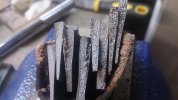
Grain growth

You said that after it hit nonmagnetic you let them sit for two
Min. Those NC's run idle at about 1600 or 1700 degrees. At least mine does. And that's with them popping and spuddering. Too hot, too long. IMHO
 
Tattoo.... Once I get set up here in Mahone Bay, you are welcome to come down and we'll spend a day heat treating using the forge and kiln, bud.:thumbup:

Your grain is WAY large. You are using a forge. In the two minutes you let it sit after it hit non-magnetic, you probably went 2-400F over for fun.
 
I suspected that when I saw it, now can someone tell me how it will affect the blades? We read all the time about grain growth and how fine grain is best but what will large grain do?
Rick, thats a deal. I do eventually want to get an oven but the forge was more of a priority, I dont know many people that forge Damascas in a kiln. I may have access to a kiln later but not quite yet.
 
Large grain makes for poorer edge holding and more tendency for blade breakage. Any blades done in this batch might best be re-heat treated with a good normalization.

Forging has nothing to do with this problem. The large grains from forging are refined during the normalization cycles before HT.
 
Thanks Stacy, thats advice I can certainly use. I handled the other blade from this batch and am using it on ship. It is holding up ok so far but I havent really put it to hard work.
 
I wanted to add in some thoughts. I would go about it the way Stacy is talking about. Think about normalizing and thermal cycling before your ht. Having said that I think you got it too hot and you don't need to soak the 1084. I would start about 1445F - 1450F and go from there to check out the type of grains you get. I know you said you were using a forge so I would try to base it off of color and the magnet.

I didn't take this picture and I can't remember where I saw it but it give you a good idea and direction for what you are shooting for with the grain in HT.

graininsteel.jpg


Now, when I saw this pictures they were talking about HT for files and getting good results. That doesn't mean 3 normalizations are correct etc. But the picture does show kind of what you really want to go for.
 
The first question that pops into my mind is how do we replicate the bottom one?
 
The first question that pops into my mind is how do we replicate the bottom one?

With three properly executed normalizations, that include consecutively decreasing heats and accurate temperatures.:thumbup:
 
With three properly executed normalizations, that include consecutively decreasing heats and accurate temperatures.:thumbup:

I would agree with Rick, some guys use more than three cycles, but I hear three is good and then you get diminished returns after that unless you reduce your heat and continue down. But then you run into running into harden-ability problems.
 
As others have said, your soak time was too long for 1084 and MUCH more importantly your temp was too high. Grain growth is much more dependent on temp that time. For a forge HT never try to do your normalization cycles or hardening process in an already forging-hot forge. Either turn it WAY down and wait a while for it to cool, or better yet, start that process while the forge is slowly warming up with a feather-flame. I break tips to check grain size on my forge-HT'd blades to get a good look as that's where overheating typically occurs. The number of normalization cycles necessary for good fine grain size is highly dependent upon the grain size you're starting with prior to the cycles. Because you're not forging the grain size should have been quite small in the mill-stock and only grew from too heavy/hot normalizing and soaking. A normalization or two just above or even a little below critical (you don't HAVE to soak that long for that steel to reduce stress, recrystalize and normalize- and anyway, what's worse a little more chance of warp (correctable) or bad grain size/increased brittleness/inability to take a fine edge?) is much better as the grinder is NOT going to put in massive stresses like forging does unless you're REALLY getting it hotter than you can hold, so the need for a heat soak normalization is less and if you keep the temp low (at or below bright red) then your grain size will never get out of control. Also, I suggest heating for the quench slowly (starting forge like I suggested earlier) and watching the steel slowly go through the red heats, moving the blade to keep heating even. You will notice parts of the blade turning a brighter color- bright-red/orange while some interior parts stay darker red- the blade is transforming phases before your eyes (shadowy transformation stage) as that transformation soaks up a lot of energy (energy of transformation). For 1084 when the blade all becomes the same color out of that transformation, quench. If the forge is too hot and you're heating too fast the core will take a while to transform while the edge overheats, so keep your temps as low as possible in the forge for control- this is the absolute key.

Mess around with it, break some pieces, that's really the only way you're going to figure it out for your forge and your setup. I've corrected overheated 1095 blades with grain size almost as bad as the ones you showed (even the tang pic had too big grain size btw) by 3 critical/subcritical heating/cooling cycles- but you HAVE to check and look-as there's no magic number, only results. Good luck!

~Luke

 
Since this is my thread, I can resurrect it if I feel like it hehe. Since the initial post I have tried to take what I read here and learned over the past little while. I have broken a number of blades (some not on purpose) and present them here. The first two pieces are the blade from the original post. The second two are a ground blade (1084) that I did a double normalization on and quenched in canola oil. the third was a forged and ground blade (5160) that I attempted a differential quench on. It was normalized three times, then brought to temp above non mag, then half the blade went in for an 8 second quench in two gal of oil, out for 3 then back in to complete. The last two (1084) was a ground blade, triple normalized (to the best of my ability), brought to non mag, then quenched in two gallons oil. If you look at the top left corner and the matching top right, you can see a darker grey. I broke the blade as it looked like there was a crack.. there was. I never heard a ping so I dont know when it cracked. However, the rest looks to me as if I have actually gotten close to a good HT based on my methods using a forge and ammo can of canola oil. Any comments, tips or other ideas?

DSC_0109 (1024x576).jpg
 
Last edited:
Attachment not working !
Differential quench I wouldn't recommend for anyone not very experienced or without a proper furnace with controls .
Any tempering should be done quickly.Cracking can occur in the quench or out ,and at any time.
 
Correct, you can fix it repeating the procedure (with other blades of course) crack is irreparable.
The grain is huge in all the 3 pics...of course the differences between the grain in the blade is larger because the handle has more mass to "resist" the huge temperature a little more.
I don't know your forge, but if it has a big flame hitting the blades, next time put the knives into an iron pipe for a more even temperature, shielding it from the direct dragon breath, which is way hotter then the average temperature of your forge....same applies to the heating elements of an electric oven.
i hope it helps

Stefano


I seems you are getting better
 
Last edited:
Hey Freak!

Looks like it is getting better. Still an open invitation to come on over one of these days, bud. We can share some secret squirrel HT recipes.
 
Back
Top