Grapevine???

Joined
Sep 27, 1999
Messages
3,164
I was on a short hike with my son, we kept seeing grape vines everywhere. It reminded me that Les said you can cut them and drink water from them.

Anyone know if there is any truth to this?

It is in a semi-public area so I don't want to whack one with a machete.
 
You have to climb as high as you can up the tree, carve a notch in the vine, climb back down and sever the bottom. Have a container ready. It yields a sweet water.
 
As a kid we had grape vines next to the garden. Sometimes if you cut a vine it would just keep dripping until it made a pool in the black plastic of the garden. I have wanted to try this method in the hills of PA where we have all sorts of wild grape vines. It always seemed to me that it was the root end dripping the water as if it was being pumped out slowly by the root system. I could be wrong. Anyway it was obvious which end was doing all the dripping so it wouldn't be hard to bag that end and collect water. Mac
 
I have cut grape & muscadine vines & drank from them at eye level, never climbed & cut , they drip pretty fast at certain times of the year, in north Ga. we have more muscadine vines than anything & it is sweet water!
 
My folks live on Jacks river on the edge of the Cohutta wilderness area! I have a small cabin there! a great place to roam!
 
I grow muscadines for jelly, and a cut vine no bigger than a pencil will drip sweet clean water for about 2-3 days. BTW, it is almost harvest time, MMmmmmm
 
I remember drinking water straight from wild grape vines as a kid, helping clear brush from fencelines and such. It does seem to have a pleasant taste. These vines were usually as thick as my wrist or more. Just don't confuse them with poison ivy!
 
What are the poison variety of vine's that can be confused with wild grape and how do you tell the differance i belive canadian moonseed is one what are some others.
 
Hey Mike,

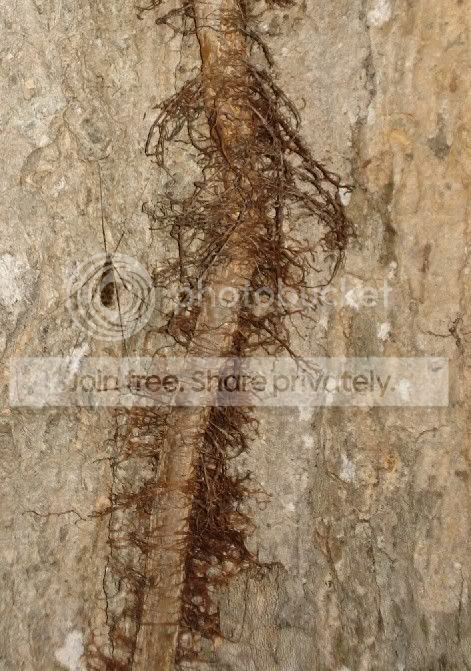
Poison Ivy (Toxicodendron radicans) can be identified by the little hairy roots it uses to attach itself to trees etc. (see picture)
PoisonIvyforPhotobucket1.jpg


Canada Moonseed (Menispermum canadense) climbs by the whole vine wrapping around whatever it is climbing, whereas Wild Grape (Vitis spp.) climbs by use of tendrils. Moonseed and Poison Ivy do not have tendrils. That's the only poisonous woody vines that grow in my area (that I'm aware of).

Doc
 
Thanks Doc-Canada
is there another type Iwas told once that the tendrils are a tell tail also, one had a streight tendril the other was coiled one safe the other not i generally leave the wild plants alone unless i'am absolutley positive of what i'am dealing with :confused:
 
Thanks Doc-Canada
is there another type Iwas told once that the tendrils are a tell tail also, one had a streight tendril the other was coiled one safe the other not i generally leave the wild plants alone unless i'am absolutley positive of what i'am dealing with :confused:

I'm not aware of this but I don't claim to be any kind of expert. Your plants should be pretty much the same as ours. Perhaps somebody else has some information.

As far as leaving them alone unless you have 100% identification, that's the only way to go.

Doc
 
The little curly tendrils on grape vines are very good to eat also, tart and taste good. We are having a good year for wild grapes and scuppernogs this year should be good coon hunting.:thumbup: Chris
 
Wild grape has a very distinctive leaf, so does the bark.

Wild Grape leaves are similar to Canada Moonseed. The big key is that the stem of the leaf of Moonseed does not attach to the margin of the leaf, but a little inboard of the margin. There is a name that describes this but I can't think of it for the moment.

Doc
 
Wild Grape leaves are similar to Canada Moonseed. The big key is that the stem of the leaf of Moonseed does not attach to the margin of the leaf, but a little inboard of the margin. There is a name that describes this but I can't think of it for the moment.

Doc

Moonseed also has just one seed where grapevine (Vitis spp.) has two. I have never gotten a lot of water out of muscadine. Sometimes muscadine when growing horizontally across a two spans puts out a lot of little roots looking for the ground - these are easy to collect and make quick cordage.
 
Back
Top