Grinding Jigs

Joined
Aug 28, 2009
Messages
7,951
I haven't posted here in a while, simply because I haven't made a knife in close to a year. My battle with elbow problems has come to an end and isn't going to get any better. As things stand right now I have lost most of the grip strength in my left hand and suffer from numbness in the hand with stabbing pains in the elbow. What all this means is I can't hold a blank to the grinder safely any more.

I am not ready to give up on making knives, but it means I have to reassess how I go about making them. First of hand sanding is pretty much out unless I want to suffer for a long period of time while the arm settles down. I am also going to have to switch to using a jig to hold the blanks securely and at the proper angle and only worry about applying pressure to the belt and moving the blank side to side.

All this means I have to do some minor modifications to my grinder too, mainly going from a minimal tool rest to an actual table that the jig/s can sit on while I am working.

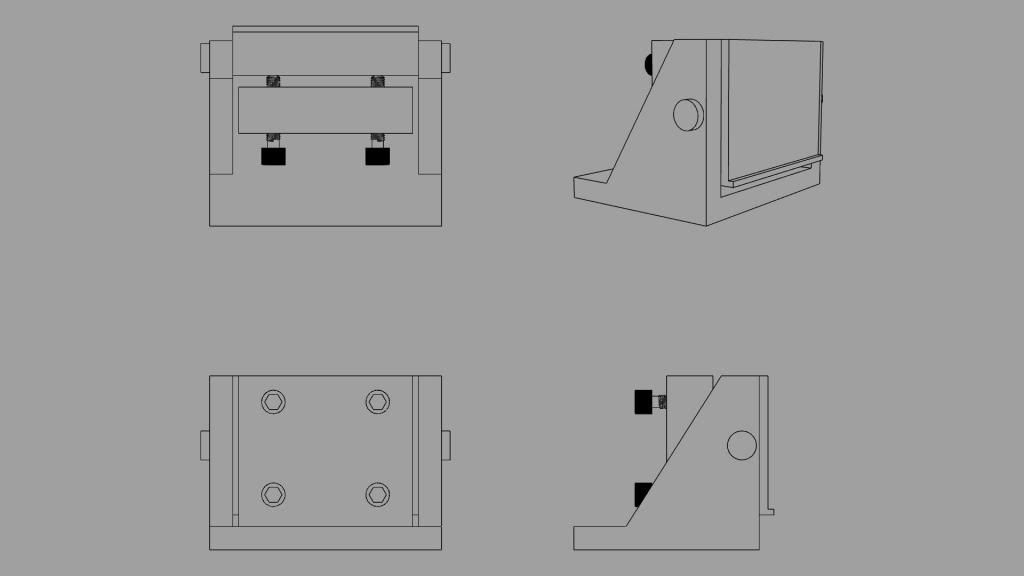
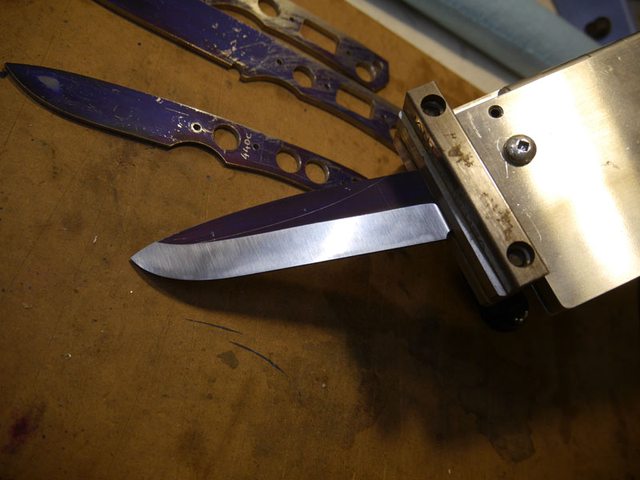
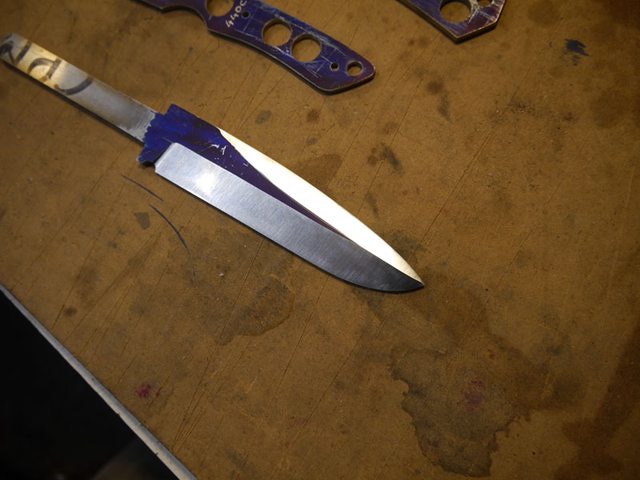
I have an idea of what to make for a jig, but I would like some input from the fine people here. This is my preliminary jig idea


jig_2_zpsb89955fe.jpg


jig_1_zps63adcec2.jpg


jig_3_zpsfea22e37.jpg


The blade would be held in by magnets, or I would extend the holder so I could bolt the blade in place. The 4 screws would allow me to adjust the angle I was grinding at. With the angle and holding the blade securely, all I would have to worry about is pressure and moving the blade across the belt. There are still a few issues with this initial design to work out, like how to compensate for a blade that has been ground on one side already. I could make wedges to take up the space or just add set screws so the back spacing is infinitely adjustable.

Yes I have temporarily gone blue, I bought a car and it needed a few things. Some of the parts are expensive and I found them on sale so I had to purchase them right away, meaning my membership renewal was put on hold till my next pay check.
 
Your jig would mean you would have to change the blade from one side to another. That would mean the blade the blade positioning would probably not be quite right with each change. There is a much easier way to get some blade grinding help if you are willing to give it a try. This works very well for hollow or flat grinding. You need to make up a table that is long enough on each side of the belt plus 6" that will tilt up or down. Probably near 36" long and 3 1/2" wide aluminum with a 90 degree angle. When this is set this up to tilt a cut out must be made to fit around the wheel or platen. This seems to work best when the cut out is made where the two sides come together. This table must sit a 90 degress to the wheel or platen. Take two blocks of micarta say 5/8" or more thick 4" X 6" and place say a 1/8" or 3/16" bolt through at each corner so that the two pieces line up especially on the long length. Place witness marks on these blocks so they will always go back together. This should look like a file guild. On one of the blocks on what you now know will be the inside cut a slot the thickness of a 1/16" or 3/32" rod that goes length wise about center. This will allow you to push the rod in here to help a bit this blade up and down alignment. But only for before you start the grinding. The blade with two scribed lines for the blade angle is placed between the two blocks edge up and if it is a short blade as for a folder a piece of equal thickness is placed at the other end. The table is now given some angle and the grinding starts. An allowance for grinding with all belt sizes that will be used must be made. Grind the one side with the coursest belt you use or even part and go to the other side before going to the next size. GRIND BY FOLLOWING THE LINE FOR EACH BEVEL. Yes, this will mean drawing your blade in the fixture towards you near the tip. This is why the table must be wide. This will also allow you to grind recurved blades . And yes, to grind a two edged blade you just turn your blade over AFTER the one edge is completed, set a start angle and go to it. Perhaps the blade tip may need to be adjusted up or down. just loosen the screws just a touch and give the end of the blade a tap in the right direction. Retighten for sure.
Get out the MILD steel and try a few blade patterns. Sorry as a lot of you already know I don't do pictures, but I use this set up - jig - for every blade I grind. I sure will try to answer your questions. Frank
 
Gee I really wish you did pictures, because I just can't seem to wrap my head around what you are describing:o I am goingto have to keep reading what you wrote till it breaks through the mental block I am having right now. Thanks for the input.

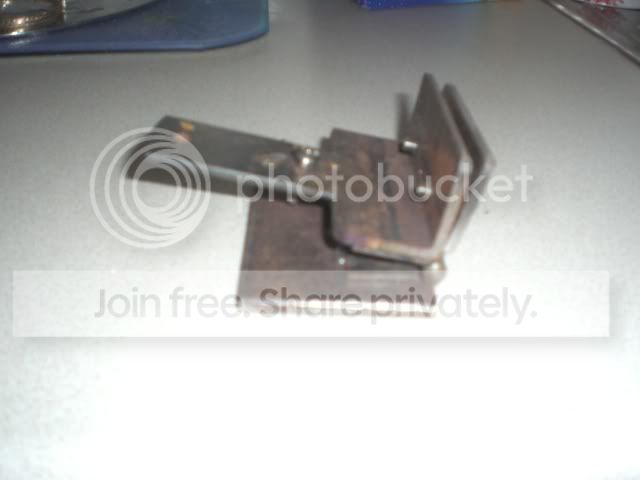
My design is still in the planning stage, and I know there are quite a few bugs to work out on it still. I was going to mock it up in wood before committing to making it out of metal.
 
Check out this set up

[video=youtube;NUdPe3N4Vis]http://www.youtube.com/watch?v=NUdPe3N4Vis[/video]
 
I'm in the process of making two jigs. One is somewhat similar to your idea, but a bit simpler design. I got a door hinge at Home Depot, 2" angle steel, and some 2" wide x 1/8" steel. Similar to the picture below. The other is a flat grinding jig similar to the hollow grind jig sold by Jantz (Well similar premise anyway). A bit more complex to make, but easier to use.

I think your design would probably work well except for the magnet. You will want to switch the knife from left to right and have it at the exact same angle, IMO that would be difficult with a magnet. I would recommend screws.

CIMG0346-1.jpg
 
Last edited:
Of course you could learn to grind from one side only.

Harvey Dean does it that way and has not hurt him at all
 
All these other designs work off of the blade holder ITSELF tipping not the main table tipping with the blade being held in a holder that doesn't tip. The difference is significant. The biggest advantage is there is no blade changing from one side of the holder to turn it around. Frank
 
All these other designs work off of the blade holder ITSELF tipping not the main table tipping with the blade being held in a holder that doesn't tip. The difference is significant. The biggest advantage is there is no blade changing from one side of the holder to turn it around. Frank

Frank, I too would be interested in getting abetted sense of what you described.
 
Someone in Canada must have a camera... Go to Franks house and take a picture!
 
All these other designs work off of the blade holder ITSELF tipping not the main table tipping with the blade being held in a holder that doesn't tip. The difference is significant. The biggest advantage is there is no blade changing from one side of the holder to turn it around. Frank

Frank, are you sure the one Faron Moore linked isn't similar? I didn't understand what you meant, but the actual blade jig in his is 90 degrees to its base, rests on a table, and the table is tilted (not the actual holder). I assume that when you turn the holder around on the table, the blade is at an equal angle, and the handle of the knife is held in the jig, which is why you need a longer table (your jig needs to be offset from the belt in this design).

I may be wrong, http://knifedogs.com/showthread.php?5457-Flat-grinding-jig-that-works <--- That was his link.
 
Unky, and Doc., send men email at niro@telus.net I have a flat rate phone for North America. If you give me some times to call you, I certainly will and provide you with answers and explanations, and who knows I may even find a picture or to you will be free to do with as you wish. Please give me times in Pacific standard time. I already have a friend in Texas that always manages early calls. I'm not often out of bed before 12:00 noon by the way. I would certainly like to help any who want to get some assistance. The big problem with this set up is in the end it's simplicity, which in itself makes people say "there's a catch here some place" Not !!!
M. FREEZE. In order to do a different blades, you would need to drill more holes but in that block and figure out the thickness of nuts to use for different thicknesses. It works for the U tube guy but even at that it's a tippy thing and does not give a solid even base to work with. Frank
 
A. Justice.
Which part does the tilting the blade holder or the grinder table? How can you just turn that tilting blade holder around and have the same angle? Yes, if you taker the blade out and turn it end for end but that upsets what you are trying to do and that is achieve some accuracy. Frank
 
Frank, it is the table that tilts in that thread, or so the caption says it does on the fourth picture.

As apposed to the table tilting, couldn't I just tilt my platen? I have the Polar Bear Forge GiB with the multi platen. For my setup I think it would be easier to stick my digital angle finder to the platen and rotate that instead of completely reworking the tool rest/table. I would still need to make a blade holder and a larger table.

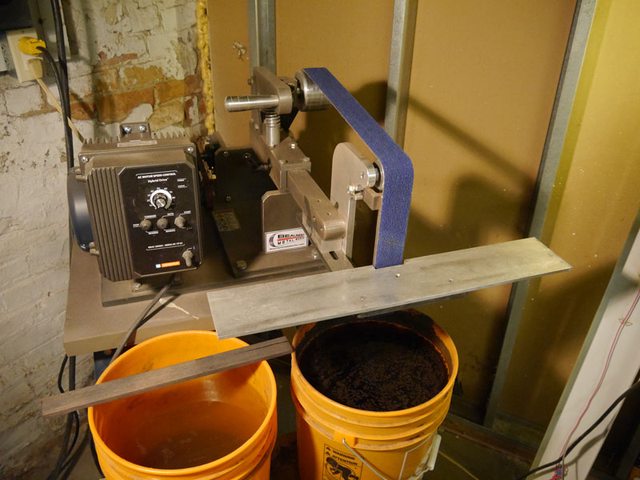
This is my grinder from when I lived in Winnipeg, before I added the little 4X6 tool rest. Since that video I have moved to eastern Ontario and set up in a garage so I have more room to work with, but I also have more tools :o

[video=youtube_share;tZ_rTozj8sI]http://youtu.be/tZ_rTozj8sI[/video]
 
Last edited:
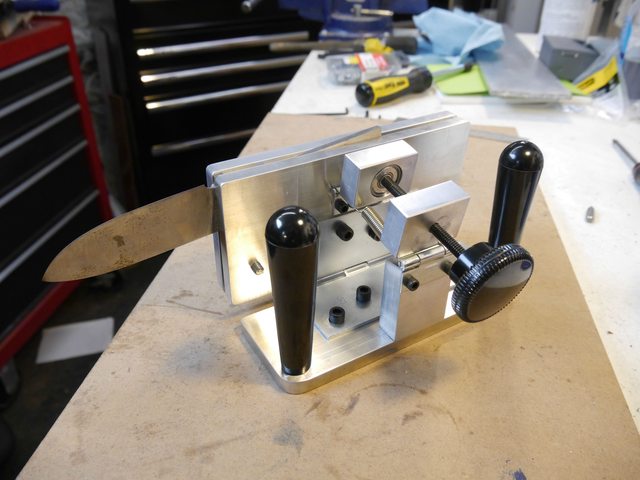
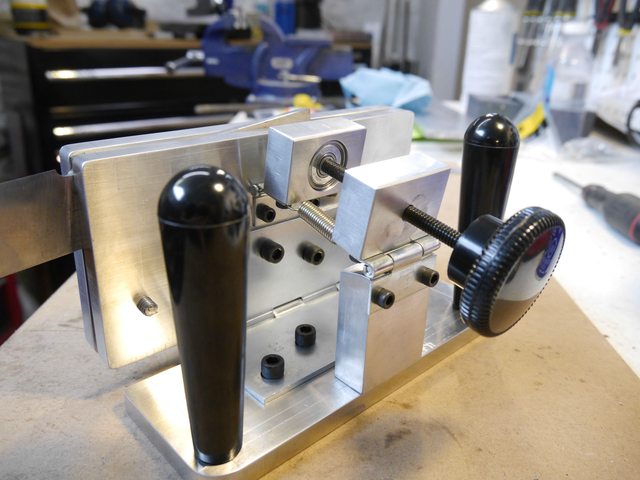
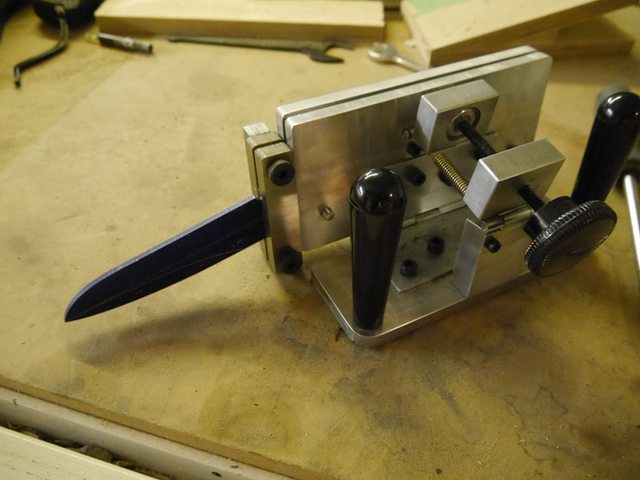
I built a grinding jig for my KMG that works very well. It is of the type where the jig changes angle. You do have to swap the blade from one side to the other, but what I do is use a file guide clamped to the blade to mark where the plunge line will be, that way the file guide stays attached to the knife the whole time (even when changing sides) and the plunge lines come out very even.

My jig is designed to make changing angles easy because in my experience the angle always needs a little tweak at least from one side to the other.

The whole jig is moved about by the handles at the rear, and the bottom is covered in UHMWPE tape that makes it slippery and relatively easy to move around...

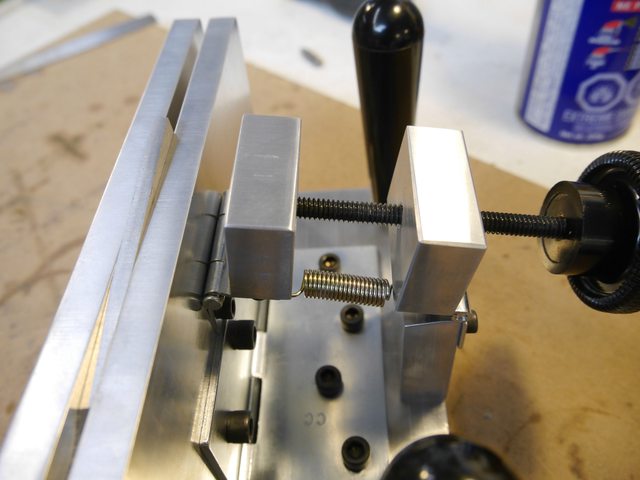
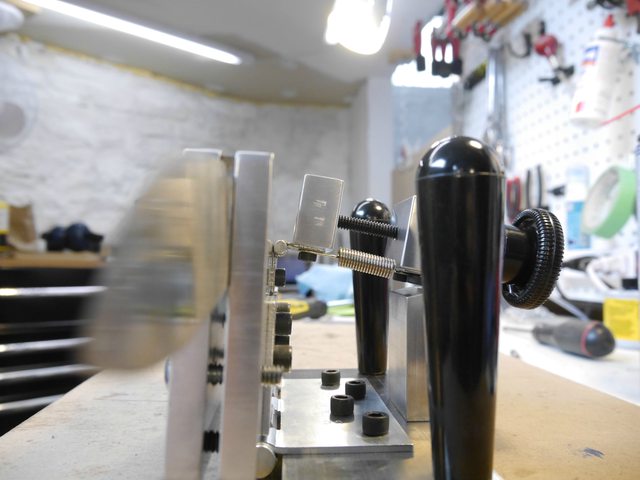
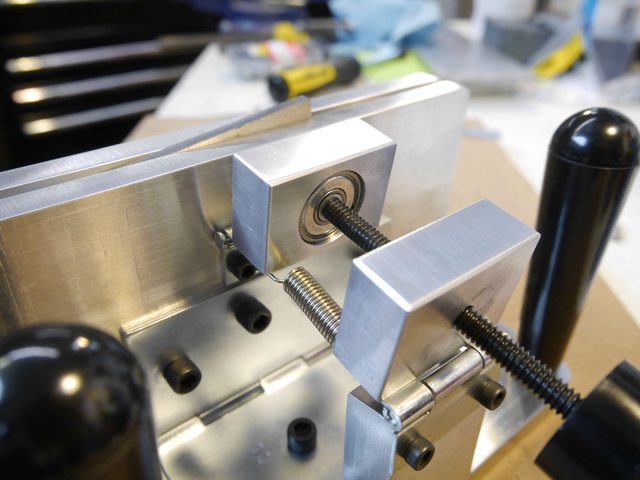
The file guide is not on the blade in these photos, I tried to show the mechanism in detail so you can get an idea what's going on:

wNSXoO5l.jpg


5dRfjIWl.jpg


1YklDTPl.jpg


Uqx6YRPl.jpg


E40t7Mel.jpg


wNSXoO5l.jpg


Basically the two hinged blocks and the threaded rod form the adjustment mechanism. The rearmost block is threaded, and the forward block captures the end of the threaded rod in a bearing. When the rod is turned it either pulls the blocks together or pushes them apart. This forms the angle adjustment mechanism.

The hinges used are regular door hinges (1x 4", 2x 1.5"). The steel loops that contain the pin in the hinges were whacked with a hammer a bit in order to tighten up the fit and remove slop. The little spring serves to load up the whole mechanism in one direction and soak up any remaining slop.

The whole thing is made from 3/8" aluminum plate, and with the exception of the little bearing block could all be made with just a bandsaw (or hacksaw if you're brave) and a drill-press (or hand-drill if you have steady hands!). The little bearing block was made on my lathe, but I'm sure there must be a way to replace that with some other mechanism, maybe 2 circlips on either side of a block or something? I will give that some thought...


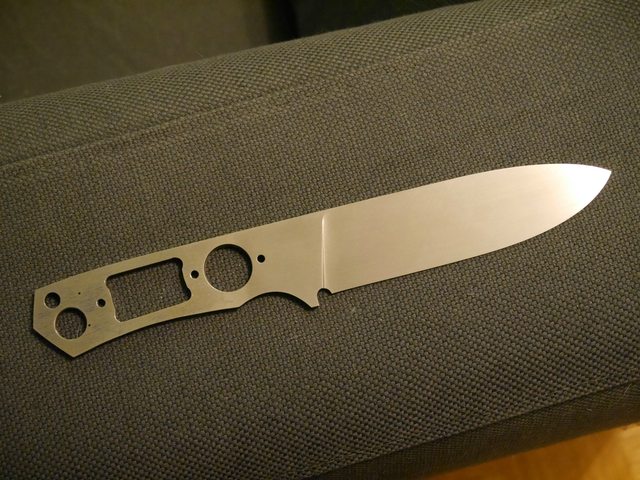
Results:
l38vNvNl.jpg


You can see the file guide attached to the blade blank in these photos:
IBaTy9Xl.jpg


XrgzHu4l.jpg


(Don't mind the messed up swedge, it was the first swedge I've done... It was also done using the grinding jig)
GpfK0ibl.jpg


And this is the large table I fitted to the KMG in order to facilitate use of te grinding jig:
zlbLyMvl.jpg


My only other thoughts are that you will find that using a jig makes the setup of your grinder much more critical. Make sure the platen is flat and also at a perfect 90º to the table. Belts need to have their edge killed, otherwise they might under-cut your plunge. I use an old file to strip the grit off the corners of the belts.

I have found using the jig to be very rewarding. It still take a fair bit of skill to use, but it does not require the constant perfect motor control that grinding freehand does. I find that kind of physical concentration very tiring and stressful, so I much prefer using the jig!

-Aaron
 
I have seen on this thread a few jigs that may help you.
Another simply way that may help is to just use a magnet of say 6" I think I still have some older ones that were originally for hanging knives on the wall in the kitchen that are backed with wood that would give you a much larger area to hold on to.

Do you have enough strength on that one side that you think this idea would help?
 
I have seen on this thread a few jigs that may help you.
Another simply way that may help is to just use a magnet of say 6" I think I still have some older ones that were originally for hanging knives on the wall in the kitchen that are backed with wood that would give you a much larger area to hold on to.

Do you have enough strength on that one side that you think this idea would help?

No both arms are affected:( but the left is much worse and I am a lefty. My hand and arm problem is due to me being an workaholic bike mechanic that would work 16+ hour days 6 days a week from April till mid September. I developed chronic tennis elbow and carpel tunnel in the left arm and hand, and mild to to sever on the right side. I have had 2 surgeries for the tennis elbow on the left side, along with years of physiotherapy with no relief. 2 weeks ago the latest specialist said that my left arm is as good as it will ever be and that the right will get worse as I try to use it more to compensate for the problems with the left side. I am sure that those first few knives I made by draw filing didn't help my condition any either:o

How bad is my grip strength? To drink my morning coffee I have to use two hands or I drop the cup:eek: and it only gets worse as the day goes by:( I also have next to no feeling in the left hand because of the nerve damage so the last time I ground I came out with a wobbly grind line and some pretty nice burns on my fingers. being as pig headed as I am, I fixed the grind by draw filing and hand sanding till it was right. That pretty much laid me up for over a month.

I like Aaron's jig, but I am concerned about the pressure not being behind the blade. With my reduced sense of "feel" I fear I may rediscover that 2" disease again:p.
 
No both arms are affected:( but the left is much worse and I am a lefty. My hand and arm problem is due to me being an workaholic bike mechanic that would work 16+ hour days 6 days a week from April till mid September. I developed chronic tennis elbow and carpel tunnel in the left arm and hand, and mild to to sever on the right side. I have had 2 surgeries for the tennis elbow on the left side, along with years of physiotherapy with no relief. 2 weeks ago the latest specialist said that my left arm is as good as it will ever be and that the right will get worse as I try to use it more to compensate for the problems with the left side. I am sure that those first few knives I made by draw filing didn't help my condition any either:o

How bad is my grip strength? To drink my morning coffee I have to use two hands or I drop the cup:eek: and it only gets worse as the day goes by:( I also have next to no feeling in the left hand because of the nerve damage so the last time I ground I came out with a wobbly grind line and some pretty nice burns on my fingers. being as pig headed as I am, I fixed the grind by draw filing and hand sanding till it was right. That pretty much laid me up for over a month.

I like Aaron's jig, but I am concerned about the pressure not being behind the blade. With my reduced sense of "feel" I fear I may rediscover that 2" disease again:p.

Sorry to hear you're having such trouble, that must be distressing...

I'm not sure if my jig would be suitable or not given what you've described. I don't think it requires much pressure to use, but it's hard to judge.

Perhaps an alternate method of knifemaking is in order? CNC tools are coming down in price these days and might be an option to let you continue to work on the things you love! The barrier there is cost as they're still not cheap, but they might enable you to keep going as well as making new things possible! Just a random thought...
 
Back
Top