
-
The BladeForums.com 2024 Traditional Knife is available! Price is $250 ea (shipped within CONUS).
Order here: https://www.bladeforums.com/help/2024-traditional/
You are using an out of date browser. It may not display this or other websites correctly.
You should upgrade or use an alternative browser.
You should upgrade or use an alternative browser.
Hamons - What substrate do you use to coat blade?
- Thread starter alclark2
- Start date


Willie71
Warren J. Krywko
- Joined
- Feb 23, 2013
- Messages
- 12,214
I don't know how chrome affects it, but I guess A2 is right on the cusp of too much manganese so I guess it's possible? I wouldn't think it'd be much to look at.
Yeah, I tried to find a pic, but can't seem to. It looked like an even wave, with no ashi. Most makers asked what the point was iirc?

Matthew Gregory
Chief Executive in charge of Entertainment
- Joined
- Jan 12, 2005
- Messages
- 6,725
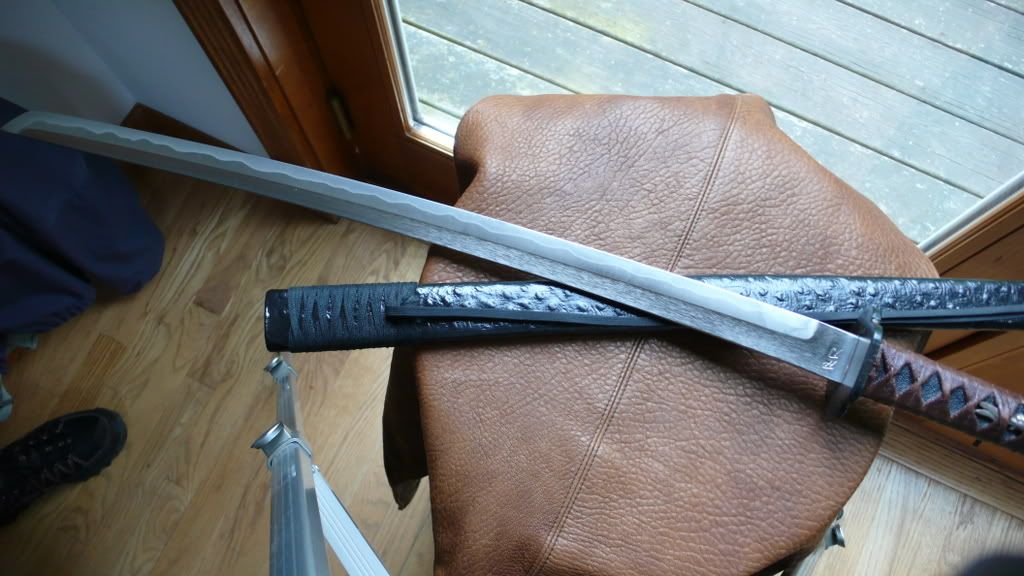
And here something you do not see reproduced except by his son a temper line in an A2 steel sword. Artist the late great Phill Hartsfield


jdm61
itinerant metal pounder
- Joined
- Aug 12, 2005
- Messages
- 47,357
There are mad scientists out there who can do weird, seemingly impossible things. Howard Clark austenizes clay coated blades in high temp salt and lives to tell about it. For the rest of us mere mortals, we have to stick to the mundane. 


Stacy E. Apelt - Bladesmith
ilmarinen - MODERATOR
Moderator
Knifemaker / Craftsman / Service Provider
- Joined
- Aug 20, 2004
- Messages
- 38,577
Not saying the blade in the photo is done this way, but remember ... a faux-hamon is only a matter of polishing and etching techniques. You see cheap Chinese katana in 440C with a perfect looking suguha or notare hamon. The problem is it is on the surface, not in the steel.
I have put a hamon on A-2 by conventional clay coating and non-foil HT, but considered it more of a surface effect caused by the clay than a structure effect in the steel. If I ground too deep post-HT it started to disappear. Overall, I was not pleased with the effect.
I also did an experiment with 15N20 where I coated the ha, not the spine. The effect was caused by the increased depth of decarb on the exposed upper bevel in the 20 minute soak. I suspect if I had ground the upper bevel down to fully hardened steel it would have removed the hamon. It did look pretty good, though. I never tried the reverse clay on any other steel, but suspect it would have left A-2 with a bright ha and a dark ji.
I have put a hamon on A-2 by conventional clay coating and non-foil HT, but considered it more of a surface effect caused by the clay than a structure effect in the steel. If I ground too deep post-HT it started to disappear. Overall, I was not pleased with the effect.
I also did an experiment with 15N20 where I coated the ha, not the spine. The effect was caused by the increased depth of decarb on the exposed upper bevel in the 20 minute soak. I suspect if I had ground the upper bevel down to fully hardened steel it would have removed the hamon. It did look pretty good, though. I never tried the reverse clay on any other steel, but suspect it would have left A-2 with a bright ha and a dark ji.

- Joined
- Oct 20, 2008
- Messages
- 5,547
I used to make 5160 hunters with "hamon" back in the day, using satanite to coat. It took a very thick layer, and what resulted looked cool but was a quench line rather than a real hamon. I'd think that's what that A2 sword has. Really it's more a result of keeping the spine from reaching austenite, rather than preventing it cooling fast enough, given its deep hardening nature.
 100_2257