Hand sanding - i've broken my spirit

I saw a YouTube video of an Eastern European guy that built a motorized hand sander. It is pretty simple design just a blade holder on a track and the motor cycles the blade back and forth it appears to be twice in a second.
 
I saw a YouTube video of an Eastern European guy that built a motorized hand sander. It is pretty simple design just a blade holder on a track and the motor cycles the blade back and forth it appears to be twice in a second.


That would be cool to see.
 
That would be cool to see.

You are referring to youtuber Shurap, I saw his machine for a brief moment on one of his videos and became obsessed with it, to the point that one month later I had my own version up and running...

Its a great aid that I use very often, shaves a lot of hours and fatigue of knife sanding .

Pablo


This was the design I made which days later became a reality

 
I'm a bit worried about his belly..
Clever setup though!

You are not alone LOL but since the knife rides on a piece of steel+leather I never leave the knife tip exposed, so worst case scenario I would be hit with a blunt piece of steel.
What I learnt the hard way is not to have a narrow sanding block, you need a wide one because when you are sanding near the tip you want the tip to be under the sanding block at all times, otherwise it will push you back and may hurt you.

Pablo
 
Haha ok, good to hear I am not the only one concerned about this stabbing, I mean sanding, machine.

I see what you are saying about the block size, make sense!
 
When you have removed all of the scratches you intend to, and you're flat, and you just can't quite obtain that uniform satin look you're going for by dropping down a grit, these are what I use.

p5lQmHJ.jpg
 
When you have removed all of the scratches you intend to, and you're flat, and you just can't quite obtain that uniform satin look you're going for by dropping down a grit, these are what I use.

p5lQmHJ.jpg

Any pictures of work produced using these? Which would be equivalent to 400-600 finish? Curious about these.
 
It's hard to give an equivalent, but I would say the "Fine" is roughly equivalent to 600-800 grit. That is how I use it anyway.

I looked through my photos but I don't think I've done a hand sanded knife that's just plain mono-steel hand finished since I started using them. Everything has been damascus or hamon and wouldn't really show what you're asking to see since all my pics were as-etched not as-sanded.

They don't really create new visible scratches the way sandpaper does. The abrasive in them is more "guarded" like a cork belt. They also through some kind of black magic, don't create "J" marks even if you scrub with them. They just make a prior sanded finish "lay down" nicely.

ETA: I do have a knife I could take a photo of tonight. I have a Wilder Tools chopper that I use these blocks to maintain the finish on. I bought it with a nice, hand sanded 600 or 800 grit finish. After whacking saplings and whatever else I do with it, I run the medium block over it to clean it.

ETA 2: They're also less expensive now than I've ever seen them. $11.50 for a 3 block set on Amazon. I just bought another set. I believe I paid closer to $15 the first time.
 
Last edited:
It's hard to give an equivalent, but I would say the "Fine" is roughly equivalent to 600-800 grit. That is how I use it anyway.

I looked through my photos but I don't think I've done a hand sanded knife that's just plain mono-steel hand finished since I started using them. Everything has been damascus or hamon and wouldn't really show what you're asking to see since all my pics were as-etched not as-sanded.

They don't really create new visible scratches the way sandpaper does. The abrasive in them is more "guarded" like a cork belt. They also through some kind of black magic, don't create "J" marks even if you scrub with them. They just make a prior sanded finish "lay down" nicely.

ETA: I do have a knife I could take a photo of tonight. I have a Wilder Tools chopper that I use these blocks to maintain the finish on. I bought it with a nice, hand sanded 600 or 800 grit finish. After whacking saplings and whatever else I do with it, I run the medium block over it to clean it.

ETA 2: They're also less expensive now than I've ever seen them. $11.50 for a 3 block set on Amazon. I just bought another set. I believe I paid closer to $15 the first time.

Truly appreciate you answering, can’t wait to see this! :)
 
It's hard to give an equivalent, but I would say the "Fine" is roughly equivalent to 600-800 grit. That is how I use it anyway.

I looked through my photos but I don't think I've done a hand sanded knife that's just plain mono-steel hand finished since I started using them. Everything has been damascus or hamon and wouldn't really show what you're asking to see since all my pics were as-etched not as-sanded.

They don't really create new visible scratches the way sandpaper does. The abrasive in them is more "guarded" like a cork belt. They also through some kind of black magic, don't create "J" marks even if you scrub with them. They just make a prior sanded finish "lay down" nicely.

ETA: I do have a knife I could take a photo of tonight. I have a Wilder Tools chopper that I use these blocks to maintain the finish on. I bought it with a nice, hand sanded 600 or 800 grit finish. After whacking saplings and whatever else I do with it, I run the medium block over it to clean it.

ETA 2: They're also less expensive now than I've ever seen them. $11.50 for a 3 block set on Amazon. I just bought another set. I believe I paid closer to $15 the first time.


Cheap project to test, went and picked up the three pack as well :)
 
I've been meaning to pick up one of those blocks in "fine" ever since I saw Ed Caffrey recommend them for things like finishing guard faces. At first I thought they were just the typical sanding sponges, which threw me off a bit as to why he would use those.

It's funny, I usually don't have much trouble getting a clean finishing pass, but one of these would've been perfect for my most recent santoku. It was ground in a bit of an odd geometry (for me) where I first flat ground about 2/3rds up the blade, then I convexed the first 1/2" or so up from the edge, and then I went and blended the shinogi with the upper flat to give it a bit of a convex as well. It's all subtle enough to appear flat, but I had a heck of a time trying to cover the entire surface of the blade with all the different angles; I tried all kinds of material for backers such as rubber (gasket), wood, paint sticks, some firm type of "foam" cut to shape from large alphabet letters that I think once belonged to my niece lol, and then I even tried with some softer leather (which I never use due it is softening up edges and lines I don't want softened), but that started to round over the heel while trying to get the ricasso with the same pass after having to take so many passes, as well as the tip. I was finally able to get it to where I could call it good, but I'll be picking up one of those blocks for sure in case even I run into a similar problem. :thumbsup:

So anyway, I just wanted to say I feel you're pain, Dustin, as this was the hardest time I've had getting a clean hand rubbed finish on a blade, and it was fairly recent as well so the headaches are still fresh in my memory lol.

~Paul
My Youtube Channel
... (Some older vids of some of the older knives I made)[/I

 
Last edited:
I've been meaning to pick up one of those blocks in "fine" ever since I saw Ed Caffrey recommend them for things like finishing guard faces. At first I thought they were just the typical sanding sponges, which threw me off a bit as to why he would use those.

It's funny, I usually don't have much trouble getting a clean finishing pass, but one of these would've been perfect for my most recent santoku. It was ground in a bit of an odd geometry (for me) where I first flat ground about 2/3rds up the blade, then I convexed the first 1/2" or so up from the edge, and then I went and blended the shinogi with the upper flat to give it a bit of a convex as well. It's all subtle enough to appear flat, but I had a heck of a time trying to cover the entire surface of the blade with all the different angles; I tried all kinds of material for backers such as rubber (gasket), wood, paint sticks, some firm type of "foam" cut to shape from large alphabet letters that I think once belonged to my niece lol, and then I even tried with some softer leather (which I never use due it is softening up edges and lines I don't want softened), but that started to round over the heel while trying to get the ricasso with the same pass after having to take so many passes, as well as the tip. I was finally able to get it to where I could call it good, but I'll be picking up one of those blocks for sure in case even I run into a similar problem. :thumbsup:

So anyway, I just wanted to say I feel you're pain, Dustin, as this was the hardest time I've had getting a clean hand rubbed finish on a blade, and it was fairly recent as well so the headaches are still fresh in my memory lol.

~Paul
My Youtube Channel
... (Some older vids of some of the older knives I made)[/I

Man, at least I’m not alone but the blade I’m trying to do has NO plunge, it’s completely flat, everything should be easy, but it seems the more I work it, the worst it gets. Is 600 not fine enough to get that soft, beautiful satin look?
 
If you want to finish at 600, take it up to 800 then drop back down to 600.
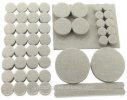
Another thing I use besides the blocks John recommended is a block with these thick soft material glued to it. The stuff you put underneath chairs so they don’t scratch your floor.
Also on finish passes I’ll cant the tip down about 20°.
FD2339B1-181C-4931-BDDA-00579FFD0573.jpeg
 
Last edited:
I am pretty new to knife making, but I think 600 is a nice and satin finish. At 800 things start to get bit shiny, and I don't like it.
 
Man, at least I’m not alone but the blade I’m trying to do has NO plunge, it’s completely flat, everything should be easy, but it seems the more I work it, the worst it gets. Is 600 not fine enough to get that soft, beautiful satin look?
Go to 600 @ then use a Maroon and then blue Scotchbrite belt and you’ll have a nice satin finish.
 
Back
Top